Ethical! Funny! But Stupid: Kentucky’s Risible Same-Sex Marriage Ban Defense.

laughing Scotus

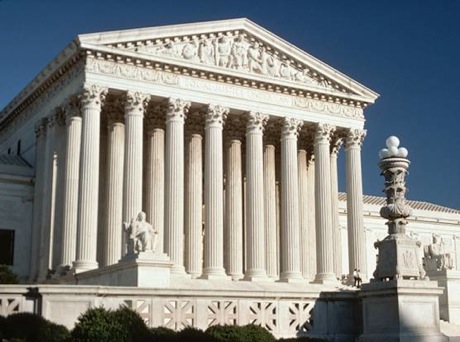
Supreme Court justices deserve to have a good laugh now and then.

Michigan, Ohio, Kentucky, and Tennessee are all defending their legislative bans on gay marriage in briefs before the U. S. Supreme Court. Only one of their legal teams came up with—-or had the guts to include—the novel argument contained in the Bluegrass State’s brief, which explains why a ban on gay marriage does not “discriminate on the basis of sexual orientation”:

Kentucky’s marriage laws treat homosexuals and heterosexuals the same and are facially neutral. Men and women, whether heterosexual or homosexual, are free to marry persons of the opposite sex under Kentucky law, and men and women, whether heterosexual or homosexual, cannot marry persons of the same sex under Kentucky law.

This is in the amusing category of arguments that make technical sense in legal terms—well yes, come to think of it, if you look at it that way, you’ve defined discrimination right out of the case!— but no sense whatever in the real world. Gays can’t marry their intended life partner but heterosexuals can; that’s obviously unequal treatment and constitutes discrimination. The defense deceitfully pretends that the whole reason for the emotional controversy doesn’t exist: “Love? What’s that? We know nothing of this thing you call love!”

These come up all the time when legal teams are brainstorming which theories to pursue in an appellate brief, and are virtually always discarded after some general amusement and admiration for the Clintonian who devised it. There is nothing unethical about including a dubious argument along with better ones in a brief, even a Supreme Court brief: consider the position that carried the day in the Obamacare case, when Chief Justice Roberts adopted a rationale for the individual mandate that the Obama Administration had repeatedly rejected and denied. The problem is that such an off-the-wall argument is risky:

1. It pulls time, attention and consideration from more promising arguments.

2. It makes the client look foolish or unserious to the public.

3.  Worse, it might make the client look foolish to the justices.

4. Some justice might react to it as an insult to his or her intelligence.

More than all of that, however,the argument is not going to work. Can you imagine what the reaction would be if the Supreme Court endorsed gay marriage bans relying on that logic? The argument is a non-starter, so including it in the brief sends a loud and clear message that no appellate lawyer ever wants a judge to hear:

“We got nothin’.”


The Case Of The Too Candid Catholic Teacher

"You can unzip it, Patricia, when you work somewhere else...."

“You can unzip it, Patricia, when you work somewhere else….”

Apparently I missed another “media firestorm,” so allow me to catch up, particularly since the analysis of this story has been muddled beyond comprehension.

Patricia Jannuzzi, a religion teacher at Somerville’s Immaculata High School, posted this on her personal Facebook page:

jannuzzi-fb-post

This being the internet, after all, someone sent it far and wide, with resulting embarrassment to the school. Jannuzzi, a theology teacher with Immaculata for 33 years, was ordered to de-activate her Facebook page after an online petition   demanded that she be punished. Jannuzzi was placed on administrative leave,  and the school administration notified alumni, parents and students, in a letter that said in part,

“This episode has reflected not only on this teacher but, by extension, on Immaculata High SchoolWe regret deeply any hurt this has caused to any individuals and the negative light in which it has cast our school….Although these were posts to a personal social media page, Immaculata High School recognizes the need to ensure that our faculty, staff and students full understand the behaviors expected of them as members of our community and recognize our intolerance of discriminatory behaviors of any kind.”

Points: Continue reading

Jerks, Liars, Hypocrites, Fools and Hoosiers: 10 Ethics Observations On Indiana’s Religious Freedom Restoration Act Controversy

Indiana5

1. The law was passed to make discrimination against gays, trans individuals and especially same-sex couples seeking marriage if not easier, to at least seem easier. Anyone claiming otherwise is lying, or being intentionally obtuse. Would Indiana be passing this law without the Hobby Lobby decision or the various court rulings requiring photographers, bakers, and other businesses to provide the same products and services to gay couples that they do to heterosexuals? Yes, you say? Tell me another.

As GLAAD alertly pointed out, Governor Pence was surrounded by anti-gay activists when he signed the bill:

GLAAD Pence

This is res ipsa loquitur, and doesn’t speak well for the Governor’s candor or intelligence.

2. Context matters. The original laws of this sort (the Federal law signed by President Clinton is also called the Religious Freedom Restoration Act) were part of the left’s long range pro-drug strategy, like medical marijuana. It was essentially a hippie law designed to create a slippery slope to recreational drug legalization by allowing fringe religious groups, specifically Native American tribes, to use peyote in tribal ceremonies. Now you understand why Clinton signed the bill.

Oops. Excuse me if I enjoy the spectacle of the clever members of the Church of the Perpetually Stoned—including the ACLU, which once supported such laws as long as they pointed the way to their young lawyers being able to have their Saturday night joints legally but now opposes them—being hoisted on their own petard.

“When the federal government adopted a religious protection act in 1993, same-sex marriage was not on the horizon,” whines the New York Times. Well, competent, well-considered, properly drafted, responsibly passed laws don’t suddenly become unbearable, then fine, then unbearable again with every shift of the cultural winds. The intent of the law was never to protect mainstream religions, but cloaked itself in language that did. It backfired.

3. That being stipulated, the good states need to read their own laws before they start grandstanding. Connecticut Governor Dan Malloy just announced on Twitter that he plans to sign an executive order banning state travel to Indiana in response to its Religious Freedom Restoration Act. Yet Connecticut, hippie enclave and bedroom community of rich, white, liberal New Yorkers that it is, happily jumped on the religious freedom train with a law of its own, one that, as the Federalist points out, makes discrimination on the basis of religion easier than the Hoosier version, which only prohibits the government from substantially burdening religion. Connecticut’s law does not include the word “substantially,” meaning that all government-enacted burdens on religion are theoretically illegal.

I wonder how Malloy is going to ban government travel to Connecticut? Is the theory that the same law can be good when liberal states pass it and evil when those bad conservative states pass it? It is more likely that the governor hasn’t looked at his own state’s law.

4. The hysteria being stirred up over the supposed horribles Indiana’s law will lead to is irresponsible. Jonathan Adler explains on The Volokh Conspiracy: Continue reading

A Single Mother’s Irresponsible Defense of Single Motherhood

To be fair, Murphy had an excuse for being irresponsible: she didn't exist.

To be fair, Murphy had an excuse for being irresponsible: she didn’t exist.

Allow me to stipulate:

1. Katy Chatel has every right to have a child if she wants to.

2. I accept her assertion that she is able to be, and will be, an exemplary parent, and that her child will not suffer in any way for want of a father.

3. Everything in her Washington Post essay “I’m a single mother by choice. One parent can be better than two” may be accurate and correct from her point of view, which as far as her own life is concerned, is all that matters. I will accept, for the purpose of this post, that it is correct.

4. This is a free country, and she can express any opinion that she chooses.

 Nevertheless,  she should not have written the article, which is irresponsible and cannot avoid doing more harm than good. Continue reading

Monetary Affirmative Action: “Women On 20s”

Patsy Mink, almost certainly one of the 100,000 most significant Americans in our history.

Patsy Mink, almost certainly one of the 100,000 most significant Americans in our history.

Barbara Ortiz Howard was interviewed on CBS this morning, talking about her effort to put a female face on our money. The thrust of her argument distills down into simple math: there are a lot of women, so the money should reflect that. We are now in the realm of affirmative action, and this was a sitting duck for the effort. There is no criteria for being on currency, just death. It’s an honor, of course, and as an honor, should be taken seriously, though its hard to argue that the current slate of faces reflects any objective evaluation. Salmon P. Chase? Kennedy’s undistinguished three years in office didn’t earn him his place on the 5o cent piece; getting shot did.

I can’t work up much indignation over the campaign being played out on Howard’s website, Women on 20’s. Like all efforts to impose quotas and encourage group identification, the effort is devisive, and the site’s candidates to replace Andrew Jackson could serve as a primer on how affirmative action can have the perverse effect of diminishing the credibility and integrity of an accomplishment. Whatever one thinks about Jackson, he had a tremendous impact on the nation and its political culture, was a transformative national leader, and a historical figure of great significance. Quick: name the major legislative accomplishments of Patsy Mink, Shirley Chisolm and Barbara Jordan for example. Jackson towers over them in importance to the nation’s growth and long-term success. That doesn’t mean he has to be on a bill, but nobody will be able to argue again that being so honored means anything more than that a powerful constituency caught an accommodating Democratic President when he needed to bump a poll number. Continue reading

Boycotting Dolce And Gabbana: Gays Becoming What They Once Hated Most

After centuries of oppression, Gays have finally achieved the right to openly be who they are as long as they don't piss of Elton John.

After centuries of oppression, Gays have finally achieved the right to openly be who they are as long as they don’t piss of Elton John.

Stefano Gabbana and Domenico Dolce are Italian fashion design superstars, meaning that I pay no attention to them whatsoever, and don’t understand the priorities of anyone who does. Nonetheless, they have a rich and famous international clientele.. The two men were once romantic partners, but no longer; how they are just business and artistic partners, and continue to thrive.

Their thriving, however, has suffered from a self-inflicted setback. In an interview with the Italian magazine Panorama, the pair declared their lack of support for same-sex families with children created by in vitro fertilization.  “I am not convinced by those I call children of chemicals, synthetic children,” Dolce told the magazine. “Rented uterus, semen chosen from a catalog.” Gabbana added, “The family is not a fad. In it there is a supernatural sense of belonging.”

The Horror: a non-conforming opinion from prominent gay fashion icons! Can’t have that! Lapsed pop superstar Elton John, who has two sons through in vitro fertilization with his husband, David Furnish, took the remarks as a personal attack and proclaimed a boycott of the Gabbana & Dolce label. “How dare you refer to my beautiful children as ‘synthetic,’ ” Mr. John wrote on social media. “Shame on you for wagging your judgmental little fingers at I.V.F. Your archaic thinking is out of step with the times, just like your fashions. I shall never wear Dolce & Gabbana ever again.” Thus was born the hashtag #BoycottDolceGabbana.”
Continue reading

Comment of the Day: “Comment of the Day: ‘Why The Sweet Briar College Fight Matters'”

Sweet BriarThe Sweet Briar closing, which was first raised as an ethics issue in the post, “The Sweet Briar Betrayal, has attracted many new readers and commenters to Ethics Alarms from the all-women Virginia college’s alumnae and supporters. Things are starting to move fast in the situation, with an investigation looming and questions being asked by the state legislature. Enlightening us further on this troubling story is faculty member Marcia Thom Kaley; here is her Comment of the Day on the post Comment of the Day: “Why The Sweet Briar College Fight Matters”: Continue reading

The Unethical French Animator, the Mammalian Duck, Dysfunctional Ethics Alarms

“Oggy and the Cockroaches” is a French animated comedy series produced by Xilam and Gaumont Film Company. Its future on the Nickelodeon children’s TV cartoon channel NickToons is in doubt, however, after the channel was thrust into an unwanted controversy by an unknown French cartoonist’s practical joke.

A recent episode that aired on NickToons featured a brief view of a framed wall hanging showing a cartoon female duck sporting a pair of bikini briefs, sunglasses and bouffant hair-do, and most significantly, naked torpedoesque breasts of a variety more familiar to afficionados of “Fritz the Cat” than the target audience of eight-year-olds. Naturally, the station was deluged with complaints from parents.

The NickToons  website now appears to have removed the show from both its schedule and its homepage. Good start. It should also end any relationship it may have with Xilam and Gaumont.

I know cartoonists are not known for an excess of maturity, but a network needs to be able to reside a modicum of trust in its contractors, suppliers and partners. If an animator would think it’s funny to slip a topless, sexy duck into a kid’s show, then who is to say the next “joke” won’t be a giant talking penis or Adolf Hitler having sex with a cow?

Far more disturbing than the prank itself are the rationalizations and justifications being offered for it in online comments to the story and in social media: Continue reading

The Unethical Cosby Victim: Jewel Allison

accuser

The thirty or so declared victims of sexual assault by Bill Cosby (sorry: when we get into double figures, “alleged” is misleading) have given various reasons for not reporting the crimes against them: fear of Cosby’s power, fear of retribution from the entertainment industry, fear of publicity, fear of not being believed, fear of humiliation. A recent addition to the list, however, has given an unequivocally unethical explanation for her 20 year silence in a Washington Post op-ed that has been called “courageous.” Jewell Allison’s confession is not courageous. It is disturbing and ominous. It shows what the trauma of the black experience in the United States has done to some African Americans, causing them to place group identification above reason, decency, good citizenship, compassion and common sense.

She writes:

“When I first heard Andrea Constand and Tamara Green publicly tell their stories about being drugged and assaulted by Cosby, I wasn’t relieved; I was terrified. I knew these women weren’t fabricating stories and conspiring to destroy America’s favorite dad, but I did not want to see yet another African American man vilified in the media. As I debated whether to come forward, I struggled with where my allegiances should lie – with the women who were sexually victimized or with black America, which had been systemically victimized.”

This makes no ethical sense or rational sense. Continue reading

Transgender Ethics: Epic Trailblazer Malpractice In New Hampshire

Ex-N.H. state legislator, Stacy Laughton, a.k.a Barry Laughton.

Ex-N.H. state legislator Stacie Laughton, a.k.a  felon Barry Laughton.

Trailblazers have an ethical obligation when they presume to break a social or occupational barrier to a marginalized group’s participation and equal treatment. Simply put, their duty is to make the bias that has created the barrier and necessitated the “trail” look ignorant, cruel, foolish and unfair. A trailblazer does not have to be a shining star, though it helps, but must be capable of at least doing a solid, average, generally acceptable job., even in the grudging judgment of bigots.

This is because a trailblazer who does a poor job or displays character traits that are objectively inadequate for a role model, which a trailblazer inevitably becomes, risks adding to the barrier he or she just breached for those who follow behind them. The ethical requirement for trailblazers is the same as the traditional edict for doctors “First do no harm.” Being a trailblazer, however, is not easy, and since failure is catastrophic for the group a trailblazer represents, there is a duty not to attempt such a high-risk, high-profile cultural role unless the trailblazer is first, reasonably convinced that he or she the resources of talent, ability, fortitude, character and courage to succeed, and second, willing to accept and overcome the added stress of relentless attention and criticism.

There have been excellent trailblazers, cultural heroes all. Jackie Robinson, the first black Major League baseball player to break the color barrier is the template, but there are many other successes: Justice Thurgood Marshall, John F. Kennedy, the first Catholic President of the U.S., Amelia Earhart, Diane Crump, the first female jockey, the late Ed Brooke, the first black U.S. Senator since reconstruction, and too many more to mention. There have also been some miserable failures. The worst trailblazer was probably Shannon Faulkner, who fought in the courts for two years to force The Citadel to accept female cadets, then, after she was victorious, showed up fat and unprepared, and washed out in just one week as millions of dubious vets said, “See? What did we tell you?” Then there was Carol Moseley Braun, the charismatic, promising African-American Democrat whon Illinois voters elected as the nation’s first black female Senator, only to turn out to be thoroughly corrupt.

More recently, we have seen other trailblazers fall short, like Michael Sam, the first openly gay player drafted by the NFL.  Is there a celebrity gay marriage that has not ended in a quick divorce? Most have been failures, reinforcing the belief that gays are promiscuous and unsuited for a real marriage. Most vividly of all in the realm of trailblazer malpractice, we are reminded of the disheartening and tragic examples of Barack Obama, and Eric Holder every day.

Still, in the annals of epic trailblazer fiascoes, it would be hard to top the story of Stacie Laughton, New Hampshire’s first openly transgender state legislator, who was elected in 2012 as one of three House members for Ward 4 in Nashua. Continue reading