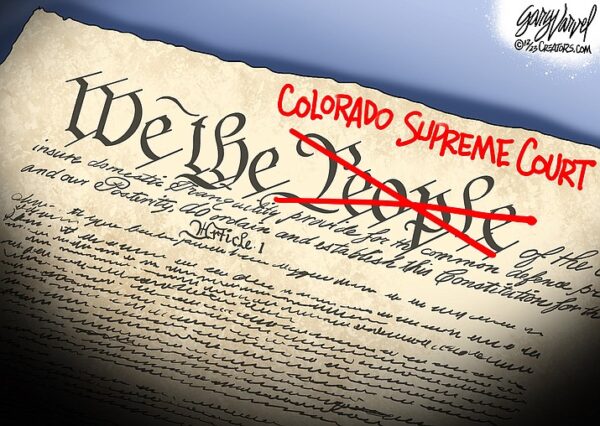
Over at the Volokh Conspiracy on Reason’s website, where constitutional law experts hang out and opine and then mostly inarticulate readers pile on, Steve Cabrizzi has pretty much slam-dunked the position that the 14th Amendment’s prohibition against those who supported the Confederacy in the Civil War holding office in the re-united United States of America can’t be used against Donald Trump. Unlike the convoluted and boot-strapping decision of the Colorado Supreme Court and the transparently partisan decision by Maine’s Secretary of State (both part of the now eight year-old effort by Democrats to use extra-legal means to destroy an adversary they fear and loathe), Bacrizzi’s brief is clear and straightforward.
First he explains the technical reasons why “Donald Trump is obviously not disqualified from seeking re-election under Section 3 of the 14th Amendment,” writing in part,
The words “President or Vice President” were deliberately edited out of the final version of Section 3 of the Fourteenth Amendment. This, together with the disqualification of presidential electors and vice-presidential elector who have engaged in “insurrection or rebellion” makes it clear that the Framers’ of Section 3 did not intend for it to apply to presidents or vice presidents who engaged in insurrection. This impression is augmented by the fact that Section 3 methodically applies in order from the highest office to the lowest office. Section 3 first disqualifies insurrectionist Senators and then Representatives. It then disqualifies all appointed civil or military officers; it then disqualifies insurrectionists from serving as a member of any State legislature, and it finally disqualifies in insurrectionists from serving as State executive or judicial officers. This careful hierarchy suggests that the phrase “or hold any office, civil or military, under the United States” does not apply to the President or Vice President, but applies only to appointed federal officers…
This fact is further confirmed by the Appointments Clause of Article II, Section 2, which says [The President shall nominate, by and with the advice and consent of the Senate shall appoint Ambassadors, other public Ministers and Consuls, Judges of the Supreme Court, and all other Officers of the United States.” The President does not appoint himself so obviously he is not an Officer of the United States under the Appointments Clause. Moreover, the Commission clause of Article II, Section 3 says that “[T he President] shall” i.e. must, “Commission all the Officers of the United States.” No President has EVER commissioned himself or his Vice President either before or after the adoption of the Fourteenth Amendment. The President is obviously not an Officer of the United States for the purposes of the Commission clause.



 Ethics Alarms