The Great Pie Controversy, or “Why Reporter April Ryan Isn’t Invited To The White House Christmas Party And Rightfully So”

Did you miss The Great Pie Controversy? Then sit down, children, and hear the tale…

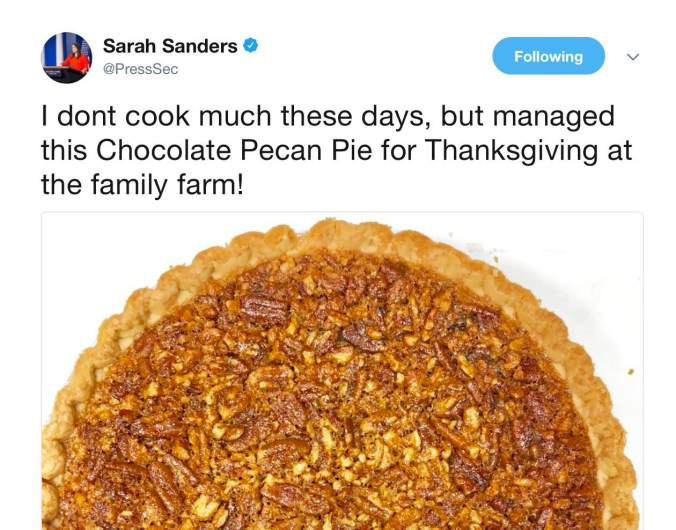
It all began when White House spokesperson Sarah Hucklebee Sanders posted a photo on Thanksgiving showing a pecan pie she baked for Thanksgiving. Above  is the  2:40 p.m. tweet.  The next day, American Urban Radio Networks Washington bureau chief April Ryan tweeted her doubts that the pie was real, implying that Sanders was a liar.  She needed to “show it to us on a table,” Ryan demanded, and had to see “folks eating it and a pic of you cooking it.”

Now, let us pause and ponder what would make someone react like that to a simple declaration that someone had baked a pie for Thanksgiving.  Why would anyone set out to embarrass and impugn an individual’s honesty over something so innocuous, based on no evidence or good reason at all? This isn’t journalism. It ‘s just meanness, motivated by sheer bias and hate. Conduct like that is so contrary to the Golden Rule that it constitutes tarnish.

And, of course, Ryan’s demands were also stupid and unreasonable. How would Sanders, where she so inclined, produce photos of guests eating a pie after it had been eaten?

Never mind. This example of disgusting and gratuitous reporter enmity was quickly picked up by the anti-Trump journalism establishment as an actual news story. Continue reading →

Ethics Dunces And Nominee For 2017 Assholes Of The Year: Ugly American Joseph and Travis Dasilva, a.k.a. “The Traveling Butts”

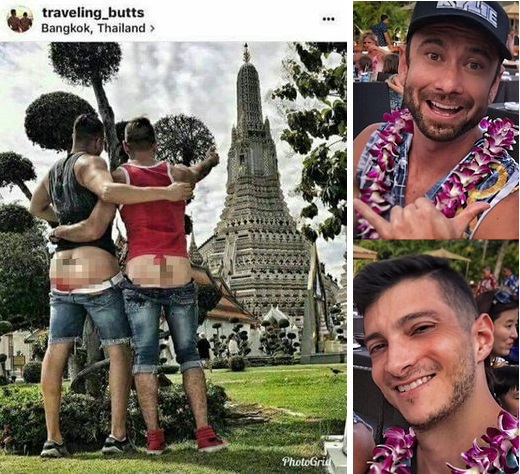
World traveling married couple  Joseph Dasilva, 38, and Travis Dasilva think it’s’ cute and funny to take what they call “belfies,” as in “below-the-belt selfies” at historical, religious and cultural sites in other nations. They then post the disrespectful  photos to Instagram. Above the witty pair is shown  at Bangkok’s Wat Arun, or Temple of the Dawn, baring their asses. Unfortunately, such conduct is illegal in Thailand. The Dasilvas were arrested at the Bangkok airport, fined 5,000 baht ( about$154) each, and will be facing charges of public indecency.

Writes Professor Turley, quite correctly:

So these two travel the world showing utter contempt for historic and cultural sites, then when they get into trouble, the United States spends money and time to try to secure their release from their well-deserved arrests….It remains a mystery why anyone over the age of 4 would find this “Traveling Butts” theme to be funny. Yet, their account had more than 14,000 followers before it was deleted. I find that following far more unsettling than the fact that two adults would engage in this type of offensive conduct. 

What do you want to bet that these two boors loudly condemn the President for projecting a poor image of the U.S. abroad? Continue reading →

President Trump’s First Year: The Ethics Alarms Ethics Audit


I planned to do this on November 8, but other matters intervened. Properly I should wait until January, I suppose. Yet I don’t see the grades changing significantly in a month or two.

For the most part, this ethics audit doesn’t consider policy matters. Calling policies unethical is usually a cheap shot and an expression of partisan priorities. I believe that the DACA is unethical; many believe that killing it would be unethical. I could not make a useful analysis using these kinds of controversies.

To keep this simple, I’m going to use the relevant ethical values listed in the Josephson Institute’s Six Pillars of Character, and add some extra categories at the end. As a preface, I have to say that there aren’t many surprises here. I had already concluded long ago that the concept of ethics is meaningless to Donald Trump. In Three Circles terms, he has only one circle, his own, and a Core circle unmoored to either a formal code of ethics or public standards of conduct will only be ethical by accident. I was hopeful that, like other Presidents of dubious character and troubling pasts when they reached office, Trump might make a concerted effort to adopt more traditional Presidential ways. This was always a long-shot, and so far, I see no signs of it happening.

Here are President Trump’s ethics grades through November of his first term, with comments and explanations where needed: Continue reading →

Morning Ethics Warm-Up, 11/30/2017: Bad Tweets, Bad Rep., Bad Rap, Bad NBC…

Bad night, but…

Good Morning!

1 Straight to the top of the charts…When we put together the definitive list of President Trump’s Top Ten (Top 100? Top 1000?) stupid, undignified and self-wounding tweets, yesterday’s sequence of unsubstantiated videos–from a radical right wing British group— of alleged violence by Muslims has to be on the list. I could counter that the eruption of indignation by the vast majority of people who can comprehend what’s wrong with this is a bit annoying from the progressive side—the official Obama Administration position that Islam is a lovely religion of rainbows and unicorns and that Muhammad doesn’t instruct his followers from the grave that infidels are scum and deserve to die is far more dangerous than Trump’s hate-tweets—but that would obscure the key point. Trump’s retweeting is ugly, unnecessary, undignified, looks bigoted, and plays into the hands of the worst of his enemies, who express themselves like this.

Now we have to listen to that dishonest and contrived 25th Amendment garbage again, which never quite stopped anyway. Once again, the President has blown more wind into the sails of anti-democratic hypocrites like Ezra Klein, who argues for a Constitution and Separation of Powers-wrecking version of impeachment to get rid of Trump. No, Trump hasn’t gone crazy: he’s exactly the man we elected, and exactly as able to do his job as he ever was. Tweeting irresponsibly is not a high crime and misdemeanor. Being Donald Trump is not a high crime and misdemeanor.

But the President is playing with fire by encouraging the large political movement that would criminalize not agreeing with their world view. That’s as indefensible as it is idiotic.

2. This much is clear. It is now clear that NBC only fired Matt Lauer because an explosive Variety exposé was on the way, and it was a close call at that. It is pretty clear that the mystery of why NBC rejected journalist Ronan Farrow’s investigative reporting on Harvey Weinstein has been solved: NBC had its own lurking sexual misconduct cover-up to worry about. It is, or should be clear from Variety’s reporting that the astounding brazenness of Lauer’s conduct had to be common knowledge among Lauer’s colleagues and NBC executives, and that they unethically applied The King’s Pass, deliberately allowing Lauer to abuse and terrorize female employees, some of whom played along to get along. TMZ uncovered an old interview in which Katie Couric happily revealed that one consequence of working with Matt was that she got her butt pinched a lot. Nobody paid attention, in part because our pathetic news media buried it. Continue reading →

The Unabomber, The Red Light, And Me [UPDATED!]

I ran a red light last night, and I’m feeling bad about it. Ted Kaczynski made me do it.

It was after midnight, and I was returning home after seeing the pre-Broadway production of the musical “Mean Girls,” based on the cult Lindsay Lohan comedy. I was late, my phone was dead, I knew my wife would be worried, and I was stopped at an intersection where I could see for many football fields in all directions. There were no cars to be seen anywhere.

Ted, , aka “The Unabomber” or “Snookums” to his friends, cited my exact situation as an example of how we have become slaves to our technology. Why do we waste moments of our limited lifespan because of a red light, when there is no reason to be stopped other than because the signal says to. Admittedly, this had bothered me before I read Ted’s complaint. Stop lights should start blinking by midnight, allowing a motorist to proceed with caution, as with a stop sign.  If one isn’t blinking, we should be allowed to treat it as if it is.

Last night, I ran the light. With my luck, there was a camera at the intersection, and I’ll get a ticket in the mail. But..

…whether I do or not doesn’t change the ethical or unethical character of my conduct. That’s just moral luck.

…it was still against the law to run the light, even it I was treating it as a blinking light, because it wasn’t

…breaking the law is unethical, even when the law is stupid, and

…there was no legitimate emergency that could justify my running the light as a utilitarian act.

So I feel guilty. Not guilty enough to turn myself in, but still guilty, since I am guilty.

But Ted wasn’t wrong.

Update: Let me add this; I was thinking in the shower.

On several occasions in the past, I have found myself stopped by a malfunctioning light that appeared to be determined to stay red forever. Is it ethical to go through the light then? The alternative is theoretically being stuck for the rest of my life. So we run such lights, on the theory the frozen stop light is not meeting the intent of the law or the authorities who placed it there, and to remain servile to the light under such circumstances is unreasonable. Yet running it is still breaking the law, and isn’t stopping for a light in the dead of night with no cars to be seen also not consistent with the intent of the law and the light? What’s the distinction?

Morning Ethics Warm-Up, 11/29/2017: Featuring Vital Questions Such As: Will Women Now Try To Look Unattractive? Should A Hospital Employ A Nurse Who Hates White People? Is That Man Trying To Rape A Manniquin With An Ice Dildo?

Good Morning!

1  Documented insanity. The New York Times has been on an extended binge of highlighting the suffering of deported illegal residents. I could probably post several more episodes of the Ethics Alarms “Good Illegal Immigrant ” series every week. The intellectual dishonesty of almost all of these Times stories, like the pro-illegal immigrant movement itself, is impressive. Essentially, they all can be reduced to, “Isn’t it terrible that these lawbreakers have to endure the consequences of their own actions?”

Complementing these stories are periodic opinion pieces like “ICE’s Courthouse Arrests Undercut Democracy,”‘ by César Cuauhtémoc García Hernández, an associate professor of law at the University of Denver. He writes a pro-illegal immigration blog, identifiable in motive by its habitual use of the cover word “migrant” to mean “illegal immigrants” and the deliberately misleading word “Immigration” to mean “illegal immigration.” Hernández’s op-ed’s argument follows as the night follows day:

“In El Paso, ICE arrested a woman moments after she requested a court’s help keeping away an abusive partner. Fear and uncertainty caused by this type of courthouse arrest are already keeping people away from the halls of justice. In Denver, the city prosecutor gave up on four domestic violence cases because the victims said they were too afraid of ICE to appear in court. In a nationwide survey conducted in April by the nonprofit Tahirih Justice Center, four out of 10 social service providers working with immigrant survivors of abuse said they had clients who had abandoned legal claims because of fear of what will happen if they call the police or go to court.”

Wait: why were these people afraid of ICE? By immigrant survivors, doesn’t Hernandez mean illegal immigrant survivors? If he does, why doesn’t he say so? His favorite terms are “unauthorized” immigrants, and here and there “undocumented” immigrants, poor things. Whatever happened to their documents?

It’s not a threat to democracy if illegal immigrants are afraid to come to court. They should be afraid to come to court. They should be afraid to take advantage of any aspect of  our government or American society. Underlying the professor’s claimed concern for democratic institutions is his contempt for the rule of law. He wants to blur the distinction between illegal and legal immigration to the vanishing point. He quotes the California chief justice as she writes that “the vast majority” of “undocumented immigrants” “pose no risk to public safety.” Is that the desired standard for law enforcement now? As long as a known law-breaker poses no risk to public safety, he or she should be immune from arrest when they turn up in court?

The Times is apparently committed to bombarding its readers with this unconscionable position in perpetuity: our monstrous government has decided to enforce its immigration laws, and the very fabric of our democracy is threatened as a result.

2. CNN Tales.   On a related note, this morning I saw a slick TV ad on CNN supporting “Dreamer” legislation. The terms “illegal,” and even the cover words “undocumented” or “unauthorized” were never used, as various Presidents were shown extolling “immigrants.” “Dreamers” were described as “immigrants” who came here as children.

An ethical broadcast news organization should not accept money to run ads that intentionally misinform its viewers.

But THIS is CNN!…and so is this:  A CNN spokesperson told Politico…
Continue reading →

The Three Circles, Prime Directives, And President Trump [With Addendum]

I can’t believe I have never written about this diagram before, but apparently I haven’t. That’s my fault, and a major one.

The diagram, the creation of my friend, attorney John May, shows the inter-relationship of the three ethical systems professionals must employ when they face ethics problems. For although we tend to think about making decisions in one context, there are several, and which sphere—these are circles after all—we choose will often determine what balance of values, principles and outcomes dictates the ultimate course.

Here are what the circles represent:

The Big Circle, in yellow, includes the ethics culture that we all live in. It includes our nation, society, community, family, and friends, and is a messy, inconsistent, multi-faceted, often contradictory melange of traditions, religion, customs, literature, history, heroes, fables, family influences, teachers, peers, laws, and more. This the largest system of all, the sun to the planet-sized influence of the other two systems. within it are not only the often competing ethics theories of Reciprocity, Absolutism, and Utilitarianism, but also all the variations in between and beyond–Ayn Rand, Nietzsche, Marx, and many others. In his invaluable book “The Science of Good and Evil,” Michael Shermer posits that despite all the internal inconsistencies, the Big Circle is remarkably functional, agreeing on what is right and wrong perhaps 97% of the time. The disagreements are in the realm Shermer calls provisional ethics,  akin to what Ethics Alarms is referring to when it cites The Ethics Incompleteness Principle. These are the troublesome problems where the usual principles don’t always work.


The Core Circle, in green, represents the values, principles, beliefs and the priority of these for an individual–you. It comprises all of those, plus such core qualities as conscience, self-esteem and courage. It’s location in the Big Circle varies with the individual. A section of it even may protrude outside Big Circle, representing the degree to which a person does not embrace the values of his or her community or culture.

Finally, there is the Compliance Circle, in red. That circle defines the special ethics of a profession, and includes ethics codes, traditions, aspirational values and professional obligations and duties.

Notice that part of the Red Circle is outside the Yellow one. These are the values about which a profession is bound to adhere to at all costs, even though the society at large often and even usually does not have the same ethical priorities. Quoting Star Trek, this is Prime Directive territory. In Gene Roddenberry’s fictional Star Fleet, it was forbidden to use the immense power a starship could muster to interfere with a planet’s inhabitants and their conduct, even to prevent what appeared to be a horrible wrong.  This principle would be repugnant to the the public at large. For example, if a starship had an opportunity to stop a genocidal race from wiping out another race on its planet, the Prime Directive would make it a crime to do so. The Big Circle would certainly view this as monstrous, but the Prime Directive wisely holds that interference must be avoided. Continue reading →
Paul Krugman, The Anti-Haidt

I don’t bother with New York Times op-ed columnist Paul Krugman here, for the most part. He constantly discredits himself by intentionally misleading his gullible readers, hiding the ball, engaging in deceit as an advocacy tool, over-stating and hyping and generally bolstering his progressive opinions with a nauseating combination of intellectual dishonesty, hypocrisy and condescension. I have no patience with such columnists, or any publication that inflicts them on its readers.

A parallel in the sportswriting field is the much lionized Thomas Boswell, a Pulitzer Prize-winning columnist who writes for the Washington Post. Boswell has written several books, and is regarded by many as a deep thinker about baseball. (My wife and I once were friends with a couple that socialized with the Boswells, and invited us to join the four of them for an evening. I told them that I could not stomach being in the same room with the guy.)  Many years ago, Boswell was writing about the individual talents of the Boston Red Sox, a topic I know at least as much about as he does. In assessing then-Sox catcher Jason Varitek, Boswell noted that “Tek” led the league in passed balls, leaving the impression that this demonstrated a serious flaw in his catching abilities. But I knew, and more importantly Boswell knew, that the Red Sox  had a regular rotation starting pitcher, Tim Wakefield, who was a knuckleballer, and was the only starting pitcher in the league who threw that confounding pitch.  If a catcher regularly catches a knuckleball pitcher, he leads the league in passed balls, usually by a large margin. Always. It has nothing to do with how good a catcher he is, and Varitek was a very good catcher. Yet Boswell deliberately cited the statistic without explaining to his readers what it meant in Vartitek’s case. He did this because he was trying to argue that Boston had defensive problems. This is unethical advocacy, and unethical journalism.

After that, I only read Boswell’s columns to document his dishonesty. I was never disappointed. He’s a cheat, relying on the ignorance of his audience to deceive them.

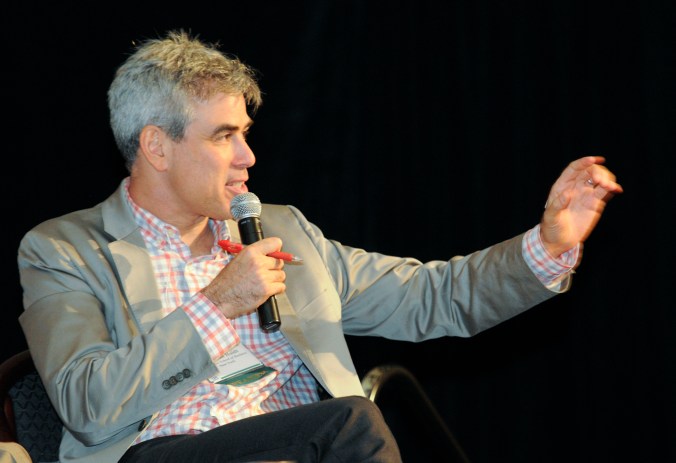
Paul Krugman is like that. After I posted the quote from Jonathan Haidt’s speech in which the professor perfectly described the ideology-driven betrayal of the culture and our democracy by institutions of higher education, I recalled a recent Krugman piece in the Times that I had instantly dismissed as classic deceit. One passage was literally the anti-matter version of Haidt’s hard truth regarding the rot in our colleges, a deliberate lie that denied the existence of the problem in order to further Krugman’s perpetual attack on Republicans and conservatives.

Behold: Continue reading →

Morning Ethics Warm-Up, 11/28/2017: The Worst Defense Of Roy Moore Ever!

Good Morning!

1 The Dumbest Moore Defense Ever Told! Debating with Chris Cuomo on CNN yesterday morning, Breitbart senior editor Joel Pollak made the following argument in defense of  Alabama GOP Senate candidate Roy Moore:

“You know, in 1973 Ringo Starr hit number one on the Billboard charts with the song, ‘You’re 16, you’re beautiful, and you’re mine,. He was 30-something at the time singing about a 16-year-old — you want to take away Ringo Starr’s achievement?”

He really did.

2. Sally Yates and James Comey are happy, anyway. Leandra English, the deputy director of the Consumer Financial Protection Bureau, argues that the Dodd-Frank Act makes her the lawful the acting director of the agency in a lawsuit she has filed  against President Trump, who also has the law on his side. He appointed Mick Mulvaney, currently Trump’s director of the Office of Management and Budget, as acting director to replace Richard Cordray, who appears to have resigned explicitly to foil the President’s ability to appoint his own choice to head the CFBP. Now there is mess triggered by a rare, genuine example of two statutes with authority over the same situation.

The Justice Department’s Office of Legal Counsel issued a legal opinion that says the Dodd-Frank Act does not displace the President’s authority to appoint under the Vacancies Reform Act. Either statute can be invoked. “We cannot view either statute as more mandatory than the other,” the opinion says. “Rather, they should be construed in parallel.”

Of course, employees of the Executive Branch are ethically obligated to defer to the President of the United States, but this President is handicapped by a thick muck of arrogant holdovers from the Obama Administration, who think it is appropriate to sabotage and undermine a leader whom they do not approve of. This is indefensible.

The lack of the basic deference and respect all elected Presidents should be able to depend upon that so many of the previous administration’s personnel have displayed is an indictment of the Democratic Party’s principles, integrity, fairness, patriotism and respect for process. This is how this story should be reported, too, and would be, by a competent and ethical news media. Continue reading →

Ethics Quote Of The Month: Professor Jonathan Haidt

This is longer than the typical featured ethics quote. It comes from NYU Professor of Social Psychology Jonathan Haidt’s 2017 Wriston Lecture to the Manhattan Institute on Nov. 15 , excerpted by the Wall Street Journal.

Today’s identity politics . . . teaches the exact opposite of what we think a liberal arts education should be. When I was at Yale in the 1980s, I was given so many tools for understanding the world. By the time I graduated, I could think about things as a utilitarian or as a Kantian, as a Freudian or a behaviorist, as a computer scientist or as a humanist. I was given many lenses to apply to any given question or problem.

But what do we do now? Many students are given just one lens–power. Here’s your lens, kid. Look at everything through this lens. Everything is about power. Every situation is analyzed in terms of the bad people acting to preserve their power and privilege over the good people. This is not an education. This is induction into a cult. It’s a fundamentalist religion. It’s a paranoid worldview that separates people from each other and sends them down the road to alienation, anxiety and intellectual impotence. . . . Continue reading →