How Should We Judge Second Apologies?

Sure, who wouldn't think this was funny coming from a member of your school board?

Sure, who wouldn’t think this was funny coming from a member of your school board?

The most important feature of apologies is that they express sincere and honest regret for the real harm done. If the first apology for misconduct fails that test, how much credence should a second attempt have? Does it negate the first apology completely? Ought it to be read and understood in light of the initial, unsatisfactory apology? Or should it be ignored completely as a public relations document crafted to achieve a result, rather than to express genuine contrition?

The case of Chris Harris, a board member for the Hooks Independent School District in the town of Hooks, Texas, provides a fascinating test.

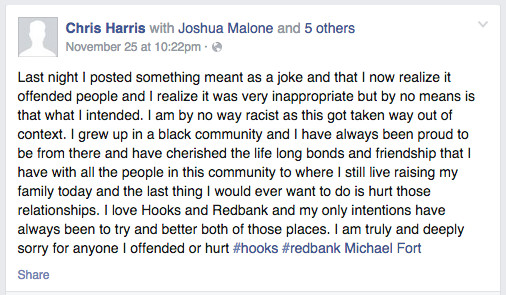
Lat week, Harris posted an image of a Klu Klux Klan member with the caption, “I’m dreaming of a white Christmas”  to his Facebook page. The reaction to this was what almost anyone with a fully functioning cerebrum would expect, a category that Harris does not belong to, or at least did not when he posted it. Perhaps after shouting, “Doh!” or perhaps not, Harris rushed to repair the damage, publishing this apology:

Harris apology 1

Terrible apology! Continue reading →

Contest Entry For Most Unethical Column, Post Or Essay About The Ferguson Ethics Train Wreck: Hip-Hop DJ Jay Smooth

It goes without saying that my efforts to avoid more Ferguson commentary is a failure. The race-baiters, grievance-mongers, police-haters and cynical Democratic-base-goosers are engaging in an orgy of self-righteousness, aided by an uncritical news media and encouraged by public sentimentality and ignorance. This is horrible for the rule of law, law enforcement, race relations and the nation, but to close our eyes and repress our gag reflexes, hoping it will go away, is cowardly and irresponsible. This stuff is dangerous, to be blunt. Lies always are, and public policy built on lies will always result in harm and distrust.

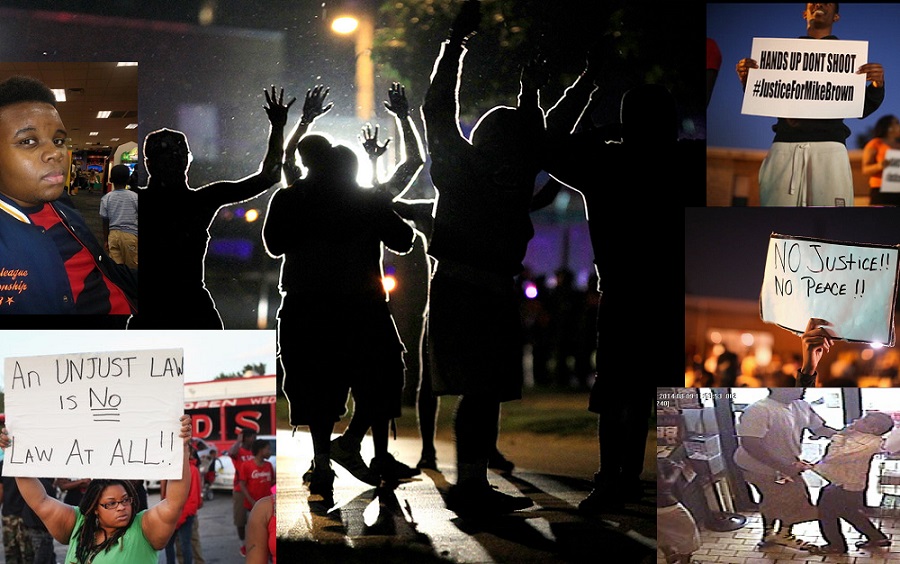
The onslaught is much more powerful than I expected: several member of the Congressional Black Caucus actually brought the false “Hands up! Don’t shoot!” rallying cry onto the House floor yesterday. Charlie Rangel is using the lawful shooting of Brown based not on race but on his conduct alone to re-open demands for slavery reparations.

In this context, I’m entering this video blog by John Randolph, a.k.a “Jay Smooth,” a popular and outspoken hip-hop DJ with pretenses of social relevance.  It is genuine mind-poison. “Smooth” is sure smooth: he’s articulate, facile, a good actor, attractive, and facts mean absolutely nothing to him. Here he spins a persuasive justification for the Ferguson riots based on a series of demonstrably false premises: garbage in, but insidiously persuasive garbage out, especially to his audience. It begins with an apparently popular tweet he made before the grand jury results came out, which said, “The fundamental danger of a non-indictment is not more riots, but more Darren Wilsons.” If Wilson was not indicted for lawfully protecting himself from a subject who attacked him, more police will protect themselves from attacking suspects? The tweet is cleverly misleading: it assumes, without stating, that a racist cop murdered a black youth, and the video blog proceeds accordingly from that assertion. The truth is that the danger of having an indictment would be to allow mob justice and vengeance to preempt due process and fairness. Not surprisingly, Smooth later reveals that he sent essentially the same dishonest tweet about the George Zimmerman trial. Continue reading →

President Lincoln’s Misunderstood Ethics Crisis: The Great Sioux Uprising

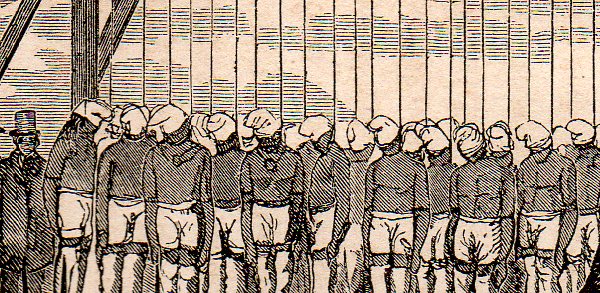
Dakota hanging

As part my so-far futile efforts to leave Ferguson in the rear view mirror, let’s revisit one of the Abraham Lincoln’s great ethical dilemmas during the Civil War, in which today’s date, December 1, was pivotal.

Minnesota’s Great Sioux Uprising, now usually called the Dakota-U.S. Conflict, was among the bloodiest Indian wars in the West, with hundreds of Native Americans, settlers and military casualties. The Sioux were defeated soundly, and the U.S. Army tried 303 Native Americans by military commission, finding them guilty of war crimes and sentencing them to death by hanging. Federal law required Presidential approval of the death sentences, and this was a problem Abraham Lincoln, the President at the time, did not need.

For it was 1862, and the Civil War was raging. This was a year full of Union defeats, indeed, disasters, like Fredericksburg, and both the war and Lincoln’s ability to lead it were in peril. Lincoln was also calculating all the political angles before issuing the Emancipation Proclamation. On top of the burdens of war and politics, he was coping with personal tragedy: his young son Willy had died nine months earlier, and Mary Todd Lincoln was teetering on emotional collapse from grief.
Now he had to decide whether to allow the execution of more than 300 Indians convicted in trials that were no better than kangaroo courts. Few Americans were concerned about the fate of the Native Americans, but Lincoln, with all of his other worries, took on the task of reviewing the trial records. What he found was manifest injustice.  Continue reading →

Deval Patrick’s Indefensible, Terrifying Admission

Welcome to my nightmare...

Welcome to my nightmare…

It is 4:30 AM. I can’t sleep, and among the reasons are not, as you might think, the fact that my father died five years ago today and I miss him terribly, or that this is my birthday, and I am that much closer to my own death. No, the cause for my tossing in bed is that I read  Massachusetts Governor Deval Patrick’s comments on “Meet the Press” about the Michael Brown shooting (yes, those eleven Ferguson posts still weren’t enough) just before retiring, and they have been giving me nightmares.

What Patrick’s remarks suggest to me  is that this incident is quite literally driving Democrats, civil rights activists and African-Americans crazy, causing them to lose their grip on basic principles of ethics and democracy. Here is what Patrick said, in part, in his interview with Chuck Todd, who, incompetently, did not ask properly probing questions in response (falling over in a dead faint would have also been appropriate):

“Look, without knowing all the facts, of course I wanted to see an indictment. And mostly because I think a trial and the transparency of a trial would be good for the community. And because so many of us have the supposition that police officers are not going to be held accountable and not going to have to answer for the shooting of unarmed, young, black teenagers.”

I challenge any civil libertarian to defend this statement. Continue reading →

Eleven Ferguson Ethics Posts In One!

APTOPIX Police Shooting Missouri

There are too many ethics topics for me to cover adequately as it is. This is frustrating. That the Ferguson Ethics Train Wreck is generating ethics issues on a daily, even hourly basis creates a professional dilemma for me. I don’t want to appear obsessed with this mess; I’m not. I am really quite sick of it, and sick as well—and depressed—by the relentless stream of emotional, incompetent, and toxic opinions issuing from the news media, well-meaning but ignorant friends, and in some cases, professionals who appear overwhelmed by confirmation bias. One of my father’s favorite lines was “My mind’s made up, don’t confuse me with facts,” and I doubt that I have ever seen commentary on an event so dominated by that state of mind. Except, perhaps, the Trayvon Martin-George Zimmerman fiasco.

Allow me, then, to indulge in this compromise, while I wait for the entries in the Ethics Alarm contest to find the most unethical article, essay or blog post about Ferguson. Here are eleven points about the current Ethics Train Wreck that I would devote full posts to if I had the time and we lived in a Hell where Ferguson was the only thing going on. I may write full posts on a few of them yet, but meanwhile, here are shorter summaries that I hope you can use to enlighten some of your friends, relatives and associates afflicted with jerking knees….

1. We keep hearing that Officer Wilson is suspect and not credible because he expresses no remorse, and seems “cold.” This attitude projects the critics’ unjustified conclusions onto Brown, who doesn’t share them and shouldn’t. Why don’t interviewers point this out? If Brown was killed in self-defense, prompted by his own threats to the officer, Wilson shouldn’t be remorseful. Remorse means “deep regret or guilt for a wrong committed.” Wilson only did wrong if he shouldn’t have shot Brown, which is the assumption—an evidence-free assumption—of those who want him tried for murder. As for “cold”: Wilson’s whole life has been turned upside-down because a community and a substantial part of the nation have decided to make him pay the price for insensitive and poorly run police departments over decades and across the country. People are calling him a murderer based on political agendas. He’s supposed to respond to that warmly?

2. On ABC this morning, Jelani Cobb, a professor of African-American studies—and boy, are we learning a lot about the racist biases of that area of scholarship lately—pronounced the testimony of Wilson “fantastical” based on this statement: Continue reading →

Ethics Quiz: The 90-year-old Scofflaw Humanitarian vs. The Heartless Mayor Who Isn’t Really

Seiler

[Fred, one of my two regular ethics issue scouts (Alexander Cheezem is the other, and what I would do without their assistance, I do not know: thank you, thank you, thank you, guys!), flagged this classic ethics conflict several weeks ago.]

Some sources reported that a “90-year-old man was arrested for feeding the homeless.” This set off typical fact-free indignation on the social media and talk shows, not to mention the angry e-mails from around the world: Charity illegal???  A kind old man arrested just for trying to help the poor! Cruelty!!! ARGGGHHH!!!

Naturally, this was not what really happened.

For 23 years, since he was 67, 90–year-old Arnold Abbott and his non-profit organization, Love Thy Neighbor, have provided food for the homeless at a public beach in Fort Lauderdale, Florida on Wednesday of every week at 5:30 p.m. This year, on October 21, the City of Fort Lauderdale Commission passed an ordinance that banned such food distributions in public. The ordinance required that organizations distributing food outdoors would have to provide portable toilets for use by workers and those being fed. It’s a health and safety regulation, for the benefit of homeless and vulerable. A few days after the ordinance took effect, on a Wednesday, at a bit after 5:30 PM, Abbott  was approached by police officers and cited for violating the ordinance. He was not arrested. He was told that he must appear in court.

After Fort Lauderdale Mayor Jack Seiler was called everything from a monster to a Republican (he’s a Democrat), someone finally asked him what the ordinance was all about and questioned his police department’s treatment of the kindly senior. “We hope he feeds, ” Seilor said. “He has a very valuable role in the community. All we’re saying is he can feed the next block over. He can feed at the church. We want them to be in safe secure settings. We wanted them to be in a sanitary matter. We them to have facilities available before and after.” That seems reasonable.

Seiler has also offered an explanation for the ordinance, which was backed by the Chamber of Commerce, that sounds more, well, Republican, saying that  providing the homeless food in public only enables homelessness, and that Fort Lauderdale wants the homeless to use government and church services. “If you are going to simply feed them outdoors to get them from breakfast to lunch to dinner, all you are doing is enabling the cycle of homelessness,” Seiler says. Well, that’s debatable, but it isn’t unreasonable.

Still,  it’s hard to teach old humanitarians new tricks, and Arnold is defiant. Continue reading →

Ethics Dunce and Unethical Facebook Post of the Month: Elizabeth Lauten, Spokeswoman for Rep. Stephen Fincher (R-Tennessee)

Elizabeth Lauten, communications director for Republican Congressman Stephen Fincher, decided that she is authorized to give parental advice to First Offspring Sasha (13) and Malia (16) Obama. She was deeply troubled by the young ladies looking bored in photographs she saw online, so she posted this jaw-dropper on Facebook:

Facebook lecture

Wow. What a Thanksgiving feast of unethical features! Let’s see: Continue reading →

Ray Rice’s Indefinite Suspension By The NFL Has Been Overruled On Appeal. GOOD!

You have to be fair to bad guys too, you see.

Ray Rice and sparring partner.

Ray Rice and sparring partner.

If you will recall, the NFL levied a paltry two game suspension on Baltimore Raven’s star last summer, following his guilty plea for knocking his then fiancée, now wife, colder than a mackerel with a punch in her face. Then security camera video of the punch, in a casino elevator, ended up on TMZ in September, and public outrage against the NFL’s casual approach to domestic violence became a public relations crisis for pro football, which has too many already.

In response, Commissioner Roger Goodell ordered a do-over, this time suspending the player indefinitely while Rice’s team, the Ravens, fired him. The NFL’s risible claim was that while Rice had admitted that he hit the love of his life so hard that he rendered her unconscious, they never suspected that he really, really hit her until they saw the video.

As I wrote at the time:

Sports stars who engage in criminal behavior should be penalized heavily by their teams and leagues, to leave no question about their special status as paid heroes and pop culture role models and their obligations to honor that status. Rice’s conduct was especially significant, given the prevalence of domestic abuse in this country. The NFL, however, had its shot, made its statement, disgraced itself and let him get off easy. Rice hasn’t done anything since then worthy of punishment. The league and Rice’s team should have to live with their initial decisions, no matter how much criticism they received for them. The overly lenient punishment should stand as symbolizing how outrageously tolerant society, and especially male dominated cultures like pro football, are of this deadly conduct. Treating the video as if it constituted new evidence of something worse is unfair and ridiculous: yes, you morons, this is what domestic abuse looks like!

Rice [I originally said “Peterson” here, getting my violent NFL players mixed up] appealed through the player’s union, and yesterday a judge agreed with him, the union, and me, writing:

“In this arbitration, the NFL argues that Commissioner Goodell was misled when he disciplined Rice the first time. Because, after careful consideration of all of the evidence, I am not persuaded that Rice lied to, or misled, the NFL at his June interview, I find that the indefinite suspension was an abuse of discretion and must be vacated…I find that the NFLPA carried its burden of showing that Rice did not mislead the Commissioner at the June 16th meeting, and therefore, that the imposition of a second suspension based on the same incident and the same known facts about the incident, was arbitrary…The Commissioner needed to be fair and consistent in his imposition of discipline….Moreover, any failure on the part of the League to understand the level of violence was not due to Rice’s description of the event but to the inadequacy of words to convey the seriousness of domestic violence. That the League did not realize the severity of the conduct without a visual record also speaks to their admitted failure in the past to sanction this type of conduct more severely.”

Yup. That just about covers it.

I think it’s overwhelmingly likely that the NFL’s lawyers advised the league that this would be the end result if they tried to punish Rice for the same act twice. The NFL decided that it was worth it to abuse its power and look like it was trying to end Rice’s career so after a successful appeal, it could say, “Well, we tried to do the right thing, and that mean old judge wouldn’t let us! Don’t blame us.”

Anyone who falls for that act is a fool. The real lesson of this ugly sequence is that the NFL’s culture doesn’t recognize right and wrong, or care about either. It’s only concern is TV ratings,  marketing and profits.

 

Incomprehensible Ethics Quote Of The Month: Rep. Charles Rangel (D-NY)

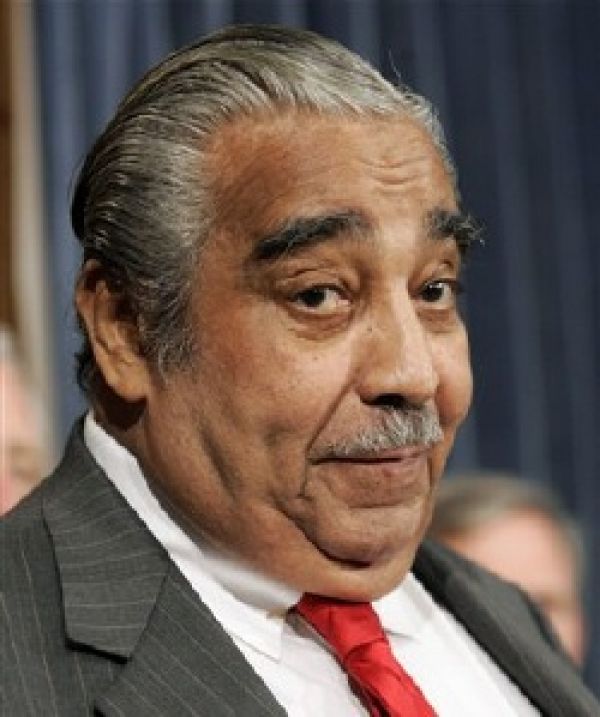
Rangel

“I always try to find something good that comes out of conflicts like this, and perhaps people realize that this is not a Ferguson problem at all; it’s a problem around the country. And as long as people feel awkward and embarrassed in talking about the racism that exists, we can never, never, never attack it…The indifference of the patrol officer’s an indication that good people ought to say that you should be sorry when you take anybody’s life. It’s not just the question of what you thought of whether you were afraid…. his total indifference just polarized that community, and I only wish that — that they had not vented themselves in a violent way and taken advantage of people coming together, white and black, and saying that you should at least be able to say you made a hell of a big mistake at least.”

—–Rep. Charles Rangel (D-NY), wandering confused in the ethics wilderness while discussing the Ferguson mess on MSNBC.

I supposed we should expect Rep. Rangel to be completely muddled when it comes to ethics, given his own history. Still, seldom have I seen such a dog’s breakfast of responsible sentiments and ethics ignorance in the same set of comments:

  • Congratulations are due to Rangel for admitting that this Ethics Train Wreck unfairly settled in Ferguson, which is being made to suffer disproportionately for the conduct of many communities and elected officials across the country, as well as the political opportunism of civil rights activists.
  • However, public officials have an obligation to be clear. What “racism that exists,” exactly? Anywhere in the U.S.? Absolutely: let’s talk about it. In the shooting of Brown? No racism is in evidence at all: if that’s what Rangel is referring to, and many will assume its is, the statement is irresponsible. Was he talking about the grand jury decision, which was the context of the interview? Prove it, Charlie. Otherwise, stop planting distrust with a population that is paranoid already.
  • Michael Brown’s actions, from Wilson’s point of view, forced him into a situation that has resulted in his career being ruined and life being permanently marred….and Rangel thinks Wilson should apologize? This is completely backward. Wilson owes no apologies to Brown, and certainly none to Brown’s parents, who have been carrying on a vendetta against him, calling him a murderer while expressing no acknowledgment that the son they raised had any responsibility for the confrontation that took his life. If anyone owes anybody an apology, it the parents who owe Wilson. Rangel thinks Wilson should apologize for trying to do his job, for not letting Brown take his gun, for not letting him resist arrest, for not letting himself be attacked, and that is ridiculous.

Continue reading →

Watch “Blue Bloods”

Blue Bloods

I owe Tom Selleck an apology. The long-time genial hunk, famous as “Magnum, P.I.” and notable in show business lore for missing the career opportunity of a lifetime when contractual obligations forced him to turn down the role of Indiana Jones in “Raiders of the Lost Ark,” has guided his CBS police series “Blue Bloods” to five seasons, exploring tough ethics dilemmas in virtually every episode, and usually doing it very well. For some reason, I’ve only cited the show a few times, once critically, and it deserves better. Netflix started streaming the show, and my wife has been watching about three a day. I really hadn’t been paying sufficient attention, or respect. It’s a wonderful ethics show, the best since “Star Trek, the Next Generation’s” hay day, and one of the very best ethics TV shows of all time.

Selleck plays fictional New York City police chief Frank Reagan. The show could be called “The Conflicts of Interest Family, ” because law enforcement is the family business, and Selleck’s large brood includes two sons, one a patrolman and the other a detective, under his command, and a daughter who is an assistant district attorney. Reagan delicately balances the jobs a father, mediator and boss, all while being given back-seat advice from his father, who is retired but was also a NYC police chief.

I have found myself thinking about how Selleck’s character would react to the Ferguson ethics train wreck. Police shootings have been frequent topics of episodes, as have political efforts to demonize police. Frank was a fan of New York’s controversial stop-and-frisk policy, and accusations of profiling do not reduce him to a mass of apologetic jelly. Meanwhile, he has forged a working relationship or trust with the City’s black mayor, whose loyalties to the black community, and more than a few dubious civil rights headline-seekers.

Selleck is a credentialed, if low-key, Hollywood conservative, and his show’s demographics are just short of Social Security territory.  It’s too bad: teachers should assign the show and discuss the episodes in class. The episode I wrote about earlier was an entire ethics course on its own, but hardly unique in the series: What should an undercover cop do when a child is imperiled in a burning building, and he is the only one who can get to the kid in time? If his photo is taken by the media that arrive on the scene, not only is his cover blown, but his life and family may be in danger. He hands off the child to his partner, who is the on photographed and becomes a hero. The city is clamoring for the Chief to decorate him as a hero. Naturally, the real rescuer is a Reagan.  Should the partner be willing to live a lie? Should the Chief deceive the public and preside over a fake ceremony to preserve an undercover operation that might bust the mob?  This was a memorable “Bluebloods” episode. but many reach this level of ethics complexity, and the duds are far and few between. This season the show has explored many ethics problems that have been debated in the news, such as campus rape, police body cameras, the “blue line,” news media bias, and others.

I apologize, Mr. Selleck. I have neglected your excellent efforts to present ethical dilemmas in law enforcement, leadership and parenting to the public in an intelligent, balanced, courageous and entertaining manner. Great job, on a great show. Please keep it up. I promise to pay closer attention.