Photography Ethics on Trial

Two photography technology ethics cases erupted this week.
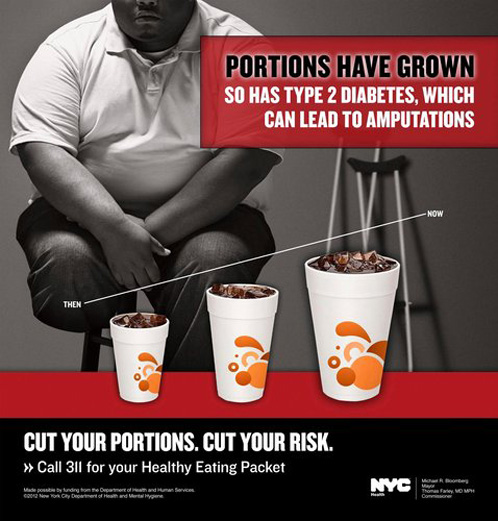
The Case of the Fake Amputee: A recently unveiled New York public health campaign warning against Type 2 diabetes uses a photo of an overweight man who is missing his leg.  The man, however, had both legs when the photo was taken. One was digitally removed to make it appear that his right leg had been amputated. The American Beverage Association, fighting the city’s efforts to reduce consumption of sweetened soft drinks and fast food, seized on the photo to press its case. “Clearly, the straight facts don’t support their singular attacks on our products, so they keep falling back on distortions and scare tactics that are over the top,” association spokesman Chris Gindlesperger said in a statement. “That’s disappointing.”  Well, diabetes does increase the risks of amputations, and a fake amputee is no more scary than a real amputee. Real amputees do exist; having a graphically-created one doesn’t change the accuracy of the ad’s message one bit. What does the association’s argument have to do with the photo-manipulation? Nothing. Continue reading

Now THIS Is Professional Misconduct!


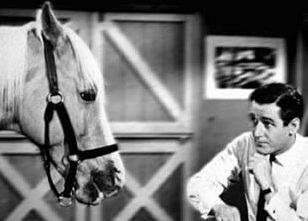
"Ed, you have to stop blaming yourself...you did nothing wrong!"

Dr. Thomas Wilson is accused of breaching professional ethical standards by having sexual relations with a patient while the doctor was still a student in Oklahoma. Normally a student’s misconduct would not result in sanctions almost two years later, after graduation and certification, but, you see, Wilson is a veterinarian, and his patient at the time of their illicit relationship was a horse.

The good doctor, who now practices at an animal hospital in Pennsylvania, is charged in Oklahoma with a “crime against nature,” but the ethical aspects of what he did go far beyond that. It is a breach of the trust with a patient incapable of  informed consent.  It is an abuse of power. It is animal cruelty. It is really, really, icky.

Are there such things as registered animal-sex offenders? I certainly hope so. Dr. Wilson should not be allowed within 100 yards of a race track, a rodeo, a farm, the Central Park carriages, or the set of AMC’s “Hell on Wheels.” The idea that he will be able to just pay a fine, go to some therapy sessions, and then blithely return to his equine practice without having to tell Mr. Ed’s owner that be has a record of horse-rape is unthinkable. Please tell me, Pennsylvania, that some kind of law protects your horses against sexual predators in sheep’s clothing?

[Thanks, I think, to Drew Curtis’s Fark for the link]

Ethics Hero AND Ethics Dunce: Secretary of the Interior Ken Salazar

U.S. Interior Secretary Ken Salazar scores a rare twin honor: He is an Ethics Dunce and an Ethics Hero in the same week.

Occupier, or just a vistor, Mr. Secretary?

First the good news, the Ethics Hero part.  Salazar has given the National Park Service  30 days to fix the inaccurate, misleading and truncated quotation on the Martin Luther King Jr. National Memorial. He did this after giving the inept King Memorial Foundation plenty of time to do its job. It didn’t, and he took the initiative. Harry Johnson, president of the Foundation, told the AP he wasn’t sure what changes could be made. Well, how about using a real quote instead of a made-up one that makes Martin Luthor King sound like a preening Newt Gingrich?

Chiseled into the monument’s left flank because there wasn’t room for the actual quote is “I was a drum major for justice, peace and righteousness.” What King really said in a 1968  speech was: “If you want to say that I was a drum major, say that I was a drum major for justice. Say that I was a drum major for peace. I was a drum major for righteousness. And all of the other shallow things will not matter.” When Maya Angelou and others complained that the pompous-sounding non-quote make King sound like a boasting egotist (and one speaking from the grave!), the Foundation shrugged and erected the monument unchanged. Continue reading

The “Your Right To Engage in Ignorant and Dangerous Speech Doesn’t Mean It Isn’t Unethical For Me To Help It Be As Loud As Possible” Dept.: ABC Full Circle and WordPress

Defending free speech doesn't mean you have to put dangerous speech where it will do the most damage...like 100 feet tall in Times Square.

As the New Year dawns, we see two companies in the communications business, and two situations raising the question, is it ethical or unethical to allow someone to use your product or service to broadcast harmful speech?

They took different paths, and both are being criticized. One company is ethical, the other is not.

The ethical company is WordPress.

A few days ago it took down one of its sites, Bare Naked Islam, after The Council on American-Islamic Relations (CAIR) complained that the site promoted violence against Muslims, which it surely did. When Muslims placed comments on the site, Bare Naked Islam published the IP and e-mail addresses of the commenters and suggested reprisals. Nonetheless, because it was CAIR’s complaint that triggered the removal, WordPress was criticized mightily in the conservative blogosphere for doing a Comedy Central—censoring legitimate free speech out of fear of Muslim violence. There is a very large distinction, however, between abandoning free speech in response to threats, as Comedy Central did in the infamous “South Park” incident, and responding responsibly to a legitimate complaint. Continue reading

Comment of the Day on “Comment of the Day: “Distracted Driving, Pot, and “The Great Debate””

Michael, whom I believe leads the field in 2011 Ethics Alarms Comments of the Day, just weighed in with an epic comment to Neill Franklin’s Comment of the Day from the lively distracted driving/marijuana post.  It restores some balance to what has been largely an Ethics Alarms vs. NORML mugging: I knew there had to be someone out there who agrees with me on the governments ethical obligation to keep drugs from further infecting American society. Here is Michael’s Comment of the Day on both Neill’s COTD and Distracted Driving, Pot, and “The Great Debate”:

“I was just a little horrified by Mr. Franklin’s comment, especially considering the source. I live in a neighborhood rife with drugs and the effects to me are evident. The effects that I see are different from those Mr. Franklin seems to care about, however. I see the wasted lives and wasted generations. If you look at the children around here, you see a generation that grew up without parents, without guidance, and without hope. They have never known adults who worked or who cared about their kids. They only know adults who are on drugs. These adults don’t play with their kids, don’t teach them. They don’t provide food, clothing, or reliable shelter and they subject their children to every form of abuse. These kids have no hope because they haven’t seen anyone like them live any other way. To escape this nightmare existence, they too turn to drugs and the cycle continues. I can’t understand how someone can advocate validating this behavior by legalizing drugs. I understand the self-serving legalization argument of the idle college student drug user and the people who somehow have lucked into good paying jobs that are easy enough to do while high, but I don’t respect them. Continue reading

Comment of the Day: “Distracted Driving, Pot, and “The Great Debate””

The drug legalization advocates attacked en masse regarding my post about the faulty opposition of the Right to measures prohibiting cell phone use while driving and the Left to anti-marijuana legislation. The passionate pot advocates shattered the previous Ethics Alarms record for comment volume; to read the threads, one would think I am the last remaining citizen who supports drug laws. I more than fulfilled my obligation to respond to as many of the comments as possible, and there were many articulate and well-informed advocates.  I was waiting for a worthy Comment of the Day from the debate, one that didn’t rely on one of the four fallacious arguments that will drive me to drugs if I have to read them much more. Neill Franklin, a first time commenter, came through.

Here is his Comment of the Day, on Distracted Driving, Pot, and “The Great Debate”:

“Well, we can discuss all of the philosophies, intent of the law and compare oranges to apples all day and night, but here’s the bottom line from a practical, what’s happening in the streets, our neighborhoods, cities, neighboring countries and to our kids, point of view. No speculation here…all facts. Continue reading

Candidate for Dishonest Quote of the Year: Rep. Michele Bachmann

"Huury! There's another four alarm fire in Rep. Bachmann's pants!!"

“I’m happy to say I don’t think that I’ve said anything inaccurate in any of the debates. And I’m extremely grateful for that. It’s a high-profile stage and so I’m grateful that I don’t think I’ve made a blunder.”

Rep. Michele Bachmann on NPR’s Morning Edition. Bachmann saying she has never said anything inaccurate is like Steve Martin saying that he has never said anything funny.

This quote occurred on November 25, and I missed it. It came to mind because the Washington Post did a long feature on Bachmann today as it profiled the Republican presidential contenders who haven’t been fingered by past paramours. As part of the coverage, Post “Fact checker” Glenn Kessler noted that of all the candidates, Bachmann has made the most statements that rated four “Pinocchios”, his rating system for dishonesty. Four puts a politician in the “liar, liar, pants on fire” category, and Bachmann’s metaphorical pants are always smoldering.

I think I missed this statement because I assumed the jig was up with Bachmann, and I could look elsewhere for topics. There are some public figures—Al Sharpton, Howard Stern, Sen. Harry Reid, Michael Savage, Joy Behar, Bill Maher (gasp for breath), Bill O’Reilly, Donald Trump, Mark Levin, and others—who violate principles of honesty, civility and fairness in their statements so regularly that I can just check their most recent comments on a slow news day and have something juicy to write about. But with these regular ethics violators there is little point in doing so. Their fans are so biased or corrupted that they are beyond reaching with reasoned analysis, and any objective, ethically grounded observer knows all about these culprits already. Bachmann is on the list; she is a charter member, in fact. Continue reading

Obama, Sibelius and Plan B: Bad Science, Bad Ethics, Bad Policy

After FDA Commissioner Margaret Hamburg advocated that all women of child-bearing age be allowed to buy Plan B, the so-called “morning after pill,” without a prescription, Health and Human Services (HHS) Secretary Kathleen Sibelius overruled the FDA with President Obama’s imprimatur. Sibelius said..

“After careful consideration of the FDA Summary Review, I have concluded that the data, submitted by Teva [the Plan B manufacturer], do not conclusively establish that Plan B One-Step should be made available over the counter for all girls of reproductive age. The average age of the onset of menstruation for girls in the United States is 12.4 years. However, about ten percent of girls are physically capable of bearing children by 11.1 years of age. It is common knowledge that there are significant cognitive and behavioral differences between older adolescent girls and the youngest girls of reproductive age. If the application were approved, the product would be available, without prescription, for all girls of reproductive age.”

What’s going on here? What’s going on here is that the Administration wants to avoid a direct clash with those who regard human life as being created from the moment of conception. Sibelius’s implies without saying that a pill that ends an unwarranted pregnancy within 72 hours is an abortion pill, or at least she is crafting HHS policy for the pleasure of those who believe this. No science supports the contention that a fertilized egg that has yet to travel to the uterus—what Plan B prevents— is a human being; the position is a moral/religious one that exists independently of science. Continue reading

TV Payola and the Shameless Alison Rhodes

" 'Conflict of interest?' What's that?"

She’s not the only one, apparently. But consumer product reviewer Alison Rhodes (“The Safety Mom”), a frequent guest on national, syndicated and local TV shows, not only reviews products whose manufacturers have paid her to mention them, she is unapologetic about it.

Today’s Washington Post reveals that Rhodes, who can be seen on such shows as “Regis and Kelly”, “Today” and “Good Morning America!” as well as local news outlets around the country, raved on the air about a home electronic monitor and a backpack with a built-in alarm known as the iSafe bag without telling either viewers or producers that she had accepted payola from their makers. Rhodes, however, shrugs off the issue. She tells the Post that she doesn’t see any problem, because “I’m not going to take on any engagement with a client unless I believe in their product.”  Amazing. Meanwhile, the news programs the Post interviewed claim that they had no inkling that Rhodes was plugging the product of a client.

This brazen deception of the public is inexcusable, but the shamelessness—or ignorance— of Rhodes and the negligence of those who give her exposure are worse. Continue reading

Now Here’s A Terrible Idea: Mandated Disclosures for Photoshopped Images of Celebrities!

And if you look real closely at the lower left corner, you'll read, "The model for Venus was a short, middle-aged bald man named Gino. His appearance was altered by the painter in the creation of this painting."

Here is another candidate for enshrinement in the Pantheon of Well- Intentioned But Terrible Ideas.

In an article published Monday in the journal “Proceedings of the National Academy of Sciences,” Dartmouth researchers Hany Farid, a professor of computer science, and Eric Kee, a doctoral student, propose a rating system of publicly displayed photographs of models, actors and celebrities to let viewers know exactly how and how much an image has been altered by photoshopping, airbrushing or other means.

“Impossibly thin, tall, and wrinkle- and blemish-free models are routinely splashed onto billboards, advertisements and magazine covers,” the two write. “The ubiquity of these unrealistic and highly idealized images has been linked to eating disorders and body-image dissatisfaction in men, women, and children.” In the interest of limiting the damage caused by unrealistic images of human beauty, the researchers argue that graphic images should include labels that disclose  “geometric adjustments” such as slimming legs, hips and arms, as well as adjusting facial symmetry—reducing a nose in size, or slightly enlarging eyes.  Users of such photos should also flag photometric adjustments that change the appearance of skin tone, blemishes and texture, such as wrinkles, dark circles under the eyes or cellulite, say the researchers.

Please, for the love of God, nobody introduce these guys to Sarah Deming and her lawyer, who are suing the distributers of the film “Drive” because the trailer was more exciting than the movie. And let us all remember this proposal when we are tempted to pooh-pooh accusations that the government is regulating creativity, commerce, art and enterprise right out of existence, and with them, individual liberty as well.The tea parties should use Farid and Kee’s article for recruitment. Continue reading