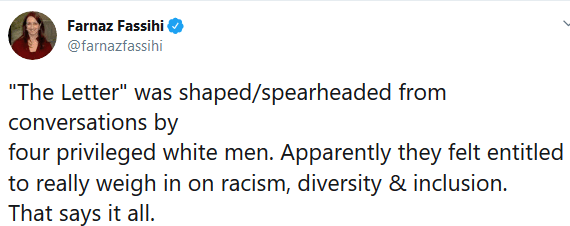
1. Re: Privilege and bit more on the Harper’s letter fiasco. At the Volokh Conspiracy, David Bernstein flags this tweet by New York Times reporter Farnaz Fassihi:
A few thoughts:
Why do I subscribe to a paper that would employ someone like this? I forget.
She’s a bigot. I just wrote a bit on the “privileged smear” on another thread:
I have to say again that I do not comprehend the “privilege” line of thought at all. In the hands of most who wield it, I find the tactic the equivalent of Butch Cassidy kicking huge Harvey Logan in the balls to start their knife fight….
Michael Shellenberger was a Time Magazine“Hero of the Environment,” and he was and is the founder and president of Environmental Progress. Now he has a best-selling book, Apocalypse Never, published at the end of last month. I haven’t read it, and I wouldn’t have the expertise to know whether it was right or wrong. It could be that he is violently rejecting the official climate change hysterics line to fill a profitable contrarian niche, though that would be out of character based on his reputation. It may just be that he is telling the truth, and exposing what was, or should have been, pretty evident for a long time. As he puts it his article,
On behalf of environmentalists everywhere, I would like to formally apologize for the climate scare we created over the last 30 years. Climate change is happening, it’s just not the end of the world. It’s not even our most serious environmental problem. I have been a climate activist for 20 years and an environmentalist for 30, so I may seem like a strange person to be saying this.
But as an energy expert asked by the US Congress to provide objective expert testimony and invited by the Intergovernmental Panel on Climate Change (IPCC) to serve as an Expert Reviewer of its next Assessment Report, I feel an obligation to apologize for how badly we environmentalists have misled the public.
Well, we knew that, didn’t we? The usual people denied it, but was so, so obvious that from Al Gore on, this was science weaponized for political and partisan purposes, by scientists seeking grants and peer approval. One doomsday prediction after another came and went, one model after another failed, and yet the refrain persisted. Climate scientists who were tempted to break ranks were intmidated: as galileo demonstarted, it is not a field often distinguished by courage and sacrifice. Shellenberger writes,
“[U]ntil last year, I mostly avoided speaking out against the climate scare. Partly because I was embarrassed. After all, I am as guilty of alarmism as any other environmentalist. For years, I referred to climate change as an ‘existential’ threat to human civilization and called it a ‘crisis.’ But mostly, I was scared. I remained quiet about the climate disinformation campaign because I was afraid of losing friends and funding. The few times I summoned the courage to defend climate science from those who misrepresent it I suffered harsh consequences. And so I mostly stood by and did next to nothing as my fellow environmentalists terrified the public.”
The cancel culture is after Shellenberger even as I write this, for he’s perceived as a traitor. Forbes, which initially published his mea culpa, pulled it down after being bombarded with social media protests, then gave no substantive explanation for why. Well, they really didn’t have to, I suppose.
Shellenberger lists “some facts few people know,” such as,
Humans are not causing a ‘sixth mass extinction’
The Amazon is not ‘the lungs of the world’
Climate change is not definitively making natural disasters worse
Fires have declined 25% around the world since 2003
The amount of land we use for meat — humankind’s biggest use of land — has declined by an area nearly as large as Alaska
Carbon emissions are declining in most rich nations and have declined in Britain, Germany, and France from the mid-1970s
Netherlands is becoming richer, not poorer while adapting to life below sea level
We produce 25 per cent more food than we need and food surpluses will continue to rise as the world gets hotter
…and more, then later lists some of the conclusions from his book, among them:
Factories and modern farming are key to human liberation and environmental progress
The most important thing for saving the environment is producing more food, particularly meat, on less land
The most important thing for reducing air pollution and carbon emissions is moving from wood to coal to petroleum to natural gas to uranium
100 per cent renewables would require increasing the land used for energy from today’s 0.5 pc to 50 pc
‘Free-range’ beef would require 20 times more land and produce 300 pc more emissions
The writer, David Kaufman, says in the article that he is black, so I’ll take his word for it. I’m not going to fisk or rebut the piece, any more than you would take the time fir rebut my Chex Mix conspiracy theory, if I really wrote it down. Both articles inhabit the special category of “res ipsa loquitur” reserved for things that, without further analysis or explication, prove that their creator is mentally ill, or, in the alternative, trying, for whatever reason, to make people believe waht isn’t so, or, possibly engaging in satire. When you read the article, the latter possibility is quicklyerases, and so is the second. The author is serious. He is deranged.
Here’s one section, just to illustrate:
“And there you have it: The government-approved origins of the “little White men” telling us to cross the street at corners across New York….I am now convinced that technology and necessity, rather than some anti-Black conspiracy, propelled the shift from verbal crosswalk cues to a lunar-white Walking Person. But my heart still sinks at the specter of teaching my sons to ask a White man for permission to do — well, anything. Because so much of the world already insists that we do.”
“Annie” opened in the gloom of the Carter Presidency and the Watergate hangover, and it’s hit ballad, “Tomorrow,” sung by a relentlessly optimistic orphan with her scruffy dog at her side, , became a sensation until everyone got sick of it.
Unlike so many child phenoms, there was a bright tomorrow for the original Annie, Andrea McArdle, the 12-year-old with the freakish belt. She never made the leap to movies, but she has had a steller stage career that’s still going strong, aided by the fact that puberty was good to her, and her voice mellowed without losing its clarion strength.
After “Annie,” McArdlehad starring roles on Broadway in “Starlight Express,” “Les Miz,” “State Fair,” and as Belle in “Beauty and The Beast.” For the last 20 years she’s continuously starred in regional production and tours, national and international, of such shows as “Cabaret,””Gypsy” (as Mama Rose), “Mame” and “Hello Dolly,” and several times in “Annie,” though now, in middle age, she plays the little girl-hating comic villain, Miss Hannigan (third photo, first row).
But she can belt out “Tomorrow”…as should we all.
1. Wuhan Virus Ethics Train Wreck update:
Apparently the memo has gone out to the mainstream media that highlighting the George Floyd Freakout/Black Lives Matter mob’s anti-America rampage isn’t helping the cause of getting rid of President Trump. Thus it’s back to fear-mongering about the pandemic. Sunday’s Times was filled with giant, scary maps with big red blotches, and the headline was “Virus Inundates Texas, Fed by Abiding Mistrust of Government Orders.” The only non-editorial content in that headline is “Texas.” Further down on page one, another headline about a story that literally has nothing to do with the virus begins, “As Virus Rages…”
In contrast, there was no mention of how protesters danced on the American flag and chanted “America was never great!” during D.C.’s Fourth of July celebration, or how D.C.’s BLM flack mayor Muriel Bowser allowed the mob to block traffic returning to Virginia after the fireworks.
When I saw this story last night, I predicted that it would receive far more publicity than the death of a relatively little known 41-year-old Broadway actor normally would warrant. The reason is that Nick Codero died from a series horrific complications after being infected–a series of strokes, heart failure, lung failure, the necessary amputation of his leg.
The severity of his reaction without having any underlying conditions is obviously an anomaly, but I see on my Facebook feed that friends are already hyping it to argue that America should remain in lockdown until everyone is living on the dole and wearing rags.
It’s not going to work now. People are right not to trust “government orders,” since the states and cities have abused their power with arbitrary restrictions and inconsistent enforcement, made fatal miscalculations (like Gov. Cuomo’s dumping of infected seniors in nursing homes), and the waffling CDC, including Dr. Fauci, has no credibility at all. (Rand Paul’s criticism of Fauci in the Senate hearing last week was fair and appropriate.) Major League Baseball, having committed to the season starting this month, is noting infections among players, getting them quarantined, and moving forward, in contrast to the NBA cancelling its season after a couple of infections in the Spring.
For historical and quirky reasons, “The Egg” is my favorite song from “1776.” The number takes place on July 3, as the Continental Congress debates Jefferson’s handiwork, and Tom, Ben Franklin and John Adams sit outside, hesitant to witness the rhetorical carnage they know is coming. I played the role of Adams in several musical reviews, a part I would have loved to have tackled on-stage in a full production, but I am about 7 inches too tall.
Some productions cut this number, which is both bad history and bad theater. (The number to cut is “Cool, Cool, Considerate Men,” a cheap shot at conservatives, and a lousy song.)
1. And I will say, “None of your business, officer!” A new Virginia law, the Community Policing Act that took effect this week, requires police officers to ask individuals pulled over during traffic stops for their race, ethnicity, and gender. I very much doubt that the law will withstand a legal challenge. The change is part of the Governor Ralph “Call me Michael Jackson” Northam regime of enacting every oppressive progressive agenda item he can get away with. This one is aimed at eliminating “bias-based profiling,” and requires officers to record the driver’s race, ethnicity, age, and sex while conducting traffic stops.
Like so many other misguided approaches to fixing “systemic racism,” this one attempts to protect the rights of African-Americans by infringing on the rights of everyone else. If I am pressed to answer the question by an officer, I will answer that I identify as Asian and female. I urge my fellow Virginians to do likewise.
Kwame Anthony Appiah, the New York Times Magazine’s ethics columnist, just opened a can of metaphorical worms, and I’m going to spread them around a little. It may get messy.
A woman—actually, now that I re-read the post, we don’t know it’s a woman— wrote to be reassured that he or she wasn’t a bad person for wanting to dump a man she had engaged in a nascent romantic relationship after discovering that he had Crohn’s Disease. “I know I’m being selfish, but is it unethical to not date him because of it?” she wrote. ” I don’t know what to do to support him, and I am worried about the future. He said it’s very likely his intestinal issues could get worse, and his life expectancy may be shorter. I want to shield myself from the pain, but I also feel like a terrible person for even thinking about it.”
Hey, don’t feel bad, sayeth “The Ethicist”:
“Once someone is truly a friend or a lover, you have all kinds of responsibilities to them that you didn’t have before. So for example, it would be deplorable to abandon a spouse because he or she has become seriously ill. That’s part of what’s meant by saying a marriage is to endure “in sickness and in health.” Of course, this can turn out to be a promise someone can’t keep. But precisely because a partnership is for the long term, you can appropriately consider what your lives together would be like before you enter into one. When a potential partner is already seriously ill, committing to this person may be committing to a life as a caregiver. (The specific condition you mention has a wide range of severity; it can be mild and well controlled or genuinely debilitating.) You don’t owe it to anyone to accept that burden; indeed, if you think you don’t want such a life, you have a good reason not to enter into the relationship. It doesn’t make you a terrible person to think about the issue. The terrible thing would be to make the commitment and then to be unable to keep it.”
Oddly for “The Ethicist,” he ducked the main question that was asked, and instead answered what he thought was an easier one. The questions he answered were ” Is it wrong to reject a commitment to someone because that commitment may be too burdensome?,” and “Is it wrong to think about the issue?” (It isn’t wrong to think about anything, regardless of what Black Lives Matter says. They should see what I think about them.)
What the inquirer was asking, however, is whether she should end a casual relationship—she had only known the guy through Zoom, after all—because he had Crone’s Disease, before she could form an attachment to him and might decide that he was worth the trouble…make that potential trouble.
I see no distinction between what she wants to do and invidious discrimination in any other relationship, like employment. Discrimination is when you treat someone worse than someone else because of who they are and features they have no control over, rather than what they do, have done, or “the content of their character.” It is also discrimination to make judgments about someone based on assumptions about people “like” them—profiling, essentially. “I don’t want to date him, even though I really like him, because he has a handicap” is, as I see it, indistinguishable from saying, “I don’t want to hire her because she has a handicap/ is likely to become pregnant/ is old/ is black.”
It is clear, if it wasn’t already, that everything hinges on whether the American public is as stupid and inattentive as those seeking to manipulate it think it is.
1. Mobs? What mobs? I just listed to CNN’s health expert, Dr. Gupta, list the reasons there has been a surge in Wuhan virus cases. Notably absent from his list were the mass, no social distancing demonstrations/protests/riots that began two weeks ago as a prominent part of the George Floyd Ethics Train Wreck. These, as you may recall, were largely supported by the health experts (though I don’t have a record of Gupta being among them) as they apparently decided that Black Lives Matter matters more than all the black lives that would be put in danger by ignoring the safety measures we shut down the country to install.
I also have yet to read a single news story about the new cases of the virus that highlights the completely predictable effect of the mobs, which are still roaming, as a factor in the so-called “surge,” though I can’t check everything.
Is the news media really certain that if they don’t report this connection, it will never occur to most of the public? I’m already reading accusations that opening up the states is “racist” because of the evidence that African-Americans have contracted the virus and died from it at a higher rate than the rest of the public. By that logic, encouraging the mobs of George Floyd protesters was also racist.
To re-phrase Wilford Brimley from his great scene in “Absence of Malice”: “American Public, are you that dumb?” So far, it seems so. Continue reading →
Update: I decided we needed a less pokey version, so now we have Leonard Bernstein’s, and the whole thing. THAT should cheer you up…
Boy, am I sick of everyone telling me how depressed they are.
1. Translation: “I’m an idiot.” Now Seattle Mayor Jenny Durkan is saying that the city will close the so-called “Capitol Hill Autonomous Zone.” It turned out to be exactly what anyone with any sense predicted it would be, with three shootings so far and a rape, along with a leader ( war lord?) who had the gall to complain when the Seattle EMTs didn’t immediately respond when shots rang out. The mayor had said that the anarchist outpost would lead to a “summer of love,” marking her as a Sixties-romanticizing dolt, but now she says she was obviously joking-–yes, the Joke Excuse. She never said it was “in jest” before the completely predictable violence broke out.
I apologize for not highlighting her as an Incompetent Elected Official of the Month, but she was competing with Bill De Blasio.
2. Fearmongering. It should be apparent by now that the news media does not want the country to re-open, does not want the economy to begin recovering before the election, and is pushing its anti-reopening goal through fearmongering, in part by focusing on isolated cases of individuals getting hit by the Wuhan virus particularly hard.
This morning HLN kept repeating a long feature about a thirtyish Broadway star who has been disabled by the virus for 80 days, and another man not in a high-risk group who has been suffering for 100 days. The Times and the Washington Post are full of apocalyptic reports about the number of cases rising. Another news outlet said, “The U.S. reported more than 33,000 new coronavirus cases on Saturday – the highest total since May 1 – while the surge of infections in several states is outpacing growth in coronavirus testing.” ARRRGH! We;re DOOOMED!
One commentator called this “needless” frightening the public. Wrong. It is needed because it is a part of the ongoing effort to defeat President Trump.
The Centers for Disease Control predicted that cases would increase as the country reopened, not that it has much credibility at this point. Remember? The lock down was never intended to stop the spread of the disease, but to slow it down, flatten the curve, stock up on supplies, fix the CDC’s testing botch, and find treatments. That was mostly accomplished. The nation cannot continue to let the economy deteriorate: depressions kill people too.
Meanwhile, the death rate is declining even as the number of cases spike, and there’s a reason for that. In all outbreaks, a disease claims the most vulnerable first. This is known as Farr’s Law, named after William Farr, a British epidemiologist and early statistician who recognized the importance of death statistics and identifying causation. Not only has the current epidemic claimed many of the most vulnerable in the U.S., thanks in great part to the catastrophic decision of states like New York to send infected seniors to nursing homes, millions of Americans have antibodies.
The combination means that even if there are lots of new cases going forward, the death toll is likely to be far less severe than it has been. Do not hold your breath waiting for the media to explain this.
Just for fun, check and see how many news organizations have mentioned Farr’s Law. Continue reading →
1. About “Juneteenth”: I confess: I had never heard of Juneteenth before this year, or at least never took note of it or what the day signifies. I am certain that I never heard the term while I was living in Massachusetts. It would have helped, in my case, if the unofficial holiday (except in Texas, where the event commemorated actually occurred, the freeing of the last slaves in America, and it is a state holiday) had a label that didn’t remind me of so many Madison Avenue gimmick labels and fad word mash-ups like “frenemy” or “momtrepreneur.” “Juneteenth” sounds to me like a summer music festival.
The end of slavery is certainly a legitimate subject for a new paid Federal holiday (as well as many others). Getting the holiday established as part of the George Floyd Freakout white guilting strategy cheapens it, I think, placing the holiday in the same pandering package with HBO Max pulling “Gone With The Wind” or the University of Florida banning the “Gator Bait” cheer. As with so much else going on, I am concerned that this will exacerbate rather than ameliorate racial tensions, with an official nation-wide “Juneteeth” having the effect of making July 4th a “white” holiday.
2. Deceitful withdrawal of the decade? Senator Amy Klobuchar, whose prospects for being named Joe Biden’s running mate vanished as soon as it was publicized that she was responsible for Minneapolis cop Derek Chauvin not being prosecuted for earlier claims of police misconduct, grandly announced that she had called Biden and withdrawn her name from consideration, an amusing variation on “You can’t fire me, I quit! “America must seize on the moment and I truly believe — as I actually told the VP last night when I called him — that I think this is a moment to put a woman of color on that ticket,” Klobuchar told MSNBC’s Lawrence O’Donnell last night. “And there are so many incredible, qualified women. But if you wanna heal this nation right now, my party yes, but our nation, this is a helluva way to do it.”
No, choosing a Vice-President purely on the basis of gender and color is not a “helluva way” to run a country, but that’s progressivism and the Democratic Party in 2020: group identity matters, actual skill and qualifications don’t. (And if there are so many “incredible, qualified women, why isn’t Biden considering any of them?) Ann Althouse writes, amusingly,
So what I hear in her effort at a high-minded statement is an undercutting of the other women who are in the running. First, Elizabeth Warren — who is not a woman of color except in her memory of younger days when family lore and a desire to identify were enough. Why step on her chances, Amy? Second, all the various black women who are in the running. Amy is ensuring that when one of them is picked, everyone will believe they were picked because of their race.
Because whoever it is will have been picked because of her race and gender! Klobuchar isn’t signaling anything that everyone paying attention hadn’t figured out months ago. As for Warren, I have never believed that the Democrats would be so foolish as to have two over-70 politicians on the ticket. Continue reading →
The poll on #4 among yesterday’s “ethics grab bag” is running strongly in favor of leaving up statues of Juan de Oñate, a particularly nasty Spanish conquistador who established the colony of New Mexico for Spain. [Aside: I was going to link to the article on the Britannica site, but as soon as I whitelisted it, I was bombarded with pop-up ads, drop-in ads, slide-over ads and more that shifted the text and made it nearly impossible to read. They are morons, and screw them, to be blunt. I’ll allow a site’s ads if the site is smart and considerate enough to format them so that they don’t make using the site infuriating. I will not be visiting again.] Only 11% of voters so far think that there needs to be some limit on how horrible a historical figure can be to have a community decide that they don’t want to be reminded of him and her every day. Voting is still open:
In general, I am not one calling for removing art from the public square. That smacks too much of Soviet Russia, Chairman Mao, and the Taliban. Perhaps a more complete history can be shown on the monument discussing the controversies.
The Oñate statue is one of those monuments that maybe should not have been dedicated, even if he founded or claimed the region for the Spanish crown over 400 years ago. Apparently, the statue’s foot amputation was in response to Juan de Oñate’s brutal repression of the Acoma Puebla after the Acoma rebelled in October, 1598, because the Acoma refused to pay a food tax to the Spanish crown, which had been implemented by Oñate. Oñate had claimed the region for Spain in March 1598, and instituted a food tax, which hacked the Acoma off – why wouldn’t it? – so they rebelled. The Acoma killing 11 Spaniards/Mexicans, including Oñate’s nephew, In response, Oñate ordered the burning of the town and the slaughter of almost the entirety of the 2,000 Acoma, leaving some 200 alive, including children. Oñate had his troops amputate a foot of each of the surviving males of fighting age and sent the children to “missions” in Mexico. The revolt has been referred to as the Acoma Massacre. Not sure that is something Spain is proud of. Continue reading →