Comment Of The Day: “A Trigger Warning About A Trigger Warning: Audiences Should Walk Out Of The Movie Theater When This Appears”

“For May wol have no slogardie a-night.
The seson priketh every gentil herte,
And maketh him out of his slepe to sterte.”

  Now who can argue with that?  The passage is from a story Geoffrey Chaucer’s “Canterbury Tales,” “The Knightes Tale,” the English  classic written between 1387 and 1400. I did not expect a substantive comment regarding Chaucer to follow an Ethics Alarms post (Chaucer has been mentioned in passing here in the context of the evolution of the English language), but there it was: Michael West revealed his fascinating discovery that Chaucer may have been a pioneer in more than just English literature. Michael’s Comment of the Day is unusual in another way besides its erudition. It was a comment on a post that is nearly two years old. It concerned the jaw-dropping warning that preceded the “Darkest Hour,” the acclaimed film about the wartime heroism and brilliance of  Winston Churchill:

“The depictions of tobacco smoking contained in this film are based solely on artistic consideration and are not intended to promote tobacco consumption. The surgeon general has determined that there are serious health risks associated with smoking and with secondhand smoke.”

I wrote at the time,

Winston Churchill, you see, smoked cigars. Actually he chain-smoked them, and inhaled. They were among his trademarks. Any adult who doesn’t know that should not have graduated from high school. Interestingly, shooting and bombing people are also serious health risks, so I don’t know why it wasn’t noted that the “depictions of warfare contained in this film are based solely on artistic consideration.”

Whatever “based solely on artistic consideration” is supposed to mean…

Of course, showing Churchill smoking cigars is not an “artistic consideration,” but one of historical accuracy and integrity. Does this mean that there was really a debate in the studio about whether or not Churchill should be shown smoking, so as not to trigger good little progressive totalitarians, who believe in changing the past for the greater good of the present? I wonder if they considered making Winston, who was fat, appear slim and ripped, since the surgeon general has determined that there are serious health risks associated with obesity and over-eating. I don’t see why they wouldn’t, if they felt that showing people smoking in the 1930s, when almost everyone smoked,  might be interpreted as promoting smoking today.  Churchill also drank like Bluto in “Animal House.” Why no warning about that? Uh-oh—does this mean that the film, for artistic considerations, only shows Winston sipping soda water and prune juice?

That warning says to me, “We, your Hollywood moral exemplars, think you are an ignorant, illiterate  dummy who can’t tell the difference between a historical drama and a tobacco commercial. We also support the government’s belief that it should impose on every aspect of your life, including your entertainment, to protect you from yourself.”

I had, mercifully, completely forgotten about that asinine warning, and now I’m ticked off all over again. Gee, thanks, Michael, for reminding me.

Here is Michael West’s Comment of the Day on the post, “A Trigger Warning About A Trigger Warning: Audiences Should Walk Out Of The Movie Theater When This Appears”... Continue reading →

Afternoon Ethics Tea, 9/26/2019: A Drunk Lawyer, A Disgraceful Congressman, Uncivil Peanut Butter And The Dolls America Needs [UPDATED!]

These trustworthy scones are divine!

1. First, the important stuff: peanut butter ethics. Now Jif, the peanut butter, has joined the detestable ranks of consumer products that deliberately evoke the vulgarity “fuckin'” in its advertising. Booking.com was the first company chided here for this particular offense against minimal civility, when I wrote,

Ethics dictates that one communicates with respect for anyone within hearing distance, and unless ugly words serve a material purpose, using them is not the mark of a good citizen, a good neighbor, or a trustworthy human being. Nor is spouting vulgarity witty, and unless you are 11, and employing obvious code words that sound like curses, epithets and obscenities isn’t especially funny either, since we pretty much exhausted the possibilities at summer camp. I have no idea why anyone would want to recast the culture as a place where professionals curse like sailors and the words “fuck” and “cocksucker” are as likely to issue from a debutante’s lips as those of a hip hop artist, but that seems to be the objective now. … TV stations happily accept money from advertisers using code words for “ass” (Verizon), alluding to sexual intercourse (Reese’s), and evoking the word “shit” (K-Mart and DraftKings).

Booking.com no longer uses this device, but Jif now pronounces itself “Jif’n good!” Fortunately, this peanut butter aficionado regards Jiff as the least of the  national brands and varieties (1. Skippy Natural 2. Skippy regular, 3. Peter Pan crunchy 4. Peter Pan smooth…and Jif, bringing up the rear.

Now I won’t even buy this peanut smutter when it’s on sale.

2. Apparently the mainstream media AND the Democrats are determined to dash what’s left of their rotting credibility to smithereens with this last ditch impeachment push:

  • Today’s “Japanese Bombs Pearl Harbor” size headline across the New York Times print edition: TRUMP ASKED FOR ‘FAVOR’ IN CALL, MEMO SHOWS.” Again, this would be really funny if it wasn’t so destructive.
  • Showing unprecedented lack of respect for the office of President (and proving beyond any doubt that no American who wants fair and objective reporting on politics should tune into MSNBC), the network’s Nicole Wallace cut off the  audio at President’s   first news conference since House Democrats opened a formal impeachment inquiry,, saying,  “We hate to do this, really, but the president isn’t telling the truth.”
  • In Congress, on TV, Rep. Adam Schiff read into the record his “paraphrase” of the transcript of the President’s phone call to the Ukraine President. Sample:

“I’m going to say this only seven times, so you better listen good, I want you to make up dirt on my political opponent, understand, lots of it, on this and on that, I’m going to put you in touch with people.”

“Is he just making this up?” Committee member Mile Turner (R-Ohio) asked. Indeed he was. Althouse’s commenters are having a field day on this. Ann’s readership is ideologically mixed, but you couldn’t tell that from the utter contempt Schiff’s stunt inspired. Continue reading →

And Now For Something Completely Stupid: “Upbeat,” Unethical Website Of The Month,

Stay away from upbeat, Bart!

Let this incompetent, sloppy, website stand for all of its ilk across the web.

This is a pop culture site initially aroused my ire by tricking me into a slideshow. These are unethical devices used to artificially inflate traffic statistics; it would be like Ethics Alarms breaking every post into ten or more chapters that every view had to click on individually. The clickbait headline was “Hollywood Actors That Don’t Get Cast Anymore,” and the intro suggested that they all had been “blacklisted” for one reason or another. This itself is misleading and sloppy: when “blacklist” is used in reference to Hollywood, it means THE blacklist, the secret list of artists who the studios conspired not to hire because of the reality or rumors of Communist associations, sympathies and activities. To confound things, the slide show mixes in, as padding, I suspect, some figures who were blacklisted for alleged Communist connections.

There is no formal “blacklist” today, though some actors with conservative leanings claim, with some plausibility, that they have struggled after being placed on the bottom of the metaphorical pile because of Hollywood’s ideological intolerance. Communists, ironically, would be welcome in today’s leftist Tinseltown. Among those actors who picked the wrong era to be conservatives are James Woods, Patricia Heaton and the late R. Lee Ermey. Even they, however, couldn’t credibly claim to be blacklisted.

“Upbeat” doesn’t bother with these interesting cases, however. It would rather just make stuff up. Of Brendan Frazier, it says, “Fraser claimed that he had been sexually assaulted by [Phillip Burke] ..the former president of the Hollywood Foreign Press Association… and whether the allegations were true or not, Fraser has not appeared in a film since. He now spends his time in his mansion outside of NYC, raising his kids and horses.” Continue reading →

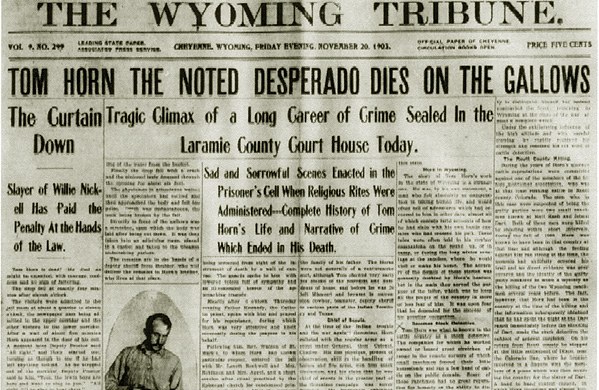
Directed Verdict Ethics In The The Movies: “Tom Horn” And “To Kill A Mockingbird”

Once again, as I watched the film version of “To Kill A Mockingbird” for the 50th time, I was bothered by the fact that Atticus never asked for a directed verdict, and the kindly, seemingly fair-minded judge never declared one.

A directed verdict is also known as a judgment as a matter of law or JMOL. It means that one side or the other has failed to meet a minimum burden of proof, and is usually declared by a judge  after is a motion made by a party, during trial, claiming the opposing party has presented insufficient evidence to reasonably support its case.  A directed verdict  is similar to judgment on the pleadings and summary judgment. Judgment on the pleadings is  made after pleadings and before discovery; summary judgment occurs after discovery but before trial.

A directed verdict occurs during the trial, and a judge can also render one spontaneously, without a motion. The motion can even  be made after a verdict is returned by a jury, where such a motion is technically for a “renewed” directed verdict, but commonly referred to as judgment notwithstanding the verdict.  In a civil trial, a party must have moved for a directed verdict before the jury reports out its decision. In a criminal trial, as in the fictional Tom Robinson case, there is no such requirement. The court may set aside a guilty verdict and enter an acquittal in the interests of justice.  A criminal defendant is not required to move for a judgment of acquittal before the court submits the case to the jury for the verdict to be overturned. A verdict of not guilty can never be overturned.

In “To Kill A Mockingbird,” black defendant Tom Robinson is convicted of rape despite the primary prosecution witness, the alleged victim, contradicting her own testimony at several points, and despite strong evidence that the beating she claimed was part of the sexual assault was shown to be delivered by a right-handed man—like her spectacularly vicious and creepy father—when the defendant couldn’t use his right hand at all. Atticus Finch never moves for a directed verdict, and the judge never declares one, though he presides over the fiasco of a trial with a disgusted look throughout. Continue reading →

Sunday Ethics Warm-Up, 9/22/2019: Five Ugly Ethics Stories (Sorry!) [Corrected]

A pleasant Sunday…

as long as I don’t read the newspaper or watch the Talking Heads…

1. Before I finish a long post about the most recent contrived Brett Kanavaugh smear by the New York Times, ponder this quote from the Times review of “The Education of Brett Kavanaugh”: “[The authors] come to a generous but also damning conclusion, which is that Blasey Ford and Ramirez are believable and were in fact mistreated by Kavanaugh as teenagers, but that over the next 35 years he became a better person.”

Ugh. The conclusion is “damning” because it relies almost entirely on confirmation bias: Blasey Ford’s own lawyer revealed that her motive in using her “recovered memory” against Kavanaugh was to discredit any future anti-abortion opinions he participated in as a member of the court. The accusation by Ramirez isn’t, apparently, even believable to Ramirez herself, since she says she isn’t certain that the Mad Penis-Dangler was Bret Kavanaugh. Why then, do the authors find the claims “believable”? Oh, because they want to believe them, of course; they work for the New York Times, and they certainly weren’t going to get their book promoted by their employer and snatched up by its readers if they concluded, as objective reporters would, that there is no more reason to believe Justice Kavanaugh did these things than there is reason to believe he didn’t.

The real ugh is this, however: if even these biased analysts conclude that the accusations, even if true, do not have any relevance on the grown man who was nominated to the Supreme Court because they relate to a minor who existed 35 years ago—and who has, as most children do, grown up—then the episodes that their book focuses upon literally don’t matter, shouldn’t have been brought into Kavanaugh’s hearing,  and should not be used now to denigrate and discredit him.

2. From “Social Q’s,” a glimpse of what a malfunctioning ethics alarm is like. Prompting the frequently appearing question in my mind, “How does someone get like this?” was the query into Phillip Gallane’s advice column from a woman who threw herself a birthday party, directed guests not to bring gifts but to make a donation to a charity she supports instead, and was annoyed that some brought gifts anyway. She asked if it would be inappropriate to send the gifts back with a disapproving note so they “would listen” to her “next time.”

I know what I would do “next time”…

3. Hey, sounds great, Facebook! Why wouldn’t everyone trust your judgment? Facebook announced  a series of changes last week to squelch hate speech and extremism—meaning what Facebook and its allies consider such— on its platform in a letter to the chairman of a House panel. Facebook said it would prevent links from the fringe sites 8chan and 4chan from being posted on its platform—you, know like it blocks links to Ethics Alarms!  Then it explained how it would develop an oversight board of at least 11 members to review and oversee content decisions—like the decision that a wide-ranging ethics blog that has no political affiliation or agenda, written by a professional ethicist of some note, doesn’t meet the Facebook “community standards.”

In other, unrelated news regarding the obstacles being thrown in my path, the Appeals Court in Massachusetts finally alerted me that it was taking “under advisement” the request for an appeal of the rejected frivolous defamation suit filed about two years ago by a banned commenter here whose boo-boo I wounded.

(I am not concerned.) Continue reading →

Someone Explain To Arizona Democrats How Ethical, Democratically-Elected Representatives Are Supposed To Act, Please? [CORRECTED]

While I was running around my hotel room yesterday trying to through everything into my travel bag and check out, I faintly thought I heard that the Arizona Democratic Party would be holding a vote this week to determine whether Sen. Kyrsten Sinema (D-Ariz.) should be censured. As I was dashing down the hall to the elevator, I mused on what Sinema possibly could have done to warrant such a sanction. A blatant conflict of interest, perhaps? Maybe the spoken work, a politically incorrect noun that the Party of Censorship ( as well as Censureship) found intolerable? The discovery that she had made a joke about trans people on her private social media account?

Digression: On the Comedy Central Roast of actor/comedian/mega-jerk Alec Baldwin, which I didn’t watch once I realized to my great disappointment that he would not be on an actual spit and rotating over real flames, that noted female comic Caitlyn Jenner, said, in her new higher-pitched by not quite female voice, that if Baldwin didn’t like her barbs, he could “suck my dick.” (CORRECTION NOTICE:  I missed the news that Caitlyn’s vestigial man-thing  was removed in 2017, and suggested otherwise before being corrected by commenter Rich in Ct, who keeps track of such matters.)  If any one else made that —ick—joke, they would be run out of town as un-woke wetches.] Continue reading →

Sunday Ethics Warm-Up, 9/15/2019: Opinions, Ethical And Not

It’s a glorious day here in Northern Virginia!

Makes me feel like things are looking up, even though they probably aren’t.

1. I refer you to the most recent post about “the resistance’s” arsenal of big lies. specifically Big Lie #5, “Everything is terrible.” In the Times’ Sunday Review section, usually a resistance nest to one degree or another, though less so in recent months, Trump Deranged Times columnist Michelle Goldberg offers a long essay beginning with the assumption that current day America is a dystopian society. How does she justify this ridiculous assertion? Referencing the science fiction novel “The Handmaid’s Tale,” in which women in the U.S. “are stripped of their identities and consigned to reproductive slavery for the elite.” Goldberg writes,

“It’s hardly surprising that in 2016 the book resonated with people — particularly women — stunned that a brazen misogynist, given to fascist rhetoric and backed by religious fundamentalists, was taking power despite the wishes of the majority of the population.”

I especially like the “despite the wishes of the majority of the population” part, but the whole statement is dishonest  agitprop. Nobody “took power;” an election took place under Constitutional constraints. Goldberg cannot possibly gauge the “wishes” of the majority, since, as usual, the majority didn’t feel sufficiently concerned about the Presidential election’s outcome to bother to vote, meaning they didn’t “wish” for either candidate to win with enough seriousness or commitment to be  part  of any persuasive analysis. Meanwhile, the President was elected according to the system the United States has operated under since its inception. And describing Trump, who is about as religious as most recent Presidents, which is to say, not at all, was “backed by religious fundamentalists” is as accurate as saying that Barack Obama was backed by anti-white racists.

Read the whole stupid thing. It is irresponsible for a legitimate newspaper to publish such crap, but no more so than for one to employ a biased disinformation specialist like Goldberg as a regular contributor.

2. Once again, Andrew Sullivan finds his way toward calling out unethical journalism. In a recent essay for New York Magazine, the occasionally conservative, gay, religious, emotional but determined truth-teller—as he sees it, anyway—declares  the New York Times a publication that has abandoned journalism for activism.

Two quick reactions: a) Ya think, Sherlock? and b) THIS was your first clue?

He concludes strongly, though, writing, “To present a truth as the truth is in fact a deception. And it is hard to to trust a paper engaged in trying to deceive its readers in order for its radical reporters and weak editors to transform the world.”

Hard? The right word is “irresponsible.”

Related: This excellent essay by Peter Wood expounds further on the duplicity of the Times’ much heralded “1619 Project.” Continue reading →

Ethics Quote Of The Day, 9/11 Edition: Nicholas Haros, Jr.

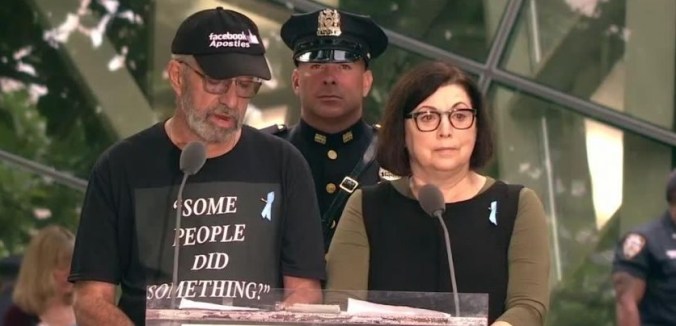
“’Some people did something,’ said a freshman congresswoman from Minnesota. Today I am here to respond to you exactly who did what to whom. Madam, objectively speaking, we know who and what was done. There is no uncertainty about that. Why your confusion? On that day, 19 Islamic terrorist members of al Qaeda killed over 3,000 people and caused billions of dollars of economic damage. Is that clear? But as to whom…I was attacked, your relatives and friends were attacked, our constitutional freedoms were attacked and our nation’s founding on Judeo-Christian principles were attacked. That’s what some people did. Got that now?”

Nicholas Haros Jr, reading the names of the 9/11 victims, including his mother, at today’s commemoration of the Twin Towers attack.

Res ipsa loquitur.

Visual Bias Ethics

Let’s see: Hack, hack, probably a hack, and hack.

One aspect of broadcast journalism ethics that the Old Guard—Murrow, Cronkite, Brinkley, Huntley, Thomas and the rest— observed and respected was a neutral demeanor. They knew (and today’s hacks know as well, but with different results), that tone of delivery, body language and facial expressions can convey a journalist’s personal views and biases as clearly as a direct statement. Their practice, therefore, was to maintain a poker face and a matter-of-fact delivery. When Walter Cronkite brushed away a tear while announcing JFK’s death in 1963, it was considered newsworthy because Walter did not bring his own feelings into the news. The consensus was that hee could be forgiven this one time.

If that professional practice is taught in journalism classes any more, it is ignored. Now broadcast journalists and reporters deliberately use every tool at their disposal to signal to viewers what they think, and thus what the viewers should think as well. The election of Donald Trump represented a full-on, industry wide rejection of objectivity by the broadcast media, as many reporters allowed themselves to appear in mourning, or close to tears.  Unlike the assassination of JFK, however, this  was not an excusable exception, or, as we have learned, an exception at all.

Look at the faces of last night’s CNN panel reporting on what had been built up as a bellweather election in North Carolina that, should a Democrat have won, would be string sign that President Trump and Republicans were in trouble nationwide. Is there any doubt who they were rooting for?

This is not only unethical journalism, it’s incompetent journalism.

But that’s the way it is.

One More Time: Leadership, Moral Luck, Accountability, And Scapegoating, Baseball-Style.

Here is part of the statement released by  Boston Red Sox owner John Henry yesterday after the team fired its head of Baseball Operations, essentially the team’s General Manager, Dave Dombrowksi:

“Four years ago, we were faced with a critical decision about the direction of the franchise. We were extraordinarily fortunate to be able to bring Dave in to lead baseball operations. With a World Series championship and three consecutive American League East titles, he has cemented what was already a Hall of Fame career.”

Wait…HUH? He was hired four years ago, the team won three consecutive American League East titles (for the first time in the franchise’s history), a World Series Championship (following an epic 2018 season that saw Boston win 108 games) and he’s fired? What did he do, sexually harass players? Flash the owner’s daughter? Continue reading →