Future Ethics News From The 2018 World Series

Bulletin: When the opposing teams are announced before Game #1 of the 2018 World Series tomorrow night, the manager of the National League Champion Los Angeles Dodgers, Dave Roberts, will receive a loud standing ovation from the capacity Fenway Park crowd as he walks out to the third baseline.

There is no question about this. Anyone who knows Boston, Fenway, Red Sox tradition or the team’s fan culture has any doubts: it is a sure thing. That ethical gesture of gratitude and respect is as certain as the tide coming in on Cape Cod’s Wellfleet beaches, or the leaves turning gold in Concord this Fall. Red Sox fans have always maintained the tradition of recognizing excellence from opposing players, but the gesture and salute tomorrow goes far beyond that. For it was Dave Roberts, then a reserve pinch-running specialist in the twilight of his career and playing his only season with Boston—and only a couple months of that season at that—who was sent in to run for Kevin Millar, who had walked  in the bottom of the 9th inning of the potential elimination game in the 2004 ALCS.

The hated New York Yankees were leading the best of seven series three games to none, and no team in baseball history had ever come back from such a deficit to win. Pitching was Yankee closer Mariano Rivera, probably the greatest relief pitcher of all time. Everyone knew that Roberts had entered the game for one reason: to steal second base and set up the possible game tying run. And he did it—it was a close play, but he made it, and seconds latter, Red Sox batter Bill Mueller singled him home to tie the score. David Ortiz won the game with a home run in extra innings, and the Red Sox went on from there to sweep New York, and the St. Louis Cardinals in the 2004 World Series as well. The team’s storied 86 year World Series drought was finally over, along with it the Curse of the Bambino, Pesky holding the ball, Lonborg facing Gibson on two days rest, Ed Armbrister getting away with blocking Fisk’s throw to second, Bucky %!^$! Dent’s cheap homer, the ball rolling under Buckner’s legs, Grady Little’s Great Choke, and more, as they all faded into irrelevancy like a long, horrible nightmare. Continue reading

Comment Of The Day: “A Sudden Impulse Poll On Cultural Literacy”

To all of those waiting to have their Comments of the Day posted, all I can say is that I’m sorry, and that I’m having trouble getting my own posts up lately. The languishing COTDS will appear in unpredictable order, but they will appear.

Extradimensional Cephalopod had, as usual, fascinating observations to convey on the question of the importance of cultural literacy I raised based on a reference to “Alice in Wonderland.” I don’t agree with his position–some cultural scaffolding is permanent, and must be—but it’s well worth pondering.

Here is his Comment of the Day on the post, “A Sudden Impulse Poll On Cultural Literacy.”

Incidentally, a majority of those answering the main poll recognized the quotes, which cheered and surprised me. As for the complaint that the second poll was limited to parents, that was the point. Do parents pass along cultural touch points like Lewis Carroll? Do the schools? That poll was for parents.

I’m eventually planning to write an article about this sort of thing. It’s essentially a concern that we’ll all end up like Ozymandias. (Cultural references can help compress concepts into easily transmissible packages, for better or worse, case in point.) For now, since I don’t have much time tonight, these somewhat disjointed thoughts will have to do.

Is the ultimate fate of all classics to become footnote? To a large extent, yes. As Nassim Nicholas Taleb would put it, fame is in Extremistan. For comparison, Mediocristan is the domain of physical properties, which often follow a normal distribution (e.g. most people are average height, and there are fewer and fewer people at heights that vary more and more in either direction from the average). Fame, however, doesn’t do that. Necessarily you have many people who are known by few and the people with the most fame are few in number.

My perspective on this issue is that everything in civilization is a scaffold. It exists to help us to get to the next place, hopefully a better one, and then it is taken down. This includes even memories, since memory is a resource that culture uses and we only have so much memory to go around, at least in our day-to-day lives. What we remember must have some functional benefit, even if that function is nostalgia. We can learn about the past, but only inasmuch as we enjoy it or as it helps us create the future. Its value is considerable, but can be concentrated more efficiently than having everyone know all the esoteric details of it at all times. Anything about the past that doesn’t help us or make us feel anything can be temporarily forgotten until such time as it becomes relevant again (hopefully before it’s too late for us to use that remembered knowledge). Continue reading

“Dear Abby” And The Unusual Name Paradox [Updated]

The famous Hogg sisters, Ura and Ima.

Let’s begin with a related observation: The now widely accepted method of expressing disagreement with a point of view that varies from leftist (now, now, I use the term with love!) cant is to set out to destroy the point of view’s owner: after all, eliminate or intimidate all the dissenters and adversaries, and progressives no longer have to win  arguments on logic and merit. I know of what I speak: I am increasingly the target of social justice warriors (fascist division), who make formal complaints to my clients or administrative bodies when my ethical guidance doesn’t jibe with the world view their professors indoctrinated them with, thus precluding an open mind.

Thus I sympathize with “Dear Abby,” actually Daughter of Dear Abby Jeanne Phillips (also the niece of Ann Landers), who is now facing the progressive Twitter mob because she dared to opine that naming one’s baby Ifeoma, Bodhi or Laszlo might not be in the child’s long-term interests. “Not only can foreign names be difficult to pronounce and spell, but they can also cause a child to be teased unmercifully,” wrote Phillips. “Sometimes the name can be a problematic word in the English language. And one that sounds beautiful in a foreign language can be grating in English.”

The Horror. Now she is being called racist, and if her syndicate has the backbone and integrity of most organizations these days, which is to say none, she will probably be toast in a matter of weeks if not days. Writer Anand Giridharadas was among those interviewed for a Times story about Abby’s Outrage. “The reality is that a lot of this has to do not with names but with whiteness,” he said. “There are a lot of complicated names from Polish and Russian and Italian and German backgrounds that have become second nature to Americans.”

No, the issue is not “whiteness.” The questions in the ethical equation are…

Are you naming a child for your amusement, self-aggrandizement or political agenda, of for the child?

Is conduct consistent with cultural norms wise and respectful, or is it preferable to announce one’s defiance?

If data and experience shows that odd and unusual names create problems later in life, should responsible parents take that into consideration?

Is it fair and ethical to hang an unnecessary handicap on a child without that child’s approval?

What Phillips said is true. It’s that simple. People don’t like that it’s true, so they are condemning her. Continue reading

Comment Of The Day: “Racist Political Correctness, Casting Ethics, Double Standards, And The Rock”

Yes, this comment has little to do with ethics, but it’s so interesting as a supplement to the main post that it deserves greater circulation.

Here is Pennagain’s fascinating Comment of the Day on the weekend’s post, Racist Political Correctness, Casting Ethics, Double Standards, And The Rock:

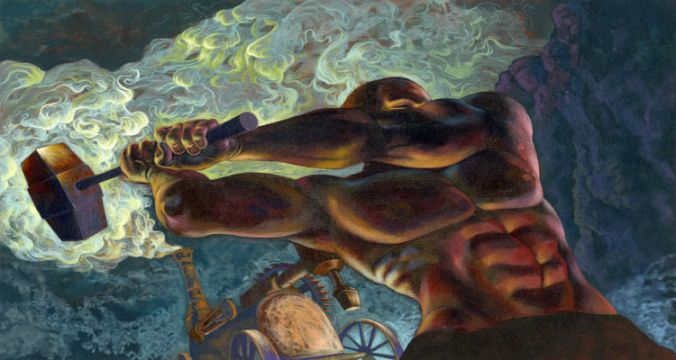
I knew there were at least two versions of the song, “The Ballad of John Henry,” but I’ve so far found dozens more online, most of them having umpteen verses, and a work-song rhythm – the most basic of which my 7-year-old self stomped in that driving stop-rhythm around the classroom (chanting?), with that hammer-driving oomph! at the end of each line, to lyrics like “gonna die with the hammer in mah han’, Lord, Lord”.

For what it’s worth, a “real” John Henry is pretty well authenticated in at least one version of the story, ending fatally at the C&O’s Big Bend Tunnel in Talcott, West Virginia.

From KPBS’ “The African-American Railroad Experience”, built on Theodore Kornweibel’s photographic history: The entire southern railroad network built during the slavery era was built almost exclusively by slaves. Some of the railroads owned slaves, other hired or rented from slave owners [later from contracted freedmen or convict work-gangs]. And. . . women as well as men were actually involved in the hard, dangerous, brutal work. … several of the song versions finish with John Henry telling his wife to pick up the hammer and continue the job.

Negative evidence of Henry’s race would be that none of the many, many verses of the songs (recorded by 38 singers besides Ives) nor folk references – negro dialect aside (arguably stretched to “Suthun,”) – refer to that figure as being other than black. And as a black man, and a real, live “Everyman” working-man’s hero, he is proudly and fiercely claimed by South Carolina, Alabama, Virginia, Georgia, Kentucky . . . and Jamaica. Continue reading

From The “Bias Makes You Stupid Files”: Who Could Have Predicted That Black Men Would Identify With Brett Kavanaugh?

Kanye West may be crazy, but he isn’t wrong.

Writes the former race-baiting ESPN reporter Jamele Hill in The Atlantic:

On Tuesday night, I was in an auditorium with 100 black men in the city of Baltimore, when the subject pivoted to Brett Kavanaugh. I expected to hear frustration that the sexual-assault allegations against him had failed to derail his Supreme Court appointment. Instead, I encountered sympathy. One man stood up and asked, passionately, “What happened to due process?” He was met with a smattering of applause, and an array of head nods.

Why did Hill expect a group that  has historically been the victim of “believe the white woman” more than anyone to regret the failure of the desperation hit on the SCOTUS nominee using the banneer of #meToo waving over an unsupported accuser? Why did the Democrats? It’s pure bias: they assume that any group in their base automatically approves of their “ends justifies the means” tactics, no matter what basic principles of justice or democracy  have to be sacrificed. I heard about Hill’s bias-driven myopia before I read the whole article, and immediately wondered what Brian Banks, the promising high school football player whose life was upended when a jury believed his false accuser, Wanetta Gibson, would think of the argument that Kavanaugh’s appointment should be forfeit because a single accuser “must be believed.” As it turns out, Hill thought about Banks too, and even approached him.

I reached out to Banks and asked whether he had any thoughts about this solidarity some black men seem to feel with Kavanaugh, but he politely declined to comment. I can’t say that I blame him, since there’s probably nothing Banks could say that wouldn’t be interpreted as being unsympathetic toward victims.

Interpreted by who? I’m sympathetic toward victims, but like Banks, I suspect, I’m not sympathetic with those who want to ruin the lives of men, be they a an African American high school athlete or a judge with an impeccable personal and professional record as an adult, by discarding the principles of due process, equal justice, and presumption of innocence. Nobody can say that Blasey-Ford is a victim any more than the women who got Emmet Till killed was a victim. Democrats wanted her to be a victim, and that was the sole basis for her to be believed more than the man she accused. Continue reading

Oh, NOW I Get It! People Are Furious At The Kavanaugh Confirmation Because They Believe Divisive Fear-Mongers And Partisan Liars Like David Leonhardt! [Part I]

I know: I could spend all my time debunking unethical columns like Times pundit David Leonhardt’s piece a few days ago. However, since I noted in the previous post that I was puzzled by the fury of so many people regarding what was, in any objective assessment, a fair and competent—and, thank god, successful—effort by Republicans to prevent Democrats from shredding basic principles of justice and fairness in their desperate effort to preserve a favorable ideological balance on the Supreme Court as if they were entitled to it (They weren’t, because elections have consequences), I am obligated to inform the assembled that my puzzlement was cleared by his screed.

There are pundits like Leonhardt who are actively trying to foment fury and division, they are using false narratives, deceit and lies to do it, and newspapers like the Times and news networks like CNN and MSNBC are actively promoting the effort. I won’t waste my time and yours on the whole column, fun as it would be, but just this section:

If you’re not angry yet, you should be.

Let’s review: Decades ago, a businessman built a fortune thanks in large measure to financial fraud. His corrupt gains helped him become famous. He then launched a political career by repeatedly telling a racist lie, about the first black president secretly being an African.

This lie created an audience in right-wing media that made possible a presidential campaign. During that campaign, the candidate eagerly accepted — indeed, publicly sought — the illegal assistance of a foreign enemy. When national security officials raised alarm with Congress, before Election Day, leaders of the candidate’s party refused to act.

The foreign assistance appears to have been crucial to the candidate’s narrow victory. He won with only 46.1 percent of the popular vote, less than 16 losing candidates over the years had, including Mitt Romney, John Kerry, Williams Jennings Bryan and the little-remembered Horatio Seymour.

Having won, the new president filled a Supreme Court seat that his party had stolen with an unprecedented power grab. This weekend, the president finished filling a second seat, through a brutal, partisan process. During it, the president, himself an admitted sexual molester, mocked victims of abuse.

Together, the two new justices have cemented an extremist Republican majority on the Supreme Court. It has already begun acting as a kind of super-legislature, throwing out laws on voting rights, worker rights, consumer rights and political influence buying. Now, the court is poised to do much more to benefit the wealthy and powerful at the expense of most Americans — and the planet.

This is not how democracy is supposed to work.

That’s right: democracy doesn’t work when journalists are complicit in fomenting public division and violence to advance a political agenda. Continue reading

Morning Ethics Warm-Up, 10/8/2018: Weenies, Dummies, Hypocrites And Creeps.

Good Morning!

1. But before we get into the ugly part..I want to recommend an article called “Rationalizations for Unethical Behavior in Tech” over at Medium. The writer, April Wensel, is the proprietor of the Compassionate Coding site.

Her article specifically employs several of the rationalizations on the Ethics Alarms list, quotes me with attribution, and does a terrific job demonstrating what the list is there for, and how it can and should be used. Thanks, April!

2. And here is another reason you can’t trust the media: journalists often aren’t very bright or well-educated.  NBC reporter Ken Dilanian opined on Twitter after Kavanaugh was confirmed that…

It may not happen in our lifetimes, but the idea that North Dakota and New York get the same representation in the Senate has to change. “Senators representing less than half the U.S. are about to confirm a nominee opposed by most Americans” https://www.washingtonpost.com/politics/2018/10/06/senators-representing-less-than-half-us-are-about-confirm-nominee-opposed-by-most-americans/ 

To begin with, quoting that Post piece is signature significance for a partisan media hack.  “Most Americans” have insufficient information to oppose or support Kavanaugh on a substantive basis, and uninformed opinions are worthless at best. If “most Americans” opposed him, it was because they were misled, propagandized and fear-mongered into ignorance and bias. This is why we don’t elect Supreme Court justices. The complaint about the Senate that Dilanian glommed onto can be translated as “The Senate is the Senate.” It was designed not to represent the population as a whole, but the states, their interests and their cultures. “It may not happen in our lifetimes” is a statement of ignorance of what it would take to fundamentally change one of the three branches of government from its original form. I’d suggest to Ken that he try reading the Constitution, especially the formula for amending it. The chances that two-thirds of the states will accede to a new Senate construction that lets the big states dictate to the small ones are exactly zero, or essentially the same as the chances that the Electoral College will be abolished.

Dilanian is NBC’s intelligence and national security reporter and frequently appears on MSNBC, and now we know that the network’s intelligence reporter doesn’t understand his own country.

3. Be proud, Democrats! A Democratic Senator I had been blissfully unaware of  until the Kavanaugh nomination stepped up during the  hearings to reveal herself as exemplifying the ugly side of the partisan divide. Hawaii Democratic Sen. Mazie Hirono said that the fact that Kavanaugh was conservative was all she needed to determine that he was lying, for example. She’s a virulent bigot. Yesterday, she was asked twice by CNN’s Dana Bash about whether she thought harassing Republican senators in restaurants was inappropriate. She wouldn’t say “Yes,” sending a clear message that her real position is “No.”

Here’s the exchange: Continue reading

Ethics Hero: Kwame Anthony Appiah, a.k.a. “The Ethicist”

In the past, I mostly visited the New York Times Magazine “The Ethicist” column to take issue with the succession of ethics amateurs and ethicist wannabes the Times employed as its ethics advice columnist. Once Kwame Anthony Appiah took over, this wasn’t as much fun, and I admit I don’t even check the column that often. Appiah is a real ethicist, and knows what he’s doing. I sometimes disagree with his conclusions, but he reaches them using valid ethical analysis, and seldom employs bias or rationalizations.

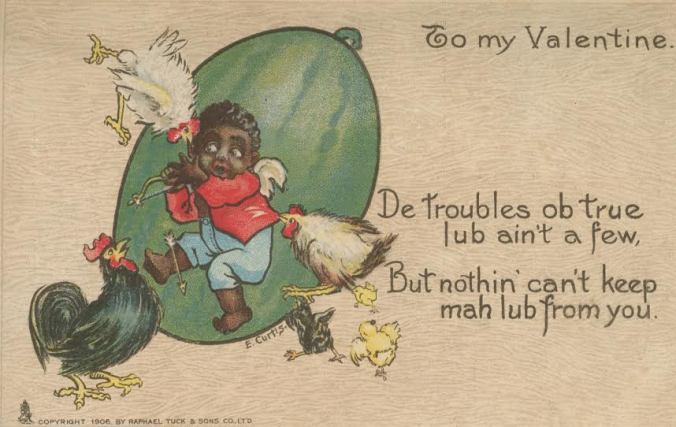
A recent column, however, deserves special praise. The inquirer asked what the ethical course would be to handle historical artifacts that reflected racist attitudes and artwork, like the card pictured above. The writer concluded her question…

I offered it to the National Museum of African American History and Culture in Washington. I never heard from them, so it moved with us. My husband thinks I should throw it away, but that feels wrong. I feel it is history that we should acknowledge, however painful and wrong. Your thoughts?

“The Ethicist’s” response is note-perfect, even with my intentional omission of its best and most surprising section. I’m doing this so you will hit the link and read the full column. Appiah wrote in part,

I am not a fan of the intentional destruction of historical artifacts….It’s a familiar thought that we need to understand our past, not least in order to help us avoid repeating the worst aspects of it. So your impulse to offer this souvenir card to a museum seems right. Of course, the sort of document you describe is well represented in collections already, and this may be why you didn’t hear back. But who knows whether there isn’t something about it that a historian might find useful in unpacking some detail of the history of American racial attitudes?

So if you think this card does have historical value, and you can’t readily find an interested archive or scholar, you could just put it up for sale on eBay, say, where it will join a large assemblage of racist artifacts. You can’t guarantee that you’ll approve of the motives of the buyer, but someone who is willing to pay for it is most likely to preserve it.

Given that your motives are honorable, I don’t share your worry about profiting from the sale. Selling an image isn’t endorsing its message. And my guess is that most contemporary collectors of such items aren’t motivated by racism. Still, if you want to avoid profiting, there’s an easy solution. Just send the proceeds to the National Museum of African American History and Culture. That’s an offer they won’t turn down. Continue reading

Afternoon Ethics Warm-Up, 9/19/18: Conditional Authoritarianism, Fake Reparations, And Profitable Harassment

Having a good and ethical day?

1. Here’s a useful definition…that I formulated while reading another issue of the increasingly and inexcusably anti-Trump propaganda obsessed New York Book Review section. This past weekend’s addition was more obvious than usual. “Democracy at Risk!”  (Not by an opposition party setting out to topple a Presidency with the assistance of the news media—no no no! The risk justifies the opposition party doing this!) “Is Donald Trump a Fascist?”  Hey, what’s Bob Woodward reading, just to pick a celebrity out of a hat? (The interview highlights the lack of self-awareness among the Trump-haters: Bernstein points out how intolerance and hate destroyed Richard Nixon as the Times allows and promotes hate in its war against the current President.) There’s an essay about…white nationalism! A Times reporter has written a book that pronounces the United States as “DOOMED!” And here’s Andrew Sullivan extolling an American revisionism exercise while referring to the current “spasm” of authoritarianism, and Doris Kearns, my old presidential power prof in college, with a new book about her faves, Lincoln, Teddy, FDR, and LBJ. These were great leaders.

The definition: Authoritarianism is when a President you don’t like exerts strong leadership within his powers to accomplish policy goals you disagree with. When a President you do like stretches and exceeds his Constitutional powers to achieve policy goals you approve of, that’s not authoritarianism. That’s great leadership.

As an aside, Andrew Sullivan tells us in his review that “the 2008 Heller decision rejecting a D.C. handgun ban is quite obviously bonkers.” All righty then! I guess that settles it!

2.  Speaking of Bonkers: Emmys Ethics. Michael Che appeared in a pretaped bit in which he handed out “reparation Emmys” to  black performers who supposedly were overlooked by the voting academy. These included Jaleel White (Urkel  on“Family Matters”), Marla Gibbs (nominated five times for her role as Florence on “The Jeffersons”), Tichina Arnold (“Martin,” “Everybody Hates Chris”) and Kadeem Hardison (“A Different World”).
Continue reading

“Antigone In Ferguson”: Embedding The Lie

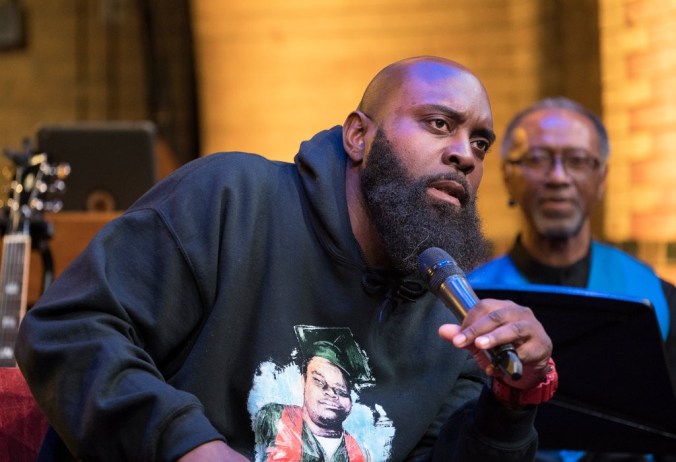
Mike Brown’s father during a discussion after the performance.

“Antigone in Ferguson”  premiered at Normandy High School, Michael Brown’s alma mater, in September of 2016. Now the Harlem Stage is presenting it in New York City, Off-Broadway. A play is a play and art is art; artists are going to enable juvenile, half-baked and even destructive political ideas and themes, and playwrights will turn their perceptions of reality into stagecraft that they often are far more qualified to execute than the task of making sense out of the world. This drama was conceived and directed by the activist playwright Bryan Doerries in response to the shooting of Michael Brown in Ferguson, Missouri four years ago,  overlays the structure of the ancient Sophocles Greek tragedy with a distorted version of Brown’s death and its aftermath. The goal, says the sympathetic—complicit may be a better word—New York Times, is “to open the door on the thoughts and feelings aroused by the shooting of the 18-year-old Mr. Brown by a white police officer, and by the protests that followed. ”

The play is championed by the Brown family, which means that in part it exists to perpetuate a politically useful lie and the  apparently invulnerable narrative that Brown was the innocent, sweet-natured victim of a racist cop who murdered the teen in the streets of Ferguson, and then got away with his deed because the white justice system is bent on killing young black men.

This quite simply is not what happened. The racialist Obama Justice Department was eager to be able to show that the officer was a killer, but in the end, despite the sympathetic spinning of the news media for months, the evidence did not support that conclusion, and no charges could be brought. Mike Brown, stoned and freshly off roughing up a storekeeper, resisted a lawful arrest, tried to grab a police officer’s gun, and then, when he focused his imposing 300 pound mass on charging the smaller cop who arrested him, got himself shot—stupidly, needlessly. His friend on the scene, however, quickly concocted the “Hands up! Don’t shoot!” exchange that never happened, and as that false version slowly twisted its way from slogan to protest to debunked myth, the facts of Brown’s case were neatly discarded for a narrative that advances the cause of division, anti-police bias, racial hatred, and more. Continue reading