The renowned private boarding school school Choate Rosemary Hall, alma mater of such luminaries as John Dos Passos, Edward Albee, Glenn Close, multiple Kennedys and dozens more of the rich, famous and powerful, , just revealed that at least twelve former teachers had sexually molested, and in one case, raped, students without the crimes being reported to police. The pattern continued over decades. In some cases, teachers were allowed to resign after being confronted with evidence of abuse, and administrators wrote still letters of recommendations for them after they were fired. The predators then went to other schools, sometimes in positions of power and authority.
After the similar institutional conduct revealed by the Catholic Church and Penn State, does anyone believe that this is a rare occurrence in institution, including the most prestigious—and virtuous!—ones? The lesson is that established, powerful, iconic institutions are programmed to protect themselves above others, and regard their own missions and continued vitality more precious than any single individual, even a child.
This rationalization has probably caused more death and human suffering than any other. The words “it’s for a good cause” have been used to justify all sorts of lies, scams and mayhem. It is the downfall of the zealot, the true believer, and the passionate advocate that almost any action that supports “the Cause,’ whether it be liberty, religion, charity, or curing a plague, is seen as being justified by the inherent rightness of the ultimate goal. Thus Catholic Bishops protected child-molesting priests to protect the Church, and the American Red Cross used deceptive promotions to swell its blood supplies after the September 11, 2001 attacks. The Saint’s Excuse allows charities to strong-arm contributors, and advocacy groups to use lies and innuendo to savage ideological opponents. The Saint’s Excuse is that the ends justify the means, because the “saint” has decided that the ends are worth any price—especially when that price will have to be paid by someone else.
The latest Sean Spicer controversy was so, so stupid that I swore—swore I tell you!—that I would not lower myself to write about it.
The Trump Administration spokesman, making the dumb assertion that Assad is even worse than Hitler because Hitler “didn’t even sink to using chemical weapons,” was absurdly—gleefully?— attacked as a Holocaust denier.ThnkProgress, which I am going to have to place on my “never trust these hacks” list, wrote that Spicer “argued that the Nazis never used chemical weapons during the Holocaust,” which is a lie, flat out. Spicer didn’t mention the Holocaust at all. Then The Anne Frank Center for Mutual Respect released a statement saying,
“On Passover no less, Sean Spicer has engaged in Holocaust denial, the most offensive form of fake news imaginable, by denying Hitler gassed millions of Jews to death.”
This is perhaps not quite a lie, since the combination of confirmation bias and paranoia could make this organization see Holocaust denial behind every rock, but it is no less ridiculous, inflammatory and unfair. Then some of my 2016 election-deranged friends—I now picture them wrapped in tin foil, wearing Groucho glasses and spreading DDT around as they sit cross-legged in a teepee with a flaming penguin on their heads—began citing the Anne Frank Center slander with approval, and garnishing likes from a lot of people who I usually like and who once had brains larger than marbles.
So now I have to defend Sean Spicer. Yecchh.
Observations:
1. Everyone is calling for Trump to fire Spicer. Of course he should fire Spicer. He should have fired Spicer months ago. Sean Spicer is incompetent, bumbling, inarticulate and gaffe prone. He is even more incompetent, bumbling, inarticulate and gaffe prone than Robert Gibbs, who was the most incompetent, bumbling, inarticulate and gaffe prone press secretary I ever had the pain of watching. (Obama’s subsequent press secretaries were just liars.). Spicer is much worse than Gibbs, though he doesn’t say uh-uh-un-um-um-um as much. I wish he would: they would be an improvement over what he does say. Spicer looks stupid and sounds stupid, so he represents the President and his entire administration as stupid WHICH THEY MIGHT BE, but his job is to place both in the best light possible. He does the opposite. This Hitler botch was just the most recent example.
2. Trump promised to appoint and hire “the best people,” so having one of the worst people imaginable representing his Presidency to the news media and the public leaves “incompetent” in the dust as “suicidal” takes over. This is especially true since the President knows that the news media is actively hostile to his leadership and is actively allied with the Democrats to bring him down and cancel out that damned election by any means possible. Trump’s situation screams out for a spokesman with the credibility, suave and wit of the late Tony Snow or the fierce intellect and articulateness of the very much alive Laura Ingraham. The fact that Trump can’t see that, and that his advisors haven’t threatened to walk out and join an anti-Trump rally if he refused to fire this clod and send him back to the Budget car rental desk or wherever he came from is really ominous. If “best people” means people like Spicer…well, I don’t like to think about it. And if the “You’re fired!” executive won’t fire someone who performs as horribly as him, who will he fire?
3. The Hitler statement was, no question, idiotic. At best, it was the most egregiously warped use of Rationalization # 32. The Unethical Role Model imaginable: Spicer was really saying, “why couldn’t Assad be more like Hitler?”! At worst, it was like walking into the buzz-saw of the Trump-hate narrative that the President and his team are virtual Nazis and secret anti-Semites. It was so dumb that the fact that Spicer didn’t physically try to stuff the words back into his mouth as they started coming out is signature significance that the man belongs in a home. Continue reading →
James K. Polk is one of my favorite Presidents, in part because he has never received his due for being spectacularly effective, if unwavering ruthless in achieving his goals. By the standards of fulfilling his own stated objectives, a President can’t be more successful than Polk. He pledged to expand U.S. territory to the West, Southwest and North, and did so, then served only one term, as he had promised. Polk also wrote a fascinating diary, essentially an autobiography.
His relative obscurity arises in part because he was a one term President, but primarily because he existed in the shadow of his fellow Tennessean, Andrew Jackson, who was more flamboyant, more influential on more political fronts, and had far more than four years in the spotlight. He was also much taller. Poor Polk lived just three months after leaving office, dying of cholera in 1849, in Nashville. Tennessee. The laws of the time held that those who died of that dread disease be buried within 24 hours to prevent epidemics, so the former President of the United States was laid to rest in a mass grave less than a year after leaving the White House.
A year later, Polk was removed from the mass grave and buried on the grounds of his Nashville home, Polk Place, in accordance with the will he drew up five months before his death. Polk, a lawyer, stipulated that his body and that of his wife be buried there, and that after his death and his wife’s, the property should be held in trust by the state, which would be bound allow a blood relative to live there. Unfortunately for the dead Polks, the ex-President made a tyro’s drafting gaffe. After Polk’s widow Sarah died in 1891, a court voided the terms of the will because it violated the common-law Rule Against Perpetuities: a property owner can’t bequeath property to unborn future generations. So Polk Place was sold to private interests, eventually razed, and today there is a boutique hotel on the property. On Sept. 19, 1893, Polk’s body and Sarah’s were moved again, to the Nashville grounds of the Capitol.
On a small patch of grass within a stone’s thrwo of the Capitol, the Polks’ grave is lies in a modest but attractive classical monument framed by Greek columns, with an inscription declaring that Polk “planted the laws of the American union on the shores of the Pacific.” It was designed by William Strickland, the architect who also designed the Capitol itself and George Washington’s sarcophagus at Mount Vernon in Virginia. But Polk’s Jackson problem continues: his gravesite is dwarfed by a nearby equestrian statue of Old Hickory, and tourists virtually ignore it. And while Jackson’s grave at the Hermitage, his family plantation, is a major tourist draw in Nashville, Polk remains—that is Polk’s remains remain—an afterthought. When President Trump visited Nashville last month, he laid a wreath on Jackson’s tomb, and saluted him in a speech. As for the perpetually dissed 11th President, the campaign jeer of the Whig Party running against the first Dark Horse candidate in 1844 apparently remains appropriate: “Who is Polk?” Continue reading →
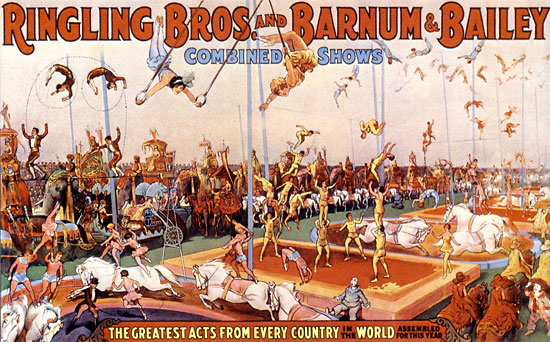
The Ringling Brothers Barnum and Bailey Circus will bring down its metaphorical Big Top for the final time in May. Its business model simply does not work any more, as an executive of the arena entertainment company that owns it said recently—especially since the circus capitulated to animal rights activists and fired its performing elephants. (Ticket sales dropped by almost a third.) This was an iconic cultural institution vanishing, so I had to say farewell, and did so last weekend, when the circus came to Washington, D.C. for the final time.
Observations:
1. It is still an entertaining show, even though the Ringling brothers would never have recognized it as a circus. Several of the acts were worth the ticket price (in our cases, about 75 bucks) all by themselves.
2. The Verizon Center was about a third filled for the final show of the legendary Ringling Brothers Barnum and Bailey Circus. The Center itself was sparsely staffed; it took 20 minutes in line to buy popcorn. Americans, as a group, don’t care about history, culture and significant changes in it landscape any more. The circus and its components gave us imagery, lore, metaphors—“walking a tight rope,” “three ring circus,” (this one is now a two-and-a half ring circus at best), “ringmaster,” “dog and pony show,” “the big tent,” “side-shows,” “clown act,” —and “The Man on the Flying Trapeze.” The nation is a little poorer and less colorful without it.
3. The public also increasingly sees little value in the mass audience experience. Live entertainment, especially family friendly varieties, were traditionally seen as an important and natural way to strengthen community ties, by bonding disparate members of society through a shared experience involving witnessing something transforming and memorable.
4. Assisting in the death of this experience is the trend of making sure all arena and stadium events are filled with loud, never-ending, pounding electronic music that would make Phil Specter grab ear plugs. Once, the circus’s dramatic music consisted of drum rolls, bands and soft calliopes. If you watch the Cecil B. DeMille movie “The Greatest Show On Earth,” you will see spectators talking to each other during the acts, or shouting out to performers. Either is virtually impossible now. Conversation consists of screaming a few words repeatedly until your companion nods. This continues the cultural trend of making meaningful interaction with fellow human beings passe. How can this possibly be a healthy development for society?
I did see a lot of people texting….maybe to those sitting next to them.
5. Almost no venders were walking among the seated. A single snow cone from one of these cost $12.00.
6. This is how unintended cultural pollution takes place. The conglomerate that owns the circus also owns various ice shows, like Disney on Ice. To cut costs, it decided to employ performers from the ice shows in the circus too, meaning that instead of a sawdust path around the rings, the track around the performing areas are ice. Everyone is on skates half the time. It isn’t a bad effect: it’s faster than the old-style parades. But now the circus is an ice show. Continue reading →
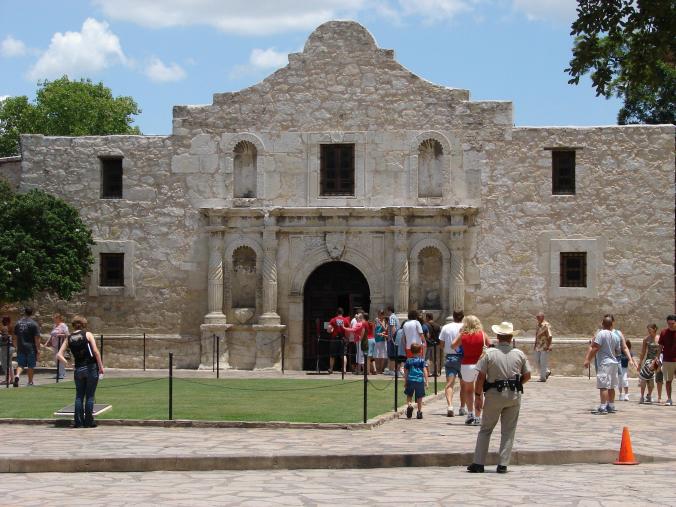
It is now April, and though I vowed at the end of February to finally post a thorough essay on the significance of the Alamo to U.S. culture, ethics, traditions and ideals at some point during the dates corresponding to the fort’s siege and fall on March 6, 1836.
I never did.
I thought I had posted an earlier essay about the Alamo. No, I haven’t. This is as inexplicable as it is inexcusable. The Alamo is by far my favorite historical landmark, and one of the events in American history that most inspires and fascinates me, beginning from when I looked on in horror as Fess Parker, as Davy Crockett, desperately clubbed Mexican soldiers as the last Alamo defender standing, and hundreds more charged toward him, as I heard on the soundtrack,
His land is biggest an’ his land is best, from grassy plains to the mountain crest
He’s ahead of us all meetin’ the test, followin’ his legend into the West
Davy, Davy Crockett, king of the wild frontier!
I learned all about Davy, of course, the real Davy, America’s first pop culture celebrity who created a legend about himself and by fate, irony or justice, inadvertently placed himself in a situation where he had to live up to his own hype—and by all accounts,did. Then there was Jim Bowie. I had seen several dramatized versions of his famous last stand, fighting off soldiers from his cot, finally dispatching one last attacker with his Bowie knife. It is one of the great examples of a scene so good it should have been true, though it wasn’t: Bowie was dead or unconscious by the time the Mexican burst into his sick room. Never mind: that’s how an American hero goes down, fighting. “Print the legend.” Later I learned how Bowie really was one tough, brave SOB, the perfect man for the Alamo, if he hadn’t been dying of cholera.
My impression of William Barrett Travis was biased by Lawrence Harvey’s portrayal of him as a martinet (with a British accent that supplanted his Southern one after the first scene) in the John Wayne film “The Alamo”, my favorite movie as a kid. The real Travis was a pefect example of someone who had failed in everything, including as a father and a husband, but redeemed himself magnificently at the end. His final letter to the world is one of the great proclamations of defiance, dedication and courage in all of history.
I will never forget my first visit to the Alamo, and seeing Texans weeping, openly, proudly, as they read the plaque with Travis’s words engraved on it:
Commandancy of the Alamo Bejar, Feby. 24, 1836
To the People of Texas & All Americans in the World
Fellow citizens & compatriots
I am besieged, by a thousand or more of the Mexicans under Santa Anna I have sustained a continual Bombardment and cannonade for 24 hours & have not lost a man The enemy has demanded a surrender at discretion, otherwise, the garrison are to be put to the sword, if the fort is taken I have answered the demand with a cannon shot, and our flag still waves proudly from the walls. I shall never surrender or retreat. Then, I call on you in the name of Liberty, of patriotism and everything dear to the American character, to come to our aid, with all dispatch. The enemy is receiving reinforcements daily & will no doubt increase to three or four thousand in four or five days. If this call is neglected, I am determined to sustain myself as long as possible and die like a soldier who never forgets what is due to his own honor & that of his country VICTORY OR DEATH.
William Barret Travis.
The story of the Alamo isn’t taught in schools outside of Texas. It wasn’t taught in my school, either: like most American history, I learned about the event though a thick mixture of pop culture, reading (Walter Lord’s “A Time To Stand” was a birthday present in 1961) and ongoing research. I recently completed “Texas Rising,” which was also just broadcast on cable as a mini-series starring the late Bill Paxton as Sam Houston. Historian Stephen Moore is a plodding writer, but he nicely puts to rest the currently popular politically correct slander that the defenders of the Alamo and the Texas rebels were fighting to keep their slaves, and trying to steal Mexico’s land. The Texians were opposing a dictator who had changed the terms under which they had come to the territory, and anyone familiar with the American character could have predicted what would happen when a despot demanded that they submit to unelected authority. The Alamo was a fight for liberty and democracy, and its martyrs exemplified sacrifice for principle and country.
I let them down. The story of the Alamo should be told and retold, with its ethics lessons made clear and bright. Next year, on March 6. 2018, Ethics Alarms will honor Davy, Bowie, Travis, Bonham, Almaron Dickinson and the rest of the 220 or so heroes who died that day, and do it the right way, not as an afterthought.
The post about the TSA agent’s excessive “patdown” of a young boy, caught on video, prompted spirited debate with many high quality comments.
Before presenting John Billingsly’s COTD, let me note up-front two of John’s points that I disagree with. First,while refusing to follow an illegal order is mandatory, the fact that one is given an order to do something unethical—and this patdown was unethical—does not reduce the responsibility to refuse if the harm to another is clear, obvious, and objectively unjust, as in this case. Second, everyone involved in a wrongful act is accountable, from the top of the chain of command to the bottom. I also have a third and fourth, but I’ll let others cover those.
According to a report at Dallasnews.com, “Afterward, the TSA officer was instructed by his supervisor, who was observing, to complete the final step of the screening process.” My emphasis added. This suggests to me that the agent himself was going to break procedure and omit “the final step” of the screening process, which I believe to be the genital grope, until he was directly ordered by his supervisor who was there in person to do it.
I understand the “just following orders” issue per the Nuremberg Trials. It looks like he was going to disobey the order (procedure) until he received the direct order from his supervisor. I don’t think there are many low level employees who would immediately disobey a direct order of a supervisor in that situation. When you are a grunt at the bottom and your boss tells you to do things the way you have been taught to do them, it is going to be very difficult to make the decision to disobey.
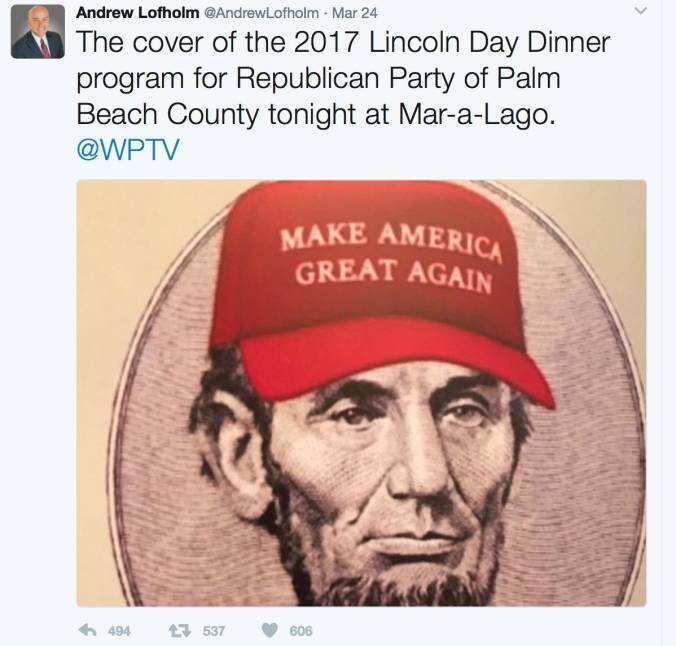
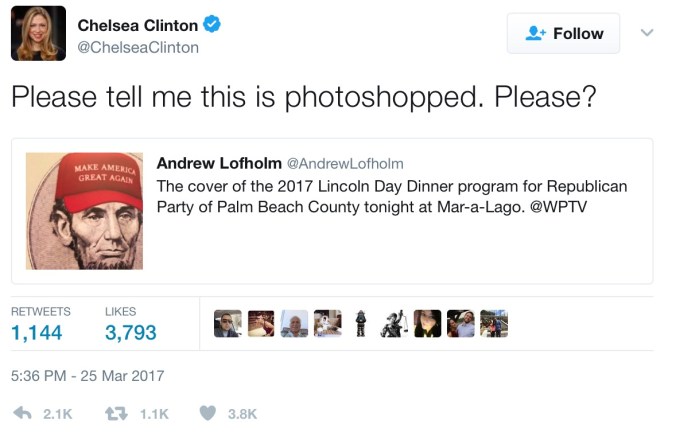
The above tweet and graphic somehow wended its way to Chelsea Clinton. You know: Hope of the Democratic Party Chelsea Clinton? Lifetime Impact Award winner Chelsea Clinton? Graduate of Stanford, with a masters degree from Oxford—that Chelsea Clinton?
Here is how that Chelsea Clinton responded:
Your Ethics Alarms Ethics Quiz Of The Day is…
How much public ridicule, if any, should be heaped on Chelsea for this?
“No, this is the exact hat Lincoln was wearing when he signed the Emancipation Proclamation. People forget that.”
“Nope, Lincoln was wearing that exact hat at the Theater.”
“Nope, they found a picture of Lincoln wearing a MAGA hat from the nineteenth century. No photoshop needed.”
“I remember this photo was taken at the 1856 Republican National Convention and is real.”
“It’s as real as those Bosnian snipers.”
My answer: she should be as much and as wittily as possible, as long as one agrees that similar treatment should greet one’s own brain-farts if they are especially funny, like this one is. This will be a great test of Chelsea’s character: if she can take the ribbing and laugh at herself, that will win her points with me.
If she doesn’t understand what’s wrong with the tweet, however…well, that would be a problem.
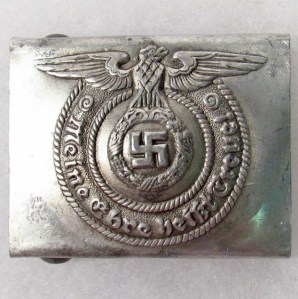
I haven’t checked in on The Ethicist column in the New York Time Magazine in a while: the current resident, Kwame Anthony Appiah, is the real McCoy, unlike all of his predecessors, and his analysis of various queries from readers is usually valid and properly reasoned. This week’s featured issue is a strange one, however.
A Peter Hulit of Los Angeles wrote to ask what was the “ethical way” to deal with a belt buckle from a Nazi uniform that was stored in his late father’s box of World War II memorabilia, collected during his service overseas. Hulit explained,
“I have kept it stashed in my desk. I’m now in my 60s and really don’t want it in my house..I have checked resale sites, and it does have some monetary value, but I do not want it to fall into hands that may use it symbolically for what my father fought against.”
I rate this question as more evidence of Nazi hysteria, one of the side-effect of the 2016 post election Ethics Train Wreck that includes the effort by the Left to slander opposition to Democrats, Clinton and Obama as nascent fascism. It is also a continuation of the historical air-brushing that Orwellian progressives seem to think will magically eliminate all evils from modern society.
World War II artifacts are history and are tools of acquiring knowledge. Knowledge is what those seeing German Nazi motivations in President Trump and his supporters sorely lack. There is no such thing as dangerous history. What is dangerous is to forget history, or to try to pretend that what happened did not.
Nor are objects cursed, or evil. People are evil, and history leaves evidence of evil deeds. “I don’t want it in my house” smacks of superstition. It’s a belt buckle.
Hulit’s question seems to suck The Ethicist down some unethical holes that he should avoid, and usually does. For example, he writes, Continue reading →
“They called off the Charge of the Light Brigade, the incompetent fools!”
Ethics Alarms feels obligated to state what should be obvious, but increasingly is not, as abuse is heaped on the Republican House and President Trump for failing to be able, for now at least, to agree on a replacement/repeal/fix for the Affordable Care Act, “Obamacare” its close friends….enemies too, come to think of it.
The headlines on stories all over the web describe the lack of a GOP bill are brutal:The failure of the Republican health care bill reveals a party unready to govern (Vox)…Republicans Land a Punch on Health Care, to Their Own Face (New York Times)…Inside the GOP’s Health Care Debacle (Politico). Those are the nicest ones. The conservative media’s headlines are even more contemptuous. This only reflects how much the prevailing delusion on the Left and by extension the Left’s lapdog media and punditry, has infected political common sense, leaving a Bizarro World* sensibility about what ethical governing is about.
It may be futile to point this out from this obscure corner of the web, but hell, I’m a fan of quixotic endeavors: the House health care bill was a bad bill. Virtually everyone who examined it thought so. If the thing had somehow been passed by the Senate (it wouldn’t have been, so this meltdown just got all the abuse and gloating out of the way early) and signed by the President (who admits that he has no idea what a “good” health care system would be), it would have thrown millions of lives and the economy into chaos. It isn’t responsible governance to pass bad laws. (Why is it necessary to even say this?) It’s irresponsible. The Republicans wouldn’t show they were “ready to govern” by passing an anti-Obamacare bill that made a bad mess messier; they would have shown that they were fools, reckless and incompetent.
You know: like the Democrats when they passed the Affordable Care Act. Continue reading →
Usually the “Incompetent Elected Official” category comes down to some variety of a conclusion that can be summed up by the sturdy phrase, “What an idiot.” This one is worse than that.
Representative Devin Nunes is chairman of the House committee investigating Russian interference in the Presidential election. This involves intelligence, investigations and secrets that are necessarily a matter of discretion until a final report can be released. No investigation can proceed in a trustworthy manner if every new shred of information becomes public, or worse, is revealed to parties who have a stake in the investigation. This has been understood by members of Congress since, oh, the first Congressional inquiry. The Constitution’s framers assumed that Congress would conduct investigations, just as as the British House of Commons did. James Wilson of Pennsylvania, Convention delegate, a future Supreme Court Justice and the Declaration of Independence signer that “1776” unjustly smears as a weenie , wrote in 1774 that House of Commons members were considered
“grand inquisitors of the realm. The proudest ministers of the proudest monarchs have trembled at their censures; and have appeared at the bar of the house, to give an account of their conduct, and ask pardon for their faults.”
During the First Congress in 1790, Robert Morris, who was the superintendent of finances during the Continental Congress and a financier of the American Revolution, asked Congress to investigate his handling of the country’s finances to clear his name of claimed improprieties. If Nunes doesn’t know the history of the legislative function he is involved in, he should.
Nunes had received intelligence that related to the President’s disputed claim that “he” (meaning who and what, it is unclear) had been wiretapped (meaning surveiled, presumably) by “Obama” (meaning someone who reports to Obama, I’m guessing), and chose to bypass his committee members, Democrats, protocol and common sense by relaying it directly to the White House. The new information, Nunes said, showed that American intelligence agencies monitoring foreign officials may have “incidentally” picked up communications from Trump transition team members, and thus the President’s much maligned accusation was kind-of, sort-of, bolstered.
Predictably, the President followed this good news with a tweet. Ugh.





 Ethics Alarms
Before presenting John Billingsly’s COTD, let me note up-front two of John’s points that I disagree with. First,while refusing to follow an illegal order is mandatory, the fact that one is given an order to do something unethical—and this patdown was unethical—does not reduce the responsibility to refuse if the harm to another is clear, obvious, and objectively unjust, as in this case. Second, everyone involved in a wrongful act is accountable, from the top of the chain of command to the bottom. I also have a third and fourth, but I’ll let others cover those.
Here is John Billingsley’s Comment of the Day on the post, From The Ethics Alarms “Res Ipsa Loquitur” Files: Now THAT’S An Unethical TSA Patdown: