The President Elect’s Happy New Year Tweet, With Musical Reflections From Ethics Alarms

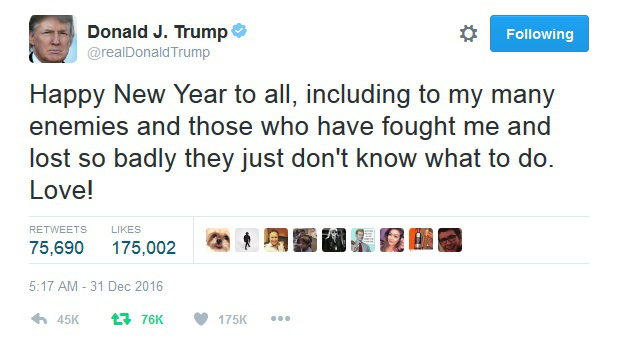
trump-tweet-happy-new-year

It’s hard to know whether to laugh or cry.

The reactions to Donald Trump’s tweet above were so predictable.  Trump-haters are continuing their meltdown, because he used that scary word “enemies,” and imagining political foes being hung by piano wire and shot against a wall…maybe even THE wall. Trump’s fans are cheering, “That’s our guy!” Predictable or not, here is the official Ethics Alarms reaction to what may be Trump’s first tweet destined for the Yale Book of Quotations:

1. Get used to this. He’s not going to stop. I recommend re-reading this post from last year, on the Julie Principle. In fact, heeeeere’s Julie!

2. Oh, let’s get this out of the way: it’s a juvenile, undignified, un-Presidential message, and a deliberately provocative thing to do. It also  made me laugh out loud, I have to admit. Really, if you’re going to let this sort of thing drive you crazy, you’re not going to make it through four years. You’re not even going to make it through one. Reserve a padded room. I’m serious. Think about this song, because this is where you’re headed…

Continue reading

The New York Times, And The Consequences Of Forfeiting Integrity

It was between Janus and the Four Season's song. "Two Faces Have I..."

It was between Janus and the Lou Christie song “Two Faces Have I…”

It would be extremely beneficial for the culture and enlightened civic discourse if there were a trustworthy, reliably objective observer with integrity and intelligence to provide fair, forceful pronouncements on the political controversies of the day. Such an observer would have to be seen as free of partisan and ideological bias, or at least show signs of actively trying to counter their effects. This, of course, is the idealized concept of what competent and ethical journalism is supposed to provide, and to the extent that any journalism organization was deemed capable of providing it, the New York Times was it.

Yesterday, the Times editors published an editorial called “The Stolen Supreme Court Seat” that was so partisan in tone and inflammatory, not to mention ridiculous, in content that it could only be taken as a biased political screed. Worse than that for the long term, however, is that the piece decisively disqualifies the Times as an arbiter of complex national issues whose judgment can ever be trusted as genuine and persuasive.  Many will argue that the Times’ biases have been blatant and unrestrained for many years, and this is true. That New York Times editorial may not be the first smoking gun, but it is the smokiest yet.

Do recall that Ethics Alarms substantially agreed with the Times in its main point that the Republican Senate’s refusal to hold hearings and consider President Obama’s nomination of federal judge Merrick Garland to fill the Supreme Court seat vacated last year with the sudden death of Justice Scalia was unethical:

“For Senate Republicans, holding hearings on President Obama’s qualified and moderate nomination for the Supreme Court is both the ethical course and the politically smart course. It is also in the best interests of the nation. In fact, the Byzantine political maneuverings by the President and the Republican leadership, by turns petty and ingenious, have handed Republicans a political chess victory, if only they are smart enough, responsible enough, and patriotic enough to grab it. Naturally, they aren’t.”

Note: unethical, but not illegal or unconstitutional. By using the inflammatory term “stolen” implying legal wrong doing, the Times intentionally adopted the language of political hacker, and Democratic Party talking points. Strike One: You cannot be trusted as objective and non-partisan when you intentionally endorse partisan rhetoric: Continue reading

The Ethical Christmas Carol

Considering that Christmas is our culture’s ethical holiday, it is remarkable that only one traditional carol—and no modern holiday songs—celebrates ethical conduct. The one carol is “Good King Wenceslas,” and a strange one it is.

The lyrics are by J. M. Neale (1818-66), and were first published in 1853. Neale is a superstar in the Christmas Carol firmament: he also is responsible for the English lyrics of “Good Christian Men, Rejoice,” and “O Come, O Come, Emmanuel,” both of which you hear much more frequently than “Good King Wenceslas.” One reason is that the ethical carol tells a story in ten verses, and if you don’t sing them all, the story doesn’t make sense. There are very few recordings of the song in which all the verses are sung. Ten verses is also a lot to remember for any song. My elementary school used to teach the whole carol to sixth graders for the Christmas assembly, but let them have crib sheets. This was before it was decreed that allowing children to learn, sing and listen to some of the most lovely and memorable songs in Western culture was a form of insidious religious indoctrination.

Here is the whole carol:

Good King Wenceslas looked out
On the feast of Stephen,
When the snow lay round about
Deep and crisp and even;

Brightly shone the moon that night
Though the frost was cruel,
When a poor man came in sight,
Gath’ring winter fuel.

‘Hither, page, and stand by me,
If thou know’st it, telling
Yonder peasant, who is he?
Where and what his dwelling?’

‘Sire, he lives a good league hence,
Underneath the mountain,
Right against the forest fence,
By Saint Agnes’ fountain.’

‘Bring me flesh and bring me wine,
Bring me pine logs hither,
Thou and I will see him dine
When we bear them thither.’

Page and monarch forth they went,
Forth they went together,
Through the rude wind’s wild lament
And the bitter weather.

‘Sire, the night is darker now
And the wind blows stronger;
Fails my heart, I know not how,
I can go no longer.’

‘Mark my footsteps, good my page,
Tread thou in them boldly:
Thou shalt find the winter’s rage
Freeze thy blood less coldly.’

In his master’s steps he trod,
Where the snow lay dinted;
Heat was in the very sod
Which the Saint had printed.

Therefore, Christian men, be sure
Wealth or rank possessing,
Ye who now will bless the poor
Shall yourselves find blessing.

For one thing, “Good King Wenceslas” has little to do with Christmas Day, and doesn’t mention Jesus or the Nativity. The Feast of St. Stephen is also known as Boxing Day, the day after Christmas, December 26. It is a British Commonwealth tradition that never caught on in the U.S. In some European countries like Germany, Poland, the Netherlands and the Nordic countries, the day is celebrated as a Second Christmas Day. Continue reading

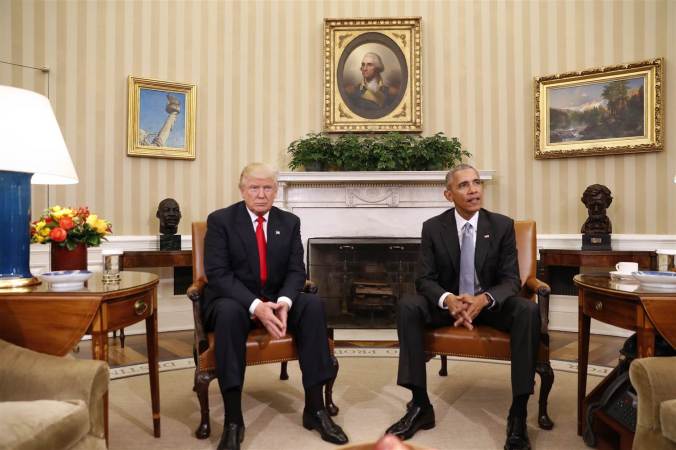
Obama, Trump, And The Avoidable “Two Presidents” Ethical Dilemma

trump-and-obama

Yesterday, Donald Trump sent out not just one but three tweets that directly interfered with current U.S. policy efforts, involving the costs of a new jet fighter plane, nuclear weapons, and a U.N. resolution criticizing Israel. This understandably is causing consternation in the Obama administration, because Trump is exercising influence without authority. Until January 20, 2017, Donald Trump has no official position or authority in the government at all. He does have power and influence, however, because everyone knows that he will have authority very soon.

What constitutes abuse of the power and influence? Should a President Elect be a mute and invisible presence until he is officially sworn in, so as not to interfere with the current President’s discharge of his duties?

For the lame duck Chief Executive, with slightly more than two months left in office and vastly diminished influence, the ethical problem is different. How much should he defer to the incoming President, and not take actions that will seriously interfere with the policy directions the new President  may choose to take? Once the will of the people has been made clear at the ballot box, is it fair and responsible for current President to actively work against the likely agenda of the incoming President?

Finally, if a lame duck President is attempting to undermine the objectives of the incoming President before that President Elect takes office, is it unethical for the President Elect to use his influence and power to stop him, or at least mitigate the damage? Continue reading

Ah! So THAT’S What’s Going On In North Carolina!

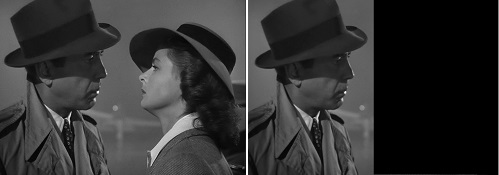
Somehow the story isn't clear without Elsa in the picture, it it?

Somehow the story isn’t clear without Elsa in the picture, it it?

While national Democrats were desperately and embarrassingly search for some way, any way, to overturn the election of Donald Trump, the mania reaching apotheosis in the unhinged rantings of Michael Moore—“Trump is not president until 12 noon on Jan 20th. So we’ll continue to fight & hope to find a legal, nonviolent way to stop this madness,” the “madness” known as “losing an election”—Democrats, news media, and op-ed writers in the New York Times (but I repeat myself) have been loudly condemning the North Carolina Assembly as part of a condemnation of Republicans generally. After narrowly losing the State House, the overwhelmingly Republican legislature has been passing measures to limit the power of the incoming Democratic governor  in a lame-duck legislative session. The changes drastically reduce the number of officials the governor can appoint within state government, require legislative confirmation of Cabinet-level appointments, eliminate partisan majorities in the state board of elections and strip the governor of the power to make appointments to the University of North Carolina Board of Trustees.

This is, according to Slate’s Mark Joseph Stern, for example, a “last-minute power grab” that “marks an alarming departure from basic democratic norms—a blatant attempt to overturn the results of an election by curtailing judicial independence and restructuring the government to seize authority lawfully delegated to the incoming Democratic governor.” By the end, he is foaming at the mouth with indignation:

“What’s happening in North Carolina is not politics as usual. It is an extraordinarily disturbing legislative coup, a flagrant effort to maintain one-party rule by rejecting democratic norms and revoking the will of the voters. It is the kind of thing we might expect to see in Venezuela, not a U.S. state. It should terrify every American citizen who believes in the rule of law. This is so much more than a partisan power grab. This is an attack on democracy itself.”

I was preparing to write something similar, but unlike Stern, I did some research first. What I discovered, however, thanks to the work of Volokh Conspiracy contributor Jonathan Adler, a Case Western law professor, was that as unethical as the General Assembly’s power grab is, the tactic is business as usual in the Tarheel State. Adler points his readers to the research of John Hood, who informs us…

Precisely four times in modern North Carolina history, voters have elected a new governor or lieutenant governor of one party and legislative majorities of the other party. In all four instances, the legislature stripped the newly elected executives of some power.

In the first three instances — Republican Gov. Jim Holshouser’s election in 1972, Republican Gov. Jim Martin’s election in 1984, and Republican Lt. Gov. Jim Gardner’s election in 1988 — a Democratic legislature did the stripping. As Martin’s biographer, I’m most familiar with his experience. Lawmakers limited his ability to staff agencies (including the State Board of Elections), subjected other appointments to constraints or confirmation, and withdrew gubernatorial control over state construction and administrative hearings, among other actions.

In each case, Republicans cried foul. Democrats insisted they were simply carrying out North Carolina’s longstanding preference for legislative supremacy….

Democrats upset with the special session might have been more persuasive had they chosen a different rhetorical strategy. Every time they accused GOP lawmakers of “unprecedented” acts, of “contempt for democracy,” of being “sore losers” and the like, all Republicans heard was hypocrisy. What happened in 2016 was different in detail, but not much in degree, from what happened in the past. A better argument would have been, “Yes, we Democrats went too far when we were in power. It often came back to bite us. Don’t make the same mistake.”

I am all for breaking the cycle. That will inspire greater trust and long-term thinking, from both sides.

That pretty well sums up my position too. Continue reading

The Electoral College’s Day Of Reckoning, Part II: Dunces, Heroes, Villains, And Fools

The failure of the ugly Electoral College revolt scheme that ended yesterday—let’s ignore the coming storm of frivolous lawsuits for now, all right?—with the official, irreversible, like it or lump it victory of Donald Trump over Hillary Clinton also settled some distinctions, some desirable, some not.

  • Ethics Heroes: All of the Republican electors who resisted the harassment, propaganda, intimidation and bad arguments and did their duty, avoiding a crisis and foiling the attempts of Democrats to cheat, which is exactly what the effort to flip the electoral vote was. The faithful electors get bonus points for making so many Democrats and progressives look silly in the process, a fate they richly deserved.

Come to think of it, it was predictable that Democratic appeals to electors would persuade more Democratic electors than Republicans. Which leads us to…

  • Ethics Dunces: A bevy of Hollywood B-listers joined forces in an offensive video that, like Brezenoff’s petition, misrepresented history and the Constitution to gull star-struck electors into defying the public’s will and its trust that their votes would be respected by electors. Led by Martin Sheen, who has no credentials in government or political science but played a wily President on TV, Debra Messing, James Cromwell, B.D. Wong, Noah Wyle, Freda Payne (Quick: who is Freda Payne?), “Better Call Saul’s” Bob Odenkirk, J. Smith Cameron (?), Michael Urie, Moby, superannuated M*A*S*H stars Mike Farrell and Loretta Swit, Richard Schiff, Christine Lahti, Steven Pasquale, Emily Tyra and Talia Balsam tell the electors that they will be following the Founders’ intent by rejecting Donald Trump. This is flatly dishonest, as they are attributing the contrarian position of Alexander Hamilton, who detested popular democracy, to all the Founders, who rejected Hamilton’s proposals on how the government should be elected and structured.

“What is evident is that Donald Trump lacks more than the qualifications to be president. He lacks the necessary stability and clearly the respect for the Constitution of our great nation,” say the celebrities. Obviously it is NOT evident, since Trump’s voters won the day.  The Federalist accurately describes what was behind the video:

“The message is clear: the candidate for whom these celebrities spent months shilling lost the Electoral College, the metric granted ultimate primacy by Article Two of the Constitution. Now, as individuals with no substantial political background, these celebrities have organized en masse to produce content designed to “educate” our electors, chosen for their political pedigree, on their electoral duty. The whole situation reeks of condescension, dirisiveness, and social hubris. What these self-ordained celebrities are demanding is nothing short of the very opposite of what they claim to be purporting. They assert that they “stand with…all citizens of the United States,” yet admittedly only if those citizens agree with their political viewpoint. If said citizens disagree, then, unfortunately, these celebrities decidedly do not stand with them. In fact, they would prefer electors to actively oppose the wishes of these very citizens, so that the candidate they personally believe to be the best suited has a second shot at the presidency.”

That’s about the size of it, yes indeed. Continue reading

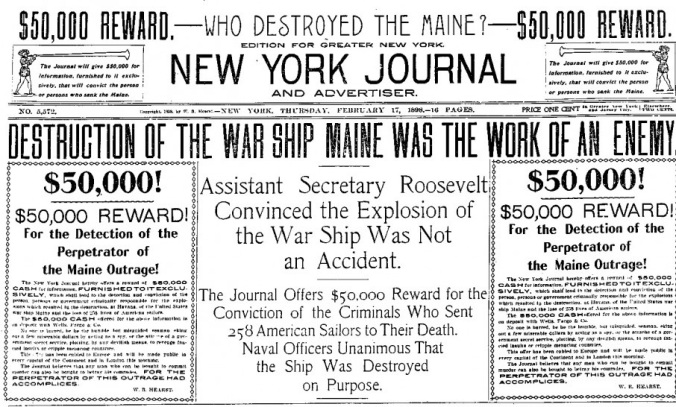
Fake News Update: Fake History, Santa’s Number One Elf, And The Ornery Irishman

maine

Consider this three-headed post an exploration of just how tangled and gray the Fake New Ethics Train Wreck really is.

Let’s start with…

1. The Irishman.

Last week the obituary of Chris Connors was viral on social media. The first part of it read,

Irishman Dies from Stubbornness, Whiskey

Chris Connors died, at age 67, after trying to box his bikini-clad hospice nurse just moments earlier. Ladies man, game slayer, and outlaw Connors told his last inappropriate joke on Friday, December 9, 2016, that which cannot be printed here. Anyone else fighting ALS and stage 4 pancreatic cancer would have gone quietly into the night, but Connors was stark naked drinking Veuve in a house full of friends and family as Al Green played from the speakers. The way he died is just like he lived: he wrote his own rules, he fought authority and he paved his own way. And if you said he couldn’t do it, he would make sure he could…

I instantly liked Chris, as did millions of others. This was published on the obituary site, Legacy.com. People like me sent the obituary  around to friends, thought about it, and talked about it, because it made us feel good. Now there’s someone who did not go gentle into that good night!

Do I have any idea if this obituary is 100% accurate, or accurate at all? No. How often are obituaries fact-checked, if they aren’t written by a reporter? For normal people, like Chris Connors, almost never. Do you care? Do you care in this case? I don’t I am pretty sure that the obituary gives a fair sense of the kind of man Chris Connors was, even if it is hyperbolic, as I assume it was. Nevertheless, the obituary made me feel good, as it was supposed to. Christmas is starting to depress me as the years mount up: too many memories, too many lost loved ones, the sense of time passing too, quickly , of time running out. Chris’s story, which may have been only partially true, was a great, bracing, much-needed slap in the face. He had the right idea, or if he didn’t, whoever wrote his obituary did. Is there any harm anyone can attach to this inspiring farewell? If it was fake news by Facebook’s new standards, does it matter?

2. Santa’s Number One Elf

Continue reading

A President Was Right, The Bunker Hill Indiana Police Are Wrong…And Also Ethics Dunces:

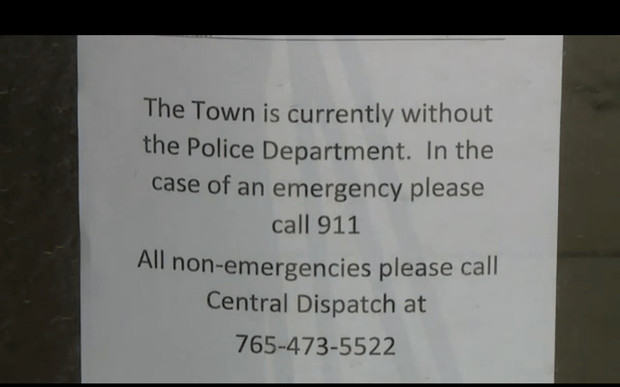
bunker-hill-police-2016-12-14

In Bunker Hill, Indiana, the police department resigned en masse over complaints about mismanagement and alleged unethical requests from the town council.
Town Marshal Michael Thomison submitted his letter of resignation and the resignation letters from his four unpaid deputies during the regular meeting of the town board last week.

Thomison alleged in his “I quit! Write your own damn parking tickets!” letter that the town board asked him to be involved in “illegal, immoral and unethical conduct,” as well as cutting police support and refusing to communicate with the officers. The Bunker Hill town council issued a statement denying the accusations, but it doesn’t matter what the provocation was. The police were in the wrong. This was settled long ago, by a wise man who clarified a bedrock principle of public service. Doing so helped make him President of the United States.

In 1919, as America recovered World War I, prices were rising faster than wages. With soldiers returning from Europe flooding the U.S. labor market, the burgeoning labor movement seized the nation. One-fifth of the country’s workers went on strike that year. New York’s harbor workers, textile workers in Massachusetts,  dressmakers, phone workers, elevated train workers— a general strike in Seattle closed all businesses from February 6 to 11. Some feared a Communist take-over.

The Boston police force was at the end of its forbearance. Starting pay for new officers had not risen in 60 years; police wages were  lower than those of unskilled factory workers. Officers worked seven days a week, with a day off every other week. They could not leave town without special permission. The typical work week for police was between 72 and 98 hours, and officers were required to sleep in the station houses, where conditions were uniformly horrible, with sub-standard sanitation, baths, beds, and toilets.

By June of 1919, with their legitimate grievances unaddressed, the police tried to unionize. The Massachusetts governor and his attorney general put forward legislation to make unionization illegal for public employees. The police responded  by voting 1,134 to 2 in favor of a strike, and scheduled it to start at evening roll call the next day.

On September 9, 1919, the Boston Police Department officers went on strike. Boston descended into lawlessness, with everything from petty crimes to looting and riots, and the  harassment of the striking officers. The mayor and the governor called out the State Guard, with the governor being adamant that there would be no settlement of grievances until the police returned to their jobs. To show he wasn’t bluffing, he eventually had  5,000 State Guards guarding the city with  mobile units using machine guns. His blunt and unequivocal statement made him nationally famous:

“There is no right to strike against the public safety by anybody, anywhere, any time.”

The police strike collapsed. By mid-December, the police commissioner had hired a new police force with higher pay, better working conditions, and additional holidays.

Police didn’t even have to pay for their own uniforms any more.

The next year that stalwart governor was nominated as Vice President on the Republican presidential ticket. By 1921, he was Vice President, and by 1923, President of the United States. His famous pronouncement about strikes against the public safety was one of his least concise statements. He was, of course, Calvin Coolidge.

Silent Cal was right in 1919, and he’s still right. Whatever the provocation and however just their cause, the Bunker Hill police were harming the public when they quit without notice or warning, and violated the public trust.

Meanwhile, Miami County Sheriff Tim Miller says that county deputies will patrol the town and respond to calls until a new police department can be hired.
___________________

Unethical Quote Of The Week: Slate Legal Columnist Dahlia Lithwick and Law Professor David S. Cohen

if you think THAT's a distortion, just try looking as the Golden Rule in the mirror...

If you think THAT’s a distortion, just try looking as the Golden Rule in the mirror…

“If Mr. Trump had lost the Electoral College while winning the popular vote, an army of Republican lawyers would have descended on the courts and local election officials.”

—-Slate Editor Dahlia Lithwick and Drexel University law professor David S. Cohen in a NYT op-ed, “Buck Up, Democrats, and Fight Like Republicans.”

I love this quote! It is a pure example of one of the many invalid Golden Rule permutations that appear on the invaluable Ethics Alarms Rationalizations list under #58. The Golden Rule Mutation, or “I’m all right with it!” Among the blatant rationalizations disguised in Golden Rule cloaks are…

  • Do unto others as you know others would do unto you.
  • Do unto others what they did unto you.
  • Do unto others as you wish others would do unto you even though you wouldn’t deserve it.
  • Do unto others as those others treat others.
  • Do unto others as they threatened to do unto you.
  • Do unto others as others who think like you do would also do to those others.
  • Do unto others according to how you feel about what they did unto you.
  • Do unto others before they do it unto you.
  • Do unto me as you would want to have done unto you if you were as devoid of civilized values as I am.

As for #58, it translates into…

“Do unto others as if the others felt like I do, even though they may not.”

The possible variations are infinite, and every one of them is intellectually dishonest and unethical. It’s astounding, and depressing, that two lawyers, one an alleged analyst and the other a law professor, would endorse such an unethical proposition.  They do it because they are openly partisan and politically biased, and as we all should know by now if you’ve been paying attention here, bias makes you stupid.

The op-ed’s Golden Rule mutation is one I should add to the list, though it’s a bit long:

“Do unto others as you conveniently assume the others would do unto you, even though there is no evidence that they would.” Continue reading

Julia Ioffe’s Vile Tweet: Now The Question Is Whether There Are Any Depths Of Unprofessional Conduct And Unhinged Bias That Disqualify A Journalist [UPDATED]

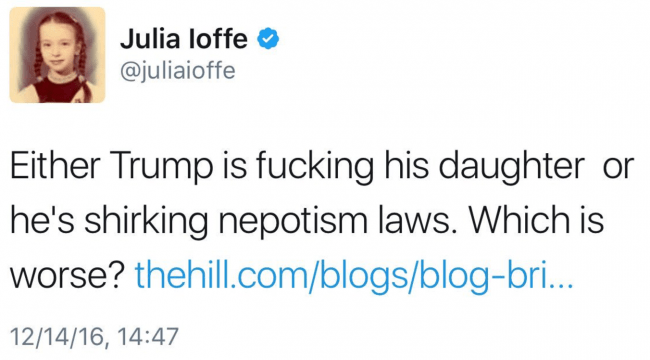
trump-incest-tweet

Julia Ioffe, a columnist at “Foreign Policy” and a contributing writer for “Politico Magazine” was moved to issue the above tweet by accounts that First Daughter Ivanka Trump would serve as First Lady while Melania Trump remained in New York to care for the Trump’s young son . Oh, nice! Keep it classy, news media!

Ioffe now joins John Oliver, Charles Blow, Harry Reid, The View, Harvard Law professor Larry Lessig and others on a growing list of nominees for the 2016 Ethics Alarms Award as the most unsavory passenger on the 2016 Post Election Ethics Train Wreck. The problem is that she isn’t a British comedian, a race-baiting Times columnist, a full-time asshole, a talk show hosted by celebrity ignoramuses, or an especially deluded academic. Ioffe is supposed to be a journalist whose analysis can be trusted, and the vicious character and unrestrained hate that her tweet reveals should disqualify her for that profession. Before Donald Trump—you know, the new President whom the New York Times decreed is exempt from ethical treatment?—such a public statement would have disqualified any journalist and ended her career immediately. This would have happened because journalism organizations once valued not just professional conduct and objectivity but the appearance of it.

The tweet wasn’t just disgusting, it was incompetent, misleading and stupid:

  • The news report has been denied by the Trump transition team, so the alleged journalist was spreading “fake news.”

There have been almost two dozen permanent or temporary First Ladies who had other family relationships with Presidents, including daughters, daughters-in-law, nieces, sisters, cousins, and aunts. Three daughters assumed the First Lady role when their mothers died: Letty Tyler Semple for President Tyler,  Mary Harrison McKee for President Benjamin Harrison, and Margaret Wilson for Woodrow. Oddly, none of them were accused of having sex with their fathers. Margaret Wilson shared First Lady duties with President Wilson’s cousin Helen Bones, who had worked for the first Mrs. Wilson as personal secretary. Thomas Jefferson, Andrew Jackson, Martin Van Buren and Chester Arthur were widowers, so their First Ladies couldn’t be spouses. Jefferson’s daughter Martha Randolph, Jackson’s niece and daughter-in-law Emily Donelson and Sarah Jackson were all First Ladies.  James Buchanan and Grover Cleveland were bachelors when they assumed the presidency,  so Cleveland’s sister Rose Elizabeth served as his First Lady until he married Florence Folsom fifteen months into his administration, and Harriet Lane, Buchanan’s niece, acted as his hostess and was the first Presidential spouse referred to as the “First Lady.” Many other non-spouses served in the capacity for limited amounts of time for reasons comparable to Melania’s conflicts.

In short, Ioffe is ignorant of American history and didn’t know what she was tweeting about, but did so anyway, misleading the public. Continue reading