Well, These Episodes WOULD Have Helped Elect Donald Trump, If He Hadn’t Been Elected Already…

kkk-art

I can’t bring myself to be thankful for the election of a President who has horrified and revolted me for the better part of a decade, but I am thankful that some troubling trends and attitudes in our society and culture have received the metaphorical slap in the face that Trump’s victory delivered. The Ethics Alarms tag “This will help elect Donald Trump” is about to be retired, but when mourning progressives ask you today, while passing the gravy, “Why? Why?”, you should direct them to this link, and this post.  If they don’t help, they are are beyond helping.

Three awful stories surfaced after the election, two of them yesterday, that illustrate the kinds of social dysfunction that have been nurtured in the Obama years, and if a Trump administration can erase them and their ilk, returning some sanity to the national landscape, no one will be able to say the Trump experiment was a total bust…

1. First, and most unforgivable, we have this recent quote from Bernie Sanders’ former spokeswoman, Symone Sanders (no relation). Appearing on CNN yesterday and talking about the future of the shell-shocked Democratic Party, she said in part…

“In my opinion we don’t need white people leading the Democratic party right now.”

On April 6, 1987, Dodger executive Al Campanis appeared on  the ABC News show “Nightline,” and infamously said that black people couldn’t be major league baseball managers. The statement caused an uproar, and Campanis, whom nobody who knew him regarded as a racist, lost his job and career. Symone Sanders’ comment, which like that of Campanis equates the ability to do a job with race, is no less offensive than what Campanis said, but similar sentiments are broadcast frequently from black public figures without widespread obfection or consequence. ( Sanders also said sarcastically this month, after the election, when shown a video of a mob beating up a Trump supporter, “Oh my goodness, poor white people!”)

Acceptable anti-white racism and a bigotry double standard both defy American values, including basic decency, respect and fairness, but there are seldom consequences for shameless bigots like Sanders, except the cumulative one of having the people she and others denigrate for their color and ancestry sticking the human thumb named Donald Trump in their eyes.

It is no more racially biased for white Americans to take offense at the broad negative stereotyping endorsed by Sanders than for black Americans to oppose white supremacists…or clueless passive bigots like Al Campanis. Their anger at being told their skin disqualifies them for any job is justified, and the fact that news media talking heads nod respectfully at racist bile like the comments of Symone Sanders is further justification. (  Ted Koppel’s reaction to Campanis’s jaw-dropping statement 30 years ago can be fairly summarized as, “Wait…what? ) Not happily voting for a political party that embraces individuals who want to marginalize you because of race or gender isn’t bigotry, as the current Bitter Hillary Fan narrative now styles it. It is common sense.

Promoting racial division and bias is unhealthy and un-American no matter what direction it comes from. Until everyone can be certain that the Democratic Party is on board with that concept, and until proud and arrogant racists like Symone Sanders are shown the same level of tolerance Al Campanis received—that is, none—distrust of  progressives and the news media will grow, and should. Continue reading
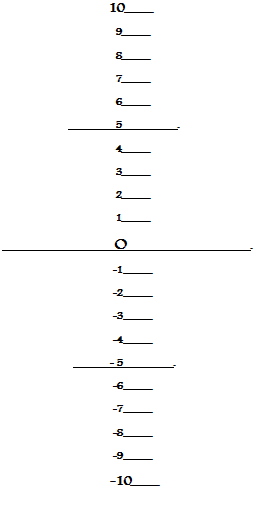
A New Poll Shows That President Elect Trump’s Popularity Is “Soaring”…GOOD!

Yes, it's that cognitive dissonance scale again! See, if the nation and the U.S. Presidency is +10, and a newly elected POTUS was -3 before being elected, what happens?

Yes, it’s that cognitive dissonance scale again! See, if the nation and the U.S. Presidency is +10, and a newly elected POTUS was -3 before being elected, what happens?

Ann Althouse, who blogged about the poll, seemed surprised. “Why do you think this happened?” asks the astute, well-educated, presumably historically informed law professor.

Why? Because that’s the way it’s supposed to work, and that’s the way it has always worked, that’s why. I explained this phenomenon here, to the jeers of skeptics. I also wrote, “Most people don’t understand the Presidency or their own culture,” though I’m a bit surprised that it applies to Ann. In the original post about the vicious attempts on the Left to undermine the new President before he has even taken office, I explained,

“Americans have always realized that the slate is cleared when someone becomes President, and that the individual inherits the office and the legitimacy of that office as it has been built and maintained by it previous occupants. He (no “he or she” yet, sorry: not my fault) becomes the symbol of the nation, the government and its people, a unique amalgam of prime minister, king and flag in human and civilian form. That immediate good will, respect for the Presidency, and forgiveness of all that went before has made the transfer of power in the US the marvel of the world, and has kept the nation from violence and division. It is part of our strength as a society. It is part of the election process, and a vital one.”

Let me quote the Gallup piece I cited before, backing this up:

“In general, the American public rates all new presidents positively — all have received majority approval in their debut ratings — though Obama is clearly near the top of the list. The three presidents who took office after the death or resignation of their predecessors tended to start out with even greater public support, as the nation rallied around the new chief executive in times of crisis. These include Harry Truman in 1945 with an 87% approval rating, Lyndon Johnson with 78% in 1963, and Gerald Ford with 71% in 1974.”

The new POLITICO/Morning Consult poll of registered voters found that 46% of voters now have a very favorable or somewhat favorable opinion of the previously reviled Trump.  Now only 34%  have a very unfavorable opinion of him, with 12% somewhat unfavorable. Continue reading

Flashback: When Even Herb Block Was Gracious To The President Elect He Hated…

herblock-free-shave

I’ve referred to the cartoon above, from 1968, several times here. “Herblock” was a legendary, hard-line Democrat political cartoonist for the Washington Post, and reflected the styles and sensibilities of the old school in his field. Corporations and bankers were always fat guys in top hats and formal wear, “the poor” were always represented by thin, desperate Depression figures in tattered clothing. Liberals were always caricatured as dignified champions and Republicans were usually drawn to look like criminals and maniacs. Herb Block got more extreme as he aged: when Reagan won in 1980, Block drew a cartoon showing cave dwellers carrying clubs and troglodytes riding Mastodons marching into Washington.

He hated Nixon; all liberals did. He was regarded as just short of  Joe McCarthy by liberals, for he had won his House seat by tarring his opponent as a pro-Commie tool, and saved his tenure as Eisenhower’s VP by the infamous “Checkers” speech, as revolting an example of using sentimental hogwash to cloud a scandal as has ever been tried. The country was a tinderbox in 1968. Colleges had been engulfed in demonstrations, strikes and violence for two years. The Democratic National Convention sparked riots in the streets of Chicago. The Vietnam war was raging. Martin Luther King and Bobby Kennedy had both been assassinated. The young idealists who had followed those two liberal icons as well as non-conformist Democratic Senator Gene McCarthy were angry and disillusioned.

In part because of the intemperate “law and order” rhetoric of Nixon’s attack dog running mate, Spiro Agnew, some feared that Nixon’s ascent would mean martial law. Nixon had said that he had a “secret plan” for ending the war, and many thought that plan was to nuke North Vietnam. Ominously, Senator Barry Goldwater, whom Democrats had painted as an atom bomb-happy madman when he had lost to Johnson in the previous election, supported Nixon vigorously. The Republican nominee appealed to the “silent majority” who found the nation’s noisy turn leftward in the Sixties distasteful.

For more than a decade, Block had drawn Nixon as a sinister, menacing presence with an overgrown 5 o’clock shadow. You think I’m exaggerating? Here’s an example… Continue reading

Revelations From The John Oliver Video Post: What I Have Learned

light-bulb PREFACE: I have just returned from a crazy three day odyssey that had me lecturing on Massachusetts legal ethics in Boston, Washington, D.C. legal ethics in the nation’s capital, and, professional ethics, legal ethics and accounting ethics in Tucson, Arizona. Keeping pace with ethics developments was even more difficult than it usually is when I’m on the road, because I had almost no time in between flights, meetings and various hassles to get to a newspaper, surf the web, or watch TV. And my browser kept crashing.

I wrote the John Oliver post, frankly, as low-hanging fruit. His performance was vile and hateful, barely funny, self-indulgent, and disrespectful in a damaging way, and I didn’t think, and still don’t, that there should be much disagreement on that assessment. I expected the usual “lighten up,” “he was only joking “[he was NOT only joking], and “he has right to free speech” comments, because I always get those any time I point out that a comedian has been unfair and irresponsible. I did not expect,for the post to get more single day traffic than all but one previous Ethics Alarms entry, and so many comments, many of which with troubling social and political significance. I returned to my office to find more comments waiting for moderation than have ever been there at one time, and I apologize for that: I try to get them cleared withing hours if not minutes. Of course, a disproportionate number of them were garbled nonsense, or just invective with no point whatsoever. They didn’t make it.

I also had some tough calls, with repetitious comments that misrepresented the post, made irrelevant or factually mistaken assertions, and also were abusive. I fear that I may have been inconsistent, and perhaps less tolerant than usual, and I’m not referring to the occasional comment I allowed to be published just to show the kind of comments that weren’t being posted. The problem is that this site is a intended to be a colloquy, and poor quality comments just make the threads hard to read, and also undermine the site.

I may have to be more ruthless in moderating comments in the future. I’m thinking about it.

Ethics is all about processing new information. Here are some useful things I learned, or re-learned, from the reaction to the post, “Ethics Dunce: HBO’s John Oliver”….

1. Otherwise reasonable, fair, smart people really do think that Donald Trump justifies unethical conduct and that makes it okay. Continue reading

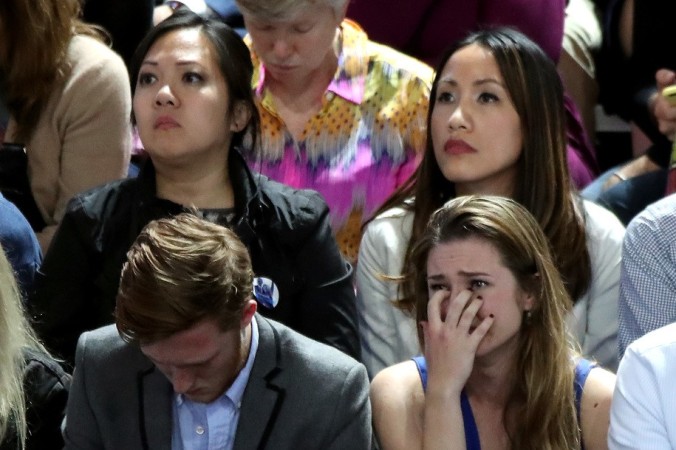
Post-Election Morning Ethics, Early Edition [UPDATED]

hillary-loses

Initial ethics observations following an amazing night in American history:

1. Give Trump a chance, and take note of those who will not.

He is now in the most difficult job in the nation at the age of 70, with less relevant experience and preparation than any previous occupant of the office. For once, it’s a good thing that he’s an egomaniac and a narcissist, because otherwise he might be perseverating in terror right now. One cannot say that he begins with the most daunting set of problems any POTUS has ever faced, but it’s close. Give him a chance. Nobody becomes President wanting to fail, and not wanting to do a good job for his country and his fellow citizens.  Begin with that, and let’s see what happens.

2. Those who are capable of being fair and objective should salute the shades of Mr. Madison, Mr. Jefferson, Mr. Adams, Mr. Hamilton and their colleagues. The Founders wanted a system that was capable of peaceful political upheaval when the public was dissatisfied and demanded change, and their unique creation was strutting its stuff last night. So much has taken place over the last year—the last eight years, really—that has undermined our democracy that it is refreshing to see its resilience and vitality. As before, I still believe that Trump is a cautionary tale about the danger when people who don’t understand leadership, ethics and government become the majority. On the other hand, it’s their country too, and the “elites” (how I detest that word) forgot that, repeatedly, shamelessly, and in many ways.

Jefferson would have reviled Donald Trump, but he would approve of the uprising.

3. Trump’s victory speech last night was widely reviewed as statesmanlike and gracious, which it was. It was also unusually coherent for him. Still, who can’t give a gracious victory speech? The effusive praise being lavished on this shows how low expectations are.

4. Hillary Clinton’s decision to not to appear in person at her headquarters and concede, also graciously, was a failure of character. On CNN, ex-Trump campaign manager Corey Lewandowski and ex-Obama flack Van Jones got in an argument over this, but for once in his life, Lewandowski  was right. Given the backdrop of Clinton and the media questioning whether Trump would “accept defeat,” the decision by Clinton was just plain wrong: unfair to Trump, unfair to her supporters, hypocritical. Continue reading

Halloween Ethics Meets Campus Ethics Meets The First Amendment, And Stupidly, Too

costume-lunching

I didn’t want to write about this, as I am having to defend too many jerks of late,but multiple readers have flagged it, and besides, there hasn’t been a good Halloween costume controversy this year. This one isn’t good, but it will have to do.

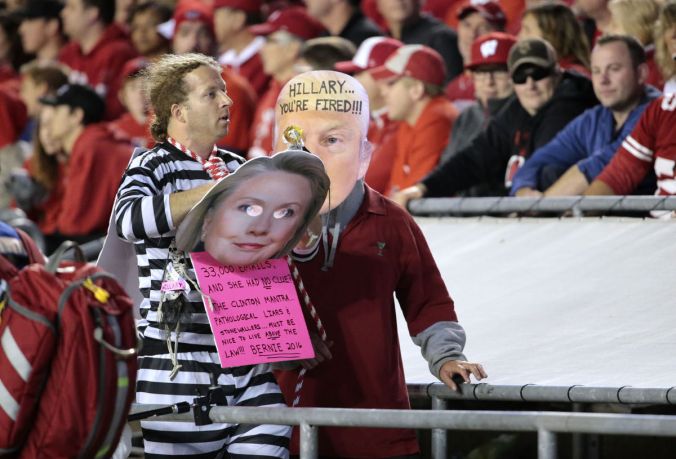
During the University of Wisconsin football home game against Nebraska, one fan in faux prison garb wore a mask of Democratic presidential nominee Hillary Clinton over his face, and a mask of Obama on the back of his head, as another person wearing a mask of Republican nominee Donald Trump held the end of a noose that was looped around the Hillary/Obama individual’s neck.

Key points:

1. It was Halloween weekend. Costumes were not out of place.

2. It was a two person costume, and an incoherent one that would support multiple interpretations. Was it an attack on Trump, accusing him of being racist or wanting to harm Hillary? Was it an endorsement of Trump, arguing that Hillary should be punished? Was it intended to evoke lynching imagery? Was it saying that Hillary was the equivalent of Obama? A sign worn by Hillary/Obama, which nobody who wasn’t close up could read, concluded, “Bernie 2016.”

3. This was unequivocally political speech, whatever it was supposed to mean.

4. The University has some discretion to forbid expression and conduct at a sporting event that risk creating violence or that are objectively uncivil .

5. Anyone who uses lynching imagery in public, in any connection to a back public figure, or any African American at all, is an asshole at best. This is a public event intended to be entertaining and a family-friendly activity. Using it for political theater is obnoxious. The civil place for this costume, if anywhere, was in front of the stadium, on the sidewalk. Continue reading

The Unethical Candidacy Of Evan McMullin

evan_mcmullin_ballot_access_2016-svg

From Wikipedia:

“McMullin will likely not appear on enough ballots to win the necessary Electoral College majority of 270 electoral votes. However, McMullin hopes to deny a majority of the electoral vote from either of the two major party candidates. In such a scenario, under the the terms of the Twelfth Amendment, the House of Representatives would select among the top-three electoral vote winners. McMullin hopes that he could win the presidential election by finishing among the top-three electoral vote winners, and then winning the contingent election in the House.”

Reportedly, Evan McMullin also hopes to some day be able to burrow to China, like a mole, so he can see the terracotta warriors without paying airfare and going through Customs. (All right, I made that up.)

How ridiculous do  a Presidential candidate’s “hopes” have to be before they disqualify him to be President? Whatever the answer is, Evan McMullin has lapped it. Either he is dangerously detached from reality, or he’s exploiting deperate voters by lying to them. On the chart above, only the orange states have McMullin on the ballot. The yellow states allow write-ins, which mean he is on the ballot exactly as I am, or Donald Duck, Batman, and Britney Spears. In the rest, you can’t vote for him at all.

McMullin didn’t even announce his candidacy until August 8. Why the rush, Evan? This is like the joke about Poland’s greatest comedian being asked what the secret to comedy is, and before the question is completed he shouts, “Timing!” Timing is essential to effective leadership too, as the dithering style of Barack Obama has shown in many tragic ways. [I expect him to give an eloquent speech about the dangers of racial distrust and attacks on the rule of law —as, for example, in this fiasco—sometime in 2018. Probably on a golf course.] It was clear to anyone paying attention that the U.S. was going to be stuck with a Donald Trump-Hillary Clinton binary hell-choice by the end of May, when the Libertarian Party demonstrated to the world that it is a joke. Was McMullin not paying attention? That’s a bad sign, don’t you think?

The U.S. Presidency is important, and elections are important. One of the first times I wrote a post critical of Donald Trump was when he first floated the idea of running for President several cycles ago, and it was clear—then— that he was doing it as a publicity stunt.  This was signature significance, I wrote.  Only a massive jerk (I already knew Trump was a massive jerk, of course) with no concern for his country sets out to confuse and confound the easily confused and confounded American voter by throwing random pollution into the Presidential campaign. After the 2000 election, where the twin ego-driven campaigns of Ralph Nader and Pat Buchanan probably changed the identity of the next President by sheer chance, it was obvious that nobody should put themselves on the ballot unless there is a very good reason related to the nation’s welfare. Building a credible third party option over time is a good reason, or can be if the party doesn’t try to do it by nominating an incompetent. Running for President for vanity, or to sell merchandise, or to get speaking gigs, is not a good reason. It is unethical. Continue reading

Sorry, Steve Bartman, But It’s Impossible To Leave You Alone

As the Chicago Cubs plowed their way to the World Series and a possible end to their 108 year failure to win a World Series, numerous sports writers, including some I thought were smart enough to know better, set out to prove their compassion, sensitivity and gooey caramel centers by arguing that the news media and fans should “leave Steve Bartman alone.” Bartman, for those of you who have lived in a bank vault since 2003, was the hapless young Chicago Cubs fan who unintentionally interfered with a foul ball that might have been catchable by Cubs outfielder Moises Alou in the decisive game of 2003 National League Championship Series. In a perfect display of the dangers of moral luck, Bartman’s mistake—it didn’t help that he was wearing earphones and watching the ball rather than the action on the field—began a chain of random events  that constituted a complete collapse by Chicago in that very same half-inning, sending the Miami Marlins and not the Cubs, who had seemed comfortably ahead, to the Series. Bartman, who issued a sincere and pitiful apology, was widely vilified and literally run out of town. He then became part of Cubs and baseball lore, one more chapter in the sad saga has been called “the Billy Goat Curse,” the uncanny inability of this team to win it all.

Over time, even Bartman’s tormenters came to see that holding him responsible for the team’s failure was cruel consequentialism at its worst. Alou, who had sicced the Furies on Bartman by angrily pointing at him after the incident from the field and later told everyone that with the interference, he would have caught the ball, even came out ten years later–five years!—to say that he wouldn’t have caught the ball, and Bartman wasn’t to blame. (I wrote about that epic example of barn-door locking here.) Now, NBC’s Craig Calcattera and many others are beating a new drum: nobody should write about or talk about Stave any more, because it’s so unfair. Continue reading

Why The World Doesn’t Work: The Case Of Jackie Kennedy’s Chef

hustebookThe world doesn’t work, and Ethics is always struggling to avoid losing ground. I collect stories that show why this is. Here is one from the obituary page, the saga of  the departed Annemarie Huste, who was Jacqueline Kennedy’s private chef.

In 1966, the former First Lady moved to New York from Washington, D.C., and in need of a private chef—rich person, you know— hired Huste, a young German immigrant whose previous employer, theater impresario Billy Rose (of “Jumbo” fame!), who had just died, rendering her skills superfluous. Huste did the job to Mrs. Kennedy’s satisfaction,  feeding the occasional hoards of family members who came to visit,  accompanying the Jackie, Caroline and John-John to the Kennedy compound Hyannis Port,  in the summers and playing with the children of JFK.

Then, in 1968, Weight Watchers Magazine approached her about cooperating in a feature called “Jackie Kennedy’s Gourmet Chef Presents Her Weight Watchers Recipes.” Huste dished about Jackie’s diets and dress sizes in the article, never asking for her famous employer’s permission or consent. Jackie Kennedy was horrified, and even tried to stop publication, something the Kennedy family was and is very good at. This time, it didn’t work.

A few weeks later,  Huste gave an interview to Maxine Cheshire, then the “beautiful people” gossip columnist for The Washington Post and syndicated nationally. In return for  inside-the-Kennedy-home details, Cheshire made Huste sound like the coming star of gourmet cookery, hinting that a television show, a cookbook, wealth and fame were just around the corner. What was really around the corner was unemployment: Jackie fired Annemarie Huste, who deserved it. Continue reading

Note To The Over-Forty Crowd: The Obligation To Be Culturally Literate Has No Age Limit, And The Duty To Be Aware Is Forever

ignoranceIn the Washington Post’s weekly crank section “Free For All,” a reader chastised the paper for not quoting more extensively from Bob Dylan’s works in its piece about his Nobel Prize, writing:

“It may come as a shock to the young people who now write and edit the paper, but there are many of us who are not familiar with the lyrics of “popular” music.”

Granted, in respect to Dylan, the complaint makes no sense. “Blowin’ in the Wind” was written in 1963; I’d expect “young people” to be more unfamiliar with Dylan than seniors. How old IS this guy? Still, the letter raised a crucial ethics point related to life competence, an ethical obligation for all of us. Being willfully ignorant of current popular culture is as much of an ethical lapse, and as great a threat to societal cohesion, as young people not bothering to learn about “Moby-Dick,” minstrel shows, Will Rogers, Stephen Foster, Babe Ruth, Charlie Chaplin, Fred Astaire or Lee Harvey Oswald.

In 1987, University of Virginia English professor  E.D. Hirsch wrote “Cultural Literacy,” making the argument that nations require common cultural reference points for generations to communicate with each other. He argued—correctly— that teaching this cultural vocabulary was a primary duty of the schools, in part because cultural literacy is an inextricable element of individual autonomy and power. Since then, the problem of the fracturing of society and the breakdown in communications between segments of the population has worsened considerably, its deterioration propelled by the loss of common information sources and the rise of the internet. Continue reading