Oh, NO!!! “The Mikado” Ethics Again (Political Correctness Division)!

[Here…listen to this while you read the post.]

I am apparently the official protector of Gilbert and Sullivan’s “The Mikado” from ridiculous accusations of ethics offenses, so once again, I will charge into the breach. No thanks needed, Mr. Gilbert, Sir Arthur—I owe you debts that can never be repaid.

In a brain-endangering op-ed for the Seattle Times, expresses the opinion that the operetta is a “racial caricature,” and thus “every snap of the fan was a slap in the face.” The nature of the complaint has old origins: the original show in 1885 nearly caused an international incident, as Japan registered an official complaint to Great Britain claiming a grievous insult to its people. W.S. Gilbert, who was skilled at such things (a few years later he stifled French indignation over a song in “Ruddigore” that pretended to make fun of the French while actually ridiculing British bravado), explained that “The Mikado” in no way ridicules anything about Japan or its people, but is entirely a witty and original satire on everything British. This was true then, and is true now. Then, however, people, including the Victorian era Japanese, were able to see distinctions, and were not seeking victim status and leave to play public censor under the authority conferred by political correctness. Today, people like Ms. Chan are not so easily calmed.

Thus is art harmed, entertainment stifled, laughter stilled and music forgotten. A good argument could be made that “The Mikado” is the greatest musical comedy entertainment ever written.* It certainly caused the biggest international sensation (the closest rival is another Gilbert and Sullivan classic, “H.M.S. Pinafore”): it is estimated that by the end of 1885, at least 150 companies in Europe and the U.S. were producing the satire. As recently as the 1960s, it was credibly claimed that a “Mikado” was going on somewhere in the world every minute of the day.

The show is fun in every respect: comedy, music, lyrics, satire, characters. It is also fun to act in and produce, for children as well as adults. Unfortunately, several factors have led to the gradual scarcity of productions in recent years, from the cyclical (Gilbert and Sullivan go out of style, but always come back) to the ridiculous ( it seems like every production has to cope with some absurd controversy, like the 2011 Montana production that was accused of threatening Sarah Palin’s life). Political correctness aversion has been the biggest factor in making the very best G&S show rare while productions of Broadway musical junk flourish, however. Since the characters are supposedly “Japanese,” shouldn’t all the singers be Asian? Isn’t Asian make-up offensive like blackface? Oh, hell, let’s just do “The Pirates of Penzance.”

From Ms. Chan: Continue reading

Is The President Checking Out A “High Crime or Misdemeanor”?

Toppled-King

Anyone who understands President Obama’s behavior the last few months is invited to step forward, and anyone who has a benign explanation for it need to step in front of him. It is so bizarre and unprecedented that amateurs and professionals alike are offering psychological diagnoses. Has any American leader ever responded to failure, adversity and crisis with this kind of a disgraceful combination of defiance, bitterness, and detachment? I can’t think of any.

It is said that during the darkest days of Watergate, President Nixon sank into depression. Franklin Pierce coped with the stress of watching the Union unravel over slavery by staying smashed as much as possible. Woodrow Wilson’s battles with Congress probably helped provoke the stroke that incapacitated him. None of these are really comparable to the current President sinking to gratuitous campaign mode, calling Republicans derogatory names and impugning their motives and humanity, while openly alternating between obsessive fundraising and vacationing the rest of the time as the world is desperate for American leadership.

Say what you will about Bill Clinton, and I often do, but the man never capitulated, gave up, or stopped battling no matter how much (legitimate) fire he was under during the Monica scandal and his impeachment. At very least, one would think Barack Obama would see the need, as past Presidents have, to model virtues like diligence, responsibility, fortitude, courage, and perseverance for the nation, especially the young.

Nope. Continue reading

The Progressive Clown vs. The Apoplectic Conservative Radio Host On Gaza: Jon Stewart, Funny But Irresponsible…Mark Levin, Uncivil But Right

Jon Stewart’s “Daily Show” riff on the Gaza conflict was praised to the skies by anti-Israel pundits, like MSNBC’s Cenk Uyger and the Daily Beast’s Dean Obeidallah as providing some kind of much needed moral clarity. In truth it was exactly the opposite, with the Obeidallah column unintentionally showing exactly what’s wrong with Jon Stewart.

Knowing that a disturbing number of Millennials (and an even more disturbing number of ignorant, impressionable older viewers who should know better) see the comedian as a truth-teller, Stewart makes no allowances in his comic routines for that fact. He intentionally encourages the idea that he is a legitimate pundit, then retreats to the convenient bunker of “Come on! I’m a comedian! Don’t take me so seriously!” when he is called out for lazy, misleading and biased—but funny! commentary. (Stewart criticizes Democrats with approximately the frequency of a lunar eclipse, which would be just fine for a comedian who didn’t pose as an objective critic of American politics.) Continue reading

Flunking Responsibility, Honesty, Common Sense and Ethics: Gov. Deval Patrick, Sen. Patrick Leahy, Daily Kos, and Anyone Else Who Repeats This Idiotic Analogy

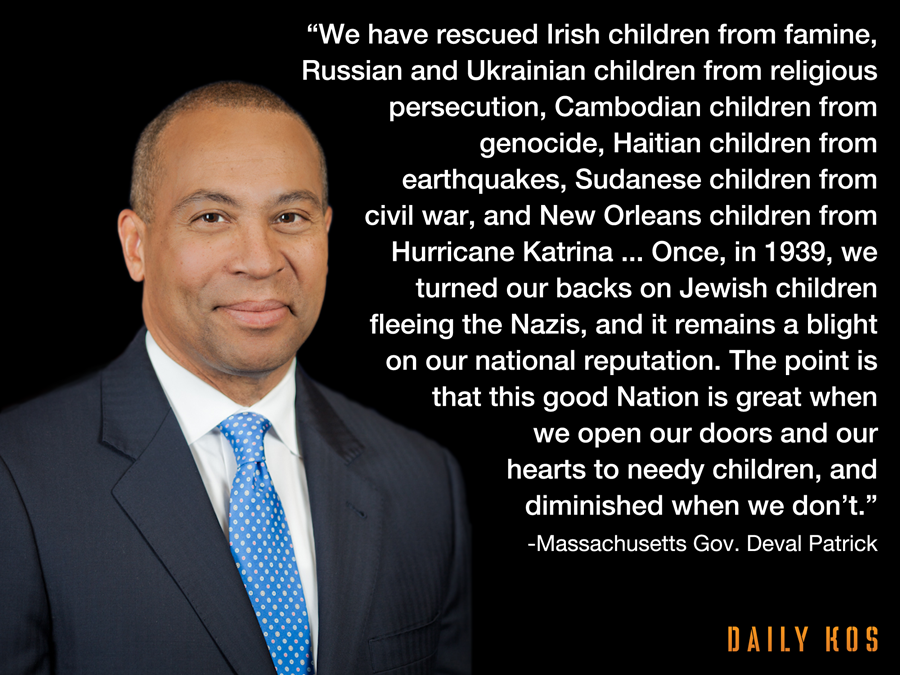
Deval Patrick

I thought I might run an ethics quiz asking whether this current and mind-bogglingly stupid argument that keeps popping up from my sentiment-addled Facebook friends is more unethical than the pro-Hamas hashtags being appended to twitter comments by the “Think of the children!” saps led by celebrities like Jon Stewart, Selena Gomez, and John Cusack. Pondering on it, however, I realized that as ethically misguided as Stewart at al. are, the above quote and its ilk are worse….especially since state governors and U.S. Senators have more credibility than comedians and Disney pop tarts. Not that they should, mind you.

If I really have to make a detailed argument explaining why Deval’s quote and  Leahy’s ( “Think of all those Jews that went to the ovens because we forgot our principles. Let’s not turn our backs now.”) are unforgivably irresponsible, we are just as dim-witted as those demagogues (or, more likely, as dim-witted as they hope and think we are.) The statements are no more nor less than an invitation to every parent of every child in every poor, war-torn, politically foul, culturally poisoned, dangerous, corrupt nation in the world to somehow get them to the U.S. border, paying shady and often treacherous agents to do so, because the United States will not “turn its back,” and turn them back. The question isn’t whether this is a legitimate, responsible or sane position worthy of debate and serious consideration: of course it isn’t. The question is how anyone can think it is. Continue reading

Deconstructing The Unethical “It’s Impossible To Be President Today!” Excuse For President Obama

Presidents since WW II

Chris Cilizza’s latest of several attempts to relieve President Obama of responsibility for his spectacularly incompetent and disastrous presidency is too full of falsities, fallacies, rationalizations and illogical assertions to let pass, as I would dearly love to. Duty calls, however, so here we go. I’m not going to comment on the quoted “terrific” Ron Brownstein piece, which is not essential. Cilizza is in bold, my comments are not….

“Being president is the most powerful job in the world. At which you will almost certainly fail.”

  • First, I must ask, fail at what? Fail at solving problems? Fail at being popular? Fail by leaving the country in worse shape than when the President took office? Fail at leadership, at management, at foreign policy, at vision? Fail at handling crises? Fail by not dealing with long-term problems? By not bothering to define the central concept of his thesis, Cilizza just betrays his ignorance and laziness. If he won’t define his terms, he can’t be challenged.
  • Let me give Mr. Cilizza, who is really, absurdly arguing that succeeding as President is harder now than it has ever been, a brief history lesson focusing on how difficult this job has proved to be for others. George Washington, numero uno, had by far the most difficult job, being President of an unstable, new, confused nation with no precedents for his office, all while being second guessed by some of the most brilliant minds the nation ever produced, who were fighting among themselves to steer the country’s culture and government in radically different directions. He did a superb job, because Washington was a natural leader, perfectly suited for his grand moment in history. The next three Presidents were not, and had a terrible time of it (Jefferson’s reputation was saved by having the Louisiana Territory fall into his lap, but he was no leader, and call me a stickler, but any time a foreign power burns down the White House, I’m calling that President–James Madison—a flop), but James Monroe got the job down, beginning with having Cabinet members–like Daniel Webster–who were smarter than he was and properly delegating and managing them. The job defeated John Quincy Adams, but the next natural leader, gutsy, crazy Andrew Jackson, managed to keep the nation from dissolving over regional differences, and solved potentially disastrous  financial problems, in part because he was able to project strong leadership. Being a killer will do that….

Continue reading

Ethics Quote Of The Week (Crystal Ball Division): Prof. Glenn Reynolds

“Expect this to play out in thumbsucker columns on whether America is ‘ungovernable.'”

Professor Glenn Reynolds, the conservative “Instapundit,” in 2009 commenting on a blog post by Ed Morrissey about growing evidence of President Obama’s deficits in leadership skills and management competence.

I mean, who can do this? It's impos---oh. Right.

I mean, who can do this? It’s impos—oh. Right.

Sure enough, here comes a the Washington Post’s Chris Cillizza, with an offensive, unethical and false column in the Washington Post titled “It’s virtually impossible to be a successful modern president.”

This is a continuation of the six year strategy of the White House and Democrats to argue the ethical value of accountability out of existence. After all, if a job is impossible, you can’t be blamed for failing at it.

If there is any analyst ill-prepared to make such an analysis, it is a journalist, who in most cases, and definitely in the case of Cilliza, have never led or managed anything. Leadership and management challenges always look overwhelming when an amateur is overwhelmed by them.

I have to rush off to a seminar, so I will let you all dissect Cillizza’s pitiable excuses for the President, and return to the topic when I get back.

Moonwalk Ethics: One Small Word

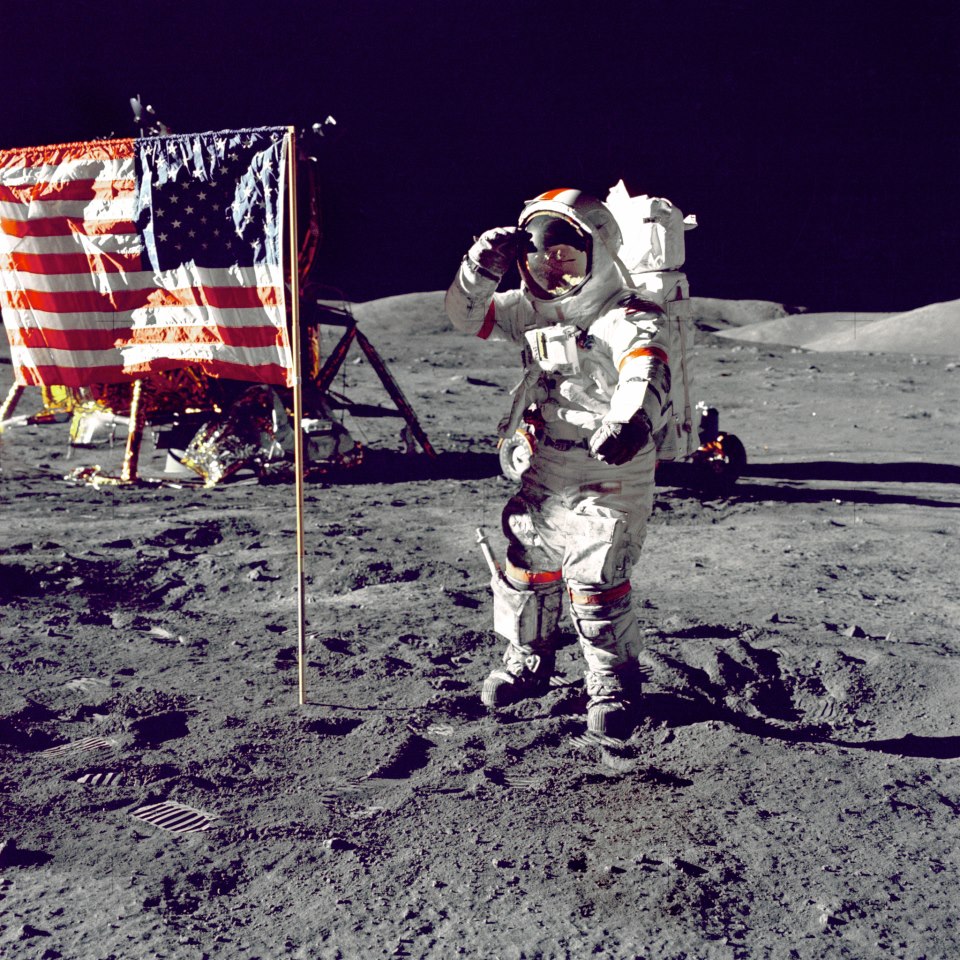
Neil-Armstrong-on-the-Moon-in-1969July 20 will be the 45th anniversary of Neil Armstrong’s first step on the moon, a day of achievement, hope and pride for Americans that seems very long ago and far away in the bleak cynicism of 2014. As I was pondering how to note the landmark in an ethics context, I remembered a section of a post on the Ethics Scoreboard that dealt with the controversy surrounding Armstrong’s famous quote upon placing his foot on the moon’s surface. Here it is, my earliest foray into what has become a frequent theme on Ethics Alarms, “print the legend”  ethics:

“When the legend becomes truth, print the legend.”

This cynical endorsement of our culture’s preference for soothing fantasy over harsh historical truth was the intentionally disturbing message of John Ford’s film, “The Man Who Shot Liberty Valence.” But rejecting Ford’s grizzled old newspaper editor’s warped ethic does not justify the equally objectionable modern practice of using spurious logic to substitute one dubious historical account for another. Even more ethically suspect is the common practice of replacing an accepted, well-supported version of an historical event with a “new improved” version that exists less because of its accuracy than because of its advocates’ biases….

An Australian computer programmer says he has discovered that Neil Armstrong’s first words after he stepped onto the moon in 1969, “One small step for man, one giant leap for mankind” were misquoted by NASA, misheard by millions of listeners around the world, and printed incorrectly in the history books. For decades, wags have criticized Armstrong for botching his iconic moment, since “man” and “mankind” mean the same thing, so the literal meaning of his famous words would be “One small step for man, one giant leap for man.” Armstrong has sometimes grudgingly acknowledged his gaffe and at other times maintained that he thought he included the elusive “a.” He hasn’t fought the consensus verdict very vigorously, as represented by NASA’a transcript:

109:24:48 Armstrong: That’s one small step for (a) man; one giant leap for mankind. (Long Pause)… Continue reading

A Proposed Guide To Spoiler Ethics

"It SINKS??? You spoiled the ending!!!"

“It SINKS??? You spoiled the ending!!!”

I was just admonished on Facebook by a friend (a real friend, not just the Facebook variety), for referencing the end of the last episode of Season One of “Orange is the New Black.”  He hadn’t finished viewing the season yet, and this was a breach of spoiler ethics. Or was it?

Ever since I encountered for real someone who was angry with me for “spoiling” the end of “Thirteen Days,” ( “Yes, World War III started and everybody died”), I have been dubious about spoiler etiquette. The advent of DVDs and Netflix has made this all the more annoying. If I’m in a group of five, and one individual hasn’t kept up with “House of Cards,” are the rest of us obligated to censor our discussion? As a devotee and fanatic devourer of popular culture, I admit that my first instinct is to say, “Keep up, get literate, or pay the price.” If I actually live by that rule, however, I will be a walking, talking, writing, spoiler machine.

Chuck Klosterman, “The Ethicist” in the world of the New York Times, recently pronounced himself an anti-spoiler absolutist:

“I’m an anti-spoiler fascist. I don’t believe that any conversation, review or sardonic tweet about a given TV show is more valuable than protecting an individual’s opportunity to experience the episode itself (and to watch it within the context for which it was designed). I’ve never heard a pro-spoiler argument that wasn’t fundamentally absurd.”

Even Klosterman, however, excepted sporting events (the question posed involved mentioning World Cup scores to a friend who was annoyed that the game had been “spoiled” for him) from his fascism, writing, reasonably:

“I must concede that live, unrehearsed events are not subject to “spoiler” embargoes A live event is a form of breaking news. It’s not just entertainment; it’s the first imprint of living history. …Because this guy is your buddy, you might want to avoid discussing the games’ outcomes out of common courtesy — but not out of any moral obligation. It’s his own responsibility to keep himself in the dark about current events.”

For once I agree with Chuck. But what are reasonable ethics rules for dealing with the other kind of spoiler, involving literature and entertainment?

Luckily, this is not new territory, though it is evolving territory. The underlying ethical principles include fairness, trust, consideration, compassion, and empathy, which means that the Golden Rule is also involved.

Back in 2010, an erudite blogger calling himself The Reading Ape proposed a draft “Guide to Responsible Spoiling.” That blog is defunct; the promised successor is not around, and so far, I haven’t been able to discover who the Ape is. Whoever he is (Oh Aaaaape! Come back, Ape!) , he did a very good job, though some tweeks might  improve his work, especially in light of the emergence of Netflix.  (I have edited it slightly, not substantively…I hope he doesn’t mind, or if he does, that he’s not a big ape.) His approach is to frame the problem as an ethical conflict, in which two competing ethics principles must be balanced. I think that’s right.

Here is his “draft”—what do you think?

“A Brief Guide to Responsible Spoiling”

by The Reading Ape (2010)

The objective is to balance two ethical principles:

I. The Right to Surprise: The inherent right of any viewer or reader to experience the pleasure of not knowing what’s
going to happen next.

II. The Right to Debate: The inherent right of any viewer or reader to engage in public discourse about the content of
a given work of narrative art.

Part 1: When Spoiling is Fair Game

In the following circumstances, one can discuss crucial plot details and reveal endings with a clear conscience. Continue reading

Ethics Hero Emeritus (Independence Day Division): John Dickinson (1732-1808)

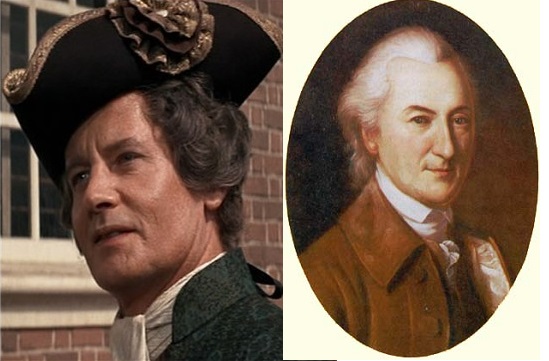
Villainous, singing version on the left; heroic, real life version on the right.

Villainous, singing version on the left; heroic, real life version on the right.

It is the American patriot John Dickinson’s curse that the very strength of character that caused him to stand out among the other Founders and that led them to respect him as much or more than any other also made him the black sheep in the inspiring tale of American independence. This led to relative obscurity. Although Dickinson is honored (along with his wife) by Dickinson College, Dickinson School of Law of the Pennsylvania State University, and University of Delaware’s Dickinson Complex, he is largely unknown to most Americans. He would be even less known, had Peter Stone not chosen to make him the villain of his 1969Tony-winning musical “1776,” where he was portrayed as a conservative loyalist who almost single-handedly foils the efforts of John Adams, Thomas Jefferson and Ben Franklin to declare independence from Great Britain. Whatever that choice’s dramatic virtues, it was unfair to Dickinson in every way.

Raised a Quaker, educated as a lawyer and a farmer by trade, Dickinson began public life in 1760 when he was elected to the Delaware legislature. During the next fifteen years he served both in that body and in the Pennsylvania legislature, a rare dual service made possible because he owned property in both colonies.

When the British Parliament instituted measures in the Colonies to raise revenue and provide for the quartering of British troops, Dickinson was one of the most eloquent and persuasive critics of the Crown, always with the intention of finding a satisfactory negotiated accord that did not involve the threat of armed rebellion. He urged Americans to rely primarily on economic pressure to oppose the hated Stamp Act, and he enlisted the influence of British merchants on the colonists’ behalf. His diplomatic orientation seemed like a prudent antidote to the firebrands calling for revolution in Boston, so the Pennsylvania legislature appointed him to represent that colony at the Stamp Act Congress of 1765. There he advocated the proposition that reconciliation was possible if the King and Parliament would only realize that colonial opposition was in the grand tradition English principles of political liberty. Dickinson set his reasoning to paper in his “Letters from a Farmer in Pennsylvania,” a series of deft essays that brought Dickinson international fame as a man of reason and principle. Continue reading

Ethics Quote Of The Week: Bill Bigelow

FireworksHistory5

“The pretend war of celebratory fireworks thus becomes part of a propaganda campaign that inures us—especially the children among us—to current and future wars half a world away.”

Former teacher and current Howard Zinn disciple Bill Bigelow, in a jaw-dropping screed titled “Rethinking the Fourth of July”

Revolting and hateful right wing radio host Michale Savage authored an appropriately revolting and hateful book titled “Liberalism is a Mental Disorder.” That kind of marginalization of dissenting opinions apes the tactic of recent totalitarian regimes, which often subjected political enemies to forced hospitalization as “insane.” Extreme ideological zealotry that refuses to acknowledge either the good faith or the possible virtues of opposing views is anathema to a functioning democracy, and the fact that we have a toxic amount of such zealotry right now is one of the reason our government isn’t working very well.  Nonetheless, when I read a statement like the quote above, I cannot help but ponder how any rational individual reaches the point where he would think such a sentiment was worth publicizing. I think it is a form of ideology-sparked derangement. That doesn’t mean that liberalism is a mental disorder. It may mean that intense indoctrination in leftist (or conservative) cant leads to progressive derangement.

How does someone come to see the colorful spectacle of fireworks as “pretend war”? The invention of fireworks predated the use of bombs as weapons. They are an art form, and nothing more nor less. All right, they are also fun. (Can’t have that.) Seeing celebratory firework displays as indoctrination requires a paranoid view of one’s country and the world.  Continue reading