Lauren Green, Fox News, and Bickmore’s First Law Of Being Biased

Watch this, if you dare.

I have been using the phrase “Bias makes you stupid” for many years, but only recently learned that a Utah climate-change scientist has claimed the observation as his own. In fact, Barry Bickmore has a lot of useful, perceptive observations among “Bickmore’s Laws” ( Example: Bickmore’s First Law of Being Reasonable Reasonable people understand that good arguments can sometimes lead to false conclusions, and bad arguments can sometimes lead to true conclusions ), though they all were apparently devised to help him debunk the arguments of climates change skeptics. Most of them have general applicability. and that includes his version of what I once called “Marshall’s First Law”: Bickmore’s First Law of Being Biased: Bias makes you human.  Unchecked bias makes you stupid.

Which brings us to Lauren Green, and Fox News.

I have no idea whether Ms. Green is really stupid or not. I do know she is a former beauty queen, and that Fox (other networks too, but Fox is blatant about it) clearly values pulchritude over journalistic acumen and skill when making their on-air talent decisions not involving Y chromosomes. This itself is stupid, unprofessional, sexist, insulting to women, unfair to better journalists with smaller bra cups and courser features, and I must admit, when it leads to an epic live embarrassment such as Green’s, I take some satisfaction that Roger Ailes is getting exactly what he deserves for such a cynical, reckless, ratings ploy.

If Lauren Green is not stupid, then her frantic efforts to play to the core Fox audience’s presumed bias in favor of Christianity of the literal variety and related bias against non-Christians, especially Muslims, sure caused her brain to take a holiday. Or, perhaps, her own unchecked Christian biases—she is Fox’s “religion correspondent” these days—triggered a classic display of Bickmore’s First Law of Being Biased. In either case, I think her credibility is permanently shot, even at Fox. She might want to consider a different line of work. Continue reading
Let’s Be Clear: President Clinton’s Conduct Was WORSE Than Anthony Weiner’s

This won’t make some people happy, but it is true.

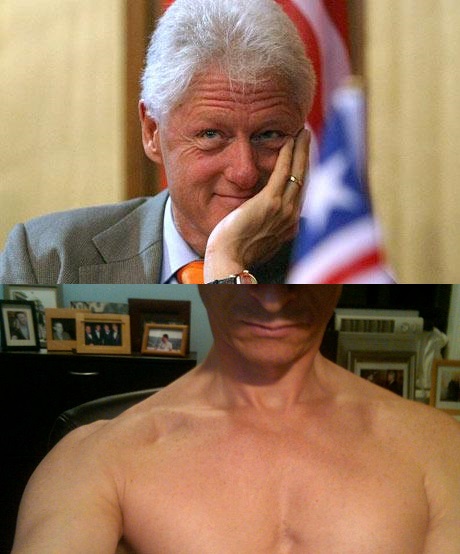
Who's more unethical? It's no contest.

Who’s more unethical? It’s no contest.

I always feel like Michael Corleone at times like these: just when I think I am finally through with having to point out the miserable ethics record of Bill Clinton, he (or his shameless supporters) puuuull me back …

The New York Post is reporting that…

“Bill and Hillary Clinton are angry with efforts by mayoral hopeful Anthony Weiner and his campaign to compare his Internet sexcapades — and his wife Huma Abedin’s incredible forgiveness — to the Clintons’ notorious White House saga…’The Clintons are upset with the comparisons that the Weiners seem to be encouraging — that Huma is ‘standing by her man’ the way Hillary did with Bill, which is not what she in fact did,’ said a top state Democrat…’The Clintons are pissed off that Weiner’s campaign is saying that Huma is just like Hillary,’’ said the source. “How dare they compare Huma with Hillary? Hillary was the first lady. Hillary was a senator. She was secretary of state.'”

My reaction to this?

Good!

Karma’s a bitch. Continue reading

The Strange, Seldom Told Story of Ethics Hero Emeritus, Albert Göring (1895-1966)

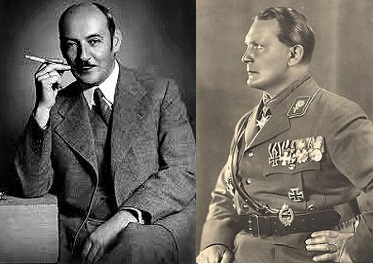
Good brother, Bad brother.

Good brother, Bad brother.

The German and Israeli news media have recounted the exploits of Albert Göring recently , because he is under posthumous consideration for the highest honorary title conferred by the State of Israel, the “Righteous Among the Nations.” These are the heroes of the Holocaust, the brave individuals who risked their lives to foil Hitler’s Ultimate Solution. Since it was created in 1953, the title has been awarded to 24,356 people from 47 countries.

Göring is a strong candidate to join their ranks, for he saved many Jews from extermination during World War II. Honoring him would not be a difficult decision, except for one thing: he was the younger brother of one of Hitler’s vilest henchman, the architect of the death camps and master of the Gestapo, Hermann Göring.

Albert became disillusioned with the Nazis early in their rise to power and moved to Austria, where he frequently spoke out against Hitler and the Third Reich. He would have ended up in prison when the Germans took over Austria, but brother Hermann Goering, Hitler’s designated successor, believed that blood was thicker than genocide: he kept Albert out of the hands of the Gestapo, even though he knew his little brother was an enemy of the state.

Nobody knows exactly how many Jews and non-Jews Albert saved from his brother’s death camps, because Albert Göring himself didn’t know how many the people he helped. Continue reading

Monica Lewinsky Turns 40: The Ethics Train Wreck That Never Stopped

Monica in March

Monica in March

The fiasco of Anthony Weiner’s political “comeback,’ including his wife’s sad Hillary imitation, has naturally conjured up the vile memories of the Lewinsky scandal, and, in turn, Monica herself. Time magazine has a post noting her 40th birthday, and as she does not do interviews, provides a timeline regarding her progress, if you can call it that, since Bill weaseled out of the political coffin of his own making.

Monica’s life reads like a cautionary fable about the perils of allowing oneself to be exploited by a powerful man. She is an expatriot, living in England because her name is a joke in the U.S. She has no husband, children or serious romantic relationship. Unable to find a stable career where her reputation and notoriety isn’t a handicap, she has sunk to repeatedly trying to cash in on her unfortunate celebrity, with a personal handbag line, a documentary, as a host of reality TV show about romantic affairs, and as a Jenny Craig spokesperson, who was dumped because local chains refused to run her ads. Now, desperate for cash, she is said to be shopping a tell-all book about the seamier details of her White House affair.

In short, her life is crap, and Bill Clinton is the reason why. While he is lionized as an elder statesman as if he didn’t disgrace the presidency and permanently lower American expectations of the office, a young, smart, attractive woman who had every reason to expect a bright future at the age of 22, is lost because a powerful man, for selfish reasons, recklessly placed her at risk of being scorched by the fiery heat of  politics and history. Scorched she was, and she has never recovered. Continue reading

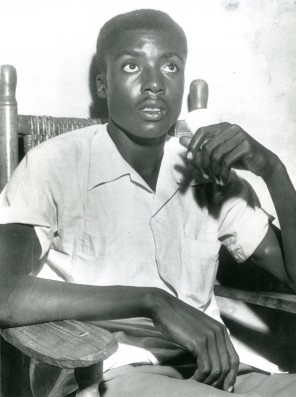
Ethics Hero Emeritus: Willie Reed ( 1937-2013)

Willie Reed

I began the day, to my surprise, with tears in my eyes from reading an obituary on the front page of today’s Washington Post.

The story announced the death of Willie Reed, who as an African American teenager in 1955, risked his life by testifying in a Mississippi court against the white men who had tortured and murdered Emmet Till, another black teenager, for the Jim Crow “crime” of allegedly whistling at a white woman.

The intensity of my emotional reaction surprised me. I think it was the product of being reminded of the horrific tragedy that befell Till and other black citizens at the height of segregation, and being slapped in the face with the reality, known to me but kept deep in the place in my brain where the ugliest things are sealed away to keep me from incurable despair, of the deranged hate that festered so long—and destroyed so many— in the country I love. I was also overcome with admiration and wonder at the almost unimaginable courage of Reed, who knew that by testifying in open court he was simultaneously  guaranteeing that he would be marked for Till’s fate for the rest of his life. Maybe most of all, I wept out of anger at my ignorance and the warped priorities of our culture and educational system, which ensures that we know the names and life stories of insignificant narcissists like Kim Kardashian, embarrassing political leaders like Michele Bachman, greedy athletes like Lance Armstrong, and cynical demagogues like Al Sharpton, but know nothing of the lives and deeds of unglamorous American heroes like Willis Reed. I consider myself an educated man, but I had never heard of him, which means I am not educated enough. I wish I could apologize to Reed. I wish I could shake his hand. I wish I could say, “thank you.” Continue reading

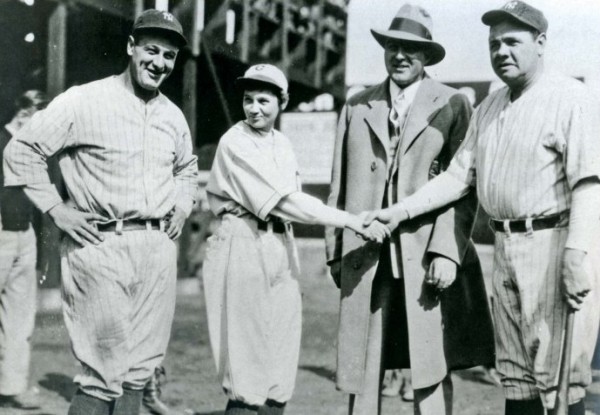
Jackie Mitchell, The Girl Who Struck Out Ruth And Gehrig: A Legend And Ethics Conundrum

jackie-mitchell

The Jackie Mitchell saga is a great, feel-good story ruined by ethics rot. On one level, it is exactly the kind of tale that compels the treatment recommended by the old newspaper editor in John Ford’s “the Man Who Shot Liberty Valence”: “When the legend becomes fact, print the legend.” On another, it is an ethics mess, which might explain why I had never heard of Jackie Mitchell, once a proto-feminist icon, until I cracked open my new issue of Smithsonian Magazine.

Mitchell was a Depression era Chattanooga teenager who had been taught how to pitch by her friend and neighbor, Major League ace Dazzy Vance. A star on local women’s baseball teams, the tomboy southpaw was signed to a pro contract by the promotion-minded owner of a local AA level minor league team, the Lookouts, in 1931. Her big moment came when the New York Yankees came through Chattanooga from Spring Training on the way to opening the season up North. Lookouts owner Joe Engel arranged for two exhibition games against the Bronx Bombers, who, you baseball fans should know, included Babe Ruth and Lou Gehrig. Engel promoted the game as a David and Goliath showdown with Jackie playing David, and he was rewarded with a full stadium. Then this happened: Continue reading

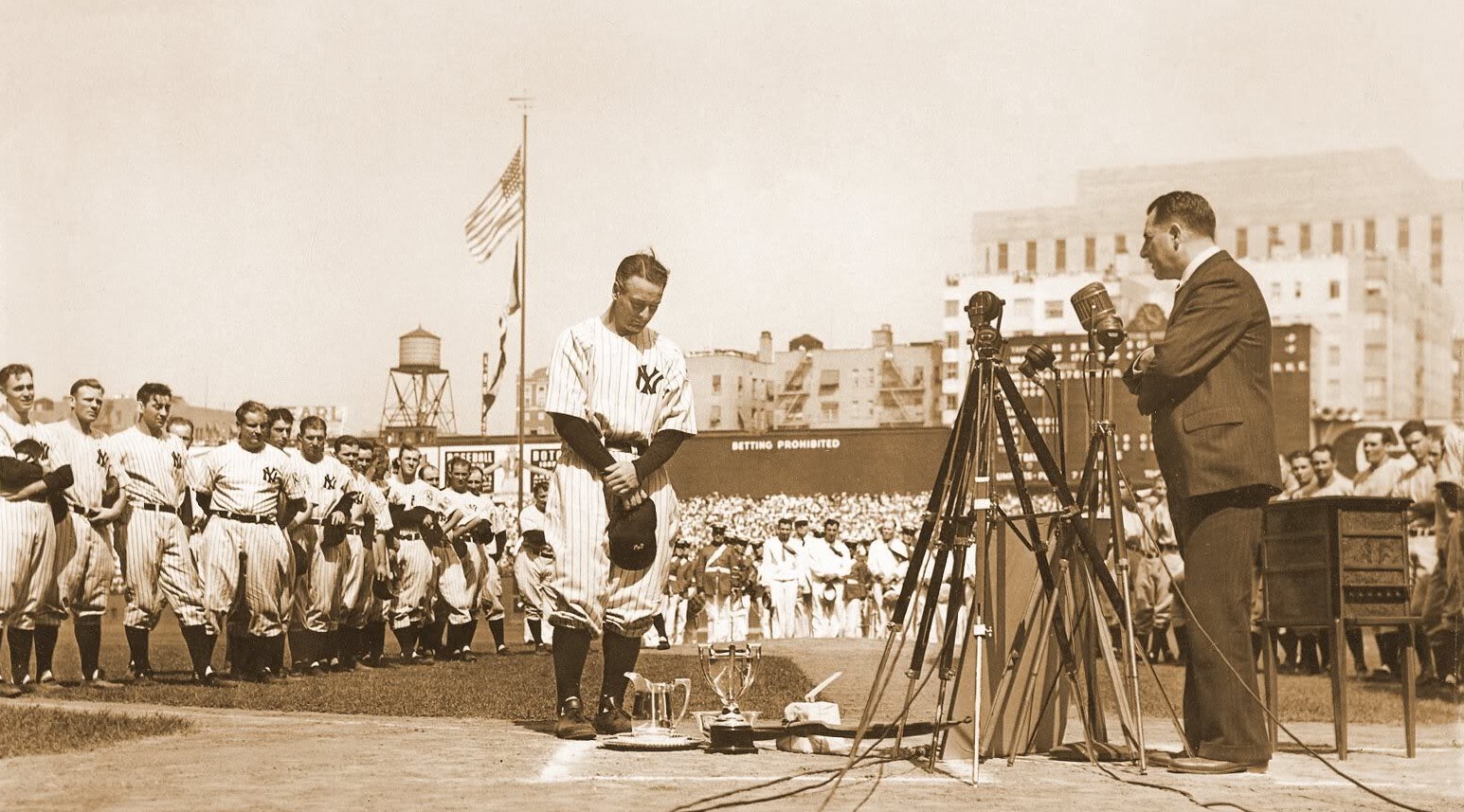
Ethics Quote Of The Day: Lou Gehrig, July 4, 1939

“Fans, for the past two weeks you have been reading about the bad break I got. Yet today I consider myself the luckiest man on the face of this earth.”

—-Baseball great Lou Gehrig, beginning his farewell speech to Yankee fans on July 4, 1939, as they filled Yankee stadium to say farewell to “the Iron Horse,” who was retiring from the game after being diagnosed with the incurable disease, amyotrophic lateral sclerosis (ALS), known forever after as “Lou Gehrig’s Disease.”

Lous Farewell

Lou Gehrig was only 36 years old when he learned that he was dying. ALS is a terrible wasting disease that has no cure, and in 1939 there was little treatment or assistance that could be offered to a victim as his body slowly ceased to function. It is an especially cruel disease for a professional athlete to face, and even more so one, like Gehrig, who was renowned for his endurance and seemingly indestructible body. When the progress of the illness, still then undiagnosed, caused Gehrig to remove himself from the New York Yankees line-up on May 1, 1939, it ended his amazing streak of 2,130 consecutive games, a baseball record that stood until broken by Cal Ripken, 56 years later.

Gehrig’s speech was from his heart. He was an educated and articulate man, but he had not planned on speaking at the moving ceremony to bid him farewell, as current former team mates, some of the greatest players ever to take the field, gathered to pay their respects. But the Yankee Stadium crowd of more than 60,000 began chanting his name, and after initially refusing, Gehrig moved to the microphone. Continue reading

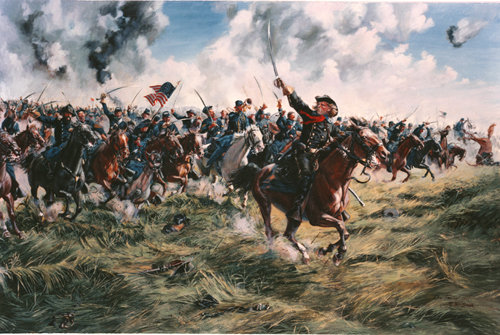
July 3: A Day To Honor Custer’s FIRST Stand, At Gettysburg… And Reflect On How Our Greatest Strengths Can Be Our Fatal Flaws

custercharge

I wrote this post two years ago, concerning my favorite neglected episode of the Civil War, when young George Armstrong Custer shocked Confederate J.E.B. Stuart with his unexpected and furious resistance to Stuart’s attempt at disrupting the Union flank while Gen. Meade’s army defended itself against Pickett’s Charge. As with the First Minnesota’s suicidal stand on the second day of the Battle of Gettysburg, Custer’s crucial moment of truth has been largely neglected in the assembly of the battle’s heroes; I don’t think it has ever been depicted in a Civil War film, for example, though there is at least one book about it.

The incident is especially fascinating to me because of the its multiple ironies. Custer succeeded when his nation needed him most because of the exact same qualities that led him to doom at the Little Big Horn years later. Moreover, this man who for decades was wrongly celebrated in popular culture as an American hero for a shameful botched command that was the culmination of a series of genocidal atrocities actually was an American hero in an earlier, pivotal moment in our history, and almost nobody knows about it.

Thus it is that among the brave soldiers of the Blue and Gray who should be remembered on this 150th anniversary of the greatest battle ever fought on this continent is a figure whose reputation has sunk to the depths, a figure of derision and ridicule, a symbol of America’s mistreatment of its native population. Had George Armstrong Custer perished on July 3, 1863, he might well have become an iconic figure in Gettysburg history. The ethics verdict on a lifetime, however, is never settled until the final heartbeat. His story also commands us to realize this disturbing truth: whether we engage in admirable conduct or wrongful deeds is often less a consequence of our character than of the context in which that character is tested.

Here is the post, slightly lengthened:

July 3, 1863 was the date of Pickett’s Charge, when Confederate General Robert E. Lee ordered a desperate Napoleonic advance against the Union line at Gettysburg in what has come to be a cautionary tale in human bravery and military hubris. The same day marked the zenith of the career of George Armstrong Custer, the head-strong, dashing cavalry officer who would later achieve both martyrdom and infamy as the unwitting architect of the massacre known as Custer’s Last Stand. Continue reading

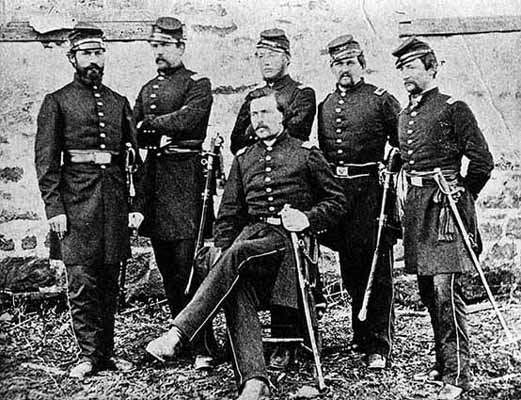
July 2, 1863: When 262 Minnesotans Saved The United States Of America

Officers of the First Minnesota Volunteer Regiment

Officers of the First Minnesota Volunteer Regiment

For the last two years, I have posted here about the courage and sacrifice of the men of the First Minnesota Volunteer Regiment at the Battle of Gettysburg. There was more than enough of those qualities, on both sides, to go around that day, and unless you are in the vicinity of that lovely and unbearably sad little Pennsylvania town, it isn’t just the brave Minnesotans who are neglected, but all of the participants. Yesterday was July 1, the anniversary of the beginning of the battle in 1863, and there was scant mention of it in the media. After all, there is the Zimmerman trial, and outrage over Jennifer Lopez accepting a million dollars to sing “Happy Birthday” for a brutal dictator, and whether movie viewers will flock to see Johnny Depp play Tonto. One of the few excellent acknowledgements of the date and its significance was by CBS, which also featured the famous feature on the battle published years ago by the Saturday Evening Post. 

In an ambitious mood, I once resolved to find a different group of battlefield heroes from that day to feature every July 2, the messiest, most important pivotal of the battle that itself has been overshadowed by the tragedy of suicidal Pickett’s Charge on July 3. But I have neither the historical research skills nor time to do justice to such a task, though the injustice of so many forgotten heroes is great. It is best to allow the First Minnesota Volunteer Regiment, who obeyed a desperate order to fill a breach in the Union line, knowing that it meant almost certain death,  “to gain a few minutes’ time and save the position and probably the battlefield,” to stand for all of them.

As for me, I’m going to watch, once again, Ted Turner’s excellent film Gettysburg, and play its soaring score in my home and my car. We have a duty to remember, and honor, every moment of those three days in July, 150 years ago. Continue reading

Shelby County v. Holder: Inflammatory Rhetoric, Biased Reporting, Irresponsible Hyperbole


The Supreme Court rules that it's not 1965 any more. The Horror....

The Supreme Court rules that it’s not 1965 any more. The Horror….

Sometimes one would think that the left-tilted media and the race-grievance industry is conspiring to divide America. Sometimes, one would be right, and such a time was the disgraceful and misleading reporting of the Supreme Court’s 5-4 ruling in Shelby County v. Holder, followed by apocalyptic and fear-mongering cries of outrage from Democrats, whose characterization of both the decision and its meaning were not just wrong, but dishonest and irresponsible.

The decision did not “gut” the 1965 Voting Rights Act as several news sources stated, nor strike at the “heart” of it, as the New York Times, editorializing in its headline, told readers (quoting Bill and Hillary Clinton), nor  did the Supreme Court “reset” the “voting rights fight,” as USA Today headlined the decision. There is no dispute, or “fight,” over whether minorities should have the right to vote (Really, really unethical headline, USA Today…)  Nor did the ruling “turn back the clock,” as multiple critics claimed. The latter was an especially Orwellian description, given that what the decision really did was insist that a clock that had been stopped for 40 years finally be set to reflect the passage of time. Continue reading