Comment of the Day: “Ethics Quiz: Peeps Ethics”

Peeps Last Supper by Leonardo DiPeepchi

Peeps Last Supper by Leonardo DiPeepchi

Extradimensional Cephalopod’s thoughtful answer to today’s ethics quiz was instantly recognizable as a Comment of the Day, so here it is, EC’s musings on the ethical limits on peeps art, as posed by the post, Ethics Quiz: Peeps Ethics:

Full disclosure: I identify as a freethinker, which in my case means my opinions are informed by this idea: “It is the mark of an educated mind to be able to entertain a thought without accepting it.” –Aristotle (or so the Internet tells me)

With that in mind, offhand I’d say anyone who can’t handle the juxtaposition of a serious scene with a cutesy or comical medium is not emotionally mature enough to be trusted to react appropriately in today’s complex and nuanced culture, and their reverence is likely to be taken to unhealthy levels. I think it is not only ethical, but a requirement for intellectual health to be able to entertain different perspectives and styles of presenting even the most serious subjects. Before someone asks, yes, that includes depictions of the prophet Muhammad, along with all other historical figures on pedestals. I think taboos are unhealthy for a society because they limit critical thinking and creative free thought, both of which are necessary (yet seldom employed) to resolve social issues and differences in perspective.

Bad taste is still a valid concept, but it is context-dependent. It is possible that a subject is not appropriate for most contexts because it leads people to feel bad, but it is imperative that there be some place where it can be discussed, even if it is only under the Jester’s Privilege. My subjective judgment rules that depicting the Civil Rights Movement with marshmallows in this case is not intended with disrespect: the contest stipulated that the medium be marshmallows, and the artist chose a powerful scene without regard for the medium, as is the artist’s prerogative. I personally think the marshmallow scene is quite dignified, but then I am a bit out of sync with humanity as to what I take at face value and what I don’t. I form opinions of peeps by their actions, not by their countenance. It’s unethical for an artist to deliberately spread misconceptions about history, and it may be unethical for an artist to deliberately show disrespect to powerful agents of good. Disrespect is usually unethical because it causes so many problems. However, I’m not sure a sincerely respectful artist can be unethical in their art, unless they simply fail to do the research on the facts they depict and the cultural context for showing respect.

If depicting scenes from the Civil Rights Movement with marshmallows (and putting a good deal of effort into it) is wrong, though, what else is wrong? Crayon drawings by kids? Macaroni? Charcoal? Embroidery? Spray paint? Etch-A-Sketch? Is anything that looks insufficiently grandiose for depicting humanity’s legendary heroes an affront upon their memories? Are scenes of historical importance off-limits to mediocre artists, for fear the general public will lose respect for heroes drawn with funny expressions and ridiculous poses? What if an artist is deliberately depicting a heroic person comically, but without telling lies? Why can’t we be mature, and tell the history with respect while artists do their best in sincerity or spite? Why not simply say, “Well, it’s nice, but it really doesn’t do it justice,” and walk away?


Continue reading →

Ethics Quiz: Peeps Ethics

peeps winner

I collect sentences that can safely be said to have never been uttered before in the history of mankind, and encountered one this morning in a letter of complaint to the Washington Post. It read…

“To take a sacred and historic event in our nation’s history and depict it using marshmallow candy is highly insulting and offensive to the legacy of the Rev. Martin Luther King Jr. and to all those who worked, and continue to work, for racial justice in this country.”

Like all of the sentences in my collection, my favorite being my sister’s immortal, “That fish looks so good, from now on I think I’ll wear my bra on my head,” this one requires some context. The Post holds an annual contest for its readers around Easter, challenging them to submit the best diorama of a scene, using marshmallow peeps. This year’s winner was created by Matthew McFeeley, Mary Clare Peate, and Alex Baker, and involved meticulously painting the colorful bunny stand-ins for King and his throng  at the 1963 March on Washingtonian eight shades of gray to evoke the black-and-white photographs of the event.

Your Ethics Alarms Ethics Quiz, in the sadly neglected field of peeps ethics, is…

Is it unethical to use marshmallow candy as a medium to portray serious, solemn, or other events that many feel deserve respect and reverence?

I know my answer, but this time, I’ll hold my fire until I hear from readers. I’d also be interested in whether any events—Gettysburg…JFK’s assassination…the Lindbergh baby kidnapping…the Crucifixion…Pearl Harbor…9-11…  are ethically off-limits for peeps creativity as inherently offensive, or if this is just  an unappetizing mixture of “ick,” art, humor, and candy.

Comment of the Day: “Comment of the Day: ‘An Unethical Website, Golden Rule Malpractice And The Worst Anti-Bullying Program Ever'”

Atom bomb cloud

Responding to according2grayson’s passionate defense of non-violence and the Golden Rule while encountering bullies (as well as while opposing despots on the march), Steve-O-in-NJ enriched Ethics Alarms with an epic response including historical perspective, ethics and personal experience.

Here is his terrific post—long but not to be missed—and the Comment of the Day, on Comment of the Day: “An Unethical Website, Golden Rule Malpractice And The Worst Anti-Bullying Program Ever”:

I question this litany of life experiences, since it sounds a bit too pat and a bit too neat to be real, or at least it sounds sanitized/incomplete. Those with truly outstanding records usually don’t feel the need to trumpet them. That said, I wasn’t there, so maybe it is all true.

I know I tried the non-violent approach a few times, and it just lead to more bullying. I also tried the fight-back approach, smashing one bully’s head against the sidewalk and nearly strangling another, and it frankly didn’t get much more done beyond getting the bullies off my back temporarily. That said, a temporary respite from abuse is better than absorbing abuse every day without a respite. What really broke one group of problem people was a combination of finally going to the authorities and the people overreaching.Despite the justified criticism of Catholic schools (a whole separate discussion), they did have one very big thing going for them: no one who was enrolled had to be, or had any right to be, and dismissal or necessary discipline was easily accomplished. Continue reading →

April 19, 1943: The Warsaw Ghetto Uprising

Warsaw uprising

A fortuitous confluence of events, dates and topics: following yesterday’s discussion of an absurd and passive application of a warped “love your enemy” approach to school bullying and the week’s earlier explication of the importance of using Nazi comparisons when they are appropriate as well as the problems arising from the rampant historical ignorance and apathy in the U.S, we arrive at April 19. I doubt that one citizen in a thousand could identify or explain the significance of today’s date in world history, but we all should; it is the essence of our duty to remember. For on this date in 1943, the residents of the Warsaw ghetto in Poland, realizing that they were in the process of being liquidated, fought back against their Nazi captors, and for almost a month, despite being outnumbered and outgunned, disrupted the extermination and, though they were ultimately defeated (most of the leaders committed suicide with cyanide as the Germans began to round them up), their courage sparked other uprisings in the ghettos in Bialystok and Minsk, and the Treblinka and Sobibor death camps.

The Germans had planned to begin the final elimination of the Warsaw Jews on the eve of Passover, so the anniversary of the beginning of the revolt is perfectly placed. Make sure you quiz the Palestinian cause fan in your life regarding the Warsaw ghetto revolt, and see if it rings any bells—it probably won’t. Learning the history may help you explain to them why the state of Israel will make no deals until the nation’s right to exist is acknowledged and unequivocal.

They, and you, can read about the Warsaw ghetto uprising here.

More On The Dangers Of Godwin’s Law


Mike Godwin

Mike Godwin

In correctly diagnosing the Obama Administration’s and the Democratic Party’s continued use of the misleading “77 cents” statistic, I rejected the application of Godwin’s Law as a bar to the evocation of the Big Lie’s most accomplished practitioners and champions, Hitler and Goebbels. I want to expand a bit on what I wrote explaining why.

Godwin’s Law, to begin with, began as a joke. An early Usenet moderator (and attorney) named Mike Godwin coined the “rule” in 1990 as a tongue-in-cheek  method to detect when internet debates had gone on too long, stating that  “if you mention Adolf Hitler or Nazis within a discussion thread, you’ve automatically ended whatever discussion you were taking part in.” The Wikipedia entry, based on the original “law” posted by Godwin, says that “As an online discussion grows longer, the probability of a comparison involving Nazis or Hitler approaches —​ that is, if an online discussion (regardless of topic or scope) goes on long enough, sooner or later someone will compare someone or something to Hitler or Nazism.”

In the ensuing years, Godwin’s Law has been cited, but seriously, as a genuine discourse limitation; that it is somehow taboo to raise the Nazis or Hitler as comparisons or references in any serious debate, online or off. It is even cited as an absolute, frequently by people who haven’t given a second’s thought to why there should be such a “law.” This, of course, is classic morality reasoning. You can’t mention Hitler because an authority, “Godwin,” has decreed otherwise, and you blindly follow because, well, he says it’s right, so it is. I have wondered if anyone would take Godwin’s Law seriously if his name had been Mike Snotwelder, or something similar. Continue reading →

The Cruelest Month And The Duty To Remember

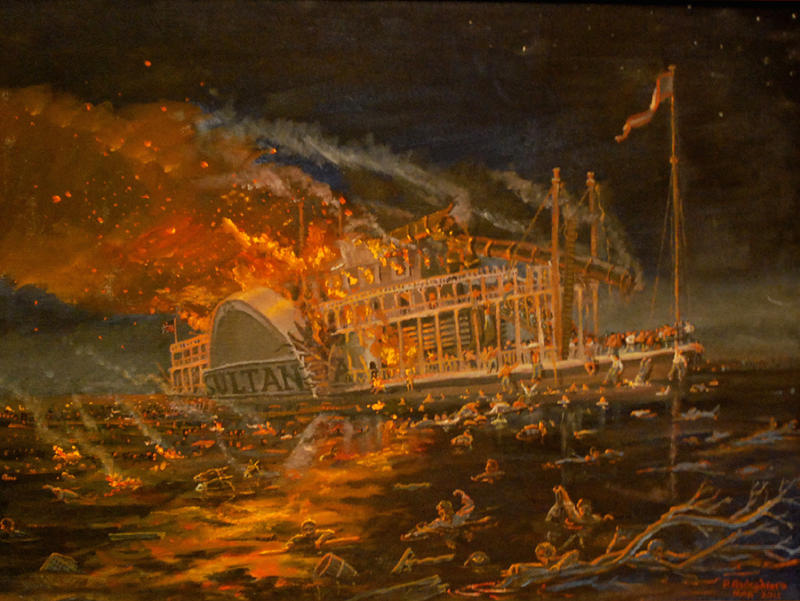
sultana-ablaze

If we have the education, curiosity, perspective and respect for our origins and those who have gone before us, the calendar is a source of constant reminders of what matters in life, and how we can be better citizens and human beings. It is a common belief among Millennials, and a lot of older Americans too, that history is irrelevant to their lives, and this is both a fallacy and a self-inflicted handicap. Not that keeping history in mind is easy: in this month, which T.S. Elliot dubbed “the cruelest,” paying appropriate respect by remembering is especially difficult.

Still, respecting history is our duty. It won’t be remembered, perhaps, but in April, 2012, a 23-year-old drunken fool named Daniel Athens was arrested for climbing over a barrier to urinate on a wall at the Alamo. Monday, a Texas judge threw the book at him, sentencing him to 18 months in state prison for vandalizing a National Monument and a shrine. The sentence seems extreme, and is a good example of how the law is a blunt weapon with which to enforce ethics. The Alamo has near religious significance in Texas, brave men died there, and the ruins serve as a symbol of critical virtues like loyalty, sacrifice, dedication, courage and patriotism. Athens, himself a Texan, defiled the memory of the fallen and symbolically rejected the values and heritage of his community and fellow citizens. Unfortunately, the harshness of the sentence will create sympathy for him: 18 months for peeing? But how else does a culture reinforce the importance of respect for the past? I don’t have an answer. Perhaps I would have sentenced him to take an exam on the lives of Travis, Crockett, Bowie, Seguin and the rest, as well as the siege itself, and imposed the jail term only if he flunked.

Yesterday, Major League Baseball celebrated the heroism and transformative life of Jackie Robinson, who broke baseball’s color barrier on April 15, 1947 by becoming baseball’s first black player, setting in motion powerful forces that propelled the cause of civil rights. Every player wore Robinson’s now retired uniform number 42, and there were commemorative ceremonies in the ball parks where it wasn’t too cold and wet to play ball. This remembrance had a difficult time competing with tax day, as history usually does when our immediate life concerns beckon.

Other important historical events deserving reflection, however, were more or less ignored entirely, for April 15 is a historically awful day: Continue reading →

To Hell With Godwin’s Law: As The Cynical “GOP War On Women” Strategy Officially Adopts “Big Lie” Tactics, Who Will Have The Integrity To Call It What It Is?

Sometimes recalling Der Fuhrer is necessary to give credit where credit is due.

Sorry. Sometimes recalling Der Fuhrer is necessary to give credit where credit is due.

One thing one can’t deny about the “Big Lie,” it sure works.

An H. F. Elson from Bethesda, Maryland indignantly writes the editor of the Washington Post:

“The April 10 news article “Senate Republicans block wage-equality legislation” reported that Republicans “say that the bill is unnecessary because discrimination based on gender is already illegal.” Pardon my sarcasm, but existing laws have worked really well, haven’t they? Republicans fear the bill would increase civil lawsuits, but the threat of lawsuits is the only way to get these needed changes in compensation made. When are Republicans going to stop antagonizing thinking, intelligent women?”

Let’s see…it’s hard to write such an incompetent and irresponsible letter while simultaneously being snotty about it, but H.F. was up to the challenge:

1. Discrimination based on gender IS already illegal. The law in question was Democratic showboating with a bad bill that would permit lawsuits when no evidence of intentional gender discrimination exists.

2. Yes, H.F., the existing laws have worked very well indeed. The remaining differences in pay by gender are almost entirely due to factors other than discrimination.

3. The only way to get the changes made in compensation would be for women to behave exactly like men, and adopt the same priorities and career paths. Lawsuits, on the other hand, are just a way to increase the costs of doing business, lose jobs, and give more money to trial lawyers—who are overwhelmingly male, by the way.

4. “When are Republicans going to stop antagonizing thinking, intelligent women?”  The real question is when will “thinking, intelligent women” stop accepting on faith outright misrepresentations about gender pay inequities, and do some research before adopting partisan talking points and writing snotty letters to the editor?

There are virtually no serious analysts of this topic that accept the proposition that “women get paid only 77 cents on the dollar compared to men in the same jobs” as an accurate measure of discrimination in the workplace and gender inequity. The misleading nature of that statistic and similar ones has been thoroughly explained and vetted in scholarly documents and the news media for decades, yet whenever Democrats want to activate their “base,” which includes a disproportionate number of women, their candidates and leaders shamelessly use the same dishonest figures. Obama and Biden used this tactic during the 2012 sliming of Mitt Romney, for example, because, after all, the ends justify the means, and besides, mean old Romney kept all those poor women in binders.

I just about fell off of my chair when President Obama sank to this abysmal deceit again in his 2014 State of the Union message, when he intoned, Continue reading →

Ethics Observations On “The Kissing Congressman” Scandal


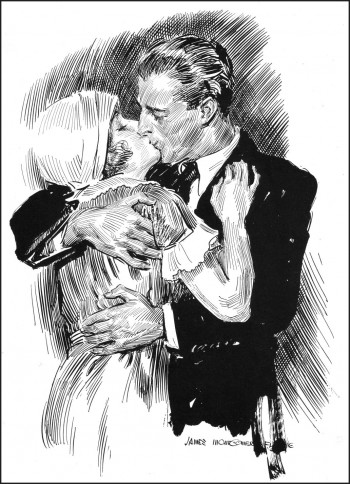
Passionate Kiss

Rep. Vance McAllister (R-La), a married freshman Republican congressman who campaigned by proclaiming his Christian, pro-family values, was seen  on leaked surveillance video from his district office embracing and kissing the Congressman’s 33-year-old  scheduler, also married, Melissa Anne Hixon Peacock.  McAllister apologized, saying

“There’s no doubt I’ve fallen short and I’m asking for forgiveness. I’m asking for forgiveness from God, my wife, my kids, my staff, and my constituents who elected me to serve. Trust is something I know has to be earned whether you’re a husband, a father, or a congressman. I promise to do everything I can to earn back the trust of everyone I’ve disappointed. From day one, I’ve always tried to be an honest man. I ran for Congress to make a difference and not to just be another politician. I don’t want to make a political statement on this, I would just simply like to say that I’m very sorry for what I’ve done.”

Meanwhile, Mrs. Peacock has been dismissed from her job, and reportedly her marriage is shattered.

Some ethics observations: Continue reading →

The Ethics Alarms List of Debate Cheats and Fallacies

fallacy

I realized it was time to post the definitive Ethics Alarms List of Debate Cheats and Fallacies after once again having to point out to an indignant commenter that calling  him a jerk based on a jerkish comment was not an ad hominem attack, and that saying idiotic things on-line carry that risk. Here, at last, is the current list, adapted from multiple sources. As with the Rationalizations List, with which this occasionally overlaps, I invite additions. Participants here should feel free to refer to the various fallacious arguments by number, and to apply critically them to my posts as well as the comments of others. Am I immune from occasionally falling into one or more of these bad debate techniques and rhetorical habits? No. The other reason I wanted to get the list up was to reinforce my own efforts to be persuasive without being manipulative.

1. Ad Hominem Attack

An ad hominem attack means that one is substituting the character or quality of an adversary’s thought for the argument the adversary is presenting. This is unfair, as well as misleading. “Your argument is invalid because you are a crook, a fool, an idiot” is an ad hominem attack. It is not an ad hominem attack to prove an argument idiotic, and conclude, on the basis of signature significance, (which requires that an  argument be so idiotic that no non-idiot would conceive such a thing and dare express it),that the one making the argument is an idiot, since only an idiot would make such an argument. Confusing the true ad hominem attack with the latter is a useful deflection by poor advocates of the fair consequence of their advocacy. Idiots can still hold valid positions, and disproving the position has nothing to do with proving they are idiots.

1 a. The Toxic Introduction.

A more subtle application of the ad hominem attack is The Toxic Introduction, where the argument of another is introduced by noting a negative quality about the individual. The effect is to undermine the argument before it has even been heard, by its association with a less than impressive advocate.

2. Butch’s Stratagem (The Straw Man)

Continue reading →

Ethics Dunce: Belmont Law School

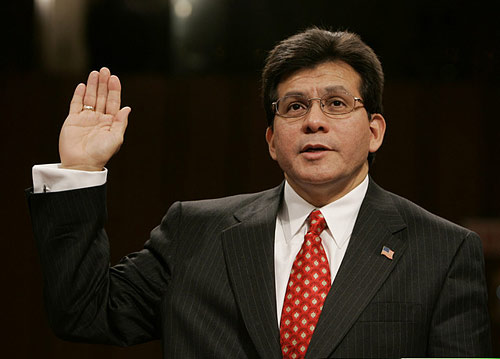
Gonzalez

Belmont Law School, in Tennessee, has appointed former Bush Attorney General Alberto Gonzalez as its new dean.

Unbelievable.

Here is law professor/blogger Jonathan Turley’s reaction, in part. I concur completely, and cannot improve on it:

“Gonzales is widely blamed for politicizing the Justice Department, destroying its credibility, appointing substandard officials, and turning a blind eye to egregious violations like the torture and surveillance programs. …For many, this appointment looks like a provisional law school accepting an equally provisional lawyer as dean. Gonzales will not help the law school’s reputation. The school defines itself as “Belmont University is a student-centered Christian community providing an academically challenging education that empowers men and women of diverse backgrounds to engage and transform the world with disciplined intelligence, compassion, courage and faith.” Gonzales has declared that he is committed “to make Belmont the greatest law school that it can be.” Given the fact that Gonzales took a department with a stellar reputation and devastated both its professionalism and reputation, that statement is rather chilling.”

If that weren’t enough, the appointment also means that there is now a precedent for appointing Eric Holder as a law school dean some day.