The Ethically Messy, Legally Muddled, Drone Killing of Anwar al-Awlaki

Ah, those were the good old days: when warfare was simple, fair, brutal and stupid!

The C.I.A. drone killing of Anwar al-Awlaki, an American citizen who was also an Al Qaeda leader, is raising multiple ethical controversies that pollute each other,  making ethical coherence all but impossible.

The issues:

  • The target was an American citizen. Whatever his crimes, shouldn’t he have the right to a trial before being summarily executed?
  • There is no conclusive proof that he actually did anything that resulted in violence against Americans, or posed an imminent threat to national security. Was he targeted for his words, rather than his conduct? How can it be legal or ethical for the U.S. to target a citizen for death because of his political views?
  • The United States has officially forsworn assassination as a military or intelligence tactic. Yet this appears to have been one.
  •   Yemen is not a field of combat, and there was no imminent threat to human life creating an exigency to require U.S. forces to target someone there, whether he was a citizen or not.

Last Meal Ethics

Sure, the dinner was great, but the after-dinner entertainment was terrible...

The dragging-death killer of James Byrd, Lawrence Russell Brewer, went to his Texas execution last week after ordering up a true pig-out for his last meal: two chicken fried steaks smothered in gravy with sliced onions; a triple meat bacon cheeseburger with fixings on the side; a cheese omelet with ground beef, tomatoes, onions, bell peppers and jalapenos; a large bowl of fried okra with ketchup; one pound of barbecue with half a loaf of white bread; three fajitas with fixings; a Meat Lovers pizza; three root beers; one pint of Blue Bell vanilla ice cream; and a slab of peanut butter fudge with crushed peanuts. When it arrived, he didn’t eat any of it. Texas authorities were annoyed, or insulted (“I make you a delicious meal, your favorite, and this is the gratitude I get?”), or something. Brewer’s wasteful order caused the state  to re-consider the appropriateness of the tradition of the last meal accommodation for the condemned, and legislators decided to eliminate it entirely. Other states have begun to debate doing the same thing.

It’s time for the question that needs to start most ethics discussions: “What’s going on here?” Continue reading

Ethics Quote of the Month: Clarence Darrow’s Closing Argument in the Trial of Nathan Leopold and Richard Loeb (1924)

When capital punishment is in the news, it's time to listen to Clarence Darrow.

I know I have previously quoted portions of Clarence Darrow’s famous courtroom plea for mercy in the “thrill killing” murder trial of teenagers Nathan Leopold and Richard Loeb. It can never be read too many times, however, and is an essential backdrop to any discussion of capital punishment. Darrow, who hated the death penalty and defended over a hundred clients facing it, never lost a capital punishment case. This, however, was the only time he articulated why he believed that capital punishment was wrong. 

Nathan Leopold and Richard Loeb were charged with the murder of fourteen year-old Bobby Franks. Both defendants were brilliant students (Leopold, the youngest graduate in the history of the University of Chicago; Loeb, the youngest graduate of the University of Michigan), Jewish and the sons of wealthy and successful Chicago businessmen. Neither showed any remorse for their act, which had been coldly undertaken as a demonstration of their superior intellects. Darrow was hired by the Leopold and Loeb families to keep their sons from dying on the gallows, and he decided to plead their case directly to the judge.

His summation on August 22, 1924, remains perhaps the most persuasive and eloquent argument against capital punishment ever made in court or anywhere else. And it worked: Judge Caverly spared Leopold and Loeb, and they were sentenced to life imprisonment. This is a somewhat shortened version, edited for The Essential Words and Writings of Clarence Darrow, a 2007 paperback compiled by historian Ed Larson with some help from me. Here is one of the great orators of the 20th Century, one of the great progressive thinkers in our history, and the greatest trial lawyer who ever lived, arguing for the life of two murderers and for the soul of our civilization. I do not share Darrow’s absolute rejection of the death penalty, but I wouldn’t want to have to argue against him either. Continue reading

The History Channel’s Unethical Science Fiction

Apparently cable TV needs some basic ethics rules, particularly focusing on integrity. SyFy, the science fiction channel, includes professional wrestling prominently in its programming, as well as movies that qualify as horror or fantasy but have no science, fictional or otherwise, in evidence. Chiller, the horror channel, includes movies that are pure suspense or science fiction, as well as re-runs of the reality show “Fear Factor,” which would belong on the Stupid Channel if there was one (other than E!, of course.) This week, a religious program was on Chiller; I have no idea what that was about. Meanwhile, The Learning Channel has become the Child Exploitation Channel, led by the “Jon  & Kate plus 8” franchise, spin-offs and imitators. What are we learning? Not much, except that the names of cable channels mean little or nothing.

Nevertheless, while it is sloppy and false branding to show “Apollo 13” on the SyFy channel, it is considerably worse to show fiction and fantasy on The History Channel, which is what The History Channel has been featuring recently with “Ancient Aliens,” a series that presents the wacko theory that aliens visited Earth centuries ago as fact. Continue reading

Perry, Insomnia, Leadership, and the Death Penalty

When should a leader lose sleep over a decision?

A lot of ink has been spilled over NBC’s Brian Williams’ question to Rick Perry regarding the death penalty, the Republican candidates debate audience’s strange reaction to it, and Perry’s response. Conservatives see Williams’ question—“Your state has executed 234 death row inmates, more than any other governor in modern times. Have you struggled to sleep at night with the idea that any one of those might have been innocent?”—as a loaded query by a biased questioner who is pressing the progressive anti-death penalty agenda. Liberals see Perry’s answer as proof-positive that he is an unthinking, unfeeling, blood-thirsty monster. Continue reading

Unethical Web Post of the Week: “Screw Civility” by Rick Robinson

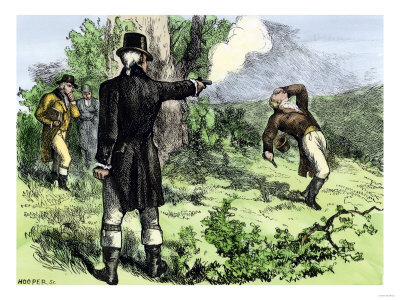
Tell Alexander Hamilton how much fun incivility is...

That an ethics dolt like Rick Robinson has spent so much time advising those in the Halls of Power speaks volumes about why our government institutions are dysfunctional and corrupt. His biography says he even ran for Congress. With ethical values like his—weak, dubious, and confused—it is a miracle he wasn’t elected.

In an essay for Tucker Carlson’s conservative news site The Daily Caller, Robinson defends the uncivil rhetoric of Jimmy (““Let’s take these sons of bitches out …”) Hoffa Jr and Rep. Joe ( “You lie!”) Wilson on the historically false and ethically idiotic grounds that “America was built on a solid foundation of uncivil political discourse.” It is ethically idiotic because this is consequentialism (“Everything turned out all right, so it was the right thing to do”) and a rationalization (“They did it, so we can too!), and it is historically false because no nation, indeed no functioning organization of any kind, was built on incivility….especially this one. Continue reading

Obama’s Fractured History

"Don't know much about history..."

I have been, some say, too hard on Sarah Palin, Michele Bachmann, and Herman Cain, for their various gaffes related to our American heritage. The reason I believe that these politicians are especially blame-worthy for their fractured history is that they are all constantly evoking America’s historical past, especially its founding. If you are going to take on the responsibility of educating Americans about the Constitution (which Cain mixed up with the Declaration), Paul Revere (whose ride Palin mangled) and the Founders (to whose number Bachmann added John Quincy Adams), you better get your facts straight, because the public trusts what you say.

What then, is the proper and fair reaction when a President the media has anointed as brilliant states in a nationally televised speech before Congress that Abraham Lincoln was the “founder of the Republican Party”? Continue reading

Comment of the Day: “Flying the Confederate Flag…”

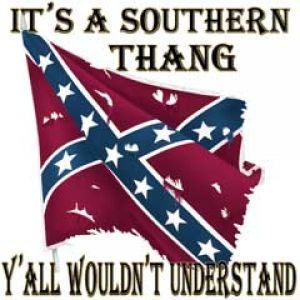
Blogger Edward Carney, who writes about the revelations of daily life (check out his blog here) put his finger on a central issue in the Confederate flag debate in his Comment of the Day.  Flying or displaying the provocative banner sends multiple messages simultaneously, and the individual responsible for the flag  is also responsible for the consequence of all of them. Claiming that one means no offense while knowing that one of the messages is unequivocally offensive is disingenuous,  naive, or willfully rude.

Here is the Comment of the Day on the post, “Flying the Confederate Flag..”:

“I’ll say this for those citizens and politicians who insist on flying the Confederate flag at local monuments and public events: at least they can make the argument that it represents history and a set of values that is still acceptable, even laudable, today. They can make that argument, however disingenuous it may be. The same cannot be said of everyone. Continue reading

Flying the Confederate Flag: Protected Speech? Of Course. Unethical? Absolutely.

Honor them for their valor if you must, but there was nothing honorable about their cause or their flag.

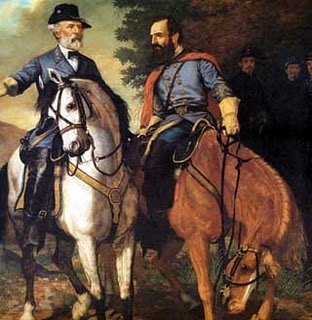
Once again, emerging from under-ground like a the seven-year locust, a controversy over the flying of the Confederate Flag is raging, this time in Lexington, Virginia, burial place of two Confederate heroes, Stonewall Jackson and Robert E. Lee. A proposed city ordinance would prohibit the flying of the Confederate banner on downtown poles, and some Southern heritage buffs as well as Jackson and Lee fans are upset. “By all means [Jackson and Lee] should be honored,” said Brandon Dorsey, commander of Camp 1296 of the Stonewall Brigade of the Confederate Veterans. “I look at the flag as honoring the veterans.”

The problem is, Brandon, that a large number of Americans look at that same flag as honoring slavery and racism, and for good and historical reasons. Continue reading

Ethics Hero Emeritus: Stetson Kennedy (1916-2011)

And he gave his book to Superman...

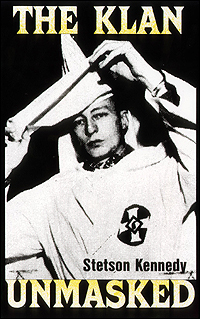
Author and folklorist Stetson Kennedy, who died this week,  is another important and courageous American that most of us never heard of. Let’s try to catch up.

After a back injury kept him out of World War II, Kennedy began a lifetime career of crusading against bigotry and what he called “homegrown racial terrorists.” He served as director of fact-finding for the southeastern office of the Anti-Defamation League and as director of the Anti-Nazi League of New York.

In his 1954 book “I Rode With the Ku Klux Klan,” Kennedy wrote that he gained entrance to the Klan by posing as an encyclopedia salesman and using the name of an uncle who was a Klan member. While posing as a member, he learned many Klan secrets that he put to use undermining the organization’s reputation and support. With evidence he snatched from the Grand Dragon’s wastebasket, he gave the Internal Revenue Service what it needed to collect an outstanding $685,000 tax lien from the Klan in 1944, and he helped draft the brief used by the state of Georgia to revoke the Klan’s national corporate charter in 1947. He also testified in other Klan-related cases. Continue reading