Ten More Hollywood Ethics Cures For A Post-Election Hangover (Part 2)

Here are the final five ethics movies, making 25 on the Ethics Alarms list so far. Except for the last, they are a sober batch. I think I now understand why they are at the back end of my list of 25; this group is darker than the first 15 and more tinged with defeat than hope. Their ethics lessons, however, remain inspiring, or if not quite that, thought-provoking:
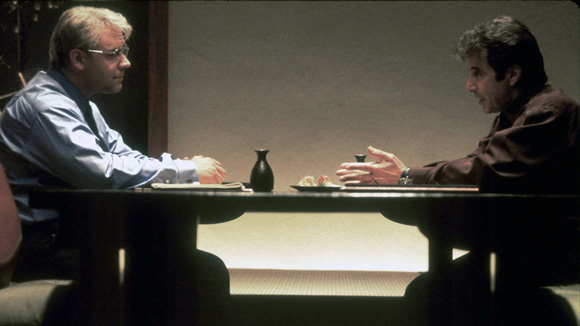
6. The Insider (1999)

Another true story, one that explores the murky area of whistleblowing and whistleblowers as well as the conflict between the business of journalism and the profession of journalism.

Ethical issues highlighted: confidentiality, whistleblowing, law vs. ethics, sacrifice, courage, media ethics, integrity, honesty, trustworthiness, betrayal

Favorite quote: “You’re in a state of conflict. Here’s how it lays out. If you have vital insider stuff that the American people for their welfare need to know and you feel compelled to disclose it and this violates the agreement – that’s one thing. On the other hand, if you want to honor the agreement, it’s simple. Say nothing. Do nothing. The only guy who can figure this out is you, and that’s you all by yourself.” Lowell Bergman (Al Pacino) Continue reading →
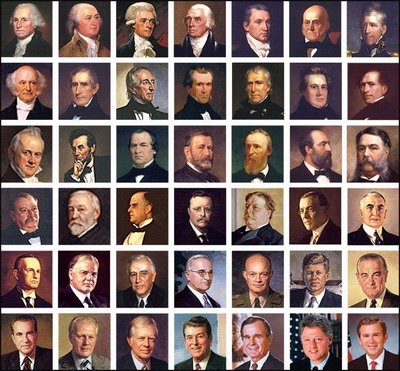
Relax, Americans: The President Will Be A Good Man…Whoever He Is.

The good guys.

The degree of anxiety over today’s Presidential election—perhaps more accurate than anxiety is hysteria—is palpable. It is also unnecessary and foolish. I have read the fevered rantings of Andrew Sullivan, who fears Mitt Romney like the Germans feared the invading Russian army at the end of World War II, and the apocalyptic monologues of conservative radio talk show host Mark Levin, who is prone to statements like, “It’s over, that’s all! Do you understand? If Obama wins, this country is never coming back!” I have watched both parties exploit and encourage this kind of irrational fear, and its by-products, predictably, are hate, division and anger. There was a time in America when political adversaries referred to each other as “my honorable opponent.” The candidates were not more honorable then. We were more sensible.

The history of the United States has shown that very few truly bad men have the opportunity to run for President. It makes sense, if you give it a modicum of thought. A Presidential contender must negotiate the perils of life for at least four decades without accumulating damning evidence of disqualifying character traits and malign intent. The candidate must have shown sufficient ability and character to impress those he worked with and owed duties to. Most of all, a potential President must have been able to engender a sufficient amount of trust over more than half of his natural life.

We should not judge political leaders by the same standards as other professionals, because the nature of politics, by definition, is ethically ambiguous. Politics knows only one ethical system: utilitarianism. The practice of governing and making human progress advance in the civic arena rules out absolute principles, and requires delicate calculations of ends and means. This often appears, to non-practitioners, as corruption, and it certainly can become that. Effective, trustworthy leaders are able to avoid the occupational hazard of believing that the ends necessarily justify the means. If they cannot, they will not have the opportunity to be President. Continue reading →

Why Nate Silver Is Wrong

Funny, Nate, I don’t see “leadership” anywhere in here…

I have wrestled with whether to write this post for about a month now. I am not in the election predicting business, which is a fool’s game, and this is tangential to ethics at best. On the other hand, leadership and American culture are among the subjects frequently explored here. Nate Silver’s analysis of the Presidential election on his New York Times blog has been at once fascinating and aggravating for me, though it has been a godsend to my nervous friends on the ideological left. Silver has insisted that his statistical analysis of the polls fortells an Obama victory with increasing certainty. Last I looked, his model was showing the election to be all but in the bag for the President, with, Silver calculates, an 86% chance that Romney goes down to defeat.

I don’t question Silver’s figures or formula. He’s a statistics whiz. His mistake is trying to use the tools he has used to great success on the poker table and in the world of sabermetrics to analyze the election of a President of the United States, without acknowledging or understanding the core of the process, or the culture and context in which it occurs. In many elections, most perhaps, his model would work perfectly. This time, it is going to fail. Silver won’t see his failure coming because as brilliant as he is in his chosen field, his demonstrated expertise is in economics and statistics. He really believes, apparently, that American history doesn’t matter, that what Americans think about when they choose a President is irrelevant, and that numbers purify the discussion and remove all the bias and static. He couldn’t be more wrong. Continue reading →

Innocence Abuse, 2012

Stop it.

In the view of many (including me), the exact moment Jimmy Carter lost the 1980 Presidential election was when he used the closing minutes of the only Presidential debate to spin the tale, dubious at best, about his solemn conversation with his daughter Amy. Carter claimed that he asked her about her assessment of the most important issue facing the nation, and that  “the control of nuclear arms” was his thirteen-year-old advisor’s sage response. The story seemed insincere and manipulative, all the worse for Carter’s placing his answer in his daughter’s mouth for tactical purposes. Carter used Amy as a prop and a ventriloquist’s dummy. Even if the story was true, the tactic was offensive.

Here in Virginia, a closely contested “purple” state, the tactic of using children to carry political messages in full bloom. An ad for Republican Senate candidate George Allen, attacking opponent Tim Kaine and President Obama for their pro-abortion stance shows a series of cute “potential” children, facing the camera and telling us what they would have been in their lives—a mother, a fireman, a soldier (no homeless, serial killers or drug dealers, oddly enough)—if their existence hadn’t been snuffed out in the womb. Meanwhile, President Obama recently descended to the rock bottom level of the rest of his campaign by calling Mitt Romney “a bullshitter” by placing the epithet in the mouth on an anonymous 6-year-old girl.

With that kind of leadership model to follow, I suppose it shouldn’t be too shocking that far worse was on the way. A pro-Obama group called “The Future Children Project” has released an ad that represents a new low in the use of children as programmed messengers. Created by advertising agency Goodby, Silverstein & Partners, the spot shows a chorus of dead-eyed, sad children, shot in black and white, singing from a dystopian future about what America became because it didn’t re-elect Barack Obama. The lyrics: Continue reading →

Ethics Hero Emeritus, Sort of: Russell Means (1940-2012)

“Fly swift, like an arrow.”

Clarence Darrow, the greatest of all American criminal defense lawyers, admired more than one criminal. One he especially admired was John Brown, the radical, violent and possibly insane abolitionist whose deadly 1859 raid on Harper’s Ferry, Maryland was a terrorist act by any definition. Brown was hung for it, but he became a martyr for the anti-slavery movement, and his raid a rallying point for its cause. Darrow believed that some societal wrongs were so resistant to law and democracy that their grip could only be loosened by violence, and so he extolled men like Brown, whom he regularly eulogized in public with a fiery speech that concluded,

“The earth needs and will always need its Browns; these poor, sensitive, prophetic souls, feeling the suffering of the world, and taking its sorrows on their burdened backs.  It sorely needs the prophets who look far out into the dark, and through the long and painful vigils of the night, wait for the coming day.  They wait and watch, while slow and cold and halting, the morning dawns, the sun rises and waxes to the noon, and wanes to the twilight and another night comes on.  The radical of today is the conservative of tomorrow, and other martyrs take up the work through other nights, and the dumb and stupid world plants its weary feet upon the slippery sand, soaked by their blood, and the world moves on.”

I immediately thought of Darrow’s words about Brown* when I learned that Russell Means had died this week at the age of 72. Clarence Darrow would have loved Russell Means. Continue reading →

The Ryan Soup Kitchen Photo: Everybody Does It, But It’s Still Unethical

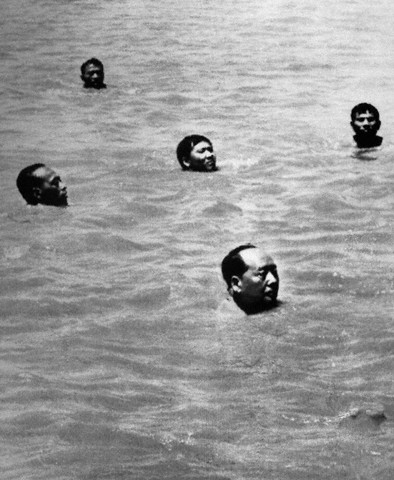
In the early 1960s, as the Great Leap Forward led China into political, social and economic disasters, the opposition to Mao Zedong’s leadership grew; Chairman Mao’s reaction was to purge the party leadership of intellectuals and officials in what is now termed, “the Great Proletarian Cultural Revolution.”

Mao Zedong’s hold on the leadership of China was shaky as he passed 70; even slaughtering more of his enemies and rivals wasn’t working. On July 16th 1966, Mao sought to debunk rumors that he was frail and ill by staging photographs of him vigorously swimming in the Yangtze River.  It was called, “The Swim Seen Round the World.” The Chinese press did its job, describing Mao’s cheeks as “glowing” and “ruddy,” his stroke steady and strong. “Our respected and beloved leader Chairman Mao is in such wonderful health!” one press report enthused.

In the West, however, there was more skepticism. Time reported that Mao swam “nearly 15 km in 65 minutes that day–a world-record pace, if true.” The photos of the swim, which showed an oddly solemn group of floating heads, were widely believed to have been doctored. As it turned out, the photos were real; Mao really did take a swim, though the event was staged, and nobody knows how long the swim lasted or how far Mao paddled. What are such photo ops? Are they deceptive? Are they ethical? Continue reading →

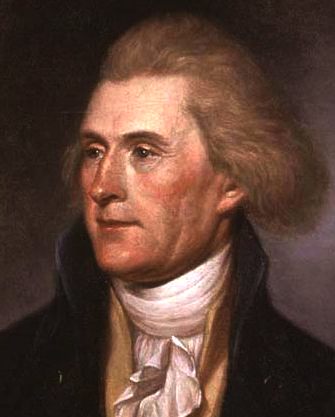
Unethical Quote of the Week: Thomas Jefferson

 “Brought from their infancy without necessity for thought or forecast, [blacks] are by their habits rendered as incapable as children of taking care of themselves, and are extinguished promptly wherever industry is necessary for raising young. In the mean time they are pests in society by their idleness, and the depredations to which this leads them.”

—-Thomas Jefferson, quoted in a new book, “Master of the Mountain: Thomas Jefferson and His Slaves,” by historian Henry Weincek. Jefferson wrote this in 1819, 43 years after the Declaration of Independence, in response to a request for support from a family friend who was taking his own slaves to freedom. Jefferson refused, and this was part of his response.

Great writer. Great philosopher. Bad man.

I have been working on a post on the topic of Presidential character, a lifetime study for me, as a rebuttal of a post on the Daily Caller titled, “Why Good Men Don’t Become President?” Good men do become President; in fact, almost all of the men who have become President were or are good men, Barack Obama included. Leaders, however, are a peculiar breed of good men, since leadership itself requires a different priority of virtues than other roles. Those who do not understand or appreciate leadership, and I believe that the author of that article does not, often conclude that leaders are necessarily bad.

Thomas Jefferson, I submit, was one of the few bad men who did become President. Continue reading →

Ethics Hero Emeritus: Eric Lomax, 1919-2012

Eric Lomax was a hero of forgiveness.

Eric Lomax, his book, the Bridge on the River Kwai,, and his friend, the man who tortured him.

In 1942, Eric Lomax, was a 19 year old  member of the British Royal Corps of Signals stationed in Singapore when he joined thousands of British soldiers in surrendering to the Japanese. It was 1942. He was one of those shipped to Thailand and became one of the slaves laboring to build the Burma Railway, also known as the Death Railway. The building of the railroad and the brutal treatment of the English prisoners by their Japanese captors  formed the plot of the classic 1957 David Lean film, “The Bridge on the River Kwai,”

After Lomax was discovered to have built a radio receiver from spare parts, he was mercilessly tortured and interrogated by his captors.  After his release, fantasies about murdering his main torturer, a man named Nagase Takashi, obsessed him. Lomax spent the early years of his retirement in the 1980s looking for Takashi, and eventually learned that he had become an interpreter for the Allies after the war. In 1992, he stumbled across an article profiling Nagase and noting that he was haunted by guilt over his mistreatment of one British soldier. That soldier, Lomax realized, had been him. He arranged to meet the man who tortured him, and whom he had spent the rest of his life dreaming of murdering.

Torturer and victim met in 1993, on the infamous bridge Lomax had been forced to help construct (and which was not blown up, the film ending notwithstanding). Continue reading →

Incompetent Elected Official of the Week: Georgia Rep. Paul Broun

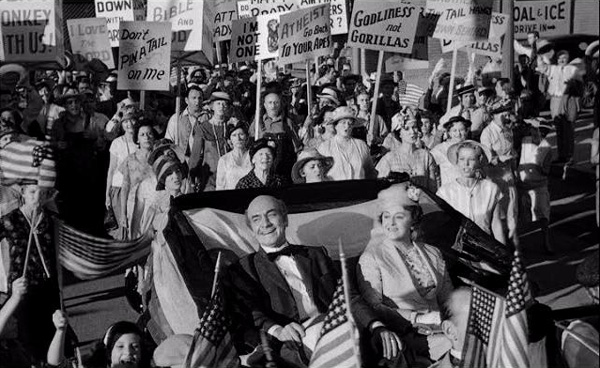
Paul! See that guy holding the sign that says, “Atheists Go Back to Your Apes”? YOU COULD BE THAT GUY, PAUL!

An ignoramus and proud of it, Rep. Paul Broun (R-GA.) is apparently serving in Congress while waiting for a juicy role as one of the fanatically religious townspeople in “Inherit the Wind,” should a local production materialize. For it was good people like Broun, with his level of education, certitude and Godly conviction, who occupied the town of Dayton, Tennessee during the Scopes “Monkey Trial,” the famous legal battle over the teaching of evolution that inspired the fictional stage adaptation of the event authored by Jerome Lawrence and Robert E. Lee, perhaps the best high school drama club play that ever graced Broadway.

Those science-hating, God-loving people of Dayton’s  imaginary stand-in, “happy Hillsboro,” get to do a lot of revival meeting singing, and scream “Praise God” and “Read your Bible!,” and join in choral renditions of “We’ll hang Bert Cates from a Sour Apple Tree,” a reference to the play’s junior high science teacher, who, like the real John Scopes, dares to defy Tennessee law and teaches his students that the world isn’t only 9,000 years old, that Adam didn’t ride around on a triceratops and that mankind evolved from more primitive primates. Broun would be terrific at the singing and screaming, I’m sure. Continue reading →

The Times Square Kiss, and Feminist Blogs’ Fanatic Crime Against Joy

The blog posts at issue make me angry. Usually it is silly to be angry about mere opinions, I know. However, the opinion registered by “Lori” on the blog Feministing, taking her cue from another feminist blogger, is a symptom, a symptom of the scourge of pernicious, political-correctness zealots, who refuse to recognize the important distinctions between malice and human beings being human, and seek to wipe out that distinction by distortion, sophistry, historical revisionism and bullying.

The bloggers’ target is an iconic photograph from the heart of American history: LIFE photographer Alfred Eisenstaedt’s shot of an American sailor kissing a nurse on August 14, 1945, in a moment of jubilation on Victory over Japan Day in the heart of New York City. Ah, but all is not as innocent and blissful as it would appear. Some historians think they have finally confirmed the identities of the mysterious couple (the photographer never identified his subjects) as Greta Zimmer Friedman, a dental nurse at the time, and George Mendonsa, a sailor. [Despite the assertions of the bloggers and the historians, we can never know for sure. There were apparently many similar pairings that day, and several couples have credibly claimed to be those kissing through the decades.] Greta was recently interviewed, and noted that that she was just grabbed by a sailor she didn’t know and kissed. “That man was very strong. I wasn’t kissing him. He was kissing me,” Greta told interviewers.

Ah HA! declare the feminist bloggers. Don’t you see, you addled, male-culture dominated, female-subjugating fools? This wasn’t a pure expression of joy in the long-awaited  end of a world conflict that had killed millions and laid waste to much of the planet! Oh, no! The famous photo was something dark and sinister: Continue reading →