The DeSantis Announcement Incompetence: This Is What Happens When No One On Your Staff—Or You—Knows Their Presidential History

Yes, the Twitter announcement was a mess, but that’s not what bothered me. What bothered me was this, five minutes and 46 seconds into Gov. Ron DeSantis’s long-awaited entry into the race for the White House…

(05:46)
We must return normalcy to our communities. America’s a sovereign country. Our borders must be respected. We cannot have foreigners pouring into our country illegally by the millions. We cannot allow drug cartels to poison our population with fentanyl. Public deserves safe communities and law and order must be maintained in American cities. We can’t have inmates running the asylum, and we must reject attacks on the men and women of law enforcement.

Normalcy??? The word was invented by then U.S. Senator Warren G. Harding when he ran for President in 1920. (The proper word was and is “normality.”) “Back to Normalcy” became his campaign slogan and is forever associated with Harding, who won election easily and went on to be regarded as one the nation’s worst Presidents, though historians are grudgingly coming to accept that he wasn’t a bad as his racist predecessor, Woodrow Wilson.

Continue reading →

The Problem Isn’t The Poem But The School And The Teachers Who Would Teach It

Poet Amanda Gorman’s interminable poem “The Hill We Climb,” read by the poetess at Joe Biden’s Inauguration, has apparently been removed from the curriculum of elementary schools in Miami-Dade County, Florida as inappropriate for grade-schoolers. It took an objection from a single parent to get the job done, which the mainstream media thinks is significant—you know, a single complaint is enough to “ban” literature. It is significant, but not in the way they think. It is significant because it shows how few parents are actively engaged in their children’s education and properly on the look-out for political indoctrination in the schools.

The poem is inappropriate for sixth grade and under even if it were taught competently and objectively. I could see the thing being used productively in high school, for example to teach what agitprop is, how events are framed differently by various political factions, or to show what bad poetry is. Unfortunately, using “The Hill We Climb” appropriately requires a level of skill and objectivity most teachers lack, and a degree of trust today’s teaching profession doesn’t deserve.

Now here is the poem:

Continue reading →

Comment Of The Day: “Wait! Is THIS Peak Stupid In The Age Of The Great Stupid?”

Yesterday’s post about the theology PhD student telling a congregation that Jesus was transsexual based on artist renditions of him was calculated to trigger lively responses, and indeed it has. CD-VAPatriot is one of the Ethics Alarms readers who doesn’t comment often but is always sharp and provocative when she does, and this Comment of the Day is another example. (I have recently figured out that EA has a lot of female participants here. Good.)

Here is CD-VAPatriot‘s Comment of the Day on the post, “Wait! Is THIS Peak Stupid In The Age Of The Great Stupid?” …

* * *

I’m often left speechless by Woke World, but this one takes the cake. I’m physically sickened by this claim.

I have no problem with the LGBTQ crowd, although when their group constantly holds their needs/wants/ideals over the importance of everyone and everything else, it becomes an issue. As for the trans community, I feel very sorry for those adults who believe they were born the wrong gender. I feel that this conviction comes from the mind of someone who is mentally ill. Mutilating healthy body parts, removing healthy organs, using heavy duty medications one’s body doesn’t actually need is considered Xenomelia (Body Integrity Dysphoria)…which is classified as a mental illness. I consider transgenders in this category. My heart breaks for someone in that much pain. I believe that someone suffering from such a serious illness should be treated with complete compassion.

Continue reading →

Wait! Is THIS Peak Stupid In The Age Of The Great Stupid?

It’s a now-familiar tactic when minority groups seek attention and enhanced self-esteem: find a universally admired historical figure of note and claim that he or she was a member of that group. Abraham Lincoln was gay! Cleopatra was black! (That worked out well…) Jesus was gay AND black! Still, I didn’t see this coming, but the Great Stupid knows no bounds, apparently:

Worshipers at a Trinity College at Cambridge were treated to a sermon by Joshua Heath, currently seeking a PhD in theology. He argued that Christ takes on a transgender body in historical artwork, appearing both masculine and feminine in different paintings.  As proof, he displayed Jean Malouel’s painting called “The Pieta,” in which the body of Christ is shown with blood running down his side. Heath noted that the blood coming down from the side wound of Christ to the groin in the painting “takes on a decidedly vaginal appearance.”  “[I]f the body of Christ as these works suggest the body of all bodies, then his body is also the trans body,” Heath concluded.

Oh. So if someone paints a portrait of me a few centuries from now showing me with the head of an aardvark, that would be solid evidence that I had the head of an an aardvark? Good thinking there, Ace. Paintings of Jesus prove absolutely nothing, as the “Jesus was black” advocates correctly pointed out. The evidence indicates he was probably dark-skinned and swarthy, and less than five feet tall. But trans is “in,” so we now have to debate whether Christ “identified” as a woman.

The residents of Woke World are apparently incapable of saying, “That’s ridiculous” when an “in” group is the topic, so Michael Banner, the Dean and Director of Studies in Theology and Religious Studies at Trinity College felt it necessary to endorse Heath’s fantasy. He wrote in response to a complaint about the sermon that Heath’s “speculation was legitimate, whether or not you or I or anyone else disagrees with the interpretation.” 

Can The Great Stupid get more stupid than this?

_______________

Source: Campus Reform

When Ethics Alarms Don’t Ring: Fun At Auschwitz!

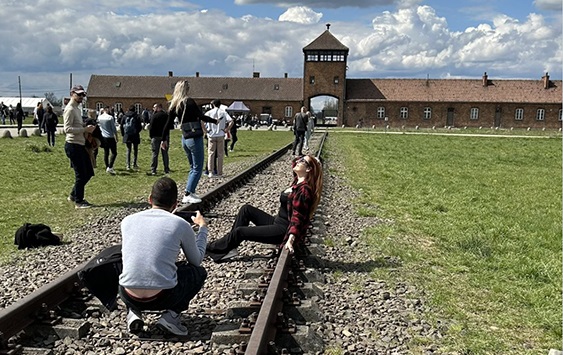
That’s an ice cream stand just outside Poland’s shrine to the victims of the Holocaust, the Auschwitz death camp. Isn’t it nice that tourists there will be able to grab a delicious ice cream cone for refreshment? Now here…

…a woman posed glamorously on the tracks that brought the railroad cars stuffed with captive Jews to be gassed. If I had to wager, I’d say the couple is American. In my various adventures abroad, I wanted to hide my head under a bag many times as I saw American tourists behaving abominably at such locales as Westminster Abbey and the Tower of London. But it isn’t just Americans: my wife’s sister reported that at Pearl Harbor she witnessed smiling Japanese tourists posing by the memorials to the Arizona, the Oklahoma and the Utah.

Where does this attitude come from? Over at Victory Girls, Kim Hirsch writes, “Money and fame have replaced honor and memory of the history which changed the world.” I’d put it a little differently: as our culture increasingly sends the message that history is just another tool of politics, the public is either ignorant of the facts of the past, unable to understand why those facts are still important, or believe that history is irrelevant to their lives.

Scholastic Was Right To Ask A Children’s Book Author To Edit Her Anti-American Introduction, But Nobody Will Admit It

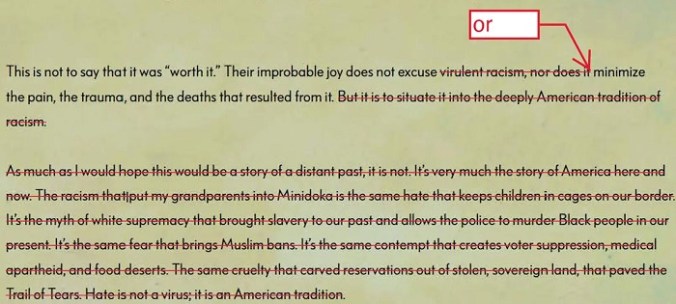
Maggie Tokuda-Hall was indignant when Scholastic, a publishing giant that distributes books and resources to 90% of the nation’s schools, offered, to license her book, “Love in the Library,” but only on the condition that she edit her author’s note as indicated above. She went public with her accusations that this was an example of unconscionable capitulation to right-wing efforts to “censor” books in school libraries, and now Scholastic is groveling for forgiveness after ” an outcry among children’s book authors,” while several authors and educators consulted by Scholastic condemned the company’s actions, and demanded an overhaul of the editorial process.

Of course, this is an issue being engaged with by only one side of the political divide, whose analysis is wildly skewed by fealty to political correctness and the anti-American movement in public education, fueled in part by children’s book authors (see above) and industry consultants (see above). The New York Times’ “news report” on the matter is, predictably, completely biased, framing what should be an issue stuffed with legitimate arguments on both sides to one where the rights and wrongs of the episode have already been settled by the demands of Leftist orthodoxy. The headline, as is often the case in the Times, frames the story dishonestly: “Asked to Delete References to Racism From Her Book, an Author Refused.”

The author, a Japanese-America, quickly plays her own race-card, telling the Times, “We all see what’s happening with this rising culture of book bans. If we all know that the largest children’s publisher in the country, the one with the most access to schools, is capitulating behind closed doors and asking authors to change their works to accommodate those kinds of demands, there’s no way you as a marginalized author can find an audience.”

Sure there is. Write children’s books that don’t seek to indoctrinate kids and that don’t try to reduce complex historical events to simplistic and misleading narratives.

Continue reading →

Psst! When You’re This Estranged From Human, Societal And Cultural Norms And Standards, No Advice Columnist Can Save You

The New York Times “Ethicist” got a jaw-dropping inquiry this week:

Nearly a year ago, I began dating two friends — I’ll call them Rachel and Dave — who were already themselves in a relationship. We all had no experience with polyamory. The throuple ended fairly quickly, with no one being at fault; the other two continued to date but broke up not too long afterward. Since then, Rachel and Dave have dated on and off, Rachel and I were casually together and Dave and I have been close friends who sleep together occasionally. There have also been relationships with others outside this group. At times, we have all behaved badly, sleeping together behind the other’s back, knowing the knowledge would hurt the other. Strong emotions, love and pain have arisen on all sides.

Throughout the past year, as multiple complex situations arose, we have all wished for a model of behavior. Monogamy-centered media suggests that one should avoid dating a friend’s ex-partner. Is this correct? And if so, can this concept be universalized? Do Rachel and Dave get “priority,” in that they should be together and I should not pursue either, because they dated first? What do we owe to our romantic partners and friends when the situations are complex?

His advice doesn’t interest me; you can read it here if it interests you. My focus is on the inquirer, predictably signed in as “Name Withheld.”

Continue reading →

Comment Of The Day: “If Cleopatra Was Black, Maybe I Am Too!”

Once again I am confronted with the phenomenon of a Comment of the Day that is better written than the Ethics Alarms post at issue. This happens a lot (Curmie, today’s author, is a repeat offender). I am torn about it, actually: the comments here contribute greatly to the value of the blog, and my original concept was to create a colloquy of articulate readers interested in ethics who also bring different backgrounds and perspectives to the issues. The high quality of commentary obviously validates that mission; it’s only my fragile ego that suffers. Curmie, like several others who participate regularly here, is an experienced blogger himself. He’s also a better proof-reader than I am (though I found one typo this time, making my day).

But I digress. The topic of Curmie’s Comment of the Day is the controversy over Netflix suggesting that Cleopatra was black in a new series, a matter Ethics Alarms raised in the post, “If Cleopatra Was Black, Maybe I Am Too!”

From here on, it’s all Curmie; I’m just going to sit by quietly feeling inadequate…

***

There are several differences, I think, between this story and the brouhaha over the black Anne Boleyn a couple of years ago.

First is a fundamental difference in the way the casting of a major role was presented. The BBC would have us believe that race doesn’t matter in the casting of the title character in the “Anne Boleyn” mini-series so long as it’s “surprising.” (As you noted, Jack, a block of cheese would also have been surprising in the role.) The forthcoming Netflix series is at least honest that being black (or mixed race and appearing black, in this case) was a prerequisite for an actress being considered for the role of Cleopatra, who almost certainly was, shall we say, significantly lighter-complected.

This is apparent in the nonsensical utterances in the promotional video, in which anonymous voices are treated as authorities. If they had a legitimate historian who supported the cause, that person would be identified as such. That omission is more than a little telling.

Continue reading →

Comment Of The Day: “The Trouble With ‘Do Something!’ Part II”

Saturday is a ghost town on Ethics Alarms these days; I’ve decided to stop obsessing about it, and blog traffic generally, other than with occasional rueful observations like this one. Despite the lack of quantity, Saturday often produces a disproportionate level of high quality commentary and Comments of the Day, such as JutGory‘s observations on the “Do something!” conundrum. I was particularly charmed by his preface, which represented a microcosm of the eternal “Do something” vs “Do nothing” conflict:

“Been going back and forth all day (appropriately, perhaps) about whether I should comment or not). Eventually, the inclination to comment won out, because I think it will do some good. However, my hesitation is based upon the effort it would take to frame a fully organized and coherent response. So, having abandoned that as a goal, there is no reason not to comment.”

Here is JutGory’s Comment of the Day on the post, “The Trouble With “Do Something!” Part II: Applying The Scale.”

***

First off, a few first principles when it comes to action and inaction:

“The only thing necessary for the triumph of evil is for good men to do nothing.” –Edmund Burke (attribution may be disputed)

“The only thing necessary for the triumph of good is for evil men to do nothing.” -JutGory

“All human action is aimed toward some good.” –Aristotle (heavily paraphrased opening lines from the “Nicomachean Ethics”)

“All of humanity’s problems stem from man’s inability to sit quietly in a room alone.” –Pascal

The inclination to “do something” is natural because we all view our actions as good and we don’t want to stand by while evil people are causing trouble.

The problem with this mindset is that good people and evil people are often equally stupid.

The people who killed Emmett Till thought they were carrying out some good and they did not want to be one of those good people who did nothing.

Nazis too.

Freedom Riders.

Tea Party Members.

Along with the laundry list of protesters, strikers, and saboteurs.

Continue reading →

The Trouble With “Do Something!” Part II: Applying The Scale

As is often the case, baseball led me to an epiphany regarding the recent “Do something!” mania. Bill James, in the 2023 Bill James Baseball Handbook, was discussing the how the tactic of the intentional walk—when a manager orders that an opposing batter be avoided and placed on first base on the theory that the lesser risk is facing the batter after him, even though placing another potential run on base tempts fate—has become increasingly rare, when once it was very common. James writes that this was a bad gamble all along (except in rare situations, like when a team’s best hitter has its worst hitter batting behind him) but was popular because managers and coaches in all sports overuse strategies that “give them control over the flow of action.”

“It’s human nature,” observes James. “It happens in all offices, all businesses. Managers over-manage because letting events take their course feels risky.”

Of course! Upon reflection that seems self-evident, but because I am slow, apparently, I never quite framed it that way in my mind before. Leaders think like managers, and the populations they lead identify assertive action with strong leadership and letting matters take their course with weakness. In truth, deciding that the best course is to do nothing is just as much a proactive decision as “doing something,” and often a more courageous one. But there it is again: human nature. The applicable Ethics Alarms motto is “Human nature is the ultimate pre-unethical condition.”

Continue reading →