History
“Dark Waters”
“Dark Waters” is another ethics movie, and a very good one. Like all ethics movies involving real events, it is also educational—disturbingly so.
The film, which was released late last year, dramatizes the story of attorney Robert Bilott and his nearly two decades of battling DuPont over its deliberate (okay, “negligent”) poisoning of citizens and the entire nation with the chemicals used to manufacture Teflon. Yes, “the entire nation”: that’s not hyperbole. It is believed that the unregulated and toxic chemical called PFOA is in the system of everyone living in the U.S. as a result of DuPont’s conduct.
The movie has not been a prominent success, perhaps because is treads along the well-worn path of earlier movies about similar corporate scandals and class action law suits, like Julia Roberts’ “Erin Brockovich” ( Pacific Gas and Electric Company ) and John Travolta’s “A Civil Action” (Beatrice Foods and W. R. Grace and Company). The star (and producer) of “Dark Water,” Mark Ruffalo, isn’t quite in the same star category as Travolta and Roberts, but an A-list cast was assembled to back him, including Anne Hathaway, Tim Robbins, Victor Garber, Mare Winningham, and Bill Pullman.
“Dark Waters,” horrifying to say, is mostly accurate. It was also one of those films where I was left wondering, “How did I miss this? Was it me, or was the story under-reported? If it was the latter, why was it under-reported?” The film was based on the 2016 New York Times Magazine article “The Lawyer Who Became DuPont’s Worst Nightmare” as well as that lawyer’s memoir. “Exposure,” giving Bilott’s perspective on his 20-year legal battle against DuPont. In the end, the company paid over $600 million in a settlement, which was far less than they should have paid; I’m sure the company regards this as a victory. (Its stock went up after the announcement.)
Imagine: Continue reading
Afternoon Ethics Warm-Up, 3/23/2020: Examining The—OH NO! I TOUCHED MY FACE!!!
1. From the “Futile isn’t Ethical” files. The hectoring over face-touching is annoying at a time when we need less annoyances. Here’s a useless article that gives elaborate strategies for eliminating face-touching only to admit toward the end that you probably can’t stop. I’ll wager that nobody can stop, since we do it thousands of times a day, often for good reasons, and that with all the other things we have to think about, thinking about NOT doing something natural all day long—which is essentially the strategy the three professors of psychology credited with the article recommend—will do more damage than it addresses.
Here’s a typical passage:
“Now that you are aware of the behavior you want to change, you can replace it with a competing response that opposes the muscle movements needed to touch your face. When you feel the urge to touch your face, you can clench your fists, sit on your hands, press your palms onto the tops of your thighs, or stretch your arms straight down at your sides.”
Here’s another idea that I’m sure everyone will want to adopt while they worry about their jobs, their friends, and where their next meal is coming from:
Self-monitoring is more effective when people create a physical record. You can create a log where you briefly describe each instance of face-touching. For example, log entries might say:
—Scratched nose with finger, felt itch, while at my desk
—Fiddled with eyeglasses, hands tingled, frustrated
—Rested chin on palm, neck sore, while reading
—Bit fingernail, nail caught on pants, watching TV
2. Baseball ethics fix: While there’s no baseball for an undetermined period, baseball continues to spark ethics consideration. Continue reading
Movies To Keep You Happy, Inspired And Optimistic , Part I

This is a very subjective and personal list. The main requirement was that they all must be, in the final analysis, upbeat. I also have seen all of them more than once.
I left out some obvious choices that I have already devoted full posts to on Ethics Alarms, like “It’s a Wonderful Life” and “White Christmas.” Some of the films on my ethics movies list appear here, but not for the same reasons. Obviously, I encourage you to see those movies too.
Below is approximately the first half of the list. The rest will be along eventually.
Rocky (1976)
It still holds up as one of the most exhilarating sports movies of all time.
The Natural (1984)
Great score and a happy ending, unlike the novelette it was based on.
True Grit (1969)
This is the John Wayne version, with two of the go-to scenes I’ll play when I want to feel better.
E.T. (1982)
Other than the unforgivable rainbow at the end, a near perfect feel-good film.
Stand By Me (1986)
One of two Stephen King movies on the list. Does anyone not love this film?
The Shawshank Redemption (1994)
And the other King movie. has any suicide in a film been quite this satisfying?
Erin Brockavich (2000)
More or less a true story, which makes it especially inspiring.
Singin’ in the Rain (1952)
If Donald O’Connor walking up walls doesn’t get your heart pumping and your mouth smiling, nothing will. Continue reading
Comment Of The Day: “Saturday Ethics Warm-Up, 3/21/20: I See Terrible People.”
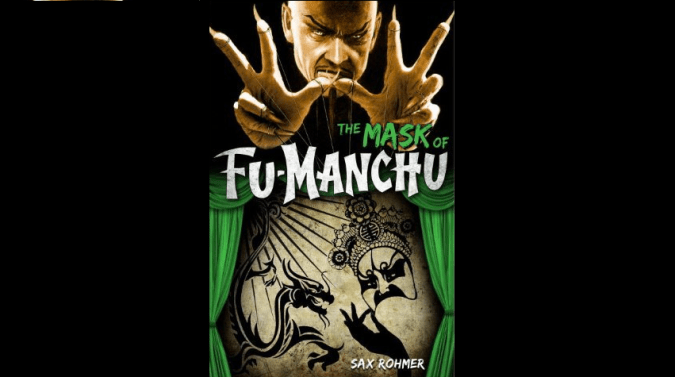
I’m embarrassed that I didn’t come up with “Fu Manchu Flu”…
Yesterday, Chris Marschner set an Ethics Alarms record with two Comments of the Day in a single day. His riff on (yecchh!) “Imagine’ was #1, this more traditional COTD is #2. I’m equally grateful for this one, because I had eschewed mentioning the small matter of the Obama response to the 2009-2010 H1N1 virus and the press coverage of that response. Why? Well, I get tired of being accused of mouthing conservative talking points, even when they are only conservative talking points because the left-wing mainstream media unethically ignores them. It also seems like whataboutism, though it is not: if resistance-allied pundits are going to tell the public that President Trump’s response to the Wuhan virus pandemic is deadly and incompetent, then they are obligated to explain why the previous President’s unquestionable worse response to his virus challenge was considered just fine, thanks. Nonetheless, the “Wait, how can you square your criticism of Trump with your Obama cheerleading?” refrain has become a cliche, even though it has done so because it has been a legitimate question so often.
Thus, twice in a single day, Chris Marschner saved me from a task I was not eager to complete. His starting point was the note in my post about Joe Biden planning on a regular feature online second-guessing the President’s response to the Wuhan virus.
Here is his Comment of the Day on the post, “Saturday Ethics Warm-Up, 3/21/20: I See Terrible People.”
We actually have a pandemic that Biden’s actions can be measured against. The 2009 breakout of the pH1N1 flu.
“Final estimates were published in 2011. These final estimates were that from April 12, 2009 to April 10, 2010 approximately 60.8 million cases (range: 43.3-89.3 million), 274,304 hospitalizations (195,086-402,719), and 12,469 deaths (8868-18,306) occurred in the United States due to pH1N1.”
https://www.cdc.gov/h1n1flu/estimates_2009_h1n1.htm Continue reading
Ethics Train Wreck Analysis: The Richard Jewell Case
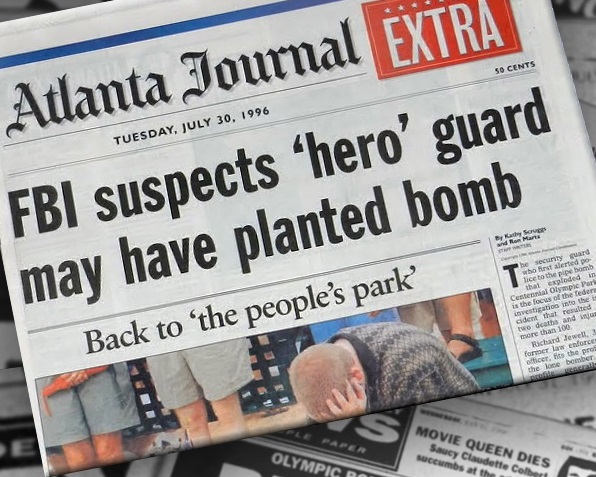
“Richard Jewell,” Clint Eastwood’s excellent but much maligned film about a historical episode with many ethics twists and turns, is extremely accurate and fair in all respects, except for the glaring exception of the screenwriter Billy Ray’s representation that reporter Kathy Scruggs obtained the information that Jewell was under suspicion by the FBI in exchange for one night stand with the agency’s lead investigator. This was the point where the Richard Jewell Ethics Train Wreck of 1996 acquired a car containing the 2019 movie “Richard Jewell.”
Let’s look at those other cars.
I. Jewell
Jewell was a socially awkward, lonely, obese man who lived with his mother. He was in many ways a stereotypical misfit with low self-esteem, who developed ambitions about becoming a law enforcement officer, a job that would would provide him with the respect and power that he lacked and wanted. The film begins with Jewell’s stint as an office supply clerk in a small public law firm, where he becomes friends with attorney Watson Bryant. Jewell quits to pursue his dream of becoming a law enforcement officer, and Bryant, in saying good-bye, asks his friend to promise that if he ever acquires the authority he seeks, he won’t become a jerk, and abuse it.
This was a real life conversation. Bryant recognized that Jewell was a border-line Asperger’s sufferer, whether or not he knew the name or the clinical condition, and exactly the kind of personality who should never be given a shield and a gun.
Jewell took a job as a campus security officer at Piedmont College, and rapidly realized Watson Bryant’s worst fears by reacting to his authority by abusing it, being over-zealous and generating an unusual number of complaints from students. Jewell was fired, but the need for security personnel at the upcoming Atlanta Olympics gave Jewell another chance at some authority at least. He probably shouldn’t have had such a chance. Jewell was not a man who should have been in the security field or the law enforcement field; his judgment was poor, and his emotional problems made him a bad risk.
Thus the conditions for the ethics train wreck were put in place. It was up to moral luck whether hiring Richard Jewell would turn out to be a disaster, or a fortunate near miss. Instead, it turned out to be something else entirely, a classic example of a bad decision having a good result—at least for a while.
2. The Bomb
In the early morning of July 27, 1996, Jewell, now working in Atlanta’s Centennial Park as part of the Summer Olympics security force, noticed an abandoned backpack by a bench. Over-zealous, officious and a fanatic about following procedure, Jewell insisted on reporting the pack as a “suspicious package,” despite the chiding of his colleagues, who wanted to take it to Lost and Found. If, as was overwhelmingly likely, the backpack had been just a backpack, Jewell probably would have been mocked. But again moral luck took a hand. He was right. It was a bomb. Jewell and other officers began clearing the area, and the bomb went off, killing one victim, Alice Hawthorne, and wounding many, still far less serious damage than what might have occurred had Jewell not been so scrupulous in his discharge of his duties.
3. The Hero, the Scapegoats, and the Tip
Continue reading
Pandemic Ethics Observations Part III: Diagnosis
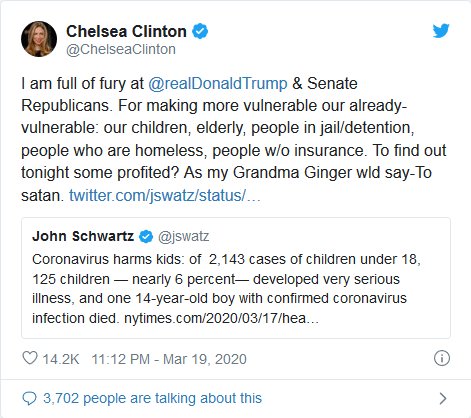
Keep it up, Chelsea. Keep it up, everybody, meaning the desperate Democrats, the bitter NeverTrumpers, the anti-America “resistance,” the suicidal mainstream media, and the Social Media Deranged. Virus stat-heads are closely watching “doubling” statistics, showing day to day whether the rate of increase in the number of infections is slowing down or speeding up. (In South Korea, it seems to be slowing down.) I’m watching a different phenomenon, the doubling of increasingly contrived attacks on the the President, fearmongering by anti-Trump fanatics, and the media as they sense one more opportunity to take this President down slipping away.
The Ethics Alarms diagnosis, not to keep you in suspense, is that this is failing, and indeed has failed for a wonderful reason. There may be a lot of stupid, ignorant, gullible people out there, but there aren’t enough stupid, ignorant, gullible people for this to work. Lincoln was right, as I have found myself observing more often in the past year than in the previous accumulated years of my muddled lifetime combined. You can’t fool all of the people all of the time.
Let’s dispose of Chelsea’s grandstanding tweet, which, among other things, shows why she desperately needed the intervention of Mom and Dad to score her various ridiculously high paying jobs. She ‘s an idiot. Literally nobody rational blames an international pandemic without precedent that began in China on a U.S. party or an individual, because that conclusion makes no sense. It makes no sense no matter how many hindsight bias stories are contrived and printed on the front page of the Times (there’s another one today.)
Of course not, Dr. Anthony Fauci said when questioned about whether the Trump administration was culpable for the testing kit manufacturing snafu. Americans know that the President isn’t God, and they can recognize the hypocrisy of partisans who have been complaining for three years that the President shouldn’t “act like a king” suddenly doing a 180 and attacking him for not controlling everything.
Chelsea’s tweet is hyper-partisan and incoherent (also remarkably lacking in filial self-awareness: if there was ever a family that has strived shamelessly to profit financially from its position and developing events, it is hers) , but it seems to have been partially triggered by the late revelation yesterday (discussed in this post) that Senator Richard Burr used the advance information his committee received about the Wuhan virus to sell off stocks before the predictable crash. Somebody should probably explain to Chelsea that selling stocks before a crash is not profiting off of the virus. Buying deflated stocks after the virus causes a crash and waiting until the stock value starts rising, as it will, would be profiting from it. (Betcha that’s what Mom is doing!)
That aside, “they” was quickly revealed to be three Republican Senators, Burr, Loeffler and Inhofe, and one very Democratic Senator, Diane Feinstein (D-Cal), the ranking member of the Senate Judiciary Committee. Her husband sold between $1.5 million and $6 million in stock in the biotech company Allogene Therapeutics, between Jan. 31 and Feb. 18. Continue reading
The 1619 Project And Ethics Villains Nicole Hannah-Jones And The New York Times

This disturbing story is signature significance.
The New York Times Magazine published its 1619 Project, named for the date of the first arrival of Africans on American soil, in August or 2019 with great fanfare and self congratulation. It purported to be a traditional wisdom-shaking view of America’s founding, placing slavery at the center of American political, social, and economic institutions, not a revolutionary desire by a remarkable group of visionaries to establish a culture rooted in human liberty, Time reporter Nikole Hannah-Jones championed and conceived the project, and authored the introduction to the epic, writing in part, “Conveniently left out of our founding mythology is the fact that one of the primary reasons the colonists decided to declare their independence from Britain was because they wanted to protect the institution of slavery.”
Hannah-Jones was candid about her objectives. “When my editor asks me, like, what’s your ultimate goal for the project, my ultimate goal is that there’ll be a reparations bill passed.” She was, she said, thrilled that people told her that they feel “they are understanding the architecture of their country in a way that they had not.”
From the beginning, the Times publication was clearly an ideological enterprise, and squarely within the paper’s partisan mission. Because that mission is shared by most of the most influential media sources, including NPR, it was almost universally praised. That endorsement was not restricted to journalism, however.
For decades, colleges and universities, bolstered by popular culture and propaganda from the mainstream media, have immersed rising generations in the narrative that America is an oppressive, white supremacist culture in need of fundamental reform. The 1619 Project offered an accompanying school lesson plan for junior high and high-schoolers, and since its publication, teachers in all 50 states and the District of Columbia (of course) taught parts of its curriculum. Just last month the Buffalo Public Schools announced their district will “infuse 1619 Project resources into the mainstream English and Social Studies . . . at grades 7-12.” Montgomery County, Maryland, and the Chicago Public Schools have followed.
The deconstruction of American pride and its origins as a nation founded on values rather than nationalistic and economic objectives is an essential predicate for so many of the Left’s plans for the country. Is this assessment unfair (by Arthur Milihk)? Continue reading
Morning Ethics Warm-Up, 3/16/2020: Zugswang!

Good morning, inmates!
I’ve been reading that social isolation may be deadly. Zugswang!
Last week “ethics zugswang” made a return to Ethics Alarms, and you can expect to read a lot more of it. The chess term describing the dilemma is which the only safe move is to stay still, and staying still is impossible, seems to be applying to increasing numbers of dire situations recently, especially in the ethical sense, in which all choices are unethical.Upon reflection, several posts involved ethics zugswang even when I didn’t use that term. The woman whose student loan debts topped 900,000 dollars is in zugswang. Progressive feminists who use gender-baiting as a partisan weapon are in self-condemned zugswang when political allies use misogynist terms against conservative women.
It’s really fun saying “zugswang,” but I will try to touch on some matters that don’t involve ethics zugswang….like…
1. “Hogan’s Heroes” ethics. I never thought it would happen, but a cable channel is re-running “Hogan’s Heroes” episodes. The very popular Sixties sitcom about POW prison camp and the wacky and inept Nazis running it has been thoroughly excoriated as outrageously tasteless and politically incorrect. My father loved the show because anything that made the Nazis look ridiculous was aces with him. Is it tasteless and offensive to show “Hogan’s Heroes” today?
It was clearly satire, in the same spirit as Larry, Moe and Curly playing Hitler and cronies, or Charley Chaplin in “The Great Dictator”—or, to pick a recent example, the child’s view of Hitler as an imaginary friend in “Jo-Jo Rabbit.” The show obviously took its inspiration from “The Great Escape,” of which it is virtually a parody (without the executions, of course.) WW II vets like my father were accustomed to the Nazis being ridiculed and trivialized in the process. In an age that has seen the Holocaust Museum’s exhibits and widely distributed documentaries about the full barbarity of Nazi Germany, the satire may no longer work.
There are other reasons why “Hogan’s Heroes” is no longer funny, despite the very talented cast. Its laugh track is annoying now, especially when the jokes are old and repetitive: how hard can you keep laughing when Sgt. Schultz (John Banner) says “I know nothing! NOTHING!” for the thousandth time? Perhaps the kiss of death for the series is the ubiquity of series star Bob Crane as Hogan, Crane was always smarmy for my taste, but knowing his fate—Crane was bludgeoned to death by a likely participant in his sick S & M porno ring that involved, among other revolting activities, secretly videotaping women engaged in sex—make watching the show a painful experience. Continue reading
A Lesson In Ultimate Utilitarianism: Israel’s Nazi Hit Man
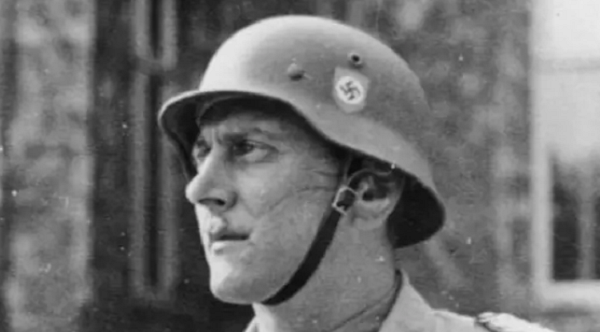
Israeli special agent, Otto Skorzeny. No, I’m not kidding.
There are few better examples of how extreme versions of “the ends justifies the means” can be adopted as an ethical course than the strange, and oddly under-publicized, story of Otto Skorzeny.
Do you know the tale? I didn’t, until today. This is a good day to consider it, being the anniversary of the date Hitler’s minions invaded Czechoslovakia.
Skorzeny was born in Vienna in June 1908. He joined Austria’s branch of the Nazi Party in 1931 when he was 23. He worshipped Hitler. When the Nazi army invaded Poland in 1939, Skorzeny left his construction firm and volunteered for the SS Panzer division that served as Hitler’s personal bodyguard force. He took part in battles in Russia and Poland, and was probably involved in exterminating Jews.
In 1944, Skorzeny handpicked 150 soldiers in a plan to foil the Allies after they landed in Normandy on D-Day. Dressing his men in captured U.S. uniforms, he procured captured American tanks for to use in attacking and confusing Allied troops from behind their own lines. This mission more than anything else earned Skorzeny two years of interrogation, imprisonment and trial after the war ended. Somehow, despite being one of Hitler’s favorite SS officers, he still managed to be acquitted in his war crime trial in 1947. The Führer had even awarded Skorzeny the army’s most prestigious medal, the Knight’s Cross of the Iron Cross, for leading the rescue operation that rescued Benito Mussolini from his captors.
After Skorzeny’s acquittal, newspapers called him one of the most dangerous Nazi criminals still unpunished. Typically brazen, he capitalized on the notoriety by publishing his memoirs, including the 1957 book “Skorzeny’s Special Missions: The Autobiography of Hitler’s Commando Ace.”
Skorzeny did not reveal in his books how he escaped from the American military authorities who held him for a year after his acquittal, perhaps saving him from more charges and another trial before the Nuremberg tribunals. The escape was rumored to have been assisted by the CIA’s predecessor agency, the OSS, which he assisted in some special operations after the war. Continue reading
 Ethics Alarms
This masterful epic by Comment of the Day auteur Steve-O-From-NJ needs no introduction, so I’m just going to say, here is Steve-O-From-NJ’s Comment of the Day on the post, “Afternoon Ethics Warm-Up, 3/23/2020: Examining The—OH NO! I TOUCHED MY FACE!!”