Sexist Broadway Musical Lyric Ethics: Carousel’s “Soliloquy”

“Soliloquy,” also known as “My Boy Bill,” may be my favorite Broadway musical song of all time. (I don’t know, it’s between that and “Losing My Mind” from Sondheim’s “Follies.”) It certainly is among the most ambitious of all the songs from the genre, an emotionally wide-ranging, musical equivalent of a Shakespearean  monologue. Both the song’s lyricist, Oscar Hammerstein, and especially its composer, Richard Rodgers, were at the top of their form when they created it, and the top of their form can match any songwriter who ever lived. It’s also a tour de force for the singer, a seven-and-a-half minute musical mountain that only the very best even dare try to scale

The song comes at a key moment in the plot of “Carousel,” when the brutish and none-too-bright hero, Billy Bigelow, has learned that his wife is pregnant. The arrested-development adolescent muses about the joys and ultimately the responsibilities of his impending fatherhood, and having accepted the fact that his child might be a girl, makes a fateful vow at the song’s climax: Continue reading →

Ethics Warm-Up, 5/13/2020….Oh, So WHAT If It’s Morning Or Not? Who CARES? Who Cares About ANY Of It?

1. I miss Ken. Ken White used to troll people who would ask him to post their sponsored content on Popehat. Now that he’s writing for The Atlantic, which morphed into a “resistance” organ and which I refuse to read on principle unless a particular screed is brought to my attention, I no longer get to chuckle at his nonsense mockery post about ponies and the rest. Now I’m getting this junk too. Faith Cormier writes,

I was visiting your website, ethicsalarms.com, and it had me wondering: do you accept outside submissions? If so, we’d love to create an original piece for you!Because it would include a totally natural reference to one of our clients, we’re prepared to pay you $100 for your time and effort. (Payments made through PayPal.) Shall we send you a draft, Jack? Alternatively, if you have any questions, please don’t hesitate to ask.

Yeah, I have a question, Faith. How could you read this blog, with the title “Ethics Alarms,” and make a proposal like that? “Totally natural reference” means a promotion, and that this would be deceptive marketing.  My integrity may have a price some day, but if it does, it will be a hell of a lot higher than a hundred bucks.

2. Ethics movie spoiler.  “Standoff,” is a 2016 film that critics mostly slammed because critics don’t understand ethics movies. A hit man (Lawrence Fishburne) who is chasing a 12-year-old girl who took a photo of him while he was executing people tracks her down to a run-down house where a depressed and alcoholic veteran (Thomas Jane) is living. The veteran, who has some facility with firearms (and who lost his own young son, sending him into his tailspin) decides to protect her, though the hit man demands that he turn her over to be shot. The veteran faces several ethics conflicts after making the altruistic decision to risk his own life to try to save a child who showed up on his doorstep by random chance. The hit man captures a police officer and tortures him to force the girl’s surrender. He then threatens to kill the officer, and does, as the veteran rejects the proffered exchange. Finally, the hit man captures the veteran’s ex-wife, and says he will kill her if he doesn’t get the little girl. (“How do I know I can trust you?” the vteran asks as they are negotiating. “You can’t!” the hit man replies.)

Now that’s an ethics conflict! Continue reading →

Sunday Ethics Scripture, 5/10/2020: It Doesn’t Include “Forgiveness”

1. You know…Kool-Aid! Rep. Adam Schiff (D-CA) finally was forced into releasing the transcripts from the House’s investigation “collusion,” one of the more extensive of the multiple Democratic coup attempts. The Federalist explains, :

Former Obama administration defense official Evelyn Farkas testified under oath that she lied during an MSNBC interview when she claimed to have evidence of alleged collusion, a newly declassified congressional transcript of her testimony shows. Farkas testified before the House Permanent Select Committee on Intelligence on June 26, 2017, as part of the committee’s investigation into Russian interference in the 2016 presidential election between Donald Trump and former Secretary of State Hillary Clinton.

Lawmakers keyed in on an appearance Farkas made on MSNBC on March 2, 2017, in which she urged intelligence community bureaucrats to disseminate within the government and potentially even leak to media any incriminating information they had about Trump or his aides.

“I had a fear that somehow that information would disappear with the senior [Obama administration] people who left…[that] it would be hidden away in the bureaucracy,” Farkas said.

[…]

“Why don’t we go back to that sentence that I just asked you about. It says ‘the Trump folks, if they found out how we knew what we knew about their staff dealing with Russians,” [Rep. Trey] Gowdy said. “Well, how would you know what the U.S. government knew at that point? You didn’t work for it, did you?”

“I didn’t,” said Farkas, a former mid-level Russia analyst who left the federal government in 2015.

“Then how did you know?” Gowdy responded.

“I didn’t know anything,” Farkas said.

Writes Matt Vespa, in a distinctly partisan tone but completely accurately,

“Everyone who isn’t Trump deranged knew this was a pile of crap. How many “bombshells” have there been? How many have turned out to be nothing burgers, not even lasting 36 hours in the news cycle because there was never solid evidence to prove such a conspiracy? This is what happens when the entire myth was based on a political opposition research document—the Trump dossier—which was compiled by an ex-MI6 spook Christopher Steele, whose anti-Trump efforts were funded by Democrats and the Hillary Clinton campaign. It was probably never vetted by the FBI, given the glaring errors in it, and it was used as credible evidence to secure a spy warrant against Carter Page, a former Trump campaign official. It was biased political propaganda. This collusion delusion was already debunked in the original Mueller report, which said there was no evidence of Trump-Russia collusion and shredded what was left of the unverified Trump dossier. The Department of Justice Inspector General’s report on the FISA abuses during the Obama administration also took a tomahawk to the dossier. The core of this collusion myth was already dead, but with the exoneration of Michael Flynn, President Trump’s former national security adviser, more pieces are falling off this dead collusion carcass. 

2. And no..I will not forgive, nor will I forget, the arrogant, biased and ignorant people who called me partisan and worse for fairly, objectively and correctly analyzing this historic attack on democracy and accurately calling it a soft coup attempt, one of many. Allowing people who behave this badly to expect forgiveness encourages them to keep being as destructive,  reckless and lazy, and to assume there are no consequences for their conduct. There are, and there should be.

There is a great deal that I will forgive. Not that.

3. Nah, there’s no mainstream media bias! Here’s Friday’s Times headline: “U.S. Drops Pursuit Of Flynn, In Move Backed By Trump.” Shameful. The case was dropped because there was irrefutable evidence that it was illegal and a set-up; that it was the epitome of a wrongful and corrupt prosecution. Never mind: the Times chooses to fuel the desperate spin the AUC (“Axis of Unethical Conduct”) is trying to put on this despite unequivocal evidence and documentation. This is a cover-up by Barr and Trump! Except it isn’t. But the New York Times, the self-proclaimed paragon of American journalism, is using its reputation and visibility to deceive Americans that it is.

I’m not forgiving or forgetting this, either.

4. I finally watched “The Post,” the star-studded film hymn to the glory of our newsmedia that recounts the mostly accurate tale of how the Washington Post and the Times published the Pentagon Papers.  The movie is dominated by progressive Hollywood icons Tom Hanks ( as Ben Bradley) and Meryl Streep (as Katherine Graham). The problem is that it falsely conveys to audiences—and, I believe, was intended to convey—the propaganda that the the Post and the Times are still serving the interests of the nation, the public and democracy by their relentless, courageous and objective search for the truth. As the entire “collusion” debacle proved, they are not (if they ever were). Let’s assume for the sake of argument that was what print journalism was like when the Pentagon Papers were published….in 1971. That was 50 years ago, a full half-century. Today’s journalism is as materially different from journalism then as today’s entertainment, drug laws, sexual mores and fashion would be  unrecognizable to a Seventies time-traveler.
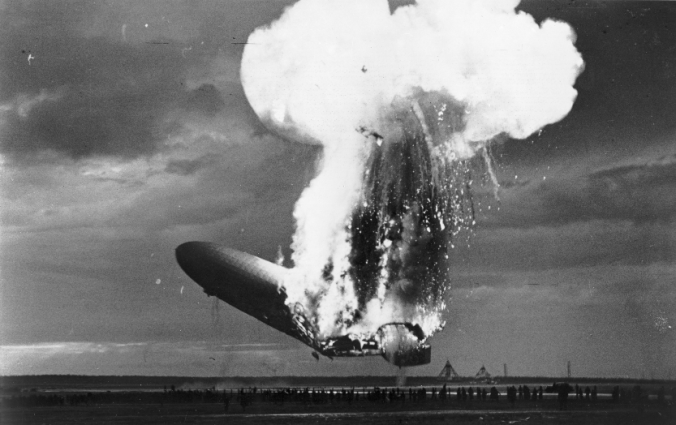
“Oh The Humanity!”

Today is the anniversary of one of the most vividly recalled disasters in U.S. history.  On May 6, 1937, the German passenger airship LZ 129 Hindenburg, a flying equivalent of The Titanic,  burst into flames while trying to dock with its mooring mast at the Naval Air Station in Lakehurst, New Jersey. The conflagration was captured in spectacular and now iconic newsreel footage, as well as in dozens of photographs.

Many  are surprised to learn that there were only were 35 fatalities in the explosion, 13 passengers and 22 crewmen,  among the 36 passengers and 61 crewmen on board (There was one fatality on the ground). The accident looked far more horrible than it was.

The appearance of the accident was so spectacular that it ended the passenger airship business That’s a  classic example of the Barn Door Fallacy, in which the reaction to  predictable and often inevitable disasters leads to  emotional over-reactions, as if by retroactively making an event impossible it can be reversed. Airships were a safe mode of travel (and a luxurious one: remember “Indiana Jones and the Last Crusade”?) in good weather when they were filled with Helium. The Hindenburg and other German Zeppelins used highly flammable hydrogen, making them flying tinderboxes, just waiting for a spark. But once the fireball that the ship became was gasped at world wide, no  explanations could make the visceral image recede. Nobody wanted to get on those things again. Continue reading →

The Pulitzer Prizes Disgrace Themselves, And For The Same Reason The Nobel Peace Prize Did…Race

When I explain the Josephson Institute’s Six Pillars of Character, I often emphasize a single ethical value under each of the “pillars” as the heart of that category. For the pillar labeled “Trustworthiness,” It’s an easy choice. The core value is integrity. Unless an organization, institution or human being possesses and displays integrity, they should not and cannot be trusted.

When the Nobel Peace Prize committee, already wounded by its  ridiculous award of the honor to Palestinian terrorist Yassir Arafat in 1994, gave another to U.S.  President Barack Obama, who had been in office less than ten months, it settled any question about its integrity: it had none. The excuse—it certainly wasn’t an explanation–was that he had made “extraordinary efforts to strengthen international diplomacy and cooperation between people”. This was fantasy, and even Obama, who should have rejected the award, said that the award was a “call to action.” The Nobel Peace Prize is not a political advocacy organization, or wasn’t. This was an unmistakable political endorsement, based on the race of the recipient. It was a rejection of its mission, and institutional integrity. No one should care who the Peace Prize goes to now. It’s a fake honorIt cannot be trusted.

Today, the committee of the Pulitzer Prize , which was established to encourage and recognize excellence in journalism, decided to toss its own integrity away in order to signal its virtue to the ideological clones of its members. Again, the catalyst was race. In the category of commentary, the prize of $15,000 was awarded to Nikole Hannah-Jones of The New York Times “for a sweeping, deeply reported and personal essay for the ground-breaking 1619 Project, which seeks to place the enslavement of Africans at the center of America’s story, prompting public conversation about the nation’s founding and evolution.”

There is a problem with this description however. The enslavement of Africans is not at the center of America’s story, and virtually no reputable historians agree that it is. The assertions made by Hannah-Jones were not merely passionate, they were substantially false. Five of the most distinguished American historians protested to the Times, saying in the course of a tough and critical letter, Continue reading →

Before The Rot Set In: Wendell Willkie And James Beggs [Corrected]

A quote in an obituary for long-time NASA chief James Beggs, who died this week at the age of 94, shocked me into realizing once again how alien basic ethics have become to our leaders in business, government, politics…hell, just about anywhere.  And once again, I’m wondering what good I’m doing, and why I bother.

Beggs had overseen more than 20 successful space shuttle launches, but he was on administrative leave due to an investigation of his conduct when the Challenger launched and exploded in 1986. As we have discussed on Ethics Alarms, a landmark example of failed ethics and decision-making caused the temporary leadership of NASA to ignore dire warnings from two engineers and send the shuttle and its precious human cargo up in dangerously cold weather.  Indeed Beggs called NASA  from his exile that fateful day to express his concern about icing. He resigned from NASA in 1986, about a month after the Challenger disaster.

Beggs was reluctant to criticize his former agency’s culpability in the accident, but he was adamant that “they shouldn’t have launched.”  “Whether I would have done anything different at the time, I’ve thought about that,” he said. “I think I would have, but that’s pure conjecture.”

Remarkable. How often does a critic of a past decision have the intrinsic fairness and integrity to say that? The Wuhan virus landscape has been polluted by extravagant and unjust second-guessing from the start, as everyone from politicians to pundits to plumbers are just certain that they would have known how to handle an unprecedented situation with significant unknown factors and substantial risk. They would have reached a different, quicker,better approach than the individual who actually had to make the call.

It’s a disgusting spectacle, and an unethical one. The “right” decision can always be made to seem obvious after the fact; critics cannot possibly know what their state of mind would have been at the actual time the decision had to be made by someone else. Beggs’ acknowledgement of that, in a situation where he could have credibly second-guessed his colleagues without equivocation, demonstrates the character of a decent and ethical professional determined to do and say the right thing even when opportunities are present for personal gain.

That story, in turn, reminded me of…Wendell Willkie. Continue reading →

Comment Of The Day: “Captain Crozier And The Ghost Of Billy Mitchell”

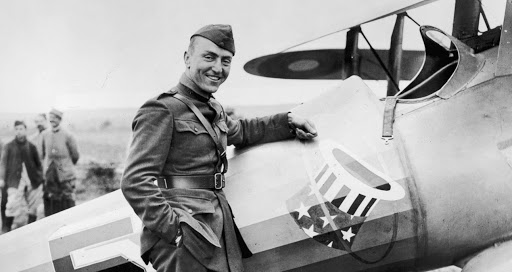
Eddie Rickenbacker

We have a lot of Michaels commenting here, and one of them, plain old Michael, I have had the honor and pleasure of knowing personally. In this fascinating Comment of the Day, he provides some fascinating details regarding Billy Mitchell’s trial, and some other perspective as well. The post immediately expanded by reading list.

Here is Michael’s Comment of the Day on the post, “Captain Crozier And The Ghost Of Billy Mitchell“:

As a cadet at the USAF Academy (class of 1969) I had Billy Mitchell  among my pantheon of heroes. Nonetheless, my philosophy professor, Col Malcolm Wakin, had us debate the ethics of the Billy Mitchell trial. He was not trying to get us to “an answer” (although it seemed pretty clear that the members of the Court were biased, and our debate centered more on Mitchell’s actions); rather, to engage in debate. It was one of the reasons he was my favorite Academy professors. Always probing. Always promoting open debate. This is a rather long intro, but I wanted the background of my own “ethics awakening” known.

Wakin was a major when he started promoting the idea that military academies should include philosophy departments. Other officers denigrated the idea, but the USAF decided to establish an Academy philosophy department and selected Major Wakin as its first department head. At the time, that meant a “temporary” promotion directly to full colonel! Therefore, not long after being called “silly” by many other officers, he outranked them. He was department head for many years, eventually retiring as a Brig General and being sought by many companies and the US Olympic Committee to provide ethics advice. Continue reading →

Captain Crozier And The Ghost Of Billy Mitchell

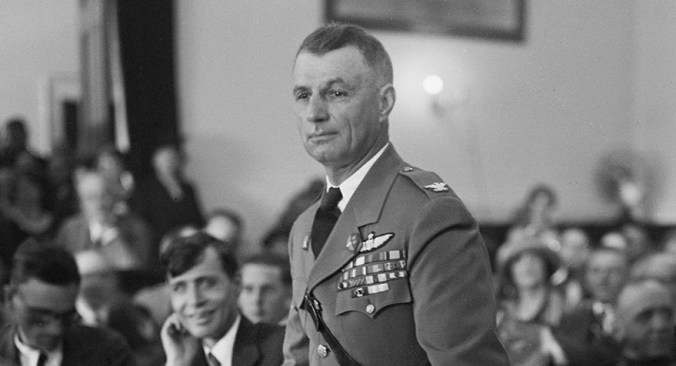
Billy Mitchell, at the court martial he wanted…

Why I didn’t think to include the tale of General Billy Mitchell in the Ethics Alarms posts regarding Captain Brett Crozier, the former commander of the aircraft carrier Theodore Roosevelt who forfeited his job by going around the chain of command to protect his crew, I really don’t know. But it’s normal for people to forget about Mitchell, and I don’t understand that, either. He, like Crozier, was an unconventional Ethics Hero, and a crucial one. And he may well have saved the world.

Do you not know the story of William Lendrum Mitchell, born December 29, 1879, died February 19, 1936? You should. Every American should.

He grew up in Milwaukee., Wisconsin. At age 18 he enlisted as a private in the army, and by the age of 23 he had become  the youngest captain in the U.S. Army. It was a pattern; being a prodigy and trailblazer in the military came naturally to Mitchell. In 1913, at the age of 32, he became the youngest officer ever assigned to the General Staff of the War Department in Washington. At a time when most in the military considered the airplane a novelty, “a risky contraption” of little or no value in combat,  Mitchell immediately saw the potential of air power, and believed that planes represented the future of warfare.

The United States had only fifty-four air-worthy planes  when it entered World War I in 1917, and only thirty-five air-worthy officers, including Mitchell, to lead them. Again he was a first, this time the first  American officer to fly over enemy lines. He organized the first all-American Air Squadron; one of his recruits, Eddie V. Rickenbacker, became a legend as  Mitchell moved his American air units to counter Manfried von Richthofen, the “Red-Baron.” When Germans planned to unleash a major ground offensive and the Allied commanders were desperate to learn where  it was being mounted, Mitchell volunteered to fly low over the enemy’s lines, and his daring mission discovered thousands of Germans concentrating close to the Marne River. Armed with Mitchell’s intelligence, the Allies launched a surprise attack on the German flank and scored a major victory. Mitchell’s solo reconnaissance flight was hailed as one of the most important aerial exploits of the war. Continue reading →

A Professional Ethics Case Study…From Broadway

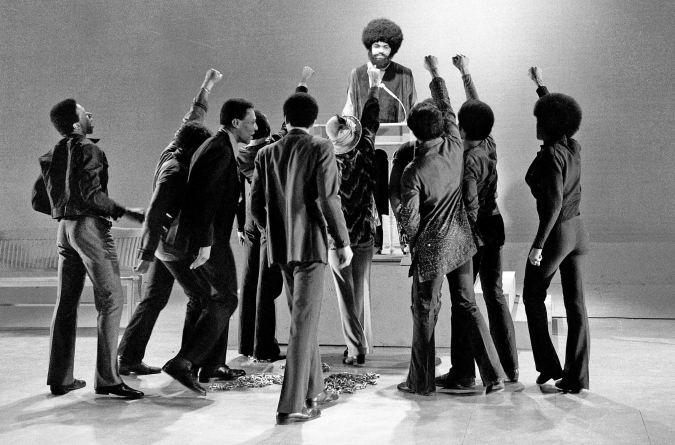
Before you read the post, can you guess who that actor is in the Afro?

Lately I’ve been helping a lot of lawyers seeking to create so-called Rule 5.4 law firms in the District of Columbia. In these firms, unique to the District, non-lawyers can be full partners. This means that they can share in the firm’s fees, which is something otherwise forbidden and a major ethics breach in the 50 states. Lawyers cannot, must not, dare not share their fees with non-lawyers…unless those non-lawyers are partners in the same firm.

There are certain requirements for that to happen, and the main one is that the non-lawyers must be supervised by a lawyer in the firm to ensure that the non-lawyers don’t engage in conduct that would be unethical for a lawyer.  The legal profession is justifiably wary that the unique priorities of the legal profession cannot be easily absorbed or understood by those who have been trained and influenced in a different culture.

It is right to be wary. Lawyers have enough trouble avoiding violations of their own rules; doctors, accountants and others, steeped in different alignments of values, can’t just shift gears like suddenly being in a law firm is like test driving a sports car. For so-called “non professionals,” a category that is increasingly contentious, it may be even harder to adjust, if not impossible.

Lawyers are often  overly optimistic about their non-lawyer partners’ ability to learn the importance of keeping all client confidences, not crossing over into the unauthorized practice of law, sensing possible conflicts of interest and illicitly soliciting clients, or engaging in misrepresentation and deceit, to name just a few. Lawyers tend to think that all professional ethics should be fungible. It’s a dangerous misconception, and there is a little cautionary tale from, of all places, Broadway, that illustrates it.

It has been mostly forgotten, but in 1969, a musical called“Buck White” opened at the George Abbott Theater. Its unlikely star: draft-resisting ex-heavyweight boxing champion Muhammad Ali.

Yes, you read that correctly. Continue reading →

Let Us Have A Moment of Appreciation For The Rude, The Vulgar And The Defiant, For They Are America’s First Line Of Defense Against Totalitarianism

Oh, how I love this about Americans!

New York Mayor Bill de Blasio announced a new program to help protect New Yorkers against the Wuhan virus outbreak. It’s quite straightforward, really: report your neighbors to authorities.

“We still know there’s some people who need to get the message,” the city’s socialist mayor said on Twitter.  “And that means sometimes making sure the enforcement is there to educate people and make clear we’ve got to have social distancing.”
The simple solution, he explained is to snap a photo of an offending person or crowd, set the location on the image, and  “text it to 311-692.”

“Action will ensue,” de Blasio promised.

History has taught us that governments seeking to bend the public to its will “for the greater good” usually seek the cooperation and participation of citizen lackeys eager to ingratiate themselves with their ascendant masters. Fortunately, the United States was settled and created by people who came here to escape presumptuous tyrants and oppressive governments not of their choosing. The contrarian RNA and traditions run deep, and it always gives me a thrill to see that while they may have been diluted a bit over time, in the face of those who either do not comprehend this nation or do not respect its unique values, the old defiance flames forth. Continue reading →