Case Study Of A Story News That Media And Web Bias Makes Impossible To Check: Susan Rice’s “Unmasking”

I am not going to write about the ethics issues in the latest Susan Rice controversy, but I am going to write about why I can’t get an objective enough assessment of what the story is to write about it competently.

Susan Rice, President Obama’s National Security Advisor,  sought to “unmask” the identities of members of President Trump’s campaign and transition team who were incidentally mentioned in foreign surveillance intelligence reports. This was first reported over the weekend by conservative conspiracy theorist Mike Cernovich, which meant that no commentators on the Left believed it, but then it was confirmed yesterday by Bloomberg’s Eli Lake.

Many conservatives treated this as confirmation of President Trump’s much-derided claim that the Obama administration “wiretapped” him. The Wall Street Journal’s editorial board issued an op-ed this morning, saying,

All this is highly unusual — and troubling. Unmasking does occur, but it is typically done by intelligence or law-enforcement officials engaged in anti-terror or espionage investigations. Ms. Rice would have had no obvious need to unmask Trump campaign officials other than political curiosity.

On Medium, Mike Doran wrote,

“In late December, the administration launched an information campaign designed to depict President-elect Trump as Moscow’s Manchurian candidate. Vladimir Putin had installed Trump in office by “hacking the election,” so the argument went; Hillary Clinton, therefore, was the rightful president.

The claim that Susan Rice was unmasking merely to arrive at the ground truth of Russian behavior would be easier to swallow if the information she gleaned from unmasking had not been used to perpetrate a fraud on the American public. The leak to Washington Post columnist David Ignatius about General Michael Flynn’s conversations with Russian ambassador Sergei Kislyak (which I discuss in this article) is the most egregious example of a senior administration official using material gathered from illicit unmasking in order to tell a very big and very pernicious lie.”

The New York Times, sadly predictable in its knee-jerk defense of Democrats rather than resolving to get at the truth,  immediately argued that there was nothing to the story at all: 

Former national security officials, who spoke on the condition of anonymity, described the requests as normal and said they were justified by the need for the president’s top security adviser to understand the context of reports sent to her by the nation’s intelligence agencies.

Mother Jones’s Kevin Drum mocked the story as pure conservative fantasy regarding a favorite villain:

But! Susan Rice is also a Republican bête noir, the villainess of Benghazi who LIED ON TV repeatedly and tried to get everyone to believe that the attacks were due to an INTERNET VIDEO when we knew all along they were really the work of RADICAL ISLAMIC TERRORISTS, a phrase that OBAMA WAS UNWILLING TO UTTER.Here’s what we can say about the Rice situation at this point.

Sarcasm is used by Drum here to hide the fact that Rice did lie about Benghazi, and was part of an Obama administration effort (that included Hillary Clinton) to blur the fact that it was a planned terrorist attack, not a spontaneous reaction to a video, which would have undermined Obama’s campaign assertions that he had “decimated” Al Qaeda. ( Mother Jones readers will not believe anything negative about Obama, Democrats, or progressives.)

The Federalist, meanwhile, called foul on CNN, which immediately moved to discredite the latest Rice story: Continue reading


O’Reilly, Fox News, And Sexual Harassment…AGAIN

Bill O’Reilly’s five accusers…so far.

I saw an online article that called Bill O’Reilly the “Bill Cosby of Fox News.” That’s not entirely fair: O’Reilly is likely just a serial sexual harasser, whereas Cosby is a rapist. Then again, they are both named “Bill,” and there are other similarities. Both have paid hush money to accusers, both have had a series of accusations made against them by women, the watermark of the sexual harasser (though Bill Cosby, so far, is way ahead in that category), both angrily deny the charges against them, and both have indignant defenders.

Both also are probably sociopaths.

Is it possible that Cosby has been wrongly maligned? Let me think…NO. Of course not. Over 50 women (what is the current count now?) do not accuse the same innocent man of sexual assault. Is it possible that the other Bill is a victim, not a predator? My “no” here isn’t quite as emphatic, perhaps, but…no. The New York Times piece yesterday thoroughly covers the evidence, and the odds against  all this being meaningless boggles the mind: Continue reading

Comment Of The Day: “From The Ethics Alarms ‘Do The Ends Justify The Means?’ Files: The Breast Cancer Survivor’s Inspiring Scam”

Glenn Logan took off from the post about Paulette Leaphart’s self-promoting breast cancer awareness 1,000-mile walk and CNN reporter Jessica Ravitz’s strangely equivocal exposé to muse on the toxic influence of social media. It’s a great post, as usual for Glenn, and I’m especially grateful because I’m behind on posts today but I have an ethical obligation to watch the Red Sox Opening Day game. (Pirates-Red Sox tied 0-0 in the 5th.)

Here is Glenn Logan’s Comment of the Day on the post “From The Ethics Alarms “Do The Ends Justify The Means?” Files: The Breast Cancer Survivor’s Inspiring Scam”:

This is yet another social media-driven disaster. We have proven ourselves unable to handle the medium, either as consumers or producers of content. In the grand scheme of things, social media has probably been the vehicle for more scams, dissociation from the real world, submersion into self-congratulatory alternate reality, fake news, and general mayhem than any innovation in my memory.

I have occasionally referred to Twitter as “the Devil,” and my loathing for Facebook knows no bounds. I still use it once a week or so just to check on friends and family (for which it is at least useful), but 99% of my input to Facebook consists of “Happy birthday, (first name here). Many happy returns” or to message Jack a link. No Luddite I, as I have been using the Internet since the early 1990’s Usenet days, and Linux as my primary operating system since 1997, so technology and I are old, old friends.

But the temptation of social media to generate attention in the name of good causes is, to me, the lesson here besides the obvious ethical wreckage caused by “the ends justify the means.” Many of us see the apparent benefits of fame, and want our 15 minutes of it very badly, usually for entirely selfish reasons. When we can achieve that in the name of a good cause, it becomes all the more insidious as a rationalization for otherwise self-serving and dishonest behavior. Continue reading

From The Ethics Alarms “Do The Ends Justify The Means?” Files: The Breast Cancer Survivor’s Inspiring Scam

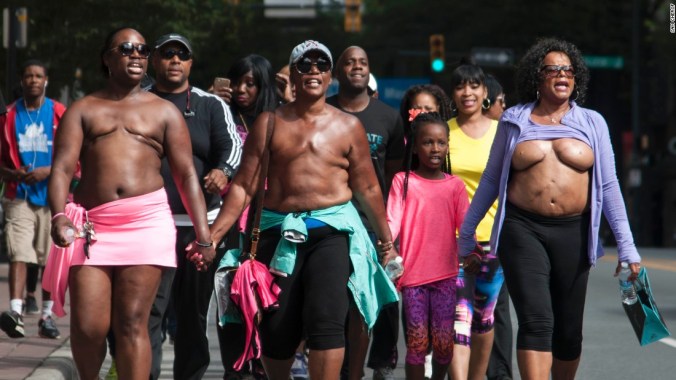
At one point, profiling the double-mastectomied Paulette Leaphart’s 1,000-mile walk from  Mississippi to Washington, D.C….topless…CNN reporter Jessica Ravitz writes,

“If even one woman’s life was saved thanks to a conversation Paulette started, wasn’t that enough? So what if our hero was flawed?”

Oh, no: the “just one child/just one life” rationalization again! (Which, I now notice, isn’t on the Rationalizations List, and it should be.)

Ravitz writes this to begin a long, detailed, infuriating narrative about the well-publicized and much-hyped crusade of Leaphart, whose journey, displaying her scarred chest,  was to ostensibly demand more funds for cancer research cure and  better and more affordable health care. She said she was a champion for women without breasts “to believe in their beauty and be proud of their strength.”

“By showcasing and embracing her scars, she hoped to inspire others to do the same,” Ravitz writes. “Her journey was bold, visual, moving. It offered a hero to admire and, given Paulette’s audacious decision to walk shirtless in the face of strangers, a rich spectacle to witness. It spoke to African-American women, who face the highest breast cancer mortality rate. It inspired legions of survivors. And it spoke to many who’d lost someone to the disease.”

Ravitz is conflicted, clearly, as she tells the complicated story of the woman whose official cause is admirable, but whose motives are murky, and whose credibility is non-existent. While explaining the mounds of evidence she uncovered that the woman has a record of deception, venality and financial flim-flam, that she sees the long walk as a ticket to fame and cash, and that she has lied and fabricated aspects of her ‘inspirational story” repeatedly while the efforts of journalists to pin her down. Yet Ravitz still ends up by  being wishy-washy and equivocal:

“There’s no way to measure how much of a difference Paulette Leaphart made in shaping the conversation about cancer in this country. She touched many minds and hearts, but whether she did so in the most honest and transparent way remains questionable.”

What? There is nothing questionable about whether Leaphart has been honest and transparent—she hasn’t. Ravitz documents her deceptions impressively. She lied about her cancer treatment. She lied about her eligibility for Medicaid and financial resources. She lied to a documentary team that had arranged to follow her, leading them to end the relationship. She lied on her Facebook page, representing her health travails by using the experiences of a friend. Her unguarded comments suggest that she began the walk as a way to make money for herself as well as research. She accepted contributions under false pretenses.  Yet the journalist still seems to want to say that all of this doesn’t matter,  if some good resulted from it: Continue reading

The Washington Post’s Very Bad, Very Revealing Day: How Often Does This Have To Happen Before Journalists Decide Their Bias Is Making Them Stupid…And Untrustworthy?

Yesterday, the Washington Post, one of the three alleged standard-bearers of U.S. print journalism, published gossip and lies as news, got caught and humiliated..twice!.., and again illustrated vividly why the distinction between hoax stories, what the mainstream media condemns as “fake news,'” and their own false reporting due to incompetence and bias, is illusory.

First, the Post published a weird and alarming story about how Secretary of State Rex Tillerson was behaving like a sultan and ordering subordinates to lower their gaze in his presence:

“Many career diplomats say they still have not met him, and some have been instructed not to speak to him directly — or even make eye contact”

This, of course, sparked widespread ridicule by the Left’s bloggers, commentators, journalists and other tweeters, despite the fact that no sources were named to back up the claim. We have here an example of confirmation bias at its most foolish,  on the part of the reporter, the editor, the paper, and the eager partisan bigots who think businessmen are monsters and the Trump administration is made up of freaks and creeps.  The Huffington Post happily published a collection of celebrities, politicians and random social media users reacting to the  story, including Democratic Congressman Ted Lieu , who said he found the article “disturbing.”

So do I. I find it disturbing that the Post, like the New York Times, cannot be trusted to check out inflammatory slurs against public official before declaring them facts. Note that the quote says the diplomats SAY they have not met him, but that some HAVE been instructed not to make eye contact. The Post stated what sounds like obvious holdover-staff rumor-mongering and sabotage as truth, opening the door for widespread contempt and disrespect of the Secretary of State without justification. Yes, that’s disturbing.

It was fake news. I didn’t believe it. I assumed this was the Post’s anti-Trump bias once again seeping into its deteriorating organizational brain. To his credit, Associated Press reporter Mike Lee immediately called foul, B.S., and fake news. Lee said that he had heard the allegation about employees being forced to avert their gaze in the presence of the Secretary of State two weeks before the Post’s story was published, and after checking into the claim,  determined that it was a rumor without basis.

“It’s compelling gossip. I have looked him  in the eyes and not turned to stone. At least not yet…This is not true and people repeating it are making it more difficult to address very real issues.”

When challenged to back up his statement that the story was false, Lee replied,

“Because I have covered State since 1999. Because I know people who didn’t start in 2009 [that is, Obama era partisans].”

Can anyone defend this Post sliming as anything but biased hackery?

But wait, there’s more! Continue reading

“Ghost In The Shell” And “Whitewashing”

Once again, a Hollywood film has political correctness furies attacking its casting. This time, it’s the sci-fi “Ghost in the Shell,” starring Scarlett Johansson.

The sad fact is, movie makers can’t win. If a black actor isn’t cast to play a white character in the source material, Hollywood is engaging in bias by eschewing “non-traditional casting,” which is necessary to remedy de facto segregation and prejudice in movies. If Charlton Heston is cast as a Mexican, as in “Touch of Evil,” it’s “whitewashing”—prejudicial and racist casting of whites to play non-whites. Of course, when Morgan Freeman, an African American, is cast to play a dark skinned Semitic character in “Ben Hur,” nobody calls that “blackwashing,” for there is no such thing as blackwashing. Casting Denzel Washington as a white character from “The Pelican Brief”: great! Who doesn’t like Denzel? Casting Denzel as the white hero of “The Magnificent Seven” in the remake, when the white hero was non-traditionally cast with the sort-of Eurasian Yul Brenner in the original, was also great, because—who doesn’t like Denzel?  Casting  Andy Garcia, a Cuban-American, as member of the Italian Corleone family in “Godfather III” was also fine and dandy, but not the casting of sort-of Eurasion Brenner as the King of Siam in “The King and I,” (even though he won the Tony and the Academy Award for an iconic performance)—, especially with all those great Thai musical comedy stars available. So that was–what, “sort-of-whitewashing”?

All right: how about a musical conceived with the novel conceit of having the Founding Fathers played by young black and Hispanic performers? Is that non-traditional casting? Minority-washing? Is it racist to stay with the original (brilliant) concept and tell white actors they can’t audition to be Hamilton, Jefferson, and Aaron Burr? Of course it’s not racist. After all, those actors are white. Screw ’em.

Are you seeing a theme here? Neither am I. What matters in casting a play, film or writing an adaptation is whether the final result works: How well do the actors play their roles? Is it entertaining? Does it make money?

Now the casting of  Johansson as an originally Japanese character in a Japanese manga comic and animated film is being attacked as racist. Whitewashing, you know. No, in fact the words applicable here are “adaptations,” “movies,” “cultural cross-pollination” and “commerce.”  In this case, not always, but in this case, the accusation of “whitewashing” is pure race-baiting.

More than forty years ago, the real life German prison camp escape engineered by captured WWII British fliers was made into the film “The Great Escape.” Brits were annoyed as production got underway, however, by the presence of heroic American prisoners in the cast, the characters played by U.S. stars James Garner and Steve McQueen. This was, British critics and veterans said, an outrage: Americans had nothing to do with the real escape. The answer by the producers contained three segments:

1. We own the film rights, and can do whatever we think will make the best movie.

2. The film is fictionalized, and makes no representations to the contrary.

3. Garner and McQueen will ensure that the film makes a profit in the U.S, plus they are both great and entertaining young stars.

Good justifications all. “The Great Escape,” as we now know,  is a classic, still honored the real event, and made lots of money. Somehow, British self-esteem recovered.

The Brits also didn’t complain when Japan’s great film auteur director, Akira Kurasawa, made an all-Japanese cast adaptation of “King Lear,” which is about a Celtic king. Wasn’t this–what, “yellow-washing”? Don’t be silly: all good stories can be told in myriad ways, in many cultural contexts. “Ghost in the Shell” is a science fiction fantasy. It is not about real people, and the characters were  Japanese because the author and intended audience were Japanese—you know, like the original “King Lear” was in Elizabethan English.

“Ghost in the Shell” director Rupert Sanders cast Johansson as the cyborg assassin named Motoko Kusanagi in the original and renamed the character “Mira Killian.” It is the “Who doesn’t like Denzel?” non-traditional casting principle, except the even more understandable “Who doesn’t like Scarlet, especially when she looks naked for much of the movie?” variation. The perambulations of critics trying to find something racist about the most obvious box office casting choice imaginable border on hilarious. At some point, actress Johansson decided it was more lucrative and fun being the next female action movie star than starring in solemn costume drama bombs like “The Girl With The Pearl Earring” and “The Other Boleyn Girl.” Since then, she has been rising as a bankable star in blockbusters like “The Avenger” films and “Lucy.” Quick: name another hot (I mean, of course, popular and bankable) female action star?

I’m waiting…

Writes Matt Golberg in a laugh riot called “Ghost in the Shell is Racist In Surprising Ways””  (another whitewashing screed, equally lame, is here): Continue reading

Ethics Quote Of The Month: Tech Dirt’s Mike Masnick On The Internet Privacy Bill

“We don’t solve problems by misrepresenting what the real scenario is. It’s true that ISPs have way too much power over these markets, and they can see and collect a ton of information on you which can absolutely be misused in privacy-damaging ways. But let’s at least be honest about how it’s happening and what it means. That’s the only way we’re going to see real solutions to these issues.”

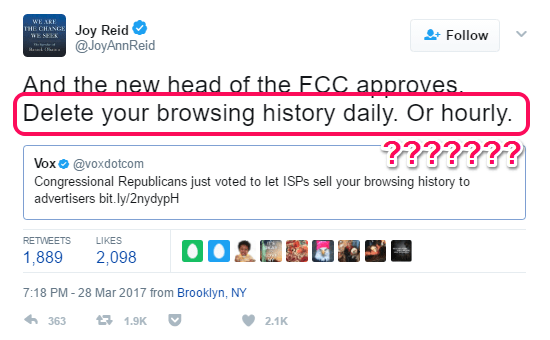
Mike Masnick on Techdirt on the ignorance of  supporters, critics, and the public regarding consumer broadband privacy protections, which were just repealed by straight party line votes in Congress, as part of the Congressional Review Act, which allows the legislative branch to eliminate regulations and limits an agency’s ability to issue similar rules to the ones being struck down. President Trump is expected to sign the bill.

I can see both sides of the Internet “privacy” debate. All I ask is that the average screaming head on TV knows what she’s talking about, and that the news media try to educate citizens on the issue, not portray it as another Obama did it so it’s wonderful, Trump is overturning it, so it’s the end of the world. This morning I watched Morning News Babe Robin Meade roll her eyes while “describing’ what the bill does completely inaccurately. The bill, her unhappy face broadcast is baaaad like everything the Trump Administration and Republicans do is baaaaad. Then she explained that the bill would allow internet service providers, browsers and “search engines” to take your internet history and sell it to big corporations.  Then she giggled about how Max Temkin, inventor of some card game* I have never heard of, promised in a tweet…

“If this shit passes I will buy the browser history of every congressman and congressional aide and publish it.”

Robin, not having the foggiest idea what the bill really did, thought this was so funny and cool. She did not inform her audience, some of whom were actually seeking reliable information and not just tuning in to ogle, that..

  • The bill only undoes the Obama FCC regulations that stopped ISPs from gathering data on its customers’ internet use, and they hadn’t taken effect yet. In other words, it changes nothing.
  • Google, Amazon, Facebook, and other browsers and internet services still can gather anything they get their grubby cyber paws on. The FCC doesn’t regulate them.

You can’t buy Congress’ internet data. You can’t buy my internet data. You can’t buy your internet data. That’s not how this works. It’s a common misconception. We even saw this in Congress four years ago, where Rep. Louis Gohmert went on a smug but totally ignorant rant, asking why Google won’t sell the government all the data it has on people. As we explained at the time, that’s not how it works*. Advertisers aren’t buying your browsing data, and ISPs and other internet companies aren’t selling your data in a neat little package. It doesn’t help anyone to blatantly misrepresent what’s going on.

When ISPs or online services have your data and “sell” it, it doesn’t mean that you can go to, say, AT&T and offer to buy “all of Louis Gohmert’s browsing history.” Instead, what happens is that these companies collect that data for themselves and then sell targeting. That is, when Gohmert goes to visit his favorite publication, that website will cast out to various marketplaces for bids on what ads to show. Thanks to information tracking, it may throw up some demographic and interest data to the marketplace. So, it may say that it has a page being viewed by a male from Texas, who was recently visiting webpages about boardgames and cow farming (to randomly choose some items). Then, from that marketplace, some advertisers’ computerized algorithms will more or less say “well, I’m selling boardgames about cows in Texas, and therefore, this person’s attention is worth 1/10th of a penny more to me than some other company that’s selling boardgames about moose.” And then the webpage will display the ad about cow boardgames. All this happens in a split second, before the page has fully loaded.

At no point does the ad exchange or any of the advertisers know that this is “Louis Gohmert, Congressional Rep.” Nor do they get any other info. They just know that if they are willing to spend the required amount to get the ad shown via the marketplace bidding mechanism, it will show up in front of someone who is somewhat more likely to be interested in the content.

That’s it.

Got that, Robin?

Probably not. Continue reading

No, Bill O’Reilly Shouldn’t Be Fired For Making Fun Of Rep. Maxine Waters’ Hair

Bill O’Reilly should have been fired before he made fun of Maxine Waters’ hair. Now would be the worst time imaginable to fire the blow-hard, untrustworthy Fox News pundit, because it would allow partisans to silence an opinion-maker whose opinions they hate by employing shameless and unjustified race-baiting. That tactic, employed repeatedly and futilely against Rush Limbaugh and other high profile conservatives, is unethical, and must not be validated by success.

In case you don’t follow O’Reilly, 1) I salute your taste and time management, and 2) here’s what caused the controversy:

O’Reilly was stopping by the set of “Fox and Friends,” and along with the gang on the couch watched some of Democratic Congresswoman Maxine Waters’ speech attacking President Trump. After the clip, O’Reilly said, “I didn’t hear a word she said. I was looking at the James Brown wig.”

Being in the Land of the Dimwits, O’Reilly sparked an idiotic defense from co-host Ainsley Earhardt, who said, fatuously, “You can’t go after a woman. Plus, I think she’s very attractive.”

Why in the world can’t you “go after a woman” when the woman is an elected official who says ridiculous things as routinely as clockwork? Earhardt’s statement was sexist on its face, and as O’Reilly quickly found out, it wasn’t sexism that he was going to be accused of with his mean James Brown wig comment. By the way…

…he had a point.

It’s a nasty, ad hominem, unprofessional point, however, that lowers political discourse into the gutter. O’Reilly has been doing this in various ways from the beginning of his career, when he wasn’t misrepresenting his credentials, his conduct, or other matters. This, however, was a relatively minor example.

Never mind though: Waters is black, so by the infinitely adjustable weaponizing definition of racism used by progressives, black activists and Democrats for the previous eight years, to criticize her at all is to be a racist. This was a sub-version; criticizing a black woman’s hair is racist. OK, comparing a black woman’s wig to an iconic black soul singer’s wig is racist. Or something: just cry racism, and the hope is that it will tar O’Reilly so badly that he will become unemployable, and no progressive will ever have their blood pressure raised by him again.

All over social media, progressives of note and non-note called for Bill’s head because his comment was “racist.” This really takes chutzpah, since mocking Donald Trump’s hair and skin-color virtually became a national pastime in Leftist Land during the 2016 campaign, and is still. What’s the standard being advocated here? Calling a white President”s comeover anything from a dead animal to decomposing vegetables is perfectly acceptable political discourse, but comparing a black House member’s wig to the hair of a dead rock icon is too horrible to tolerate? The Washington Post published a feature called “The 100 Greatest Descriptions of Donald Trump;s Hair” last June. It included such entries as

  • A mullet that died in some horrific accident
  • Combed like he’s televangelist Benny Hinn.
  • Like Biff, from “Back to the Future”
  • Like Lucille Ball
  • Like a troll doll

And most worthy of discussion,  this: Continue reading

Portrait Of A Really, Really Stupid Ethics Train Wreck

This is the incredibly ridiculous United Airlines/dress code/ leggings story. I don’t want to write about it: there are no good guys, lots of miscreants, and I have a well-earned bias against United already.

Fortunately, the travel site One Mile At A Time did a thorough and ethically astute analysis, here, ending like this:

I see non-revenue passengers asked to follow different rules nearly every time I fly — you probably do too. Nothing about two non-revs being asked to change clothes and/or take a later flight is shocking or newsworthy or even interesting to anyone with an ounce of perspective.

Exactly: not even interesting. So how did this become a hot story on cable news and social media? Well..

1.  Two employees of United didn’t follow company policy regarding proper dress when they fly free. They were Wrong.

2. A family behind the two employees in line and who didn’t understand what was happening leaped to conclusions, and made their daughter change what she was wearing too, completely unnecessarily. They were Wrong.

3. A prominent  publicity-seeking social justice warrior, Shannon Watts, was an observer of all this, and began furiously tweeting, misrepresenting what was going on, and claimed that United was engaged in sexist and discriminatory conduct, when it was not.  She was Wrong.

4. United’s Twitter team responded by referencing the §21 of the company’s Contract of Carriage, stating that passengers can be denied boarding for being “barefoot or not properly clothed”. This was confusing, since that provision had nothing to do with why the two non-revenue passengers were told to change. Typical of the crack United staff, however. Incompetent. Also Wrong. Continue reading

The Rockville Rape News Coverage


Two young men, ages 17 and 18, were enrolled as freshmen at a public high school in Rockville, Maryland after being detained and then released by federal immigration authorities. Both were in the country illegally. The students forced a 14-year-old girl into a bathroom stall at the school raped her, sodomized her, and forced her to perform oral sex on them  as she cried out for them to stop, according to police reports. Police collected blood and DNA at the scene.

Were you aware of this case? I wasn’t, and I live in the D.C. metro area, which includes Rockville. I wasn’t aware, apparently, because I have personally boycotted Fox News as a regular news source, relying instead on the straighter Fox Business channel and some equally biased sources that don’t prominently employ the likes of Sean Hannity, Bill O’Reilly, the Fox and Friends smarms, or encourage sexual harassment of female personnel.

The Washington Post wrote about the case, but relegated the illegal immigration component to afterthought status. Doing this made it a local story only, and the headline, “Two Rockville High students arrested for allegedly raping classmate at school” made it an easily ignored story. I assume high school students are periodically raped; I assume that, as in college, students occasionally falsely claim rape; I assume that it’s a big country, and bad stuff happens. The Post doesn’t mention the illegal immigrant angle until after 224 words. Without that aspect, the story can not be called national by any stretch of the imagination.

The New York Times noted, in a feature about Fox News coverage, that

“[T]here was also considerable time given to topics, like a rape case in Maryland, that viewers would not have heard about if they had turned to CNN or MSNBC. The rape case, which involved an undocumented immigrant and went virtually uncovered on most networks, received almost hourly updates on Fox, and at times was used as proof that Mr. Trump’s calls for tighter borders and a crackdown on immigration were justified.”

That’s a fair assessment of the tone of the Fox  coverage, as I have checked it on YouTube. Of course, one incident doesn’t prove anything: that kind of coverage is why I don’t watch Fox. This story does have a res ipsa loquitur aspect to it, though: if the US enforced its immigration laws sufficiently to stop these two rapists from slipping through the cracks, this 14-year-ol girl would not have been raped, at least by them. The Times also was correct: none of the major news networks covered the story, and it sure wasn’t going to be mentioned where hip millennials get their news, the comedy shows. Ah, but those stories of the poor, oppressed, good illegals are newsworthy, and covered everywhere.

Does that seem like objective, balanced, ethical news coverage to you? Because it isn’t. Continue reading