Comment of the Day: “What Michelle Obama Calls Racism…Today, Anyway”

The First Lady at Target, whose skin color obviously led a shopper at Target to ignore the blouse, cart, shopping cart, purse and sunglasses and assume that she was a minimum wage target employee who just wasn't wearing her red shirt today, because whites are such racists. It's amazing she wasn't shot, when you come to think of it. No really. Amazing.

The First Lady at Target, whose skin color obviously led a white shopper at Target to ignore the blouse, cart, shopping cart, Target bags, purse and sunglasses and assume that she was a minimum wage Target employee who just wasn’t wearing her red shirt that day, because whites are such racists. It’s amazing Michelle wasn’t shot, when you come to think of it. No really. Amazing.

I suppose it should be no surprise that my bias toward “Comment of the Day” candidates tilts toward comments that save me a post. This couldn’t be more true than in the case of this edition, a comment by johnbuger2013 (and I can’t wait to see what johnbuger2014 has to add!). The effort by Michelle Obama to paint normal , harmless, benign and trusting interactions between black and white citizens as racist profiling is really horrible, and the degree that the news media (“oh, there go those tea-bagging right-wing media again, picking on the Obamas for nothing!”) is ignoring the implication of what she did is not merely horrible but terrifying. Essentially, it is a declaration that the media will accept false accounts as truth as long as it furthers the narrative that all blacks—even the Obamas!—are constant victims of thinly disguised bias and racism.

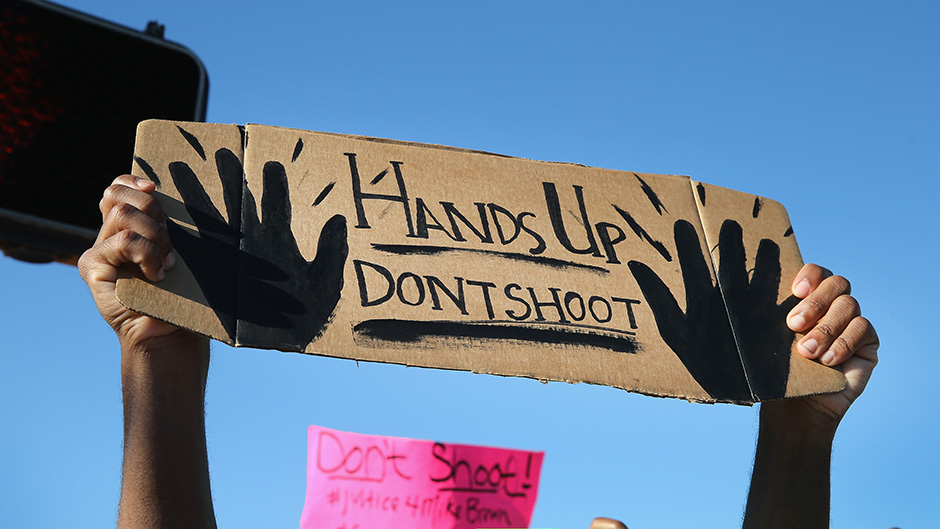
What Michelle launched into the the public discourse, and “People” irresponsibly abetted, is yet another Big Lie, like the myth that Mike Brown was gunned down while surrendering with his hands up.  Though she was dressed at the time of the alleged incident like a shopper, with a cart and a giant purse, in sunglasses and wearing a Nike cap, Michelle absurdly told the magazine that a shorter fellow shopper, who was short but white—that’s the key, white—asked her if Michelle  could take down an item from a high shelf because the shopper assumed the first Lady was “the help’–because she is black.  The story is unbelievable on its face, and more than that, it exposes Obama as an anti-white bigot. Never mind: everywhere, her offensive characterization is being treated as fact. Fact—even though it is impossible, even though shoppers ask each other, regardless of race, for assistance all the time. Knee-jerk loyalists to the cause of race-baiting, victim-mongering, eternal grievances and Team Obama—including other commenters here— have twisted logic and fairness into grotesque shapes to justify this disgraceful story. The Big Lie, as we know, works.  From the Hollywood Reporter:

“During the show’s Hot Topics section, the co-hosts addressed Barack and Michelle Obama’s recent statements that they’ve been mistaken for the help.”

But Michelle wasn’t mistaken for the help. Michelle is so paranoid, bigoted and race-obsessed that she thought she was mistaken for the help with no justification whatsoever. Never mind: her story is now Truth. From US:

“The ladies [ of “The View”] got into a heated discussion when O’Donnell, co-host Rosie Perez, and Orange Is the New Black’s Laverne Cox agreed that it’s racist when African-Americans are profiled in stores.”

But Michelle wasn’t profiled in the store (and nobody on The View’s panel of ignoramuses had te wit or integrity to point out that the whole discussion was based on a falsehood). Someone foolishly mistook her for a normal, well-adjusted, non-white-hating human being who would happily assist a stranger without assuming the worst about her. This will teach her. next time, only ask white shoppers for help: they won’t hate you for it.

As you might be able to tell, I am upset about this story, and the trend it represents, and angry with anyone, regardless of race, who won’t view it objectively and condemn it for what it is. But this is not a politics blog, but an ethics blog, and even though ethics outrages just pour out of the Obama Administration Ethics Train Wreck like the waters of Niagara, my mission is broader,  my target audience is broader still, and on a topic like this, where 90% of journalist are inclined to promote a lie, I can’t accomplish much by flogging the same issue day after day on Ethics Alarms, other than assuaging my own frustration.

I digress, however. Here is the Comment of the Day, by johnbuger2013, on the post, “What Michelle Obama Calls Racism…Today, Anyway”: Continue reading

What Michelle Obama Calls Racism…Today, Anyway

Target Michelle

The current People Magazine has a feature titled “The Obamas: How We Deal with Our Own Racist Experiences,” in which both Obama’s reflect on their personal experiences with a racist America. It begins like this…

“The protective bubble that comes with the presidency – the armored limo, the Secret Service detail, the White House – shields Barack and Michelle Obama from a lot of unpleasantness. But their encounters with racial prejudice aren’t as far in the past as one might expect. And they obviously still sting.”

Here is a relatively recent experience, the first one cited by Mrs. Obama in the article, that “stung”:

“I tell this story – I mean, even as the First Lady – during that wonderfully publicized trip I took to Target [in 2012], not highly disguised, the only person who came up to me in the store was a woman who asked me to help her take something off a shelf. Because she didn’t see me as the First Lady, she saw me as someone who could help her. Those kinds of things happen in life. So it isn’t anything new.” 

That’s right, Michelle feels—or says she feels—that this incident was proof of incipient racism, one of the “micro-aggressions” that white society inflicts on African Americans daily, sapping their self-esteem, confidence, and trust in society.

She’s right that it “happens in life” and isn’t new. In fact, it happened to me, in the local Target, coincidentally, just last month. A very short elderly Asian woman asked if I would take down a large container of laundry detergent from a high shelf. Obviously, she thought I worked at Target and was denigrating me, applying racial stereotypes to a large bald Greek-American man.

I can say with no hesitation whatsoever that what happened to Michelle at Target was not an incident of racial stereotyping. The photo above shows how Michelle was dressed on the fateful day, and anyone who would mistake her flowered blouse, Nike hat, shades and shopping cart as the uniform of a Target employee had recently escaped from a Home for the Bewildered. What wasn’t new about the encounter is that in a healthy, ethical community strangers should ask each other for kindly help and assistance, and normal, non-paranoid, non race-obsessed citizens—and especially their leaders, who are supposed to model responsible  behavior— ought not to be so warped by ideologically-dictated confirmation bias that their immediate reaction is, “Hmmmm…what did she mean by that?” Continue reading

Encore: “Ethics Call To Arms: Fight the ‘Fuck You!’ Culture”


kid fu

[This happens sometimes with 5000 posts in the bank: some topic causes me to find one that I can’t even remember writing, and I realize that I still agree with it, and if I forgot about, everyone else probably did too. The previous post led me to link to this one, and I decided that the list of steps I recommended to try to halt the culture’s slide into permanent vulgarity and incivility was worth re-posting, especially since five years ago the blog got less than a fifth of the traffic it does today. Thus I am re-posting this one, slightly edited to remove a few rhetorical excesses and outdated references, from November 18, 2010.]

“Every action done in company ought to be with some sign of respect to those that are present.”

This was the very first edict in the list of civility rules memorized by George Washington as a child, rules that shaped his character and significantly influenced not only his life and career but the fate of America. Like most of Washington’s 11o rules, the first has universal and timeless validity, pointing all of us and our culture toward a society based on mutual respect, caring, empathy, and fairness.

Recently, however, there has been a powerful cultural movement away from George’s rules and the culture of civility that they represent. Rudeness has always been with us, of course, and public decorum has been in steady decline since the Beatniks of the Fifties, to the point where it is unremarkable to see church-goers in flip-flops and airplane passengers in tank-tops. Something else is going on, however. Like the colored dots of paint in a George Seurat painting, isolated incidents and clues have begun to converge into a picture, and it is not one of a pleasant day in the park. I believe we are seeing a dangerous shift away from civility as a cultural value, which means that we are seeing a cultural rejection of ethics. Continue reading

“It’s Unethical To Be A Weenie,” Part I: The Lipreading NFL Fans

Preface: The Rise of the Weenies

Tom Brady, mid-

Tom Brady, mid-“Fuck!”

Everywhere we look, it seems, we see the United States culture being threatened by weenies and the rise of Weenyism. In a nation founded on the principles of self-reliance and individual liberty, built and shaped by stunningly brave men and women who hacked civilization out of an uncertain and perilous wilderness, there is a growing mass of citizens—the cancer imagery is intentional—who are committed to giving the government near total control over every conceivable danger, threat, peril, offense, inconvenience or annoyance, real or imagined, as the role of individual Americans devolves into pointing and saying, “There! Fix that! I don’t like that! Arrest them. Fine him.” Increasingly, the primary motivation for public policy is fear, planted by activists and politicians to panic, terrify and mobilize the weenie base, who are ever eager to trade individual freedom for protection against, well, almost everything.

I know I am hyper-sensitive to the weenification problem right now, having spent three weeks reviewing the history of the American West and its portrayal by Hollywood in preparation for my Smithsonian Associates program last week on how the Hollywood Western shaped American culture. Around the same time that the Sixties exploded, the culture’s unified acceptance of traditional American values began to collapse, just as the primacy of the Western as an entertainment genre declined. Now weenyism is in its ascendency. There are those who claim that the name of a distant football team causes psychological trauma to Native Americans who don’t follow football. Blogger Andrew Sullivan (a candidate for Head Weenie) asserts that the United States should have the “courage” to do nothing about ISIS and allow it to run amuck (the ultimate goal of the Weenies: an Orwellian “Weenies Are Heroes” motto). Feminists insist that women are so vulnerable to male sexual predations on campus that due process, fairness, common sense and much of the respect as equals their predecessors fought for must be surrendered, in a new system that begins with the presumption that all men are potential rapists and all women simpering, helpless victims, even when they say “yes.” College students and other are demanding that books, stories, essays and blog posts contain “trigger warnings” to alert weenies that words and topics in the text might give them the vapours. Needless to say—I hope—this not a healthy development for the United States, or  our culture.

The resistance to Weenyism ought not to be a partisan issue. The obligation to help the weak, disadvantaged and powerless become stronger, overcome their handicaps and acquire power is part of the American tradition too. Somewhere, however, this obligation was distorted by the realization that in a system where the government is looking for victims to justify its existence, Weakness Is Power (Orwell again). Weenies—fearful, risk-averse, passive-aggressive citizens who shrink from conflict, confrontation and the messy process of democracy— have realized that they can mobilize power to satisfy their narrow biases and interests, often at the expense of their fellow citizens’ right to liberty and the pursuit of happiness. Now the culture is tilting away from the uniquely American model that encouraged individuals to fight their own battles and succeed or fail on the merits of their causes and their own determination and skill, to one that rewards the perpetually offended, victimized, and passively unsuccessful.

It is unethical to be a weenie, and equally unethical to allow Weenieism to overcome what has been an American cultural strength.

Part I: The Lipreading NFL Fans

Several TV viewers who watched the NFL’s  New England Patriots-Green Bay Packers made official complaints to the Federal Communications Commission because they could see Patriots quarterback Tom Brady saying “fuck” repeatedly on the sidelines in frustration over his own play.  They couldn’t hear it, mind you: they were just able to read his lips. This was so horrible that they felt that the Federal government needed to investigate and take remedial action.

One complaint was from an Indianapolis parent who wrote that their “6 year old children know how to read lips.” Another was from a Pennsylvania grandparent who complained to the FCC,  “My 8 year old grandson was watching the game with me and even commented that he should not have said that.”

The Horror. Law professor Jonathan Turley opined on his blog,  “I do not believe that this was a good thing for a NFL QB to be doing.” Well, sure: he should be picking his nose of grabbing his crotch, either, but this isn’t scripted, and its a football game.  The whistle has to be blown for Federal retribution for mouthed obscenities to nobody in particular, as these sensitive parents and grandparents happily allow their delicate charges to cheer men in the process of maiming themselves and risking that their children will be changing their fathers’ diapers in the disturbingly near future?

The really frightening thing is that our regulatory morass encourages such attempts at censorship. Continue reading

“Beverly Johnson And The Bill Cosby Scandal”: NPR’S “On Point” With Michel Martin, and Me, Among Others

old-microphone

//embed.wbur.org/player/onpoint/2014/12/16/bill-cosby-beverly-johnson-assault

The panel segment starts after the interview with Johnson, about halfway in. You can also listen on the WBUR website, here.

My comments regarding the discussion are here.

The Michel Martin Question I Didn’t Answer This Morning, and More On The Bill Cosby Scandal

On pointIn the segment on “Beverly Johnson And The Bill Cosby Scandal” I just completed for NPR’s “On Point” program, out of Boston with the magnificent Michel Martin hosting, I emulated the Sunday morning talk show guests I so revile for answering questions by making their own points that have little or no relevance to what was asked. Michel asked me, as the time left in the hour-long program was ticking down, what ethical obligations consumers—that is, the audience for his concerts, TV shows and albums—have regarding Cosby, in light of the rape allegations against him.

I was still stunned by the comments made by three callers, encompassing several ethically confused assertions that you know I would find annoying:

  • That the victims should not be coming forward so late;
  • That Cosby is “innocent until proven guilty” (GRRRRR…);
  • That it’s “easy” for women to make unsubstantiated allegations against celebrities, and
  • That there is a parallel between the allegations against Cosby and the Rolling Stone campus rape story.

That last one especially had my head threatening to explode, which would not be good for my relationship with NPR, so I think I can be forgiven for missing Michel’s query. Yes, the UVA rape allegation is exactly like the Cosby scandal, other than the fact that the accusers in Cosby’s case have come forward publicly while “Jackie” has not; that its two dozen (so far) alleged victims for Cosby and one in the UVA case; that one situation is a classic example of abuse of power, wealth and influence and the other is not; that Cosby settled one claim rather than air the allegations in a court of law; and that virtually every part of “Jackie” claim has failed to hold  up under scrutiny and investigation, whereas Cosby, the one individual who could offer evidence to counter the allegations against him, has done nothing but have spokesmen and lawyers issue blanket protests and denials.

Yup. Identical.

My answer to Michel should have been this:

“It’s up to Cosby fans, If they still can still laugh and cheer at Cosby’s nice guy schtick and “America’s Dad” persona knowing that he’s a serial rapist, fine: laughter is good, get it where you can. Personally, I can’t laugh at someone whom I know has engaged in horrific acts, hurt women who admired and trusted them, and by his own conduct left another cultural hero lying face-down in the mud. I can’t forgive it, I can’t get past it, and I’m certainly not going to keep laughing. this is no different from the NFL fans who keep wearing Ray Rice jerseys, or for that matter, Democratic women who continue to swoon over Bill Clinton. If they do, they either:

  • Can’t get over their cognitive dissonance, and at some level refuse to believe what cannot be rationally denied, or…
  • Don’t think the conduct involved—punching women, exploiting women, raping women—is worth getting upset about, or…
  • Buy the absurd personal/public dichotomy, and can still cheer wife-beatering athletes, star-struck intern-exploiting leaders, and raping comedians.

All of these are sad and impossible to justify, but they are common. Does the continued support of a Cosby ratify his conduct? Not in the eyes of his undeterred fans, but in the culture? Of course it does. If Bill Cosby’s career escapes relatively unscathed by this, and he is not held accountable by society, the verdict of the culture will be a particularly extreme version of The King’s Pass: if you are rich enough, powerful enough and seen as contributing enough to society, then you will be held to a lower standard, and can get away with, if not murder, serial rape.”

Continue reading

Scheduling Note: Cosby, Michel Martin, NPR, and Me

Beverly Johnson

Beverly Johnson

Beverly Johnson, the super-model whose Vanity Fair article about being drugged by Bill Cosby decades ago when she was summoned for an “audition,” will be a guest on the Boston NPR station, WBUR, as former “Tell Me More” host Michel Martin stands in. After Johnson, a panel will discuss various issues legal, ethical and cultural about the Cosby allegations, and I’m on it, along with Renee Graham, music and pop culture critic for NPR’s Here & Now. Op-ed contributor at the Boston Globe, and Debra Katz, partner at the law firm Katz, Marshall and Banks. You can catch up on some of the ethical implications of the Cosby mess here, and some more details about the show here. If you can get the show on the radio or web, you’ll hear it at 10 AM, E.S.T.,  this morning.
Continue reading

Ethics Quote Of The Month: Aaron Sorkin

“You want the truth? Well, you can’t have the truth because I’ve decided that it isn’t newsworthy!”

“I understand that news outlets routinely use stolen information. That’s how we got the Pentagon Papers, to use an oft-used argument. But there is nothing in these documents remotely rising to the level of public interest of the information found in the Pentagon Papers. Do the emails contain any information about Sony breaking the law? No. Misleading the public? No. Acting in direct harm to customers, the way the tobacco companies or Enron did? No. Is there even one sentence in one private email that was stolen that even hints at wrongdoing of any kind? Anything that can help, inform or protect anyone? The co-editor in chief of Variety tells us he decided that the leaks were — to use his word — “newsworthy.” I’m dying to ask him what part of the studio’s post-production notes on Cameron Crowe’s new project is newsworthy. So newsworthy that it’s worth carrying out the wishes of people who’ve said they’re going to murder families and who have so far done everything they’ve threatened to do. Newsworthy. As the character Inigo Montoya said in “The Princess Bride,” I do not think it means what you think it means.”

—-Acclaimed screenwriter, playwright and Hollywood liberal Aaron Sorkin, reprimanding the news media  for publishing material from the Sony computer hacks in an Op-Ed in the New York Times.

There are many other titles for this post I considered, like “Jaw-dropping Hypocrisy of the Month,” “Self-serving Delusion of the Month,” and “This Is The Tragedy of Partisan Delusion: Won’t You Give Generously To Help Aaron”?

I’ve got to give the man credit: it takes world class gall for to write something like this self-serving for international consumption. Self-righteous, Freedom of the Press-promoting (Sorkin is the creator and writer of “The Newsroom” series on cable) Hollywood liberals applauded and screamed for blood when a near-senile billionaire’s private comments made in his own bedroom were surreptitiously recorded by his paid female mistress and plastered all over the media, because the private, private, private words suggested that he held racist attitudes, and no matter what he actually did (which was sufficient to be named an NAACP “man of the Year,” a distinction Aaron Sorkin has never earned),  that meant that he had to be publicly humiliated, fined millions and stripped of his business. We didn’t hear Sorkin protesting that this wasn’t newsworthy. Nor did the Sorkins of an earlier generation protest when the very same newspaper carrying his essay published criminally stolen Defense Department documents that, whatever was contained in them, were part of a sincere effort to win a war. Continue reading

Smith College President Kathleen McCartney’s Apologizes For Saying “All Lives Matter”: Is There A Problem?

Damned if you do, damned if you don't.

Damned if she does, damned if she doesn’t.

There is a problem, all right, but not the one you might think—at least not this time.

Smith College President Kathleen McCartney attempted to  show support for her students  protesting racism and police brutality by sending a campus-wide email titled, “All Lives Matter.” But the official slogan of such protests is “black lives matter.” McCartney immediately came under fire from black students and others, accusing her of minimizing the specific nature of her concerns. “No, Kathy. Please do not send out an email saying ‘All lives matter.’ This isn’t about everyone, this is about black lives,” Sophia Buchanan, a Smith student, in a typical critique.

The college President apologized several hours later, saying that she hadn’t thought about the fact that “all lives matter” was being used by some as a rebuttal to “black lives matter”:

“I regret that I was unaware the phrase/hashtag ‘all lives matter’ has been used by some to draw attention away from the focus on institutional violence against Black people…. “It minimizes the anti-blackness of this the current situation; yes, all lives matter, but not all lives are being targeted for police brutality. The black students at this school deserve to have their specific struggles and pain recognized, not dissolved into the larger student body.”

That statement put her in the cross-hairs of the “conservative media” and others, who treated it as a full-fledged “gotcha!” What??? Saying that all lives matter is offensive now? What next Orwellian proposition will political correctness bullies demand from spineless college administrators? Continue reading

Comment of the Day on “Comment of the Day on ‘The Perils Of Over-Regulating The Police: A Case Study'”

Robocop

Stephen Mark Pilling contributes the second consecutive Comment of the Day providing perspective on the issue of police militarization, in response to the first. Here is his Comment of the Day to the post (by dragin_dragon, which you should read first if you haven’t yet), Comment of the Day on “The Perils Of Over-Regulating The Police: A Case Study”

When critics speak of the “militarization” of the police, not all are looking at it from the same viewpoint. Some are, of course, sociopathic or are conspiracy theorists. Some have swallowed the loudly flaunted concept that policemen are evil racists, corrupt ward healers in uniform or just about anything heinous, as they represent law as an absolute, not a relative.

There is a rational based distrust, however. Many of us grew up in a time where the police still walked a beat or patrolled his neighborhood in a squad car, armed with nothing more than a revolver. We’re also the product of an old tradition of law enforcement that stems from the British mold. Unlike the continental European system of paramilitary gendarmes, we adapted a system of localized lawmen, run by an elected county sheriff. The metropolitan police department is still a relatively new phenomenon, started in late 19th Century London.

To many citizens, police who are unaccountable to a directly elected chief and who sport automatic weapons strike a sour note. But recently, people have been seeing them acquiring armored vehicles, military assault training and a tendency to wearing black uniforms. They’ve also noted an increased likelihood of these tactics and weapons being utilized and the increased incidence of “no knock entries”. Likewise, citizens have been imaging police making arrogant idiots out of themselves and caused other cops to become ever more touchy about cell phones, whether they’re right or wrong.

These and other factors have been serving to create a gap between the citizens and the police. That’s never a good thing, of course, because that trust is vital in a free society. Citizen distrust only deepens when they perceive policemen in whom this sense of civil mastery is full blown. As a former military cop, as a private citizen and as a friend or relative of a lot of civilian cops, I’ve seen all this from different angles. I’ve also seen the divide deepen in recent days.

One small note. The funding of police units on all levels directly from federal sources coincides with the worry by many that state and local police units may be more or less within the pocket of federal departments. The actual militarization of once innocuous federal police units and the memory of Obama’s projected National Civilian Defense Force has resulted in fear that this is an intentional part of a program to create an instrument of oppression. For myself, I highly doubt that any street cops would lend themselves to some “martial law” based takeover of the homeland of America. What I’m not sure of, though, is how many in higher authority have not conceived of the notion and would execute it if they could.

Again; it’s vital that the bonds of trust be strengthened between the police departments and those law abiding citizens whom they “serve and protect”. They must never- ever- be heard to make disparaging remarks about “civilians”, as that only deepens the gulf. In the Army Military Police Corps, the official motto is “Of the troops and for the troops”. It’s a good motto. It should also carry over to every local police or sheriff’s department in America. “Of the citizens and for the citizens”. Policemen who embrace that attitude will seldom go wrong. Both they and the communities they serve will benefit.

Continue reading