“Baby-Killing” Ethics

No "moral right to life"?

Aided by Rick Santorum’s over-heated rhetoric, the concept of infanticide (I’m against it, by the way) has been hot in the marketplace of ideas lately.

A group of medical ethicists at Oxford made headlines by arguing that parents ought to have the option of killing their newborns because they are “morally irrelevant” and thus ending their lives is no different from abortion. After some recent examples of the press mangling the real message of scholarly papers, I was dubious about the news reports, but son of a gun, that’s what these ethicists wrote.

The article, entitled “After-birth abortion: Why should the baby live?”, was authored by Alberto Giubilini and Francesca Minerva, who argue, Continue reading

Ryan Braun, Steroids and Fairness

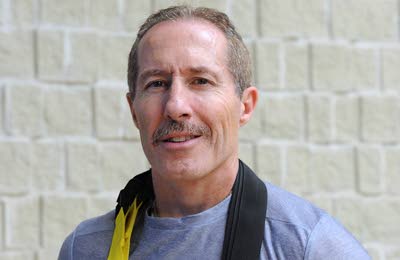
If Ryan Braun is innocent, this man, who never met him. tried to ruin his career. It can happen…you know, like Mark Furman tried to frame O.J.

The strange case of Ryan Braun, the 2011  National League Most Valuable Player who tested positive for steroids during the post-season play-offs, once again raises the perplexing ethical issue of fairness when formal procedures concerning alleged wrongdoing are involved.

Braun’s positive test sent a shudder throughout baseball. He was supposed to  be one of the game’s rising young “post-steroid era” stars. For Braun to be caught cheating was a discouraging reminder that the game had not left its disastrous days of pumped-up stars and dubious records behind: now the legitimacy of an MVP season was being called into question. Braun vehemently denied the charges (as every positive-testing player has) and appealed them, a move that had been futile in every previous case. To literally everyone’s surprise, however, the three member arbitration panel ruled 2-1 in Braun’s favor. Although the report of the independent arbitrator who cast the deciding vote has yet to be released, the reason Braun prevailed appears to be that the Major League Baseball contractor who had  responsibility for sending Braun’s urine samples to the testing facilities had to store them at his house for the weekend because FedEx had closed before he could mail them to the lab. This created a sufficient break in the chain of custody, it seems, to make the results invalid. Continue reading

Ethics Hero: Journalist Harris Meyer

Harris Meyer is an Ethics Hero because he won’t let a bad lesson go unchallenged.

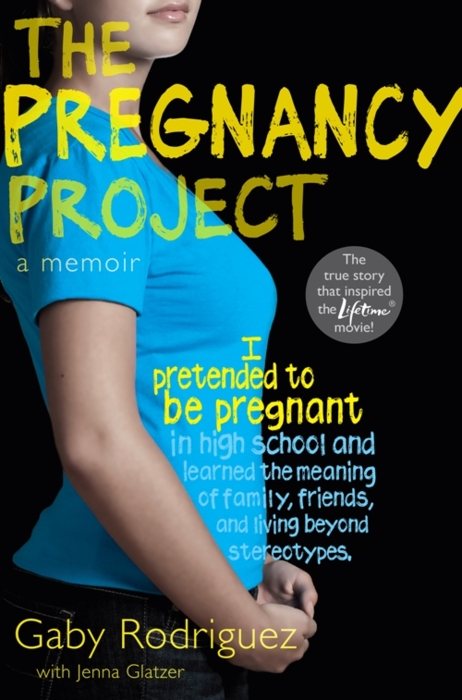
Meyer is an award-winning  freelance journalist and a former editor at the Yakima (Wash.) Herald Republic. That was the paper that first broke the story of Gaby Rodriguez last year, which I wrote about here. With the encouragement of her high school principal, Rodriguez, a senior, embarked on some amateur social science research that involved deceiving everyone in her life except her mother, one (of seven) siblings, her boyfriend, and the principal. She pretended that she was pregnant, suing padding. She faked the pregnancy for months, finally announcing the sham in a student assembly. This extended hoax was supposedly designed to expose how pregnant teenagers are treated by their peers and others. It was, by any rational standard, a despicable thing to do—a betrayal and exploitation of her friends,  her boyfriend’s family, her siblings and teachers. Deception on such a scale must be justified, if at all, by both need and necessity. Were there other, less destructive ways to investigate the treatment of pregnant teens? Sure there were; interviews come to mind. Collecting published journals and other accounts. But Gaby’s unethical stunt was in spiritual synchronicity with a reality show-obsessed culture, where fake is entertaining and collateral damage is of no concern.  I wrote: Continue reading

Weekend Ethics Catch-Up

If you took an ethics break this last weekend of February, here’s your Ethics Alarms make-up assignment:


Comment of the Day: “Charles M. Blow’s Anti-Mormon Tweet, Chapter 2…”

Michael, who is now the Ethics Alarms all-time leader in the Comment of the Day category, scores another with a thought-provoking post inspired by the New York Times’ stunning disinterest in its columnist tweeting a religious slur about Mitt Romney. I’ll have some added reflections at the end. Here is his Comment of the Day onCharles M. Blow’s Anti-Mormon Tweet, Chapter 2…”:

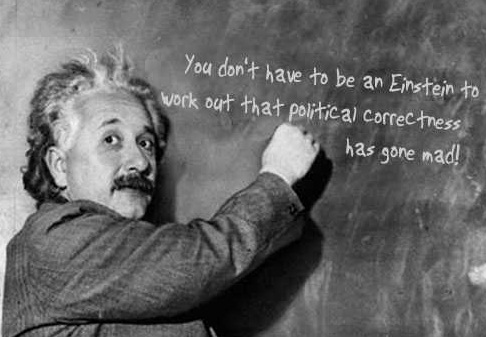
“I remember an article about this when I was in college. In analyzing how the news media treated different races, they came up with the PC Hierarchy. Anyone higher on the hierarchy can criticize or be insensitive to anyone below them. If there is a conflict between two groups, the one higher on the PC scale is assumed to be right”

PC Hierarchy of RacesContinue reading

Unethical Quote of the Week: The Washington Post Editors

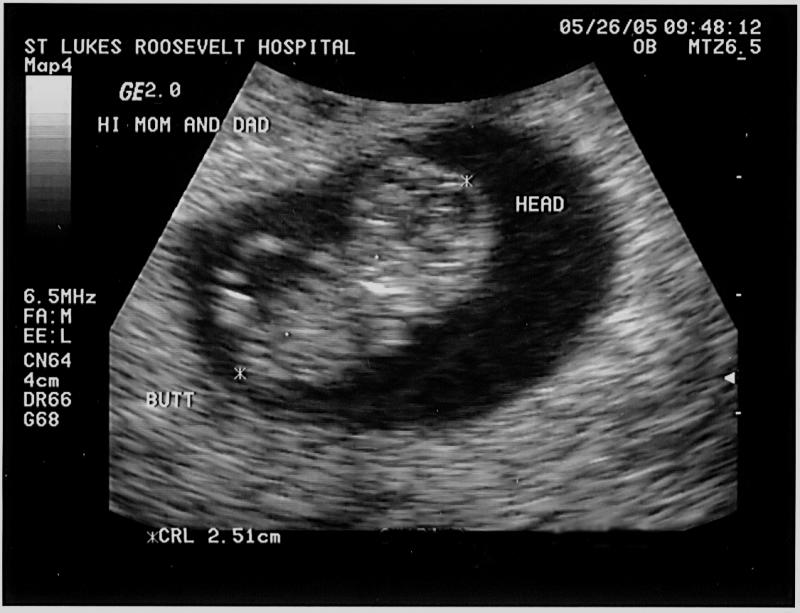
“In their anti-abortion fervor, they thought that requiring ultrasounds, even transvaginal ones, was justified if it would change the minds of some women who’d considered ending their pregnancies”

The Washington Post, in an editorial condemning the efforts of Virginia’s Republicans to pass a measure requiring an ultrasound scan of the fetus before a woman could get an abortion. The bill, which had been poised for passage, evaporated after it was revealed that women in the earliest stages of pregnancy would be required to suffer an invasive procedure, and Republican Governor Bob McDonnell announced that he would not sign it in its current form.

Seldom has an editorial managed to be so frighteningly dismissive of human life while being entirely correct on the issue it was discussing. Continue reading

Charles M. Blow’s Bigoted Anti-Mormon Tweet, Chapter 2: Ironies, Regrets, and Hypocrisy on the Left

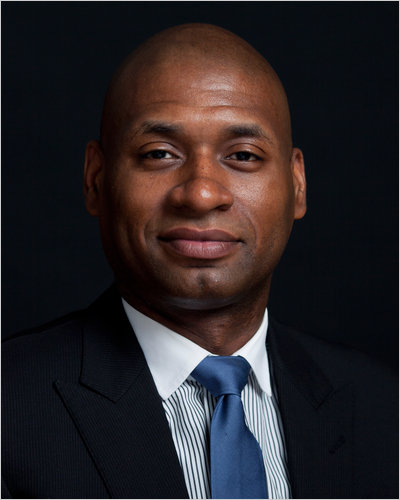
Charles M. Blow, trapped in regret-apology hypocrisy. Fortunately for him, his paper doesn't care.

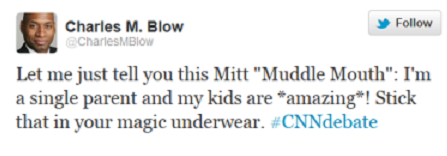
Charles M. Blow, the New York Times columnist who sent his followers an uncivil, unprofessional and bigoted tweet regarding Mitt Romney and his faith during Wednesday’s debate [“Let me just tell you this Mitt ‘Muddle Mouth’: I’m a single parent and my kids are *amazing*! Stick that in your magic underwear.”] issued a fascinating…something...today in response to criticism, which did not come from the supposedly bigotry-sensitive left. He tweeted:

“Btw, the comment I made about Mormonism during Wed.’s debate was inappropriate, and I regret it. I’m willing to admit that with no caveats.”

It is fascinating to me that this is being called an apology by Blow’s supporters and conservative critics alike. If it is an apology, and that is open to dispute, I’d like someone to explain to me how Blow can use “regret” as a stand-in for “I apologize,” and yet the same commentators who are interpreting the word that way have insisted that President Obama’s repeated use of “regret”to refer to past U.S. foreign policy actions was not the equivalent of apologizing, and have in fact stated that this interpretation by conservative critics is “a lie.”

Among those who have defended the President in this way, I believe, is Charles M. Blow. Continue reading

Albert Pujols, Stan the Man, and the Shameless Jeremy Lin Censors

THIS is "El Hombre." Stan's Polish, by the way. Do you care? Does the Asian American Journalists Association?

If you don’t know who Albert Pujols is, you should: he’s probably the best hitter in baseball, a slugging first baseman whose career so far has already guaranteed him a spot in baseball’s Hall of Fame. Over the winter he left his original team and the city that worshiped him, St. Louis and its Cardinals, because, though the team he professed to “owe everything” offered him a deal that would guarantee that his great-grand children could be beach bums all their lives, a team in Southern California, the Angels, offered him even more, so he can light his cigars with C-notes and pave his driveway with gold.. I think elevating money over every other value to that extent is an unethical and culturally corrupting choice, and said so at the time.

Now Albert has re-endeared himself to me  by publicly objecting to the Angels’ pre-season promotional campaign calling him “El Hombre.” “What?” you say. “I thought you have been condemning political correctness in the discussion of athletes with ethnic identities! Don’t you think it’s ridiculous for Pujols, who is of Hispanic descent, to object to a nickname that plays on his heritage?” Indeed I have been condemning such political correctness and over-sentivity, and still do. But that isn’t why Albert is objecting.

Back in St. Louis, you see, they also tried to call Pujols “El Hombre,” in a deliberate evocation of the city’s most famous and celebrated slugger, the great Stan “The Man” Musial, one of the best and most admirable players in baseball history. Pujols put a stop to it. There was only one player in the city who could carry the title “The Man”, he said, and that was Musial, who is alive and in his 90’s. Just saying “the Man” in a different language didn’t change the fact that the honor was Musial’s, and shouldn’t be taken  away. Stan Musial was and is “the Man;” Pujols respected that, and defended it Continue reading

Ethics Dunce: NY Times Columnist Charles M. Blow, and the Times, If It Doesn’t Do Something About Him

Behold the above tweet from last night, appearing on the Twitter feed of Charles M. Blow, a regular New York Times op-ed columnist. And note:

  • This is supposed to be a respected and respectable journalist of the preeminent U.S. newspaper, and he is sending gutter-level messages via social media, plus
  • …his tweet immediately descends to crude name-calling (“Muddle-Mouth”) aimed at a Republican presidential candidate, and
  • …goes lower still, making first a crude reference to underwear, and
  • …making the reference a religious slur as well. Continue reading

Facebook’s Weird Ethical Standards

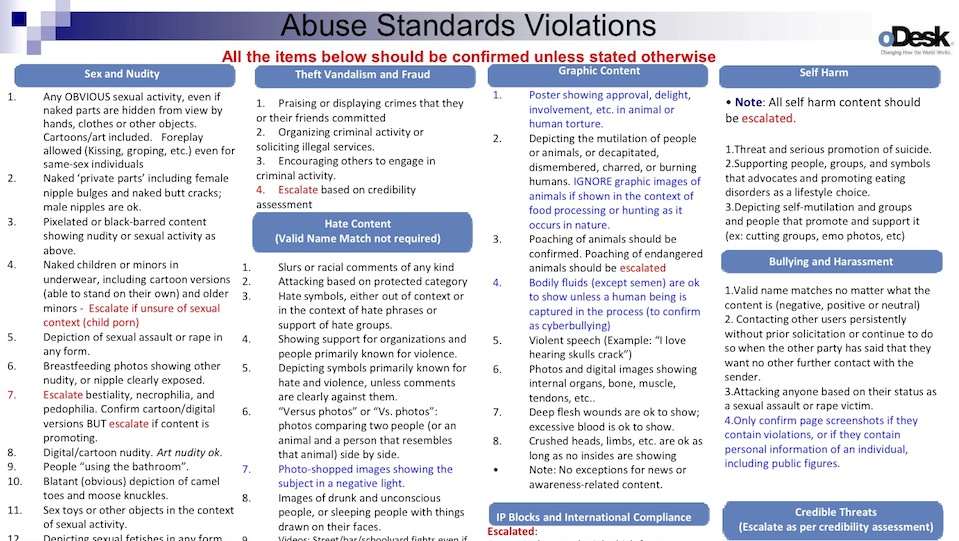
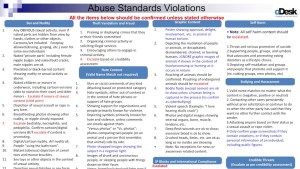
I know, they're too small to read. Never mind; they also don't make any sense

The idea of Gawker, a website that shares the ethical standards of the seamier denizens of “Rick’s” in “Casablanca,” doing a legitimate ethics expose gives me a brain cramp, but the gossip site has given a platform to a Facebook whistleblower, sort of.

I say “sort of,” because knowing Gawker, I wouldn’t be surprised to learn that he was paid to rat out his former employers-once-removed (he was hired by  Facebook’s outsourcing firm that handled his training—oDesk), making him ethically less of a whistleblower than a candidate for Gawker’s editorial board. The argument, I suppose, would be that a dollar an hour, which is what Gawker’s source says was his princely reward for doing Facebook’s dirty work, shouldn’t buy much loyalty and confidentiality, if any. Ethically, that’s false: you are obligated to abide by the terms of bad deals if you voluntarily agree to them. Practically speaking, it is true. A worker a company exploits is likely to harbor more animus than good will, and it isn’t the happy workers who blow whistles. Fine: neither Gawker’s source nor Gawker are ethically admirable. On to Facebook.

The whistleblower is Amine Derkaoui, a 21-year-old Moroccan who was recruited by an outsourcing firm to screen illicit Facebook content. This is what he was paid a dollar an hour for, which, when one considers the news reports flying around recently about how rich Mark Zuckerberg is, and after the company filed its record $100 billion IPO, seems unequivocally exploitive. His real exposé, however, involves what he was paid to do, which was to be Facebook’s censor. Derkaoui supplied Gawker with a bootleg copy of part of Facebook’s abuse standards, which lays out what the company believes is appropriate and what it believes should be banned from the web. Thus it is Facebook’s morality, revealing the ethical standards that the company embraces. Continue reading