Professor Who Most Needs To Get Over Himself Of The Month

Gilbert Kalonde, a Montana State University assistant professor of technology education, says an employee at the Bozeman, Montana Wal-Mart wrongly listed his occupation on a fishing license as “toilet cleaner” rather than “pompous assistant professor.” This, the toilet cl…er, professor says, constitutes libel, and he is suing for damages because the license has held him up to “hatred, contempt, ridicule.”

Boy, you can say that again. I know I always judge people by what it says on their fishing licenses. Come to think of it, I just judge people harshly if they have a fishing license. Actually, I’m not sure I wouldn’t regard a toilet cleaner as more admirable than a college professor. True, he doesn’t teach at Wellesley….

Why would anyone get upset over something like this? I would be hauling out that license at parties. Yes, that’s not exactly sterling service he got, but it’s Wal-Mart. Besides, based on the law suit, I bet the prof was so insufferable–“See here, my good man, make sure you place the correct occupation on that document, lest my credentials are obscured!”—that the Wal-Mart clerk decided to teach him a lesson in humility. I guess it didn’t work.

The ethical values involved here are proportion, compassion, humility, and kindness, none of which Gilbert Kalonde appears to possess.

At least he has a sense of humor.

______________________

Pointer: Fark

Ethics Quiz On A Story I’m Betting Is A Hoax: The “Identical Twins” Married Couple

I have now read three accounts in borderline news sources about a Mississippi married couple who went to a fertility clinic and discovered to their horror that they were “identical twins.” I’m assuming it is a fake news story, perhaps planted through collusion with the Trump campaign by Russian government operatives, and not just because identical twins cannot be different sexes. (Hey! Maybe one of them had  gender reassignment surgery! Now that would be a story!)

I suppose it’s possible; Robert Ripley found odder coincidences for decades, but never mind: let’s assume for the sake of ethics problem-solving practice that the story is true. (I’ll be stunned if it is.)

Your Ethics Alarms Ethics Quiz of the Day is…

What is the couple’s most ethical course now that they know they are siblings, or is there one?

Key question: Is this ick rather than ethics?

Trap: I’m not asking what’s moral.

It’s all yours…

Comment Of The Day: “More Ethics Observations On The United Flight 3411 Ethics Train Wreck”

Public discussion and media reports is finally waning regarding United’s cascading botch of a full and fully seated flight in which the airline wanted to get four seats back and had neither the law, nor policy, nor sufficient justification to acquire them. Thus its agents lied, exceeded their authority, mistreated a passenger, called in police, and they further escalated the fiasco, badly injuring the victim in the process. (Their conduct was similar in some ways to that of the police officers who killed Eric Garner.)

Even now, however, many people still believe this arose from an overbooked flight. Some misguided pundits are still blaming Dr. Dao. The news media has not taken responsibility for its terrible reporting on this incident, and still hasn’t done a good job explaining what really happened. Meanwhile, Delta has taken advantage of United’s pain by announcing that it will pay up to $10,000 to bumped passengers in the future. And Southwestern won itself an all time record for audacious cheekiness with the above ad, which United deserves. [UPDATE: Apparently this is a hoax, not a real ad. Too bad.]

Here is brian’s Comment of the Day on this ethics train wreck in the sky:

The I don’t think you’re being overly cynical here. I have seen multiple responses from media, politicians, and the CEO all following the basic pattern, propose solutions that do not address what went wrong. A handful of employees acted incompetently, and United (and probably most airlines) didn’t think through their carriage contract, police were ill trained, and the culture of United is horrible in general. But instead of addressing any of those issues, they all have motivated reasons to misconstrue the issues and offer ‘solutions’ to problems that don’t exist.

Things that could be done:

1) CEO comes out and says we are going to train and empower our staff to deal with more and varied types of situations as they arise. We also recognize that our current customer facing staff do not have the appropriate level of customer service training, which is entirely the fault of management. We are going to fix this starting now. We have pulled together XYZ resources and will be meeting weekly for the next 12 weeks to generate a comprehensive plan to begin changing our culture. You can expect an interim report in 4 weeks.

2) CEO says, we are going to set up a true reverse auction, paying cash, for all situations when we have to either remove or deny a paying customer due to reasons beyond their control. We will train all gate staff and front line managers on how to conduct this easy and straight forward auction. We should have been doing it already, because the value of the additional seats we can sell by overbooking far outweigh the costs we incur from the small portion of riders who we must justly compensate for any inconvenience.

Continue reading →

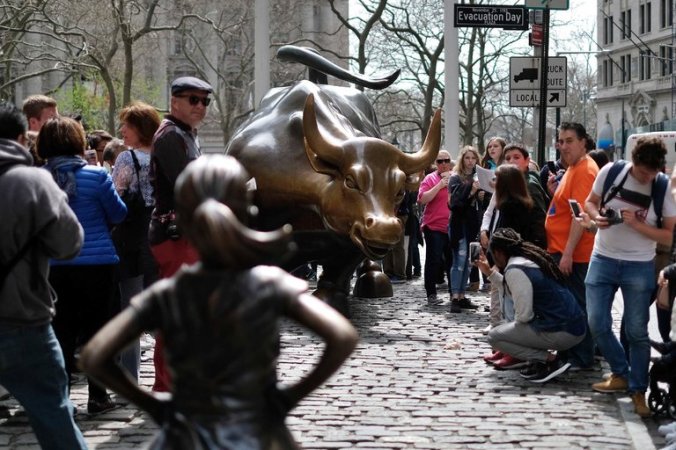
Statue Ethics Stand-Off: “Charging Bull” vs. “Fearless Girl”

The Wall Street art ethics controversy pitting a nearly 30-year-old sculpture of an angry bull against the upstart statue of a defiant little girl has fascinating cultural implications. The ethical solution to the confrontation are simple and undeniable, however, though the legal issues a bit less so. “Fearless Girl” has got to go.

Arturo Di Modica created “Charging Bull” in response to stock market travails during the late 1980s. The three-and-a-half-ton sculpture was placed near Wall Street in the dead of night,  and was embraced by the financial ditrict and New Yorkers as iconic public art. The artist copyrighted and trademarked his work, which he has said was meant to symbolize “freedom in the world, peace, strength, power and love.”

I don’t get the love part, but okay: the point is that the bull is a positive metaphor, not a sinister one.

The “Fearless Girl” statue was positioned this year, the night before International Women’s Day, in a direct stand-off with the bull. It had been commissioned by State Street Global Advisors, a financial firm based in Boston, as a public relations and advertising move and classic virtue signalling. State Street Global’s home page trumpets the new statue’s message of “the power of women in leadership” and uses it to urge “greater gender diversity on corporate boards.” The metal girl’s  cynical and self-serving origins don’t seem to bother the work’s fans though.

The problem is that the message of “Fearless Girl” requires the participation of the bull to make any sense and to have any power at all. Otherwise, it might as well be Pippi Longstocking.  In essence, the new statue appropriates Di Modica’s work, and violently alters it. The artist is a furious as a charging bull that what he intended as a symbol of capitalist power and national vigor has been transformed into a sexist representation of male domination. Di Modica and his lawyers demand that the statue be moved away from its bull-baiting position, arguing that State Street Global commissioned “Fearless Girl” as a site-specific work conceived with “Charging Bull” in mind. It thus illegally commercialized  Di Modica’s statue in violation of the artist’s intent and copyright. They also claim that the city  violated the artist’s  legal rights by issuing permits allowing the four-foot-tall tyke to face off with the bronze bull without the artist’s permission. Letters to the Mayor DiBlasio, Ronald P. O’Hanley, the president and chief executive of State Street Global; and Harris Diamond, the chairman and chief executive of McCann Worldgroup, State Street Global’s marketing agency demand the removal of “Fearless Girl” forthwith.

Ethically, “Fearless Girl” doesn’t have a leg to stand on. Continue reading →

From The “Saint’s Excuse” Files:The Catholic Church, Penn State, and Now Choate…What Have We Learned?

Protect the hive. Always protect the hive…

The renowned private boarding school school Choate Rosemary Hall, alma mater of such luminaries as John Dos Passos, Edward Albee, Glenn Close, multiple Kennedys and dozens more of the rich, famous and powerful, , just revealed that at least twelve former teachers had sexually molested, and in one case, raped, students without the crimes being reported to police. The pattern continued over decades. In some cases, teachers were allowed to resign after being confronted with evidence of abuse, and administrators wrote still letters of recommendations for them after they were fired. The predators then went to other schools, sometimes in positions of power and authority.

After the similar institutional conduct revealed by the Catholic Church and Penn State, does anyone believe that this is a rare occurrence in institution, including the most prestigious—and virtuous!—ones? The lesson is that established, powerful, iconic institutions are programmed to protect themselves above others, and regard their own missions and continued vitality more precious than any single individual, even a child.

Revisiting one of the most important of the Ethics Alarms’ 92 rationalizations:

13. The Saint’s Excuse: “It’s for a good cause”

This rationalization has probably caused more death and human suffering than any other. The words “it’s for a good cause” have been used to justify all sorts of lies, scams and mayhem. It is the downfall of the zealot, the true believer, and the passionate advocate that almost any action that supports “the Cause,’ whether it be liberty, religion, charity, or curing a plague, is seen as being justified by the inherent rightness of the ultimate goal. Thus Catholic Bishops protected child-molesting priests to protect the Church, and the American Red Cross used deceptive promotions to swell its blood supplies after the September 11, 2001 attacks. The Saint’s Excuse  allows charities to strong-arm contributors, and advocacy groups to use lies and innuendo to savage ideological opponents. The Saint’s Excuse is that the ends justify the means, because the “saint” has decided that the ends are worth any price—especially when that price will have to be paid by someone else.

Continue reading →

Comment Of The Day (2): “A Definitive Tome About Pit Bulls, Which The Breed Bigots Will Ignore, Naturally”

No, this isn’t my sister’s Havanese, but you get the idea…

“There are two kinds of people…” and one of the most undeniable ways to finish this much-worn sentence is “those who understand dogs and those who don’t.” To understand them is to marvel at them, cherish them, and love them. Not to understand them, as an astounding number of humans do, is to live in ignorance and fear, and to miss out on one of the mystical joys of life: bonding with an animal.

I never fully appreciated this until my younger sister under went a rare midlife conversion, changing sides from the canine-phobic to the dog-allied.  Divorced, she was faced with an empty nest, and though she had always emulated my mother, who had nothing but contempt for dogs (cats too), decided that she could not bear returning to a house with no one to express joy that she had returned.

My wife, who had witnessed  my sister’s callous treatment of our dogs, who were greatly insulted, was dubious, and was certain her new companion, an abusrdly cute, cheerful, silly, dumb as a brick Havanese named “Elphie,” would be neglected. She has never been happier to be wrong.

My sister’s entire attitude has changed, not merely toward dogs, but toward the whole of humanity and the world. She is happier, friendlier, more resilient and less anxious. She has fearlessly assisted a huge lost wolf hybrid; she has guided a wandering Great Dane home; she lets pit bulls leap up to lick her. Now she complains that she missed so many years of interaction with what she has learned are fascinating, empathetic, loving creatures with individual personalities and the ability to surprise and delight every single day.

I thought of my sister as I read Lisa Weber’s Comment of the Day on the most recent Ethics Alarms post about the other side. Here it is:

A dog’s heart is cooperation over competition. Here in SoCal the shelters are full of Pitties and Chi’s and their mixes. I blame greedy ignorant breeders, a throw away society that thinks nothing of getting rid of dogs that become an inconvenience, and a lazy society that won’t put the effort and time into researching before acquiring, socializing and training….but still wants a puppy over an adult dog…

I sit at my desk, typing this listening to the soft snores of the dogs at my feet. All 16 of them. Yesterday there were 17. I had to help one old fellow shuffle off the mortal coil yesterday. Some asshole dumped him and his elderly lady friend at the shelter, claiming they “found them running stray”. Because they were “stray” the shelter by law had to hold them 5 days for their owner to reclaim them, which never happened. See in our state, it costs $80 to surrender your dog, but to drop off a stray is free. Hence we get a lot of strays that certainly weren’t stray.

The little old pug dogs, Monty and Matilda, sat on the cold, cement floor of a kennel terrified for 5 days before I could be allowed to get them. By then they both had caught kennel cough and an intestinal bug. Matilda has a collapsing trachea, and her kennel cough quickly turned to pneumonia. I had to put her in my ICU cage on oxygen twice to save her life. She is recovering now, but still doesn’t want to eat much. Her boyfriend Monty had bizarrely abnormal x-rays and an ultrasound revealed a huge tumor on his liver which was displacing his other organs. I had him just two weeks before having to let him go. At least he died warm and loved with gentle hands and the tears of someone who loved him on his coat instead of on the cold cement with a heart stick. That is how he would have died if I didn’t intervene. Both of them little old balls of furry love. How can humans fail their oldest companions so completely?

Continue reading →

More Ethics Observations On The United Flight 3411 Ethics Train Wreck

Yes, Ethics Alarms was able to find a photo of an actual plane-train wreck.

Observation 1.

This was all due to moral luck

If  four passengers had taken the United offer to surrender their seats, or if the passenger selected by the agent had complied, grumbling quietly, we would neither know about this horrific episode nor would anyone be talking about it. Yet the United employees would still have lied, and would still have abused United customers. They just didn’t get away with it, that’s all. They were unlucky.

Good.

Observation II

NOW passengers are informed.

Fine print is technical disclosure, but especially in the era of electronic ticketing, not actual or ethical disclosure. Before this episode, most flyers didn’t know what they had agreed to regarding overbooking, nor were they even aware that there was such a thing as “involuntary bumping” A lot more are aware now. From travel site One Mile At A Time:

When an airline knows that a flight is likely to be oversold, they’re required to solicit volunteers. Sometimes airlines will ask at check-in, and other times they’ll ask at the gate. When it comes to a voluntary denied boarding there are no regulations as to what you get….

When airlines can’t find volunteers and still have more passengers than seats, they need to involuntarily deny people boarding. Every airline has a clause in their contract of carriage allowing them to do this. Furthermore, airlines all have procedures they use for determining who gets bumped. Some airlines bump the people who don’t have seat assignments. Other airlines decide based on who checked in last. Others decide based on status and the booking class you have.

Do note that the number of passengers being involuntarily denied boarding was at a 20 year low in 2016. Out of roughly 660 million passengers last year, only 40,000 were involuntarily denied boarding, which is roughly 0.6 involuntary denied boardings per 10,000 seats.

If you’re involuntarily denied boarding, the Department of Transportation regulates what you’re entitled to. Here are the rules, as published by the DOT:

  • If you are bumped involuntarily and the airline arranges substitute transportation that is scheduled to get you to your final destination (including later connections) within one hour of your original scheduled arrival time, there is no compensation.
  • If the airline arranges substitute transportation that is scheduled to arrive at your destination between one and two hours after your original arrival time (between one and four hours on international flights), the airline must pay you an amount equal to 200% of your one-way fare to your final destination that day, with a $675 maximum.
  • If the substitute transportation is scheduled to get you to your destination more than two hours later (four hours internationally), or if the airline does not make any substitute travel arrangements for you, the compensation doubles (400% of your one-way fare, $1350 maximum).
  • If your ticket does not show a fare (for example, a frequent-flyer award ticket or a ticket issued by a consolidator), your denied boarding compensation is based on the lowest cash, check or credit card payment charged for a ticket in the same class of service (e.g., coach, first class) on that flight.
  • You always get to keep your original ticket and use it on another flight. If you choose to make your own arrangements, you can request an “involuntary refund” for the ticket for the flight you were bumped from. The denied boarding compensation is essentially a payment for your inconvenience.
  • If you paid for optional services on your original flight (e.g., seat selection, checked baggage) and you did not receive those services on your substitute flight or were required to pay a second time, the airline that bumped you must refund those payments to you.

As you can see, in many cases you’re entitled to a sizable cash payment, up to $1,350. However, here’s the dirty secret of the airlines. In a vast majority of cases they’ll only offer cash compensation if you specifically ask for it. Otherwise they’ll offer you the same voucher they gave anyone who was voluntarily denied boarding.

Note, however, that none of this involves taking people who have already been seated off of the plane. That’s because bumping doesn’t work that way, and also because the United flight in question wasn’t overbooked, as discussed below. Continue reading →

A Definitive Tome About Pit Bulls, Which The Breed Bigots Will Ignore, Naturally

“I’m just a dog, sitting in front of a human, asking him to love her.”

Among the posts on Ethics Alarms that still get comments regularly long after they were written is the 2015 designation of Dogsbite.org as an Unethical Website of the Month. That site is a pit bull hate nest, notable for its bad science, bad history, bad logic and hysteria. Even though the Ethics Alarms post and previous ones here explain in  detail why the propaganda on Dogsbite.org is wrong, makes so sense, is pure fearmongering  and does terrible harm, people keep writing in to Ethics Alarms, citing the same false statistics, the same debunked facts, and the same lies that too many municipalities have used to ban many dog breeds and mixes, essentially for looking like what people think are pit bulls. I don’t know that there is any other topic where the commenters are so immune to fairness and reason.

Well, other than the President, of course.

Now  award-winning journalist Bronwen Dickey has written  Pit Bull: The Battle Over an American Icon , which just came out in paperback on April 4. Her goal was to take as objective and analytical look at the breed (and breeds) as possible, using genetic science, research, expert testimony and reliable data, neither sentimentalizing the dogs nor demonizing them. Dickey’s  conclusion, already obvious to anyone who has had prolonged or extensive contact with them: Pit bulls are just dogs.

The author was recently interviewed in New York Magazine, which couldn’t resist adding a misleading title to the feature: “How Both Sides of the Pit Bull Debate Get It Wrong.” Talk about false equivalency: one “side” believes the dogs are demonic killers that should be wiped off the face of the earth, and the other mistakenly says they were “Nanny dogs,” when they were just called “the Nanny Dog.” See? Both ides are wrong!

There are no sides. Pit bull phobics are driven by fear and ignorance, while those who understand dogs try to mitigate the harm their lies do to families and animals

Bronwen Dickey would be in the latter category. I note that she owns a pit bull. She knows what she’s writing about. The hysterics will say she’s biased.

Tidbits from the interview, in which she comments on some of her findings… Continue reading →

Thank The U.S. Women’s Soccer Team For Illuminating The Muddled Ethics Of Wage Gap Arguments In Women’s Professional Sports

News item (April 5, 2017):

The U.S. women’s soccer players’ union and the sport’s governing body have agreed to a five-year collective bargaining agreement, improving standards for the national team and pro league and ensuring labor harmony through the next World Cup and Olympics.

In a joint statement, the U.S. Women’s National Team Players Association and U.S. Soccer Federation said they have “ratified a new collective bargaining agreement which will continue to build the women’s program in the U.S., grow the game of soccer worldwide and improve the professional lives of players on and off the field. We are proud of the hard work and commitment to thoughtful dialogue reflected through this process, and look forward to strengthening our partnership moving forward.”

The sides had been operating under the terms of the previous deal, which expired Dec. 31. In recent years, the players have raised issues about compensation and working conditions compared to their male counterparts, casting a shadow over the efforts of the most successful women’s team in soccer history and pitting the federation against wildly popular athletes, such as Carli Lloyd and Alex Morgan.

In March 2016, the players  filed a federal complaint with the Equal Employment Opportunity Commission, charging the USSF with wage discrimination. The case remains active.

Now this, from a day before:

In preparation for two upcoming friendlies against Russia, the U.S. women’s national team played the FC Dallas U-15 boys academy team on Sunday and fell 5-2, according to FC Dallas’ official website. This friendly came as the U.S. looked to tune up before taking on Russia on Thursday night in a friendly.

Ethics musings:

1.  CBS immediately provides cover, writing,

“Of course, this match against the academy team was very informal and should not be a major cause for alarm. The U.S. surely wasn’t going all out, with the main goal being to get some minutes on the pitch, build chemistry when it comes to moving the ball around, improve defensive shape and get ready for Russia.”

No, there’s no cause for alarm, because maybe the Russian women’s team would lose to amateur teenage boys too. But the women have loudly and indignantly insisted that they should be compensated at the same rate as the men’s soccer team. On what basis? If it is that the women’s team makes as much money as the men’s team (it doesn’t), OK, that’s a valid point. If it is that their skill, performance and level of play require equal pay, I think it is clear that facts and reality are not on their side. Continue reading →

Ethics Quiz: Prosecuting Juliet In “Romeo And Juliet 2017”

Last month, on March 14, 11-year old Tysen Benz  read text messages saying that his 13-year-old girl friend had committed suicide. In apparent grief, the 11-year-old boy from Michigan’s Upper Peninsula hanged himself.  In reality, the girl had sent the fake news as a joke. Or as a cruel trick. Or because she was 13.

In the Shakespeare play, to fake her death Juliet took a sleeping potion that made her seem dead. (They didn’t have text messaging then.)

Now, if this was really “Romeo and Juliet,” Juliet would have killed herself too after learning that her boyfriend was dead. Instead,  she is facing criminal charges. Marquette County Prosecuting Attorney Matt Wiese says that she is responsible for Tysen’s death, so he is charging her with malicious use of telecommunication service, punishable by up to six months in juvenile detention. He is also charging “Juliet” with using a computer to commit a crime, which carries a sentence of up to a year.

Your Ethics Alarms Ethics Quiz of the Day is…

Is this a fair, just and ethical prosecution?

Continue reading →