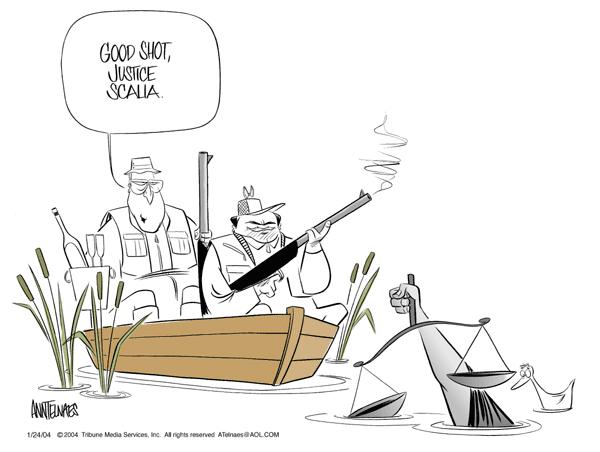
From The Appearance of Impropriety Files: Justice Scalia’s Hunting Trip

ScaliaCheney

A partyist, ignorant hack named Andrea Paysinger, who is banned from further commentary by the Ethics Alarms “too dumb and biased to contribute” rule, just wrote a comment to the Clinton-Lynch post making the typical ratioanalization-rotted argument that “all the brouhaha over this is ridiculous, childish on the part of all the RIGHT WING jerks who SAW NOTHING WRONG with JUSTICE SCALIA taking gifts and spending vacations PAID FOR by those who actually had cases coming up before SCOTUS AND NOT ONE FUCKING TIME DID HE RECUSE HIMSELF.”

I just love it when people accuse me of being a partisan hypocrite without bothering to check what I have written. As it happens, I wrote a great deal about Scalia’s infamous hunting trip, which I unequivocally condemned as creating the appearance of impropriety. (It was, however, factually less troubling than the Clinton-Lynch meeting, as Scalia and Cheney were never alone during the trip in question.) So for people like Andrea (though not Andrea herself, who won’t be able to get back on this site if she recruits an army of Myrmidons), I will hereby post the two Scalia essays, which currently reside only on the Ethics Scoreboard, now an archive of my ethics commentary prior to 2010.

Unfortunately, the site’s search function stopped working when I had to change platforms recently. If you want to check out the Scoreboard now, just use Google: type “Ethics Scoreboard” and the subject or topic. If there was commentary, you’ll find it.

To give due credit, Andrea did identify real hypocrisy on the Lynch issue. Many of the Democrats exposing themselves as corrupted by partisan bias by now trying to defend Lynch also furiously attacked Scalia’s appearance of impropriety. They—your idols, Andrea— have no integrity. I do.

Here was what I wrote about Scalia’s clear appearance of impropriety in 2004.

Good Judge Hunting: Antonin Scalia and the Cheney Case

Supreme Court Justice Antonin Scalia recently went hunting with Vice President Cheney, even as the Supreme Court prepares to rule on whether the documents pertaining to Cheney’s meetings with energy company officials regarding future US energy policies must be made public. This has led to critics calling for Scalia’s recusal from the case, on the grounds that the social contact renders his objectivity in the matter suspect. Scalia, feisty as always, denies this, and maintains that he is fully capable of ruling objectively.

And I’m sure he is, but that’s beside the point. In the case of judicial independence, it is often appearances that count, and because this is an issue particularly charged with partisan passions, the Supreme Court must avoid any hint that cronyism or personal loyalties are playing a part in the outcome of the legal showdown. Scalia should remove himself from the case.

Justice Scalia has pointed out that personal friendships between the justices and Washington leaders are commonplace, and that mere friendships among professionals should not raise the specter of favoritism or bias. Indeed, had Scalia maintained exactly the same collegial relationship with Cheney, but avoided the hunting trip, there would be no issue. But the outing conjures images of male bonding and frank talk by the campfire (lobbying, perhaps?), and if Justice Scalia were to rule Cheney’s way (and Scalia’s past opinions would suggest that this is likely), the legitimacy of the ruling would be, in the eyes of many, tainted. But there is more.

According to the L.A. Times, Scalia was flown to the hunting reserve on the small jet that serves as Air Force Two. That could be interpreted as a gift to a judge from a pending litigant. The trip has value, and judges are not supposed to accept things of value under circumstances where it calls their objectivity into question. This alone would justify a recusal. And there’s a “strike three.”

The Times reports that the reserve where the duck hunting took place is owned by Wallace Carline, the head of Diamond Services Corp., an oil services firm that is on 41 acres of waterfront property in Amelia, La. The company provides oil dredging, pile driving, salvage work, fabrication, pipe-rolling capability and general oilfield construction. There is no indication that he has a direct stake in the case, but he is an energy executive. So we have a Supreme Court Justice ruling on whether materials should be released regarding the input of the energy industry into national energy policy in meetings held by the Vice-President, after he spends a hunting trip with the Vice-President, who has also provided charter jet transportation, at a hunting reserve where he is the guest of an energy executive.

Come on, Justice Scalia. Continue reading →
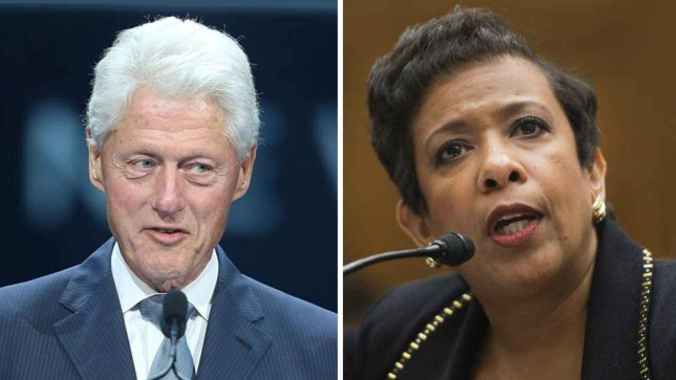
Attorney General Lynch, Meet The Appearance Of Impropriety! Funny, I Assumed You Were Acquainted…

Clinton Lynch

U.S. Government officers and employees are directed to avoid engaging in conduct  “creating the appearance that they are violating the law or the ethical standards promulgated pursuant to this order. ” Some of those officers, like those who work in law enforcement and the justice system, shouldn’t require Executive Order 12674 – Principles of Ethical Conduct for Government Officers and Employees to know that the appearance of impropriety, including bias, favoritism, influence peddling and conflicts of interest, is unethical, since judges have a prohibition against creating such appearances in their codes of conduct no matter where their courts are located. They also know that as  professionals charged with making sure the rule of law works equitably and efficiently for all, rich and poor, high and low, the public trust is essential and indispensable. If the public doesn’t trust the fairness, objectivity, competence and wisdom  of those who enforce the law, then the public will not trust the law itself, and the rule of law, and democracy itself, will be threatened.

This is ingrained into every government lawyer’s hide, and so core to the principles of justice professionalism that the news that Attorney General Loretta Lynch met privately with  former President Bill Clinton this week just defies explanation. Supposedly President Clinton walked uninvited from his plane to her government plane, which were both parked on a tarmac at Phoenix Sky Harbor International Airport to chat.

Her only proper and ethical response to Clinton is undebatable:

“I’m sorry, Mr. President, but my Department is in the midst of investigating your wife, and it is crucial that the public does not detect any evidence of collusion or influence occurring, and observes no evidence that would cause it to question in any way the ultimate determination by Justice regarding any possible legal action. You certainly must understand my position…and by the way, since you do understand, what the hell are you doing here? Go! Now!”

She did not say this, however.

She met with him.

Game over.

Appearance of impropriety. Continue reading →

Freddie Gray Prosecution Update: A Law Professor Formally Accuses The Unethical Prosecutor Of Being Unethical

finger-pointing

George Washington Law School Professor John F. Banzhaf III has filed an ethics  complaint against State’s Attorney Marilyn Mosby with Maryland’s Attorney Grievance Commission. Banzhaf accuses Mosby in his 10-page complaint of breaching Maryland’s rules of professional conduct for lawyers, which requires that a prosecutor refrain from prosecuting a charge unless it is supported by probable cause, in her conflicted and incompetent prosecution of six police officers involved in the arrest of Freddie Gray. The complaint also flags Mosby’s improper use of public statements to bias the administration of justice.

Good.

Of course he is right, as I have repeatedly explained here, here, here, here, and here. I assume there have been other complaints before this one, but he has made the issue a high profile one, and that’s excellent news.

Mosby has earned the Mike NiFong treatment: the unethical prosecutor in the Duke Lacrosse rape case was disbarred, briefly jailed, and sued. She is black, female, and a Democrat, and NiFong remains one of the very, very few prosecutors to be punished significantly for unethical conduct. I will be amazed if the commission does anything momentous or sufficient to discourage grandstanding prosecutors like Mosby in the future, even though such prosecutors are willing to ruin lives for political gain.

I hope I am wrong.

(But I’m not.)

KABOOM! The Tale Of The Third-Grader’s Racist Brownie Offense: No, I Don’t Understand This At All

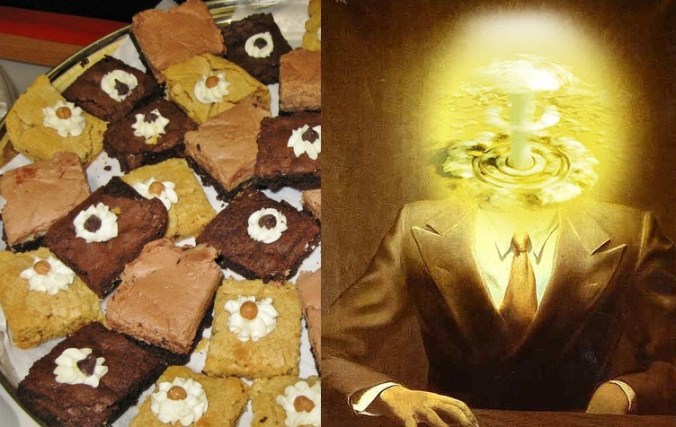
brownies explosion

This story made my head explode, and thus it will be tagged “Kaboom!” Unlike most such Kaboom! posts, however, this one is likely to make my head explode every time I read it. Or think about it. Forever.

On June 16, a third grader made a comment about the brownies being served to his class during an end-of-the-year class party at the William P. Tatem Elementary School in Collingswood, New Jersey.  After another student opined that the remark was “racist,” the school called the Collingswood Police Department.

Okay, stop. I’m puzzled already, and my head exploded again just writing that:

  • How could a comment about brownies be racist? Did the child say, ” As with human beings, the blonde brownies are innately superior to the dark ones”? Somehow, I doubt it.
  • Another third grader pronounced the statement as racist. Not a teacher, now. An eight-year old. How can that trigger anything, in a sane world, but a discussion led by the teacher about what is and isn’t racist, and how people shouldn’t leap to such  inflammatory observations, because it makes human interaction difficult if not impossible?
  • The school called the police department? For what? A threatened brownie massacre? How is this conceivably a police matter? Why did the police come?

“What is the nature of your emergency?” “A third-grader in my class made an inappropriate remark about brownies!” “Calling 911 with prank calls is a crime, ma’am. Don’t do this again.” 

It is per se unethical and irresponsible for any police department to treat such trivia seriously.

All right,slogging on… Continue reading →

The Unethical Courtroom Exchange Of The Century!

believe-it-or-not-1024x442

This would have been rejected by “Boston Legal” as too ridiculous.

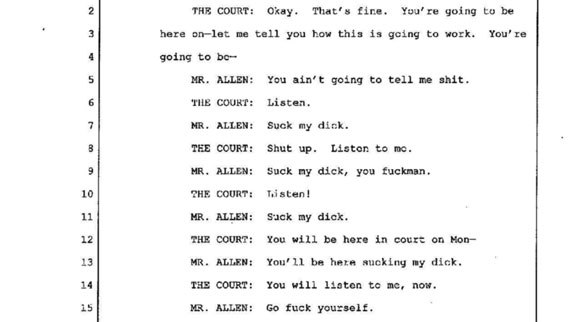
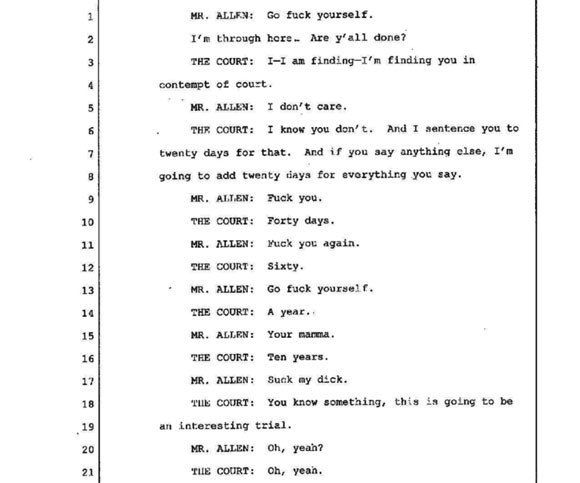
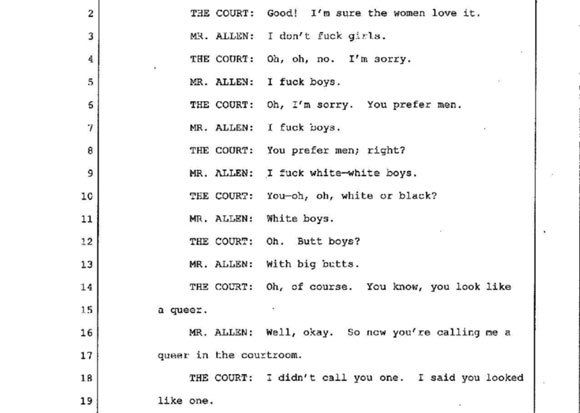
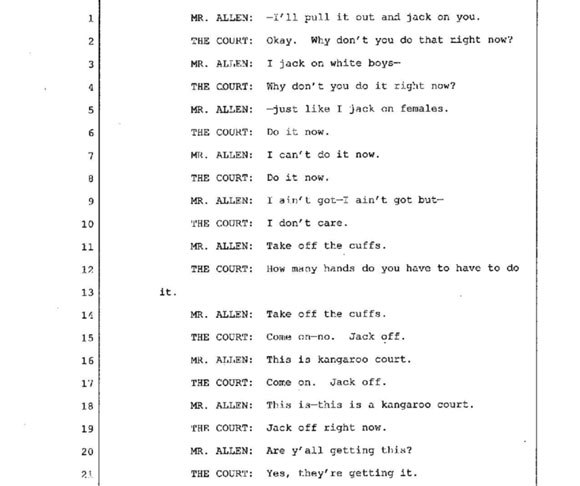
In a Rome, Georgia court room, as others looked on, Floyd County Superior Court Judge Bryant Durham allowed himself to be provoked by a defiant murder suspect named Denver Allen.

What resulted was a rare (thank goodness) example of a judge lowering himself, his position, the court and the justice system to the level of those with no respect for the law or society. Here is a portion of the transcript:


dialogue 1

dialohue 2dialogue 3dialogue 4


Stay classy, Judge Durham. Continue reading →

No, Ashleigh, That Isn’t “Libel,” And Why Are You Hosting A CNN Show Called “Legal Affairs” When You Don’t Know That?

Ashleigh-Banfield

In an epic clash of incompetents, CNN’s Ashleigh Banfield challenged Michael Cohen, one of Donald Trump‘s advisers over his retweeting an internet meme that said that Hillary Clinton “murdered” the victims of the Benghazi mission assault.

After the House Benghazi Select Committee released its final report on the 2012 terror attacks, Cohen delivered his tweet featuring this…

Cohen tweet

It is about as stupid, lazy and inflammatory as most political memes, and the fact that Cohen would think it worth circulating tells us all we need to know about both him and the man who pays him, who would have probably tweeted this junk himself if Cohen hadn’t. Remember Cohen? He’s the Trump lawyer who crudely threatened the Daily Beast and went on to proclaim that spousal rape was legal, when it isn’t. Cohen is, by definition, a thug, a creep, and a crummy lawyer. Naturally, he’s also a Trump advisor. (Tell me again how Trump, that keen judge of legal talent,  can be trusted to appoint better Supreme Court justices than Clinton would. Or that Honey Boo-Boo would.)

Sparring with Cohen on her show “Legal Views,” Ashleigh Banfield lectured the lawyer and told him, “This is libel.” thus making exactly as accurate a statement of law as Cohen’s earlier one about spousal rape. It was not libel. It was inflammatory political speech in a satirical context (would anyone think Clinton actually said this, as the meme suggests?) about a public figure, clearly an opinion rather than a statement intended to be taken literally, and no more libel than “Bush lied and people died.” Banfield’s diagnosis was 100% wrong, and the fervor with which it was delivered is the calling card of a Clinton defender. Continue reading →

Four Supreme Court Decisions: Abortion, Guns, Affirmative Action, Corruption…And Ethics. Part I: Fisher v. University of Texas

Abigail Fisher: Not dark enough to get "an equal shot"

Abigail Fisher: Not dark enough to get “an equal shot”

The under-populated U.S. Supreme Court recently made four decisions on issues with ethical principles involved. This is the first of four posts reviewing the ethics implications of the decisions.

I. Affirmative Action: Fisher v. University of Texas

The University of Texas’ admissions program guarantees admission to top students in every high school in the state. It is dubbed the  Top 10 Percent program, though the percentage cutoff is flexible. A second part of the admissions program admits other students from Texas and elsewhere using standards that take into account academic achievement and other factors, including race and ethnicity. Many colleges and universities base all of their admissions decisions on such grounds. The case before the Court challenged that part of the program, and presented an opportunity for the Supremes to finally declare affirmative action unconstitutional, as previous opinions hinted they might do some day.

This was not the day, however. Justice Kennedy, writing for the majority, said courts must give universities significant but not total autonomy in designing their admissions programs, writing:

“A university is in large part defined by those intangible ‘qualities which are incapable of objective measurement but which make for greatness.’ Considerable deference is owed to a university in defining those intangible characteristics, like student body diversity, that are central to its identity and educational mission.But still, it remains an enduring challenge to our nation’s education system to reconcile the pursuit of diversity with the constitutional promise of equal treatment and dignity.”

This defines either an ethical dilemma, which the Court’s majority is punting, or an ethical conflict…which the Court majority is punting. Is diversity an ethical objective, or a practical one, that is, a powerful non-ethical consideration? It is hard to argue that diversity in a student body isn’t desirable—to enhance the educational experiences of students, to avoid having a permanent, under-credentialed underclass, to “look like America.” However, fairness and common sense argue that admitting one candidate over another who is better qualified simply because of ethnicity or race is per se wrong. I don’t blame the Court at all for not making a clean call.

As usual, President Obama described the result in simplistic terms. “I’m pleased that the Supreme Court upheld the basic notion that diversity is an important value in our society,” he told reporters at the White House. “We are not a country that guarantees equal outcomes, but we do strive to provide an equal shot to everybody.”

Thank you, President Obvious. The crux of the case, however, was what should be done when using race as a standard for admission to attain that diversity denies an “equal shot” to someone who has the misfortune to be white, like Abigail Fisher, or Asian-American. Continue reading →

On Climate Change And The First Amendment, Yale’s Law School Dean Gives Us A Reason To Be Very Afraid

I just wrote in a comment thread,

“The one thing that could change my mind to believe that Trump is less dangerous than Clinton is that the trappings of Trump and his followers reek of stupidity, and the trappings of Hillary and her allies are redolent of totalitarianism.”

The effort by Democrats and anti-gun zealots to deliberately breach the Fifth Amendment to allow “pre-crime” anti-gun laws was one example of the Obama/Clinton/Sanders left’s creeping embrace of totalitarian principles.

Here is another.

Over the weekend, Robert Post, the current dean of Yale Law School where both Bill and Hillary learned to be unethical lawyers, authored a shocking 0p-ed for the Washington Post. In it, he attached his influence and credibility to the idea that the government should use the power of prosecution to intimidate opponents of government policy and widely accepted left-wing agenda items. I have never seen such a disgraceful breach of academic prestige. If I were a Yale grad, I would be heavily involved in calling for Post’s resignation.

Post is supporting the attempts by Democratic, climate change policy-supporting attorneys general to target Exxon-Mobil for fraud because the company opposes certain climate change measures. This comes after eco-facists like Robert Kennedy, Jr. and climate change shills like  Bill Nye (The Self-Promoting Not-Really-The-Expert-He- Pretends -To-Be  Science Guy) have suggested that “climate change deniers” should be jailed. That’s not the theory, though. The theory is that Exxon-Mobil has defrauded investors by misleading them about the results of their own research. Thus the company has been hit by demands for documents by the Massachusetts and New York attorneys general to reveal all of that research.

Exxon-Mobil, as well as others, has condemned this effort as an attempt to chill First Amendment debate. Post, who has allied himself with the censors because climate change is “settled science,”  bolsters the political inquisitioners’ deceit. “It may be that after investigation the attorneys general do not find evidence that Exxon-Mobil has committed fraud. I do not prejudge the question. The investigation is now entering its discovery phase, which means it is gathering evidence to determine whether fraud has actually been committed,” the esteemed dean writes.

Cute. Of course, once the precedent had been established that the government can force someone into expensive legal defense for “the fraud” of disagreeing with the pronounced truths of the State, then dissent and political opinion will be repressed, suppressed, and discouraged. Continue reading →

Revisiting The “Ten Ethics Questions For Unshakable Hillary Voters”

Hillary Rally

Less than a year ago, I responded to a series of what I regarded then (and now) as irresponsible expressions of support, bias and denial by Hillary Clinton supporters with ten questions designed to rescue them from corruption. At the time, the possibility that an even worse candidate would (or could) be nominated by the Republican Party never crossed my mind.

Although it was largely buried over the last week in the aftermath of the Orlando shooting, Clinton’s e-mail fiasco was further exposed as the deep evidence of  long-term Clinton corruption that it is.  One of the most damaging e-mails handled on her private server, for example, was not turned over to the State Department (Hillary has sworn repeatedly a that ALL State Department business-related e-mails were turned over, raising the rebuttable presumption that she had other State communications among the 30,000 or so that her personal lawyers had destroyed.) We also learned that State Department staffers struggled in December 2010 over a serious technical problem that affected emails from the improper server, causing State staffers  to temporarily disable security features on the government’s own systems, thus making them more vulnerable to attack.

In a deposition under oath, Clinton’s IT specialist Bryan Pagliano, a central figure in the set-up and management of Clinton’s personal server, invoked the Fifth more than 125 times.  Meanwhile, the shadowy Clinton Foundation machinations came to the fore once again. An Associated Press review of the official calendar Hillary Clinton kept as Secretary of State identified at least 75 meetings with longtime political donors, Clinton Foundation contributors, corporate and other outside interests that were not recorded.  The calendar omissions naturally reinforce suspicions that she sought to hide possibly improper or even illegal uses of her influence and position to raise funds for the foundation. While the news media tried to spin Donald Trump’s statement in his attack on Hillary last week that “Clinton’s State Department approved the transfer of 20% of America’s uranium holdings to Russia while nine investors in the deal funneled $145 million to the Clinton Foundation,” his statement was accurate. For a change.

What was striking about the ten questions, looking at them again, is how little I would alter them today. The major change is that the arguments of those who claimed that evidence of Hillary’s unethical conduct was partisan or inconclusive look even more desperate and dishonest than they did last August. For the same reasons, the passage of time makes Clinton’s shameless and insulting lies seem even more shameless and insulting. The Democratic Party also looks worse and more corrupt: it rigged the nomination for this woman of demonstrably untrustworthy and venal character, as well as of dubious skills. Nothing can surpass the complete abdication of its duty to the United States by the Republican Party and its voters, but this was a betrayal by the Democrats.

Here is the list. I’ll have a few observations along the way, in bold.

“Ten Ethics Questions For Unshakable Hillary Voters” Continue reading →

Johnny Manziel’s Lawyer’s E-Mail Ethics Disaster

email mistake

In an article last year inspired by increased attention in the legal profession prompted by Hillary Clinton’s epic incompetence handling her e-mail, New York’s Legal Ethics Reporter last year published “Ethical Implications & Best Practices for Use of Email.” It began with a quiz:

Which of the following statements are true?

A. Email is a wonderful tool for the successful practice of law.

B. Email not only saves time and money, but also allows for prompt communication with clients, colleagues, and opposing counsel.

C. Email is overused, often results in incomplete or inaccurate responses to inquiries, and fills up your Inbox with useless information.

D. Careless use of email can subject the sending lawyer to embarrassment, unhappy clients, lost income, breach of the duty of confidentiality, discipline, or claims of malpractice.

E. All of the above.

The correct answer is E— All of the above.

One reason lawyers are, as a group, far less forgiving of Hillary’s nonsense (and lies) is that her conduct, if it involved a client, and not just a relatively minor institution like the U.S. State Department, would constitute a clear violation of  the ethics rules covering competence and confidentiality. (Let’s ignore, for now, the rules requiring honesty and the avoidance of conflicts of interest.). Work- and case-related e-mail must be handled with care, or disasters occur. One of the lawyers for disgraced ex-NFL quarterback Johnny Manziel just provided a lesson in how that can happen, and it is going directly into my next seminar.

Defense attorney Bob Hinton, representing  Manziel  in a hit-and-run case, accidentally sent an Associated Press reporter an e-mail intended for the athlete’s legal team. The misdirection appears to be the result of an auto-address feature that assumed whom Hinton wanted to communicate with based on the first few letters he typed.

In the memo, Hinton expresses exasperation at the extent of Manziel’s dependence on illegal drugs, and reveals that he has a receipt that shows Manziel may have spent more than $1,000 at a drug paraphernalia store just 15 hours after he was involved in the crash. “Heaven help us if one of the conditions is to pee in a bottle,”  the lawyer wrote. This is a problem, since Manziel is seeking a plea deal that almost certainly would require periodic drug tests. Continue reading →