Incompetent Elected Official Of The Month, Or “You Know, Sometimes The Southern States Really Ask for All The Ridicule They Get”: Alabama Chief Justice Roy Moore

This is, I know, akin to shooting fish in a barrel, as Moore has long established himself as a renegade wacko, notably when he defiantly displayed the Ten Commandments in his court house even after a higher court declared that it was unconstitutional. It’s unethical to violate a court order if you are a judge (duh!), and as a consequence of his silly and expensive grandstanding in defiance of the Establishment Clause (Moore believes that the Government of the United States was established to support Christianity,that’s all there is to it, and nobody is going to convince him otherwise, so there), he was quite properly removed from office by a court order he couldn’t defy.

Oh, never mind ethics, law, the Constitution, the U.S. Supreme Court and the general advantages of not having a Chief Justice heading your state’s Supreme Court who makes up the law as he goes along: the citizens of Alabama, in their wisdom, elected Moore to be Supreme Court Justice again, and so he is.

WOW. Continue reading

Now THIS Is Ethical Sentencing, And Terry Lynn Brown Is A Wise And Fair Judge

The Andersons: First the system doesn't work, then it does.

The Andersons: First the system doesn’t work, then, miraculously, it does.

This bizarre tale will be adapted into a movie, or Hollywood has lost its mind.

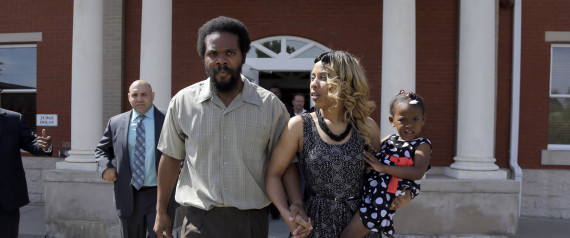
Missourian Mike Anderson was only 23 in 2000 when he was sentenced to 13 years in prison for committing a hold-up at gun-point. He was out on bail, waiting to be ordered to report to prison, and the order never came. He called his lawyer, who said, “Wait for it. Be prepared.”  Anderson even inquired within the system regarding what he was supposed to do, but he got no definitive answer. The order never came, because the official paperwork said he was already in jail.

So Anderson kept waiting, and remained prepared to be arrested and taken to jail at any minute. He didn’t leave the jurisdiction (Mississippi County—and why Missouri has a county with that name is a mystery in itself: no wonder its systems are messed up), and he took no steps to disguise his identity. Anderson started a successful business in construction, married and had children. He coached youth football and volunteered at his church in Webster Groves, Missouri. Then, right about when he would have been released from prison if officials had done their jobs competently, the paperwork error was discovered, and Mike was finally put in jail to serve his original sentence. Continue reading

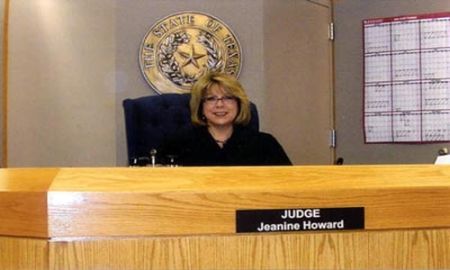
Unethical Quote Of The Month: Judge Jeanine Howard (Who Is Also The Incompetent Elected Official Of The Month, An Ethics Dunce, And Pretty Much A Blight On The Justice System And American Society In General)

judge Howard

“There are rape cases that deserve life. There are rape cases that deserve 20 years. Every now and then you have one of those that deserve probation. This is one of those and I stand by it.”

—-Texas District Judge Jeanine Howard explaining her stunningly lenient sentence of probation and community service—“250 hours of community service at a rape crisis center” !—for a confessed rapist of a 14-year old girl at her school.

The sentence  was not merely lenient but probably illegal, and a it seems likely that the sentence will be altered by another judge. Nonetheless, this kind of result, based on the judge’s assessment that the victim was promiscuous and had been pregnant (which she denies) will certainly make other rape victims think twice before they report the crime. Bobby Villareal, executive director of the Dallas Area Rape Crisis  Center, told reporters…

“This is an example of why people don’t come forward and report their sexual assaults because they are not only victimized at the time but the continuing game of shame and blame. They are put on trial again in the judiciary and the media. The things that were said were outrageous and some of them were actually untrue that were reported.”

Judge Howard seemed to be making up the law and sentencing guidelines on the fly. The rapist, 20-year old Sir Young, never denied that he had raped the girl, or that she hadn’t strenuously told him to stop. “Consent is not an issue and it wasn’t an issue because he admitted he didn’t have her consent,”  prosecutor Andrea Moseley said. “When consent is not an issue, a victim’s past is never appropriate for comment. That’s my problem with it as a woman and as a prosecutor. I was certainly disappointed in the message I think it sends to the community.”

The community can send a message back, as Judge Howard is up for re-election in the fall, but it won’t be easy. A Democrat, she is running unopposed. Continue reading

Ethics Hero: Arkansas Attorney General Dustin McDaniel

Dustin McDanielSome attorneys general understand the obligation of a state’s highest legal representation, even if the Attorney General of the United States does not.

Arkansas Attorney General Dustin McDaniel, a Democrat,told the press yesterday that he personally  he supports allowing same-sex couples to marry,  but will nonetheless continue defending his state’s 2004 ban on gay marriages in court.

The news angle, as reported, was that McDaniel, a Democrat serving his final year as the Arkansas AG, is the first statewide official in conservative Arkansas to back same-sex marriage. Ethically, however, the significance is that although he disagrees with the current law of the state that is his client, he will nonetheless do his duty according to the laws he swore he would uphold….as he should, as an ethical and honorable lawyer who is there to serve the public’s interests, not his own conscience. Continue reading

Are Haunted House Ethics The Same As Murder House Ethics?

Haunted-Homes2

I spent the wee hours last night watching “Insidious 2” (not as scary as “1,” and too confusing to watch while composing ethics blog posts), and, to fend off nightmares, the Wayans’ “A Haunted House” (sillier, grosser and not as funny as their two “Scary Movie” efforts). Naturally, this set me wondering about the ethics of selling a haunted house to an unaware buyer.

I thought I had covered this problem before here and here, where the topic was whether a property owner had an ethical obligation to divulge that the house in question had been the site of gruesome murders or suicides. The law in most states declares caveat emptor, but that’s only the law. The ethics verdict, in my view (but not everyone’s) is this, which my last comment on the topic, in 2013: Continue reading

Animal Ethics: Now THIS Is An Unethical Veterinarian

Believe it or not, Dean Jones was a NICE vet compared to Dr. Tierce...

Believe it or not, Dean Jones was a NICE vet compared to Dr. Tierce…

Yechh. This story reads like a sick version of “Beethoven,” which, as all you Charles Grodin fans will recall, featured a villainous veterinarian (Dean Jones, no longer cute) who stole pets to use for medical research.

In Fort Worth, Texas, Jamie and Marian Harris took their dog, a 5-year-old Leonberger named Sid, to the well-respected  Camp Bowie Animal Clinic, to be treated for what they thought was a minor health issue. After undergoing treatment,  Sid developed trouble walking and the veterinarian, Dr. Lou Tierce, told the Harrises that  their dog  had an untreatable spinal condition that would get worse, cause him increasing pain, and ultimately cripple him completely. The family was told the best option was to have Sid euthanized. The couple and their young son agreed, said their goodbyes and authorized the clinic to bury Sid on the vet’s farm.

Six months later, a veterinarian technician named Mary Brewer, who worked at Camp Bowie, contacted the Harrises to inform them that Sid was alive and being kept alive in a cage, surrounded by his urine and feces, so he could be used for blood transfusions to treat other dogs.
Continue reading

A Brief Ethics and Culture Lesson For First Amendment Pedants

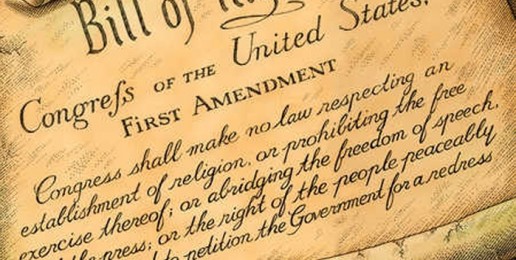
First-Amendment-on-scroll1

Thousands or pundits and web commenters, perhaps hundreds of thousands, in their concerted effort to justify the speech and thought police, (at least as long as the Enforcers are not likely to disapprove of their thoughts and speech), are mocking those who cite the First Amendment as authority for the proposition that the treatment of Donald Sterling, and others, are harmful, sinister, and un-American. The pedants are technically correct, of course. When someone who is fired for posting something offensive on Facebook screams, “My First Amendment right of free speech has been violated!”, that typically speaks of a poor civic education. The Bill of Rights only constrains government action, not private transactions. No rights, which are enumerated and protected from government incursions by the Constitution, have been lost or affected when only private action is involved.

That does not mean, however, that when private action opposes an individual’s Constitutional rights, it is necessarily acceptable, fair, harmless, reasonable or right. Indeed, the government and law serves a crucial function by delineating and encouraging cultural and ethical values. The principles articulated in the Declaration of Independence, the Constitution and the Bill of Rights do not merely constrain government. They form the basis of the ethical values that make the United States a unique culture, and point the way to what Americans, as Americans, regard as right and wrong.

Thus, while searching though a friend’s private e-mail account isn’t a violation of one’s right to privacy under the 10th Amendment, violating a fellow citizen’s privacy is wrong, and the Bill of Rights stands as authority that it is something important to each individual that should be respected. The Constitution and the 13th, 14th, and 15th Amendments won’t and can’t stop Americans like Sterling from being bigots in their private dealings, but they send a clear message that bigotry is not approved by the United States and was not by those who have charted our ethical course. Privately interfering with someone’s right to worship as they please is wrong, and the fact that the government is prevented from doing it tells us so. The First Amendment’s existence also tells us that preserving free speech—open, fearless, speech—is essential to core American values, because it also supports free thought, that which tyrants and dictators fear. Yes, we all have the right to make free speech, thought and discourse costly, difficult and painful, but we should not. We have the right to punish severely the non-conformist, the iconoclast, the rebel, or the citizen who may be a little late, or slow, or reluctant, to accept the conventional wisdom of the moment. We have the right to do it, but it is wrong. It is un-American. The Constitution tells us so.

Addendum: After I wrote the post, I encountered this.
 

Clayton Lockett Is Dead, Right? Then 1) Good! and 2) His Execution Wasn’t “Botched”

Capital punishment foes have no shame, and (I know I am a broken record on this, and it cheers me no more than it pleases you), the knee-jerk journalists who have been squarely in their camp for decades refuse to illuminate their constant hypocrisy. In Connecticut, for example, holding that putting to death the monstrous perpetrators of the Petit home invasion was “immoral,” anti-death penalty advocates argued that the extended time it took to handle appeals made the death penalty more expensive than life imprisonment—an added expense for which the advocates themselves are accountable.

A similar dynamic is at work in the aftermath of the execution of convicted murderer and rapist Clayton Lockett in Oklahoma.Witnesses to his execution by lethal injection said Lockett convulsed and writhed on the gurney, sat up and started to speak before officials blocked the witnesses’ view by pulling a curtain. Apparently his vein “blew,” and instead of killing him efficiently,  the new, three-drug “cocktail” arrived at as the means of execution in Oklahoma after extensive study and litigation failed to work as advertised.  Why was there an excessively complex system involving multiple drugs used in this execution? It was the result of cumulative efforts by anti-death penalty zealots to make sure the process was above all, “humane.” Of course, the more complicated a process is, the more moving parts it has, the more likely it is to fail.

Continue reading

The Maryland Supreme Court Clearly Doesn’t Believe In Signature Significance

PeepingTom

But I do.

The Maryland Supreme Court just reinstated a Clayton W. Boulware, a Montgomery County attorney who had been suspended for six months after being convicted of covertly filming up the skirts of two women, one of whom was a minor, in a public place.  Boulware was suspended in September for six months with a three-year probationary period to follow the suspension.

In his defense, Boulware blamed his upskirt peeping on an “open relationship” with a younger woman, introducing him to a “swinging lifestyle” that included filming themselves having sex. But that relationship is over now, the court notes, so, hey, no problem.

The bar disciplinary board noted in its report to the court that it believed  a more lenient approach to punishing Boulware was called for because of those “mitigating circumstances.”  Lawyers are, as everyone knows, putty in the hands of swinging young women, and this always results in them shooting up other women’s skirts.

I feel like I am losing my mind. Continue reading

Jim Ardis, Mayor of Peoria, Uses The Police To Crush A Social Media Critic, But Never Mind, It’s Not Important Because He’s Not Racist

"OK, we know you have tweets in there! We're coming in..."

“OK, we know you have tweets in there! We’re coming in…”

This story is obviously trivial, because the news media doesn’t think it’s worth getting upset about. After all, it doesn’t involve race:

PEORIA — Police searched a West Bluff house Tuesday and seized phones and computers in an effort to unmask the author of a parody Twitter account that purported to be Mayor Jim Ardis. The account — known as @Peoriamayor on the popular social media service that limits entries to 140 characters — already had been suspended for several weeks when up to seven plainclothes police officers executed a search warrant about 5:20 p.m. at 1220 N. University St. Three people at the home were taken to the Peoria Police Department for questioning. Two other residents were picked up at their places of employment and taken to the station, as well. One resident — 36-year-old Jacob L. Elliott — was booked into the Peoria County Jail on charges of possessing 30 to 500 grams of marijuana and possessing drug paraphernalia, but no arrests were made in connection with the Twitter account.”

The Twitter account was obviously a parody, if not an especially deft or clever one. After all, one would have to be a hopeless doofus, and an unusually dim one at that, to believe that the mayor of any city, even Toronto’s ridiculous Rob Ford, would happily tweet about his own drug use, crimes and corruption like the Twitter avatar of the Peoria mayor did.

Yet here was Mayor Ardis’s justification to reporters for his jaw-dropping abuse of power:

“I still maintain my right to protect my identity is my right. Are there no boundaries on what you can say, when you can say it, who you can say it to? You can’t say (those tweets) on behalf of me. That’s my problem. This guy took away my freedom of speech.”

Uh-huh. Show me a how “this guy” broke any law that justifies a police raid, you unbelievably arrogant, incompetent fascist.

Some observations: Continue reading