That’s “Rust Red Hills” (1930), by Georgia O’Keeffe above. Does it seem “conservative” to you? Does “conservative” even seem like a word that can be relevant to such a painting?
Welcome to the weird court petition filed by Valparaiso University in Indiana. The school wants to be able to get around the terms of a large testamentary gift that it happily accepted in 1953. Percy Sloan donated millions of dollars and hundreds of fine art works in honor of his father, Junius R. Sloan, a famous artist in the Hudson River School. His will directed that any art acquired with the funds must be “exclusively by American artists preferably of American subjects” and “of the general character known as conservative and of any period of American art.” The University wants to sell some of the most valuable paintings it purchased with Sloan’s bequest, including the one above, to fund the construction of new dormitories.
I could go into an analysis of what was so stunningly dangerous and incompetent about the Secret Service FUBAR that almost got Donald Trump murdered, at this point just about the only way the Democrats would be able to keep the White House. I’m happy to wait for the results of Congressional hearings and the investigation, but as I heard many experts say on multiple networks, you don’t have to be an expert to figure from the time-line and what we do know that the Secret Service was spectacularly incompetent, and that Cheatle’s pathetic explanations (I particularly like “the sloped roof was too dangerous for our agents so we let a gunman use it to shoot Trump”) haven’t passed the giggle test. Her ridiculous statements and the fact that the agents knew an unknown person with a gun was within killing distance of Donald Trump and waited for him to take a shot before doing anything (like, say, keeping Trump off the stage: don’t those little earpieces work?) are res ipsa loquitur, so damning that conspiracy theories are unavoidable.
18-year-old Sumaya Thomas of North Liberty, Iowa was supposed to go on a blind date with a young man she had met on an online dating app. But by the time her date arrived at her abode to pick her up on the evening of June 16, Thomas had changed her mind. Did she tell him that to his face, like any normal, decent human being, apologizing for wasting his time and dashing his hopes? Oh noooo. Did she text him, the weenie’s way out? No. Did she just leave him on her doorstep, knocking and buzzing while she hid under the bed? No. Did she sneak out the back door? No, not that either.
Instead, Thomas called 911 and said her abusive ex- was outside harassing her because she was seven months pregnant with their child. She said she needed the police to get him off her property as he was threatening to “hit, punch, kick and stab her.”
Nice! A police car was dispatched, and when officers arrived they found an apparently calm, confused young man in the process of walking away. Upon being questioned about the situation, he explained that he had arrived to go on a date with the woman inside the house, and that he had only met her online a week ago.
Once again we are faced with the despicable ethics violation of an alleged authority making her readers dumber and more ignorant. And, once again, the example falls in the category of someone unqualified to read a Supreme Court opinion declaring what the holding means without understanding it.
Tressie McMillan Cottom is a 2020 MacArthur “genius” grant recipient who opines in the Times and elsewhere on culture, “higher education, work, media and inequality”(she is black, so I guess that’s mandatory). Her credentials do not justify her writing this in her latest essay:
“[T]he Supreme Court finally weighed in on presidential immunity. There is no other way to read its decision than as a signal that whoever owns the Republican Party also owns the power to break the law.”
That’s funny, because there is no possible way to read that ridiculously misrepresented decision to mean that at all. If she’s read the decision, then she’s lying or incompetent. If she hasn’t read the decision, then her ethical breach is worse. Continue reading →
Just as the Far Left plays into the worst conservative stereotypes about them with demands like abortion right up to birth and open borders, the Far Right parodies itself with Constitution-defying laws like Louisiana’s requiring the Ten Commendments to be displayed in public school classrooms. Now Oklahoma says, “Hold my beer!”with the State Superintendent of Public Instruction, Ryan Walters announcing in a memo today that every Oklahoma school must teach students the Bible the 2024-2025 school year. “The Bible is an indispensable historical and cultural touchstone,” Walters said in a press release unveiling the mandate. “Without basic knowledge of it, Oklahoma students are unable to properly contextualize the foundation of our nation which is why Oklahoma educational standards provide for its instruction. This is not merely an educational directive but a crucial step in ensuring our students grasp the core values and historical context of our country.”
There is no chance, none, zip, nada, that this obviously religiously motivated law will stand up to judicial scrutiny. This is pure grandstanding.
As weird as things have gotten in the U.S., much weirder stuff goes on abroad, and I ignore most of it. This story, however, requires that attention be paid.
Mujahid, a 20-year-old from Muzaffarnagar, Uttar Pradesh–that’s India—claims a hospital staff performed a sex change operation on him without his consent. A man named Omprakash, the alleged victim claims, had been harassing him for years and deceived him into believing that he was suffering from a serious medical condition. He then offered to take him to Mansoorpur hospital, where he was sedated and then operated on. “He brought me here, and the next morning I had an operation. When I regained consciousness, I was told that I had been changed from a boy to a girl!” a sobbing Mujahid told NDTV reporters. “When I woke up, Omprakash told me that I am a woman now and that he would take me to Lucknow to marry me. He threatened to kill my father if I resisted.”
The betting is that te retired Madison, Wis. law professor and longtime bloggress will still vote for Biden and the Democrats—like Bill Maher, Ann talks a good neutrality game, but always seems to come home again—but still, her observations are frequently spot-on.
“Passing AI images off as real ones for the sake of commercial or political gain should be prosecuted as fraud.The severity of the penalties should match the level of risk that disseminating these images poses to our society; i.e., they should be extreme.”
Ann adds, “How terribly punitive and repressive, and yet, isn’t it what you’ve come to expect from the segment of America that reads the New York Times?Notice the aggression mixed with passivity. The comment-writer doesn’t want to face the challenge of becoming more perceptive and skeptical dealing with the onslaught of A.I. images. They want the government to do the dirty work and do it good and hard.”
No weenie he! If only every thinking person confronted with this standard “it isn’t what it is” dodge by open borders advocates responded with similar force. Unfortunately the best part, “That’s sweet!” was muffled by the cross-talk.
Symone Sanders-Townsend is trying hard to catch up to Joy Reid as MSNBC’s most repulsive ideologue. Imagine: Bernie Sanders actually employed this woman as his spokesperson! While discussing an illegal immigrant’s rape and murder of a 12-year-old girl, what Sanders-Townsend is most concerned about is describing him in a manner that hides the criminal’s actual status. How can anyone of sound mind and ethical orientation respect people like this, much less vote for the party they are working for?
[Two Curmie’s Conjectures columns in a week! We are blessed. I was also thrilled to have this particular issue examined by a non-lawyer, because in many areas, legal training fogs clear thinking when it is supposed to do the opposite. Also, of the two options Curmie closes with, the majority of lawyers I’ve discussed this case with vote for the second.
Oh—Curmie had a standard pedestrian sign as his illustration for this post, but I saw another opportunity to use one of my all-time favorite Charles Addams cartoons, and went for it. I hope he doesn’t mind—JM]
I was tempted to call the recent decision by the Wisconsin Supreme Court in the case of Sojenhomer v. Egg Harbor a head-scratcher, but I fear that such an assessment might be a little too kind.
Sojenhomer LLC owns a brew pub/restaurant located along County Highway G in the village of Egg Harbor. They used a small portion of that land, .009 acres, for patron parking. The village, citing safety concerns, sought to put in a sidewalk where those parking spaces currently are. To do so, they sought to condemn that small area under eminent domain regulations.
The problem with their plan is that Wisconsin state law bars the use of condemnation to acquire property to establish or extend “a pedestrian way….” So the case boils down to whether or not a sidewalk is indeed “a pedestrian way.” The majority opinion, written by Justice Rebecca Frank Dallet, says no, to which I reply, “then what the hell is it?”
Louisiana became the first state to mandate that the Ten Commandments be displayed in every public school classroom. Republican Gov. Jeff Landry, showing poor judgments and no spine, signed this foolishness into law. Louisiana is the first sate to do this because no others state is this stupid, apparently. The law is obviously, flagrantly unconstitutional, a bright-line First Amendment violation. American Civil Liberties Union (ACLU) and other organizations are going to sue, they will win, and a lot of time and money will be wasted so Louisiana Republicans can grandstand.
Brilliant! The Democrats are basing their 2024 election hopes on painting Republicans as anti-democratic fanatics who would just love to live in a theocracy, so the GOP does this.
An exchange between Republican Louisiana state Rep. Lauren Ventrella and CNN host Boris Sanchez illustrated just how dim-witted the Louisiana GOP’s reasoning is—and Sanchez isn’t exactly Clarence Darrow; a sharper interviewer could have made metaphorical mincemeat out of Ventrella’s lame arguments.
Ventrella began by stating that faith, as represented by the Ten Commandments, are a significant historical component to the founding of the U.S. OK, but that’s not the issue. If schools are going to teach that, the lesson has to be faith-neutral, and using the central religious code of Christianity and Judaism as a centerpiece isn’t neutral.
“Sure, but do you also recognize that the Constitution of this country, its founding document, doesn’t include the word God or Jesus or Christianity and that’s for a reason and that’s because the founding fathers founded this country as a secular one,” Sanchez said. “You don’t see that?”
Ugh. Stay on point, Boris! All that matters is that the Supreme Court has held emphatically that the Constitution forbids the state from dictating religious beliefs. Where the line should be drawn is still a live question, but that the Ten Commandments are over that line is not.
“Boris, I bet you CNN pays you a lot of money. I bet you got a lot of dollar bills in that wallet,” Ventrella replied. Ugh again. She’s after the old “In God We Trust” motto. This is like the open border activists who cite the poem on the Statue of Liberty as evidence of a national policy. Both the motto and the poem are irrelevant.
“What does this have to do with the network that I work for or what I’m getting paid?” Sanchez asked. “Don’t make this about that, answer that question. Why did the founding fathers not include God in the Constitution if they wanted this country to be the way that you see it?”
Boris apparently didn’t see the silly motto argument coming. Well, you know: CNN.
“In God We Trust. We’ll make it about me. I’ve got a dollar bill in my wallet. In God We Trust is written on that dollar. It is not forcing anybody to believe one viewpoint, it’s merely posting a historical reference on the wall for students to read and interpret it if they choose,” Ventrella explained, making no sense. What is stamped on money isn’t the equivalent of highlighting a particular religion in schools. Sanchez then stated the obvious, that the Ten Commandments are more than merely “historical” and obviously advance specific religious beliefs. Of course, and Ventrella and her ilk know this, which is why the party wants the Ten Commandment in the classes rather than the Magna Carta. Her argument is completely disingenuous. And stupid.
“This is a very valuable document. Look, this nation has gotten out of hand with crime, with the bad, negative things that are going on. Why is it so preposterous that we would want our students to have the option to have some good principles instilled in them? If they don’t hear it at home, let them read it in the classroom,” she said. “Which is different than the Mayflower Compact which is mentioned in the document as well. I don’t understand why this is so preposterous in that litigation is being threatened. It doesn’t scare us in the state of Louisiana, we say bring it on.”
Wow. What a moronic rant. Has she read the Ten Commandments? The first one tells readers not to have any other god, and the next three are purely religious edicts. That’s 40%! A poster stating the messages of the next six commandments would be harmless and constitutional, but this law’s intent is promoting juddeo-Christian religious beliefs, despite Ventralla’s posturing
“Because if someone has a home in which they choose to believe something different, which is welcome in this country. It’s literally why people fled to come here to found this country to begin with. Then they should be allowed to. And it’s not really an option if you’re requiring it to be put up in the wall of the classroom,” Sanchez said. To this, Ventrella shrugged that students, parents and teachers who don’t share the “religious views” of the Ten Commandments should just avoid looking at it.
Ooooh, good one, Lauren.
The CNN host compared the Ten Commandments poster to hanging up the Five Pillars of Islam in public school classrooms. That is an excellent analogy, and, of course, all the state rep could do was babble. “This is not about the Five Pillars of Islam. This bill specifically states the Ten Commandments. It is a historical document …” Boris cut her off, since she was ducking the issue or, just as likely, too dumb to comprehend it.
“Sure, but I’m presenting you with a hypothetical that would help you put yourself in the shoes of someone you may not understand and their point of view,” he said. “How would you feel if you walked into a classroom and something you didn’t believe in was required to be on the wall? You can answer that question.” Ventella had no answer, because, again, she knows the objective of the law is religious indoctrination.
“I appreciate you, Boris. I cannot sit here and gather and fathom … you could give me a thousand hypotheticals. But again, this specific bill applies to this specific text. The Quran, or Islam, that is a very broad statement. We’re specifically talking about a limited text, on mind you, a piece of paper that’s not much bigger than a legal sheet of paper. Some kids might even need a magnifying glass to read all of this. This is not so preposterous that we’re somehow sanctioning and forcing religion down people’s throats. I’ve heard the comments and it’s just ridiculous,” Ventrella answered. Translation: “Huminahuminahumina…” She’s got nothing.
She also kept calling the Ten Commandments “historical.” Inigo Montoya has an observation:
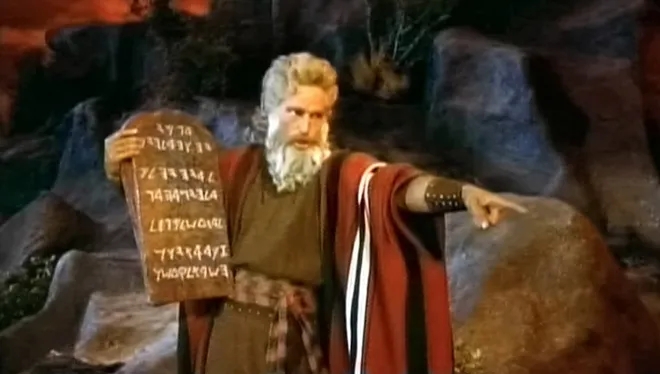
There is no justification for calling the Ten Commandments a “historical” document. There is no historical evidence that Moses and the Ten Commandments as stone tablets ever existed, or that the Exodus occurred. These are religious stories, and Moses has the same “historical” status as Adam and Eve, Noah, and other Old Testament figures. A school even calling them “historical” is a religious assertion.
Neither the Constitution, nor precedent, not common sense backs her “it isn’t what it is” blather. Sadly, the conservative media immediately fell into line defending the law, wounding their own credibility in the process. Newsbusters:
This story is ultimately less about the actual Ten Commandments than about what they represent in this particular instance: a challenge to the left’s monopoly on what can be taught in schools. Said differently, Louisiana challenges the (secular) religious orthodoxies of the public education system as run by left-wing administrators in unison with the teachers’ unions…. The media have no problem with kindergarteners being taught on gender, or on third and fourth-graders having access to graphic sexual materials in school libraries. But the Ten Commandments are a bridge too far.
One final Ugh. The story is about the Ten Commandments, and Louisiana’s transparent effort to force a religious code on students in violation of the Establishment Clause. There’s nothing in the Constitution prohibiting public school indoctrination regarding sex. There is very clear prohibition against public schools promoting specific religions.