Morning Ethics Warm-Up, 9/21/2017: Climate Change Deceit, Jimmy Kimmel, Trump’s Golf Ball Attack, Stephen King, And How to Cover The Left’s Epic Freak-Out

GOOD MORNING!

(he shouted…)

1 When I wrote today’s early morning post about the Sherwin-Williams controversy, with a “hit the ball into the paint can” promotion going horrible wrong thanks to fake news and lying sports reporters, I wanted to use a famous old cartoon based on a sign that hung in the outfield in old Ebbets Field, where the Brooklyn Dodgers used to play. I couldn’t find it online, perhaps because it was 4 am. I just did, however…

2.  For some time, now, as the Left has commenced its nervous breakdown following Trump’s election, I have faced a daily dilemma. The ethics breaches, in civility, in journalism, in politics, have been so over-weighted to one side of the political spectrum that to cover issues based on importance and degree of ethics madness automatically makes Ethics Alarms seem partisan. I resent it, to be honest. The counterbalance is, of course, the President himself, but his brand of unethical conduct hasn’t changed since the campaign, though the Trump-haters never tire of freaking out over the same stuff. For example, after the infamous wrestling tweet about CNN, how nuts can you go when Trump posts a gag video showing him hitting Hillary in the head with a golf ball? Yes, it’s childish, yes, its unpresidential, yes, it shows lack of self-restraint, yes, it’s stupid. But I know and you know, and certainly his haters know, that Trump is childish, unpresidential, lacks  self-restraint, and is stupid. I’ve written too much about it already.

He is not, however, getting worse. Democrats, progressives and “the resistance” are getting worse, as they become more desperate in their derangement. I’m seeing things I didn’t believe possible, like serial child abuser Jimmy Kimmel being held up by the news media as the moral center of the Democratic Party. Jimmy Kimmel is nothing. He is a smug high school grad who has never done anything but perform, often disgustingly, as when he was host of the too-vulgar-to-be-believed “Man Show” on Comedy Central.

He’s never run a business; he’s never studied public policy. He’s a comedian whose signature act is egging on parents to make their kids cry and take videos of them. Ah, but he’ll give Hillary Clinton a forum to deliver her shadow UN speech, and pimp for Obamacare, so that makes him a policy expert. Incredible. Incredible, the depths to which progressives have fallen.

An immature, inexperienced, impulsive President, rather than being opposed, as he should be, by a professional, honest, respectable and responsible opposition party, has instead mutated the liberal establishment into as revolting a presence as he is. This is catastrophic for our politics, our culture, and our society, and that’s why Ethics Alarms devotes so much space to it.

3. Ann Althouse has the sharpest hypocrisy detector around, and she nailed horror novelist Stephen King (I like his novels, some of his movies, and he is a big Red Sox fan) for sending this anti-Trump tweet:’

Trump thinks hitting a woman with a golf ball and knocking her down is funny. Myself, I think it indicates a severely fucked-up mind.

She writes in part, Continue reading
Morning Ethics Warm-Up, 9/20/17: More Factchecker Spin, More Hillary (Unfortunately), And A Thank-You [UPDATED!]

Good Morning!

1 One comment thread over the last few days encompassed media fact-checkers and the consistent position here that they are intrinsically biased and untrustworthy. Law prof/blogger Jonathan Turley was so incensed (his term was “floored”) over one of the better factcheckers (Wapo’s Glenn Kessler) spinning for James Comey and against Trump press secretary Sarah Huckabee Sanders that he wrote a column for The Hill exposing it. (Hey! That’s MY job!) He writes on his blog about what prompted the column:

I have discussed previously how there has been a palpable bias in reporting on the Trump Administration. It is often that case that some journalists are not simply satisfied with disagreeing with the Administration. They sometimes take judgment calls or opinions and declare the Trump side to be simply factually incorrect. This relieves the need for readers to address the opposing view of controversies like the alleged misconduct of former FBI director James Comey. Those views are simply dismissed as untrue. This is a prime example.

The professor is right. It’s embarrassing. Read Turley’s whole piece, clearly prompted because Kessler refers to Turley’s repeated indictments of Comey (while saying that he does not believe Comey should actually be indicted). One respect in which the ever-polite and professorial Turley differs sharply from Ethics Alarms: he says that he has ” written for the Washington Post and [has] great respect for the publication. Indeed, I have objected to the attacks by President Donald Trump on the Post and the New York Times which remain two of our premiere journalistic organizations.”

Hmmm.

1) Turley obviously wants to keep writing for the Post, I guess, and 2) premiere members of a group that has become unprofessional and untrustworthy are still unprofessional and untrustworthy. Be that as it may, Turley concludes,

The Post concludes that the memos were, despite Comey’s denial, FBI material and that he violated FBI rules in removing and releasing such information. It also accepts that employees under Comey as director could well have been fired for such violations. It also agrees that the memos might have been either classified or privileged, even though there has been no final determination. Regardless, the Post awarded two Pinocchios for Sanders stating that Comey’s actions were “improper and likely could have been illegal.”

I have to give the Post two “Blue Fairies.” (I do not want to steal the Post’s Pinocchio signature motif so the Blue Fairy in the Disney story will do). After all, it was the Blue Fairy who said, “A lie keeps growing and growing until it’s as clear as the nose on your face.”

2. There are two items about Hillary Clinton in the Warm-Up today, because she is simultaneously a human ethics train wreck of a failed Presidential candidate, but also needs as little publicity for being so as possible. Continue reading

Ethics Quote Of The Month: President Donald J. Trump

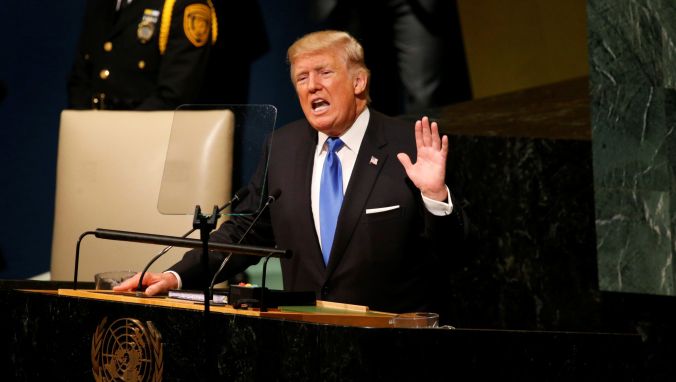
“In America, we do not seek to impose our way of life on anyone, but rather to let it shine as an example for everyone to watch. This week gives our country a special reason to take pride in that example. We are celebrating the 230th anniversary of our beloved Constitution — the oldest constitution still in use in the world today.

This timeless document has been the foundation of peace, prosperity, and freedom for the Americans and for countless millions around the globe whose own countries have found inspiration in its respect for human nature, human dignity, and the rule of law.”

—-President Trump, in his address to the United Nations, today.

Below is the whole speech.

Let’s guess how the pundits will attack it, as you know they will.  Personally, I think it is exactly what the United Nations, and the world, needs to hear from the U.S., especially this part:

“The problem in Venezuela is not that socialism has been poorly implemented, but that socialism has been faithfully implemented. From the Soviet Union to Cuba to Venezuela, wherever true socialism or communism has been adopted, it has delivered anguish and devastation and failure. Those who preach the tenets of these discredited ideologies only contribute to the continued suffering of the people who live under these cruel systems.”

But my favorite line, which only the President could have inserted, was this:

“Major portions of the world are in conflict and some, in fact, are going to hell.”

The President owes me a keyboard for that one.

Continue reading

Morning Ethics Warm-Up, 9/17/17: Boy Scouts, “Will and Grace,” An Actress Whines, Wedding Cakes, And (I’m Sorry!) More Hillary

Good Morning!

1 I’m giving an ethics talk to a Boy Scout troop this afternoon. Figuring out how to use example that are appropriate to ages 11-14 while avoiding hot-button issues like race, sexual orientation, police, guns and politics in general is a lot more difficult than I thought it would be. What pop culture reference points will work is also a conundrum. What movies are they likely to have seen? In the Sixties, I could have referred to Westerns, many of which routinely embodied ethics lessons. But they also often involved shooting people, and kids don’t see Westerns now. In the Eighties, I might have sent Boy Scouts to episodes of “Star Trek: The Next Generation,” which was virtually all about ethics. But Patrick Stewart is just an old guy doing commercials now, and there have been four TV incarnations of the franchise since Data packed it in, not counting the movies. Pixar movies are usually ethics-rich, but a lot of kids will bristle at being presumed to be cartoon fans. Superhero movies? The ones that raise ethics issues usually do so badly, or the issues are too complex—or too dark– for a Boy Scout Troop. Here we see the serious cultural problem of declining cultural literacy and deteriorating cross-generational communications as a result of the loss of common experience. and interests.

Well, it’s early. I’ll figure out something.

One approach I considered was to suggest they practice ethical analysis by reading the newspaper, picking out the ethics dilemmas and controversies that appear, thinking about them and arguing about them. Of course, that was foolish: they would probably ask, “What’s a newspaper?” However this morning’s Sunday Times is a perfect example. I could teach a four hour ethics seminar based on the stories in this edition alone. Look…

2. The baker who refused to sell a cake to a gay couple is back on the front page, thanks to the case winding its way to the Supreme Court. This time, the focus isn’t on Freedom of Religion (in this case, freedom to act like a jackass using your religion as an excuse), but Freedom of Speech. The government cannot compel speech, nor will the law compel specific performance of an artistic nature. The baker claims that his cakes are artistic creations, and he doesn’t have to make them for anyone or anything if he doesn’t want to.  The gay couple says that they weren’t asking for him to create an artwork, just to sell them a wedding cake. If the cake is a commodity, then the bake shop should be a public accommodation, and subject to applicable laws. Then the baker has to sell his cakes to anyone. If the cake is an “artistic creation” made specifically for the couple, then the law cannot force the baker to make it, or punish him if he refuses. Art is speech.

I hate these kinds of cases, and I’m sure the SCOTUS justices do too. A cake is sometimes just a cake, and sometimes a work of art. The confrontation should have been handled with ethics rather than law. The baker is a bigoted jerk, that’s all. I think he has a right not to make a cake for a gay couple, but exercising that right is cruel and insulting. Continue reading

Morning Ethics Warm-Up, 9/14/17: Reed College…Fired For Mentioning Grits?…Stupid Protests…The DNC Lies To Democrats…And The Times Clarifies Its Double Standards

Hi there!

1 There is another one of those hybrid ethics stories coming out of Oregon. Cross oppressive political correctness with racial-offense hypersensitivity with Lena Dunham-like totalitarian-minded progressives itching to report “wrong-thinkers” to authorities with organizations punishing individuals for private speech they did not intend to make public and what monstrosity do you get?

This: a white conductor and festival artistic director fired by a music festival after he was overheard talking to a black friend in a fake Southern accent and saying, “Do you want some grits?” or words to that effect.

I’m not going to explain in any detail what and who are unethical in this fiasco, because I shouldn’t have to. Halls is a victim. The woman who reported him after eavesdropping is worse than merely unethical: she is an evil-doer, someone who sets out to hurt other people to feel powerful. She either never heard of the Golden Rule or doesn’t accept it. (Maybe she IS Lena Dunham!) The festival’s conduct is unfair, uncaring, cowardly and irresponsible. It deserves to have its artists boycott the festival in support for Halls, but since artists tend to be leftists of the knee-jerk variety, addicted to virtue-signaling and with the depth of analysis exhibited by the typical dachshund, I wouldn’t expect any colleagial  support if I were the conductor.

If you have functioning ethics alarms, it will be obvious that the episode was disgusting and unjust, and why. If the festival’s conduct  makes sense to you, then I’m afraid you’re hopelessly corrupted.

2. Morning Warm-Up may yet morph into “stories that are so irritating I can’t stand writing full posts about them.” Take this one, for example: at small liberal arts school Reed College,  a mandatory humanities course on ancient Mediterranean civilizations was canceled after student protesters kept  interrupting the class to protest “Eurocentrism.” Western culture has been, like it or accept it or not, the beacon of world civilization, and even those who (idiotically) choose to deride or reject it need to understand the history and forces that brought us to where we are today—where we are today being a time when weak and incompetent college administers refuse to assert the indispensable fact that students are there to learn, not dictate to their elders.

My favorite part of this story: to accommodate protesters, the Reed administration agreed to allow adverse students to stand surrounding lecturers in the course. “The general understanding was that the protesters would be allowed to continue as long as they didn’t interfere in the lecture period”…as if forcing lecturers to teach under such circumstances isn’t inherently interfering, as well as intimidating to the teachers and other students.

Colleges and universities that cannot respond more effectively and professionally to such unethical bullying by extremists don’t deserve to exist at all. If you don’t want to learn about Western civilization, go to another school, probably in California. If you disrupt the learning experience of other students, you should be expelled. Continue reading

Casting Ethics: A Black Joan Of Arc?

Sure, why not?

From Playbill:

Manhattan Theatre Club has announced a Broadway revival of “Saint Joan” by Nobel Prize and Oscar winner George Bernard Shaw with direction by Tony winner Daniel Sullivan. Heading the cast as the famous heroine will be Condola Rashad, fresh off her Tony-nominated performance in “A Doll’s House, Part 2.”

Superficially, at least, the casting of Rashad, an African American actress, as the famous “Maid of Orléans,” the French teenager who gained political and military power as a self-proclaimed messenger of God and who was burned at the stake, would seem like precisely the kind of stunt non-traditional casting that I have condemned by subjugating the intent and art of a playwright to affirmative action and virtue-signaling. However, this is not a legitimate objection to this casting choice, and in fact the upcoming Broadway production is as close to a perfect example of how creative casting can enliven a production and deepen its ability to make an audience think.

Joan of Arc, of course, was not black. Nor was she Swedish, though Ingrid Bergman played her memorably enough in the most famous Hollywood version of  Shaw’s play, She also didn’t speak English, and certainly not Shavian English. She spoke French. Ethnicity, race and color are not part of Shaw’s drama, however, nor are they relevant to what Joan of Arc did in life, and what she meant to her nation, its history and our shared Western culture.

How many public schools teach anything about Joan of Arc? How many U.S. students graduate completely ignorant of the historical Joan, not to mention Shaw’s version? Yet hers is one of the most remarkable stories in recorded history.

Joan of Arc was born around 1412, the daughter of a tenant farmer, Jacques d’Arc, from the village of Domrémy, in northeastern France. She was illiterate, as were most  of her class and gender, but also was indoctrinated into the teachings of the Catholic Church by her mother.  France was engaged in what we now call the Hundred Years’ War with England, and England had France by the throat.  A forced  treaty in 1420 disinherited  Charles, French crown prince, and England’s King Henry V—there’s a famous play about him, too– was made ruler of both England and France. Upon his father’s death, Henry VI succeeded him as king in 1422. At this point England occupied much of northern France, and many in Joan’s village, Domrémy, were forced to abandon their homes under threat of invasion.

Thirteen year-old  Joan began to hear voices in her head. Today we think the cause was tinnitus, but she was certain God was assigning her the mission of  saving France by defeating the English, and installing Charles as its the rightful king. Joan took a vow of chastity, as part of her bargain with God; this allowed her to reject a marriage her father arranged for her when she was 16.

Around this time, Joan traveled by herself to  Vaucouleurs, a nearby stronghold of those loyal to Charles. With her faith and her persuasive claim of being a holy messenger, she attracted a small band of followers who were convinced her sudden appearance was the the result of a popular prophecy coming true, and that she was destined to save France. Joan cut her hair short and dressed in men’s clothes to make an 11-day journey across enemy territory to Chinon, where the crown prince’s palace stood. She met with the young man, and convinced him that she was the Real McCoy (they didn’t use that phrase in France, of course)  by allegedly telling him things only God would know. She also  promised Charles that she would see him crowned king at Reims, the traditional site of French royal investiture, and asked him to give her an army to lead to Orléans, then under siege from the English.

Charles granted her request. Think about this for a bit. A strange teenage girl, dressed like a boy and claiming to hear voices, meets with the leader of a nation at war and convinces him to put her in charge of an army.

Amazing. Continue reading

I Hate To Say This, And Believe Me, I REALLY Hate To Say This, But The More I Read Of “What Happened” And The More I Hear Hillary Spin Her Defeat, The Less Upset I Am That Trump Is President

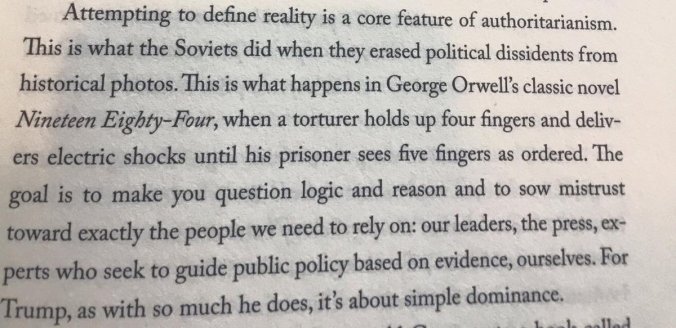
Exhibit A:

Yes, Hillary Clinton thinks the lesson of Orwell’s “1984” is that the public needs to rely on leaders, the news media and “experts.”

This would have exploded my head, thus earning a KABOOM! tag, if it was much of surprise. There is no benign reading of this passage, which was presumably either written by Clinton or approved by her, as well as by editors who one would assume had her interests in mind. Hillary is saying that it is authoritarian to try to define reality, and that the public should trust the government, leaders, the press and approved experts to define reality.  Their authoritarianism is evil; OUR authoritarianism is good, because, of course, we are right. Hillary Clinton thinks this way. She just told us, if we didn’t know already.

Terrifying.

Or, perhaps, “Whew! That was a close one!”

This is, as readers of Ethics Alarms will recall, the reason I ultimately abandoned my decision to vote for Clinton as the horrible but obviously better candidate than Donald Trump. I realized that Hillary and her party now embodies exactly this anti-democratic and creepily (and creeping) totalitarian mindset. We know what’s best; we are manipulating the news, facts, and public opinion (and the nomination, debates, statistics, FBI investigations, the Constitution, Senate procedures, IRS policies, whether Benghazi was caused by a YouTube video…) for your own good, so trust us; when they do it, it’s wrong and sinister, but when we do it, it’s gooooood… Continue reading

Miss America Ethics: Know Your Place, Stupid Beauty Pageants!

Public policy experts all…

Your place, as anachronistic, culturally embarrassing meat shows, is to be as unobtrusive as possible while feminists and people of taste figure out a nice, fair way to wipe you off the face of the United States. But until that happens, you have a duty not to be deliberately annoying, not to wave your ignorance like it is a bloody shirt, and also not to make the undeniably stupid people who watch you even dumber than they already are.

Perhaps I am getting ahead of myself..

Two nights ago, we were treated to the finals of the inexplicably still-televised Miss America beauty pageant, the grandmommy of them all. The traditionally risible interview portion of the competition, which has for as long as there were turnips on earth featured open-ended general questions conducive to virtue-signalling blather, usually features puzzlers like (from a list of such queries)

What do you think is true beauty?

What would you do differently if you could start your life over?

Who is your greatest role model or hero?

What does it mean to be a beauty queen?

If you could be granted one wish, what would it be?

What is the greatest challenge facing humanity?

What makes you happiest?

…and so on. The idea once was that anyone with a mouth is capable of answering these questions relatively competently, and they are not traps or invitations to attract criticism. Oh, once in a millennium a finalist might answer “What would you do differently if you could start your life over?” with, “Well, I would sure skip all those years I was a crack whore,” or “If you could be granted one wish, what would it be?” by saying, “I’d wish for boobs the size of El Capitan!,”  but these are pretty easy questions to ace. They are also well within the intelligence levels and expertise of the pageant administrators, judges and the contestants, so employing them isn’t political, or divisive.

A beauty pageant should not be divisive or political, just like an NFL game shouldn’t be divisive or political. I shouldn’t even have to write that.

Miss America 2018 decided to ditch the tradition of one question per finalist in the final round of competition, and ask two questions of each. The final five questions to the last five finalists were all “serious,” we were told.

Here they are, with the answers they evoked, and my observations. Continue reading

Morning Ethics Warm-Up, 9/12/17: Hurricane Reports, And Poor Charles M. Blow Needs A Vacation

Good morning.

1 There is supposedly a controversy regarding the on-the-spot hurricane reports: is it ethical for networks and news stations to place reporters and camera operators in mortal peril by having them scream into a mic while being buffeted by wind, rain and debris?

What’s the controversy? Of course it’s unethical. In addition to sending ridiculously mixed and self-contradictory messages—“I’m standing here in the storm telling citizens in the area that they shouldn’t be in the middle of this storm!”—it is also bad Ethics Chess. This stunt will continue until the first reporter is blown into a wall and sustains permanent brain damage, or is injured by a flying piece of debris that impales her, maims her, or cuts her in half. It is entirely predictable that this will happen eventually, and once it does, reporters will stop doing it. Why not stop this before a the inevitable tragedy occurs?

TV stations do it for ratings, that’s all. It’s great visual programming. It’s not necessary. Half the time, we can’t make out what the reporter is screaming, and what they are screaming is redundant and stating the obvious.

Apparently the first reporter to do this was Dan Rather.

Figures.

2. What is the mission of a pundit, a talking head, a columnist? It has to be—don’t you think?—to enlighten readers, to convey a constructive, useful analysis of complex issues, to reliably filter facts and controversies through a unique view-point without so completely tainting his or her output with bias that it actively misleads.

Yesterday New York Times columnist Charles Blow issued a column titled “Soul Survival in Trump’s Hell on Earth.” This was the apotheosis of the kinds of columns Blow has been writing almost exclusively now for months; at least I hope it’s that, for I can’t imagine where he goes from here. This column, like the others, is nothing, literally nothing, but a nearly fact free exposition on the theme, “I hate the President. I really do. I do so, so much. I know you do too, and if you don’t, I hate you too. ARRRGGGGHHH!”

The headline isn’t hyperbole; Blow, if he is to believed, really thinks Americans are living in Hell because Donald Trump is President. Not because there is a Great Depression hovering over the land, not because we are embroiled in a Civil War, or the existential threat of a world war, or the daily threat of an  international stand-off igniting into world-wide thermonuclear obliteration, but because a President was elected that offends the ideological and partisan sensitivities of Charles M. Blow.

Hell.

Seriously.

How can the New York Times continue to justify publishing the weekly primal screams of this pompous, doctrinaire, and now apparently deranged pundit? Exaggerating problems and pronouncing that we are all but doomed is not a service. It is harmful. The only readers who will be persuaded by a column like this are the ones who decide that something has to be done and that it’s time to build that bomb. Moreover, when a pundit reaches the stage that Blow has, where the simple act of a government not agreeing with his views and enacting policies that he does not favor launches him into hysteria, that pundit needs a vacation. Or maybe another career.

What are Blow’s arguments that justify his diagnosis that the United States is now Hell on Earth? Is it that a major party and its supporters have set out deliberately to undermine American institutions by rejecting a national election, seeking to remove an elected President by non-electoral means? Is it that the  international fumblings and ditherings of the previous administration are, as predicted, resulting in increased threats to the United States and the rest of the world? Is it that American journalism and its uniquely free news media, beyond question the app that makes democracy function, has now become, by its own abuses, so completely politicized and untrustworthy that it has become a threat to the nation, rather than its watchdog?

Nah, none of this appears to bother Blow at all; as far as I can detect, he approves of all of it. Here is his Bill of Biased Generalities that add up to Hell on Earth: Continue reading

From The Ethics Alarms “Law vs Ethics” Files: The Deadly Hexes Of Sally Quinn

In a newly published memoir, Sally Quinn, the famous journalist who married iconic Washington Post editor Ben Bradlee and became a D.C. society matron, then a religion columnist, reveals a lief-long obsession with mysticism and the occult. Ouija boards, pentagrams, witchcraft, charms, spells, seances, messages from the dead (like Ben), voodoo, the whole thing: Quinn writes that she has had an  “epiphany” revealing that “believing in magic is as legitimate as any religion or faith.”

I’ll buy that. I wouldn’t say that the next step is an application to Hogwarts, however.

So these are the people who presume to tell Americans what to think, eh? Good to know.

But I digress. In a recent Washingtonian Magazine profile contrived to puff the release of  “Finding Magic,” Bradlee’s widow says that she not only believes in hexes, she’s used them. And they work!

She reveals that, in her less mellow days, she put hexes on three people who promptly wound up having their lives ruined, or ended.

The first, cast in 1969, was spurred by old-fashioned jealousy. Some exotic beauty at a Halloween party inspired lust in Quinn’s beau at the time—and then killed herself just days after Sally cast her spell.

Her second victim was Clay Felker, the longtime editor of New York magazine who oversaw a brutal profile of Quinn in 1973, just before her catastrophic debut on the CBS Morning News. Quinn hexed Felker not long after flaming out at CBS and returning to Washington. “Some time afterward, Rupert Murdoch bought New York magazine in a hostile takeover, and Felker was out,” she writes. “Clay never recovered professionally. Worse, he got cancer, which ultimately caused his death.”

Target number three: a shady psychic who, the autumn after Quinn Bradlee was born, ran afoul of Sally’s maternal instincts. The woman dropped dead before year’s end.

This raises a classic ethics question that I nearly posed today as an Ethics Quiz. I didn’t, because I know the answer and have no doubts about it. (If it’s an ethics quiz, I at least have doubts.) The question would have been:

Ethically rather than legally, is there any difference between Sally Quinn and a murderer?

The answer is no.

I’d say that the first two victims make her the ethical equivalent of someone who is guilty of manslaughter, and the last one, after her first two hexes led to her targets’ deaths, was, again ethically rather than legally, premeditated murder.

Sally says that after the psychic dropped dead, she swore off her Death Hex. That’s admirable. The fact remains, however, the while believing an instrumentality would lead to harm when employed against specific individuals, she employed it, got her desired results, and believed that she was the cause of their subsequent deaths. She also doesn’t express any remorse or regret. Continue reading