I Hate To Say This, And Believe Me, I REALLY Hate To Say This, But The More I Read Of “What Happened” And The More I Hear Hillary Spin Her Defeat, The Less Upset I Am That Trump Is President

Exhibit A:

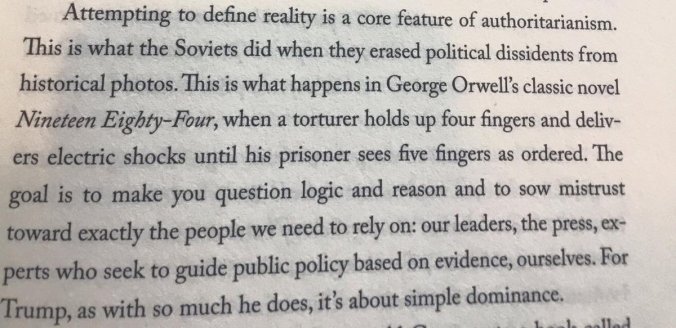
Yes, Hillary Clinton thinks the lesson of Orwell’s “1984” is that the public needs to rely on leaders, the news media and “experts.”

This would have exploded my head, thus earning a KABOOM! tag, if it was much of surprise. There is no benign reading of this passage, which was presumably either written by Clinton or approved by her, as well as by editors who one would assume had her interests in mind. Hillary is saying that it is authoritarian to try to define reality, and that the public should trust the government, leaders, the press and approved experts to define reality.  Their authoritarianism is evil; OUR authoritarianism is good, because, of course, we are right. Hillary Clinton thinks this way. She just told us, if we didn’t know already.

Terrifying.

Or, perhaps, “Whew! That was a close one!”

This is, as readers of Ethics Alarms will recall, the reason I ultimately abandoned my decision to vote for Clinton as the horrible but obviously better candidate than Donald Trump. I realized that Hillary and her party now embodies exactly this anti-democratic and creepily (and creeping) totalitarian mindset. We know what’s best; we are manipulating the news, facts, and public opinion (and the nomination, debates, statistics, FBI investigations, the Constitution, Senate procedures, IRS policies, whether Benghazi was caused by a YouTube video…) for your own good, so trust us; when they do it, it’s wrong and sinister, but when we do it, it’s gooooood… Continue reading

Miss America Ethics: Know Your Place, Stupid Beauty Pageants!

Public policy experts all…

Your place, as anachronistic, culturally embarrassing meat shows, is to be as unobtrusive as possible while feminists and people of taste figure out a nice, fair way to wipe you off the face of the United States. But until that happens, you have a duty not to be deliberately annoying, not to wave your ignorance like it is a bloody shirt, and also not to make the undeniably stupid people who watch you even dumber than they already are.

Perhaps I am getting ahead of myself..

Two nights ago, we were treated to the finals of the inexplicably still-televised Miss America beauty pageant, the grandmommy of them all. The traditionally risible interview portion of the competition, which has for as long as there were turnips on earth featured open-ended general questions conducive to virtue-signalling blather, usually features puzzlers like (from a list of such queries)

What do you think is true beauty?

What would you do differently if you could start your life over?

Who is your greatest role model or hero?

What does it mean to be a beauty queen?

If you could be granted one wish, what would it be?

What is the greatest challenge facing humanity?

What makes you happiest?

…and so on. The idea once was that anyone with a mouth is capable of answering these questions relatively competently, and they are not traps or invitations to attract criticism. Oh, once in a millennium a finalist might answer “What would you do differently if you could start your life over?” with, “Well, I would sure skip all those years I was a crack whore,” or “If you could be granted one wish, what would it be?” by saying, “I’d wish for boobs the size of El Capitan!,”  but these are pretty easy questions to ace. They are also well within the intelligence levels and expertise of the pageant administrators, judges and the contestants, so employing them isn’t political, or divisive.

A beauty pageant should not be divisive or political, just like an NFL game shouldn’t be divisive or political. I shouldn’t even have to write that.

Miss America 2018 decided to ditch the tradition of one question per finalist in the final round of competition, and ask two questions of each. The final five questions to the last five finalists were all “serious,” we were told.

Here they are, with the answers they evoked, and my observations. Continue reading

Morning Ethics Warm-Up, 9/12/17: Hurricane Reports, And Poor Charles M. Blow Needs A Vacation

Good morning.

1 There is supposedly a controversy regarding the on-the-spot hurricane reports: is it ethical for networks and news stations to place reporters and camera operators in mortal peril by having them scream into a mic while being buffeted by wind, rain and debris?

What’s the controversy? Of course it’s unethical. In addition to sending ridiculously mixed and self-contradictory messages—“I’m standing here in the storm telling citizens in the area that they shouldn’t be in the middle of this storm!”—it is also bad Ethics Chess. This stunt will continue until the first reporter is blown into a wall and sustains permanent brain damage, or is injured by a flying piece of debris that impales her, maims her, or cuts her in half. It is entirely predictable that this will happen eventually, and once it does, reporters will stop doing it. Why not stop this before a the inevitable tragedy occurs?

TV stations do it for ratings, that’s all. It’s great visual programming. It’s not necessary. Half the time, we can’t make out what the reporter is screaming, and what they are screaming is redundant and stating the obvious.

Apparently the first reporter to do this was Dan Rather.

Figures.

2. What is the mission of a pundit, a talking head, a columnist? It has to be—don’t you think?—to enlighten readers, to convey a constructive, useful analysis of complex issues, to reliably filter facts and controversies through a unique view-point without so completely tainting his or her output with bias that it actively misleads.

Yesterday New York Times columnist Charles Blow issued a column titled “Soul Survival in Trump’s Hell on Earth.” This was the apotheosis of the kinds of columns Blow has been writing almost exclusively now for months; at least I hope it’s that, for I can’t imagine where he goes from here. This column, like the others, is nothing, literally nothing, but a nearly fact free exposition on the theme, “I hate the President. I really do. I do so, so much. I know you do too, and if you don’t, I hate you too. ARRRGGGGHHH!”

The headline isn’t hyperbole; Blow, if he is to believed, really thinks Americans are living in Hell because Donald Trump is President. Not because there is a Great Depression hovering over the land, not because we are embroiled in a Civil War, or the existential threat of a world war, or the daily threat of an  international stand-off igniting into world-wide thermonuclear obliteration, but because a President was elected that offends the ideological and partisan sensitivities of Charles M. Blow.

Hell.

Seriously.

How can the New York Times continue to justify publishing the weekly primal screams of this pompous, doctrinaire, and now apparently deranged pundit? Exaggerating problems and pronouncing that we are all but doomed is not a service. It is harmful. The only readers who will be persuaded by a column like this are the ones who decide that something has to be done and that it’s time to build that bomb. Moreover, when a pundit reaches the stage that Blow has, where the simple act of a government not agreeing with his views and enacting policies that he does not favor launches him into hysteria, that pundit needs a vacation. Or maybe another career.

What are Blow’s arguments that justify his diagnosis that the United States is now Hell on Earth? Is it that a major party and its supporters have set out deliberately to undermine American institutions by rejecting a national election, seeking to remove an elected President by non-electoral means? Is it that the  international fumblings and ditherings of the previous administration are, as predicted, resulting in increased threats to the United States and the rest of the world? Is it that American journalism and its uniquely free news media, beyond question the app that makes democracy function, has now become, by its own abuses, so completely politicized and untrustworthy that it has become a threat to the nation, rather than its watchdog?

Nah, none of this appears to bother Blow at all; as far as I can detect, he approves of all of it. Here is his Bill of Biased Generalities that add up to Hell on Earth: Continue reading

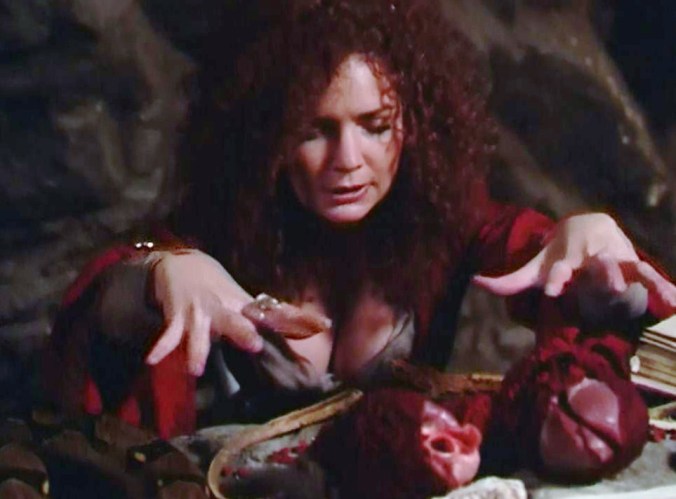
From The Ethics Alarms “Law vs Ethics” Files: The Deadly Hexes Of Sally Quinn

In a newly published memoir, Sally Quinn, the famous journalist who married iconic Washington Post editor Ben Bradlee and became a D.C. society matron, then a religion columnist, reveals a lief-long obsession with mysticism and the occult. Ouija boards, pentagrams, witchcraft, charms, spells, seances, messages from the dead (like Ben), voodoo, the whole thing: Quinn writes that she has had an  “epiphany” revealing that “believing in magic is as legitimate as any religion or faith.”

I’ll buy that. I wouldn’t say that the next step is an application to Hogwarts, however.

So these are the people who presume to tell Americans what to think, eh? Good to know.

But I digress. In a recent Washingtonian Magazine profile contrived to puff the release of  “Finding Magic,” Bradlee’s widow says that she not only believes in hexes, she’s used them. And they work!

She reveals that, in her less mellow days, she put hexes on three people who promptly wound up having their lives ruined, or ended.

The first, cast in 1969, was spurred by old-fashioned jealousy. Some exotic beauty at a Halloween party inspired lust in Quinn’s beau at the time—and then killed herself just days after Sally cast her spell.

Her second victim was Clay Felker, the longtime editor of New York magazine who oversaw a brutal profile of Quinn in 1973, just before her catastrophic debut on the CBS Morning News. Quinn hexed Felker not long after flaming out at CBS and returning to Washington. “Some time afterward, Rupert Murdoch bought New York magazine in a hostile takeover, and Felker was out,” she writes. “Clay never recovered professionally. Worse, he got cancer, which ultimately caused his death.”

Target number three: a shady psychic who, the autumn after Quinn Bradlee was born, ran afoul of Sally’s maternal instincts. The woman dropped dead before year’s end.

This raises a classic ethics question that I nearly posed today as an Ethics Quiz. I didn’t, because I know the answer and have no doubts about it. (If it’s an ethics quiz, I at least have doubts.) The question would have been:

Ethically rather than legally, is there any difference between Sally Quinn and a murderer?

The answer is no.

I’d say that the first two victims make her the ethical equivalent of someone who is guilty of manslaughter, and the last one, after her first two hexes led to her targets’ deaths, was, again ethically rather than legally, premeditated murder.

Sally says that after the psychic dropped dead, she swore off her Death Hex. That’s admirable. The fact remains, however, the while believing an instrumentality would lead to harm when employed against specific individuals, she employed it, got her desired results, and believed that she was the cause of their subsequent deaths. She also doesn’t express any remorse or regret. Continue reading

Morning Ethics Warm-Up, 9/7/2017: Compromise, Competence, Verrit, A Congressional Jerk, And Democratic Crooks Don’t Matter…

Good Morning!

1 President Trump stunned the political world and particularly the left’s “I hate him” news media by crossing party lines and cutting a debt deal with Democratic leaders in defiance of his own hyper-partisan party. One reason they were stunned is because this is what competent Presidents do and are supposed to do in order to govern, and we have just finished eight years with a previous President who was unwilling and incapable of doing it.

This single episode doesn’t make Trump a competent President, but it does show that he is competent in at least one aspect of democratic leadership (Obama was competent at exactly two: appearing Presidential and speaking coherently), and has some guts. The demonstrated ability to negotiate and the willingness to act in the teeth of furious opposition were two characteristics that the advocates of his candidacy cited as justification for electing him.

It is also dawning on some that the structure of the DACA executive order may well be to fashion the measure as a bargaining chip to be cashed in later. This is also the kind of thing competent leaders do.

2. There is a new website called Verrit, which appears to be an openly, proudly, left-biased news source which purports to “verify” news stories, obviously based on its own progressive world view. Verrit founder and CEO Peter Daou told the news media,

“We’re in a time now where you just no longer trust anything that you’re reading,” Daou said. “Facts are now in question. Reality is now in question. So we want to do something where we rigorously vet these facts and we actually stand by our research and put an authentication code on every fact that we put up.”

And what qualifies Verrit as a fair and objective “authenticator”? Apparently it is the virtue of being hard-progressive and anti-conservative to the bone. Here is a recent Verrit collection of its “cards”:

Continue reading

Morning Ethics Warm-Up, 9/6/17: Comey’s Premature Draft, Obama’s Golden Rule Breach, Newspapers “Protecting Us,”And Thank-You, Boston Red Sox


1 I want to sincerely thank the Boston Red Sox for giving me, the sole baseball ethicist on the web who also devotes a disturbing amount of his time, energy and passion to following the team, the challenge and opportunity to address a major cheating scandal involving the organization and institution I love. Seriously, guys, thank you. This is exactly what I needed to face after staying up past 1 AM watching the Sox pull out a 19 inning, 6 hour game on Hanley Ramirez’s bloop single to center.

I’ll cover the issue in the next post. Ugh.

2. Ironically, just as the anti-Trump news media was hyperventilating over the fact that the Special Counsel was examining a draft letter by the President regarding his reasons for firing James Comey (draft letters have minimal probative value if any, but you know: Trump), it came to light that in May of 2016, Comey had drafted a statement declining to charge Hillary Clinton or her staff in the State Department e-mail scandal, months before key witnesses (like Clinton herself) had been interviewed or much of the evidence had been reviewed. President Trump, of course, tweeted that this proved there was a “rigged process,” but Comey’s draft is no more incriminating that Trump’s draft. (Now, Loretta Lynch’s meeting with Bill Clinton might suggest a rigged process, but that’s another story.)

Supreme Court Justices have drafted opinions before oral argument; that doesn’t mean they can’t change their minds. It is certainly odd that Comey would have drafted a statement that Clinton would not be indicted so long before the investigation was completed. It is odder still that Hillary’s interview was not under oath, that it wasn’t videotaped, that there was no transcript, and that she was allowed to have representing her as an attorney at the session a top aide who was also a potential witness.

Professor Turley, in a column at The Hill, agrees that the early draft doesn’t implicate the integrity of the investigation, but raises a related issue:

While I am inclined to accept assurances from Comey that he did not finally decide on charges until after reviewing all of the evidence, the details from the Clinton investigation hardly support a view of a robust and dogged effort in comparison to the type of investigation of people like Paul Manafort.

In pursuing Manafort, special counsel Robert Mueller has now enlisted an army of investigators, reached a cooperative relationship with staunch Trump critic New York Attorney General Eric Schneiderman, and actively pursued tax and financial dealings far afield of the original Russian collusion allegations. He also ordered a heavy-handed (and unnecessary) “no knock” search in the middle of the night on Manafort’s home.

The Clinton investigation looks like Club Fed in comparison. Clinton and her staff refused to cooperate with State Department investigators seeking confirm any damage to national security. Key laptops were withheld and only turned over after Comey’s staff agreed to destroy the computers after their review, despite the relevance of the evidence to congressional investigations. Comey then cut five immunity deals with key Clinton staff members, including former State Department staffer, Bryan Pagliano, who set up a server in Clinton’s home in Chappaqua, N.Y., and worked for her at the State Department.

Pagliano refused to cooperate after invoking his Fifth Amendment right against self-incrimination and destroyed evidence after being given a preservation order. Those deals raised the concern over a type of prosecutorial planned obsolescence, making a viable case less likely.

The amusing part is that all of this circles back to Comey’s firing, which was justified by his handling of the Clinton investigation regardless of any other factors.

3. The New York Times today reviews a festival play called “___hole.” That’s not really the title, however, although “___hole” was printed twice as the play title before the Times made this clear. A comment by the reviewer noted that the real title couldn’t “get past the editors.” Continue reading

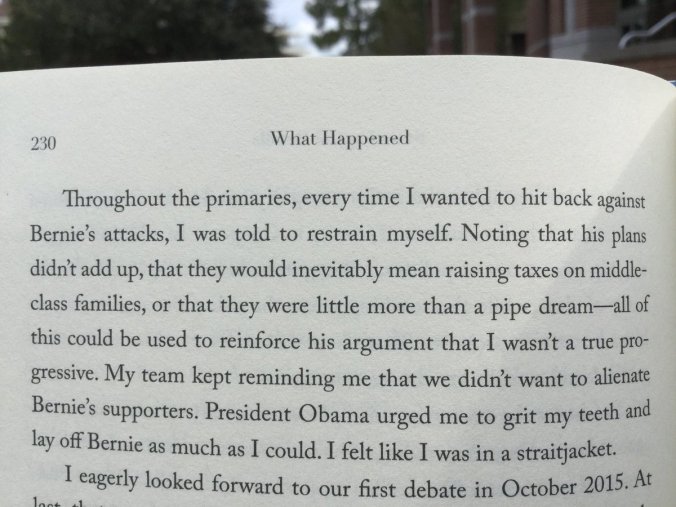
Ethics Quote Of The Month: Hillary Clinton In Her Upcoming Book, “What Happened”

You see the quote above. This is a section of one of the excerpts being doled out to the media and public to build interest in Clinton’s latest book. In the excerpt she blames Bernie Sanders, among others, for her defeat, saying that his attacks against her during the primary caused “lasting damage” and laid the foundation for “(Donald) Trump’s ‘Crooked Hillary’ campaign.”

Observations:

1 As with her earlier excerpt about how she wishes she had acted more assertively when Donald Trump was “stalking her” during a debate, Clinton displays the opposite of leadership instincts here. Although she was the one offering herself as the leader of the free world, she whines that she was rendered powerless by the advice of others and the recommendation of President Obama. Saying that she felt that she was “in a straitjacket” is simply admitting that she was indecisive and accepted the judgment of others over her own. However, that decision was hers; she was not in a straitjacket, and she is accountable for the ultimate decision to “lay off Bernie.” She can’t credibly blame anyone else.

2. Bernie Sanders was as inoffensive and respectful as opponent as Hillary could have possible drawn for the Democratic Party nomination. His obvious reason for running was to get a national platform for his far-left, Socialist positions. He was too old, he was eccentric, and he wasn’t even a Democrat. Like Barack Obama, who also ran against Hillary believing that he had no chance, Hillary’s lack of charisma, chilly public persona and inherent untrustworthiness suddenly made Sanders’ underdog candidacy viable. Nonetheless, as Ethics Alarms discussed during the campaign, Sanders never behaved as if he was committed to winning. Most remarkably (and unforgivably for his supporters), he gave a pass to Clinton on her e-mail server scandal, saying more than once that he didn’t care about her “stupid e-mails.” Since Clinton was lying about, double-talking around, spinning and ducking the issue almost daily, this was a gift that no other serious candidate would have given her. Yet she’s blaming Bernie now for not being even less competitive.

Incredible! Continue reading

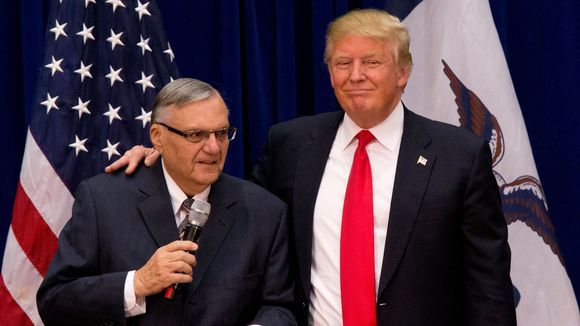
From The “Didn’t I Tell You To Stop Making Me Defend President Trump?” Files, An Ethics Alarms Popeye: More On The Joe Arpaio Pardon

I would prefer not to keep talking about the Joe Arpaio pardon, but the news media and the “resistance” won’t let the pardon go, because in the absence of anything legitimate giving them cause to scream for an impeachment, they have to latch on to whatever they can. So this is a Popeye: I’m writing it because, as the spinach-living cartoon sailor would say, “That’s all I can stands, cuz I can’t stands no more!”

Oh, before I forget: here’s what the Southern Poverty Law Center says about the pardon:

“By pardoning Joe Arpaio, President Trump has demonstrated his contempt for the rule of law and the racism at the core of his agenda. Arpaio, a Trump favorite on the campaign trail, is the former sheriff of Maricopa County, Arizona. He was convicted of criminal contempt of court for intentionally violating a federal court order prohibiting racial profiling. As a result of President Trump’s pardon, Arpaio will never be held accountable for his unconstitutional conduct.”

Following this logic, by pardoning drug dealers President Obama proved that at heart, he is a drug dealer. By pardoning Chelsea Manning, President Obama proved that sharing classified information with our enemies is at the core of his agenda. This is a “law center”  including such tripe on its website? It sounds like the legally ignorant accusation often made against defense lawyers (like Hillary Clinton) that they endorse the crimes, motives and values of their clients.

In a front page article on Sunday, the New York Times tried to break its own record for desperately trying to make a case for Presidential wrongdoing while still stating the undeniable fact that no wrongdoing had occurred:

  • The Times states, correctly, “that there is nothing in the text of the Constitution’s pardons clause to suggest that [Trump] exceeded his authority.” But it tracks down yet another law professor who has allowed the anti-Trump brain virus to swallow his integrity. Noah Feldman, a law professor at Harvard, claimed that pardoning Arpaio “would express presidential contempt for the Constitution.”

Good thinking. The President expressed contempt for the Constitution by engaging in an action described and enacted in the Constitution. A better argument, though still unfair, would be that President Obama was expressing contempt for the Constitution by not using its pardon power provision even once within his first 400 days in office.

  • More from the Professor: “Arpaio didn’t just violate a law passed by Congress…His actions defied the Constitution itself, the bedrock of the entire system of government.” Yes, and so what? If that same document gives the President an open-ended power to forgive any crime, and it does, then this is just huffing and puffing.

All Feldman is saying is that he doesn’t believe that Arpaio’s particular crime should be pardoned. When you’re President, Professor, by all means let that standard be your guide.

  • By saying Mr. Arpaio’s offense was forgivable, Professor Feldman added, Mr. Trump threatens “the very structure on which his right to pardon is based.”

Note to  Professor Feldman: Get help. The reason the President has unlimited pardon power is because, in the view of the Constitution’s authors, any offense IS forgivable. Presidents have pardoned traitors, those who have killed American citizens. They have pardoned terrorists, and a President of the United States who plotted to subvert justice and our democracy itself. No Harvard Law professor has made the claim that any of those offenses were unpardonable (that is, literally, unforgivable). Why is that? Well, a) Trump is special and doesn’t deserves to be judged by the same standards as other Presidents, and b) the Left hates Arpaio beyond all proportion, because of his opposition to illegal immigration.

  • The Times writes, “It was the first act of outright defiance against the judiciary by a president who has not been shy about criticizing federal judges who ruled against his businesses and policies.” If this pardon is “outright defiance against the judiciary,” then most pardons are. Almost all pardons erase a judicial sentence or verdict.

This is misleading, biased, inflammatory, unethical journalism.

  • The Times writes,

“Mr. Trump could pardon any of the subjects of the special counsel’s Russia inquiry, though some legal specialists believe he could increase his risk of prosecution if he is seen as abusing his pardon power.Were Mr. Trump to announce that he has pardoned himself, impeachment would remain possible. A prosecutor might also test the limits of the pardon power by indicting Mr. Trump notwithstanding such an announcement. That clash could lead the Supreme Court to weigh in on the limits of the president’s power to spare himself from punishment for criminal wrongdoing.”

This story has nothing to do with impeachment! No evidence has been found that suggests the President has committed any impeachable acts. The Times story is about the Joe Arpaio pardon. How can the Times justify suddenly piling tangential hypothetical on top of tangential hypotheticals in this article to get to a scenario where the Supreme Court has to determine whether President Trump can pardon himself for crimes as yet unalleged and undiscovered? Well, the reporter is Adam Liptak, the epitome of what Instapundit calls “Democratic operatives with bylines.” He’s not reporting here; he’s promoting a nakedly partisan narrative. Continue reading

Morning Ethics Warm-Up: 8/29/17

Good Morning!

1. Jezebel fails an integrity test. Are you surprised? The feminist site  has a story about John Smelcer, a successful novelist who has falsely claimed to be a Alaskan Native American  and has used  twenty-five-years of fake credentials and phony biographical details to gain a foothold with academia, publishing houses and critics. Smelcer’s deceptions are a good ethics tale on their own; I especially enjoy his tendency to use blurbs from dead authors on his Amazon pages. But it was this sentence in the Jezebel piece that really impressed me:

“…he was hired by the University of Alaska Anchorage as part of an effort to increase its diversity, with the understanding that he was an Alaskan Native.”

preceded by,

“Smelcer sounds like a Rachel Dolezal…”

Rachel Dolezal? The former NAACP official who claimed (and still claims) she was black when she wasn’t? Is that who comes to mind when you think about a prominent figure who was hired by a university as a diversity candidate after falsely claiming Native American status, and who has parlayed that fraud into national prominence?

The feminist website is shamelessly (transparently, clumsily, hilariously) protecting Senator Elizabeth Warren, aka “Fauxahontas,” and demonstrating how it and the rest of the left-wing media will try to whitewash her personal history to advance the hypocritical demagogue to the White House if possible.

The same story has another example of flagrant unethical conduct being unsuccessfully slipped under the ethics radar. In the process of noting that Smelcer’s Amazon page includes bogus endorsements by such dead literary luminaries as  Norman Mailer, Saul Bellow, and J.D. Salinger, the story quotes Roxanne Dunbar-Ortiz, author of An Indigenous Peoples’ History of the United States,  who also authored an accolade for Smelcer. She wrote to Jezebel that she has asked Smelcer to remove her blurb several times, explaining,

He was so intrusive, he kept lobbying me to give him a blurb. And I basically gave him one just to get rid of him. I was very busy on tour, and unbeknownst to me, he put it on a new book he just published. I’ve written him multiple times for over a year to take my blurb off his publicity, and he wouldn’t do it. He uses all these famous dead people’s names. I never thought someone would be so brazen as to do something like that, but I thought, okay, I’m in good company!

We see. Dunbar-Ortiz thinks it’s okay to give a fake endorsement of a book that she knows will be used to deceive purchasers and critics as long as she’s busy, and doesn’t have the integrity to say “no” and mean it. And wait—what? She gave him a blurb and says now that she didn’t expect him to use it?

No, Roxanne, you’re not in good company, all those dead authors are in bad company, with you. They didn’t give Smelcer blurbs; they’re dead. You’re the one who voluntarily aided his scam. Continue reading

The Stupid Wall

The current Trump upset over the Stupid border Wall is fascinating as a lesson in the danger of making improvident promises that you don’t think you will ever be in a position to break. Presidential candidates do this all the time; I don’t think Trump’s Stupid Wall was even the worst of the 2016 crop.  The President almost certainly thought he had no chance of winning when he began promising to build the SW, then doubled down when he said, ridiculously, that he would make Mexico pay for it.

A lie is still a lie when it is said to deceive even if only the gullible and dim will be fooled, as the old Ethics Scoreboard (current down, but it will rise again) used to  remind readers when it celebrated such lies in its David Manning Lie of the Month, named after Sony’s fake movie reviewer that Sony argued wasn’t fraudulent since nobody believed those review snippets in movie ads anyway. “Manning” had said that Rob Schneider’s  idiotic comedy “The Animal” was a comic masterpiece.

It’s not certain that the President knew the idea of the SW was ridiculous since he is—well, you know. Either way, however, it was a promise that shouldn’t have been made, just like Bernie Sanders’ promise only to appoint SCOTUS justices  who would “repeal” Citizens United should never have been made. Luckily for Sanders (and the rest of us), he wasn’t elected, and never had to try to deliver. That’s just moral luck, though. A promise you cannot keep is unethical when you make it, whether your ethical breach is dishonesty or incompetence. Continue reading