Morning Ethics Warm-up: 8/16/17

GOOD MORNING!

1. I’m heading to Boston and Fenway Park in a few hours to meet with two of my high school classmates and together pay our respects to the 1967 Boston Red Sox, the spiritual beginning of Red Sox Nation, and a group of men, then barely more than boys, who had as profound an effect on my life and view of it as anything I have ever experienced.

It’s the 50th Anniversary of that amazing team and the heart-stopping pennant race it won against all odds, in a four team race that came down to the final game of the regular season. I mean heart-stopping literally: the team wasn’t called “The Cardiac Kids” for nothing. TWO of my father’s colleagues at the Boston Five Savings Bank died of heart attacks while attending Red Sox games, during one of the 9th inning desperation rallies for which the team was famous. The only reason I didn’t perish in like fashion is because I was just 16 years old.

Why was this team, and that summer 50 years ago, so important to me? I don’t have time or space to answer that question well, and you’d probably wonder what I was babbling on about anyway. A 2017 film by Major League Baseball called “The Impossible Dream” does a fair job of explaining it, but it’s too short to do the job right.

I had listened to, watched or attended every Boston Red Sox game for five years, as the team lost and lost. From those bad teams, followed weakly by the city in those days, in a crumbling old park that seemed destined to be abandoned and torn down, I learned that winning wasn’t everything, that loyalty wasn’t easy, that Hemingway was right, and that baseball was about courage, humility, perseverance, doing your job every day, sacrifice, and hope, as well as usually losing at the end. That summer of 1967 taught me that hope is worth the effort even though hope is usually dashed by the ice water of reality, that you should never give up, that miracles do happen, and that nothing is as wonderful as when a community is united in a single, inspirational goal, no matter what that goal might be…and that you should never be afraid to give everything you have in pursuit of a mission, even when it is likely that you will fail.

I learned difficult, discouraging lessons, too. When an errant pitch hit Red Sox right-fielder Tony Conigliaro in the face on August 18, 1967, it was the beginning of a lesson that revealed its tragic last chapter 23 years later. That one taught me that life is horribly, frightening unpredictable, and that we envy others at our peril. It taught me that we need to do what we can to accomplish as much good as we can as quickly as we can, because we may lose our chance forever at any moment.

Tony C, as he was and is known as, was a beautiful, charismatic, local kid, the idol of Boston’s huge Italian-American community,  in his fourth season with his home town team at the age of 22. He dated movie stars; he recorded pop songs; he had a natural flair of the dramatic, and was destined for the Hall of Fame. One pitch took it all away. Although he had two comebacks and played two full seasons facing major league fastballs with a hole in his retina and his field of vision, Tony was never the same. After his final attempt to keep playing failed at the age of 30, he became a broadcaster, and at 37 was seemingly on the way to stardom again in 1982 when he suffered a massive, inexplicable heart attack—Tony  did not smoke, and had no family history of heart problems– that left him brain damaged until his death in 1990.

As Henry Wiggin, the star pitcher protagonist of the novel, play and movie “Bang the Drum Slowly” observes as he  reflects on the death of his catcher and roommate, everyone is dying, and we have to remember to be good to each other. But it’s so hard. Ethics is hard. The ethics alarms ring faintly when we are about the task of living, or not at all…

At the end of the story, the narrator, the best friend of the catcher (but not really that close a friend) recalls how quickly everyone on the baseball team went back to their selfish ways after their teammate went home to die Even the narrator, who was the leader of the effort to make the catcher feel loved and appreciated in his last days, ruefully recalls his own failing. The catcher had asked him a favor, just to send him a World Series program (the team won the pennant after he had become too ill to play), and he had forgotten to mail it until it was too late. How hard would it have been, the narrator rebukes himself, to just put it in an envelope and mail it? Why are we like that, he wonders?

1967 was the beginning of my exploration of that mystery too.

So I am going to Boston for the 30 minute ceremony. I can’t even stay for the game; I have a seminar to teach tomorrow morning, and the last flight out of Logan is at 9 PM. There will probably be just a small contingent from the Cardiac Kids: most of them are dead now, or too infirm even to walk onto the field. But Yaz will be there, and Gentleman Jim Lonborg; Rico Petrocelli, Mike Andrews, and maybe even Hawk Harrelson  and Reggie Smith. I will be there to say thank-you, that’s all.

And to show that I remember. Continue reading

More Perspective On Charlottesville, The Left, And The First Amendment

I’ve been spending the day pointing out the bias and hypocrisy of various Facebook friends who posted emotional, warped, virtue-signaling junk assuming they would be greeted with the sounds of a thousand well-trained seals clapping. I’m not sure why I bother: it gets close to the cartoon about the guy who tells his wife, “Someone is wrong on the internet!” I feel like the alternative is to  just let a brain virus run amuck. These once intelligent people just know the President is secretly a white supremacist. He’s obligated to specifically condemn the white nationalist group, because they were “emboldened” by his election. And, they say, their “side’s” violence is “less disgusting” than the violence of the bad people….because, though they don’t say this, the ends justify the means.

I think the reason I subject myself to the sneers and abuse—did you know I must be a Donald Trump supporter and a white nationalist?—is that the Left’s assault on free speech, which is the cornerstone of democracy,  has to be opposed, called out and condemned every single time, until they either embrace the Constitution, move to Canada, or haul us off to re-education camps. White supremacists aren’t a danger to the nation, because that kind of prejudice is antithetical to core American values, and no credible, respectable institutions and individuals support them, or ever will. Fascism of the Left is a real danger, because it is seductive and misleading, and it is infecting the most powerful and influential institutions we have. We saw it in Charlottesville. In a college town indoctrinated in the progressive cant that the wrong opinions don’t deserve to be heard because they constitute harm and violence by spoken word, the state and local government  combined to use violence to stifle political speech.

One of the best and most objective political, government and ethics websites around is City Journal; I really should cite it more often. Today Bob McManus posted an excellent essay which began with this… Continue reading

Morning Ethics Warm-Up: 8/11/17

GOOD MORNING!!!

1. From sources within Google management, we learn that the firing of the diversity memo writer, James Demore, was hotly debated, but in the end...

“…Damore’s focus on biology really made it clear that he had crossed the line.” What turned the tide, said sources, was when it was noted that if Damore’s dubious contentions about women’s skills were replaced by those about race or religion, there would be no debate.’

Ethics diagnosis: Bias made them stupid…that is, Google’s political correctness bias. If someone says that blacks, for example, are biologically handicapped for certain jobs, that’s bigotry and ignorance, the equivalent of poor Al Campanis’s  infamous statement to Ted Koppel that blacks “lacked the necessities ” to manage a baseball team. If someone says that holding religious beliefs suggests one may have biological disadvantages, then that individual is, of course, an idiot.

Women, however, are biologically different from men. If this was the reasoning behind Demore’s dismissal, then it is an example of regarding fealty to cant and politically correct mythology as more important than dealing with complex realities.

2. Professional Trump apologist Jeffrey Lord reacted with a tweeted Sieg Heil! to  Left Wing attack group Media Matters organizing a boycott of the Fox News star’s sponsors to force Sean Hannity off the air.  CNN responded by firing Lord, saying, “Nazi salutes are indefensible.”

Except that Lord was not performing a Nazi salute, but alluding to it to make the very accurate point that the Media Matters wing of progressive America is anti-free speech, and, Nazi-like, determined to shut down inconvenient dissent. Sieg Heil!, in the context of Lord’s tweet, did not mean “Yay Hitler, and let’s kill some Jews!” but rather “Media Matters embodies fascism of the left.”

Which it does.

This story is just full of detestable people and organizations. Jeffrey Lord is a dishonest hack whom CNN keeps parading before its viewers to pretend that the network is “balanced” in its relentless critical commentary on the President. Typically Lord is the sole defender of the Administration on a panel of multiple virulent critics, presided over by one of CNN’s myriad anti-Trump hosts. Sean Hannity is a knee-jerk conservative without scruples, perception or shame. Media Matters is a left-wing propaganda machine that makes a mockery of the term “media watchdog” by its very existence, and it is not unfair to rate its creator and leader, David Brock, as unstable. And I don’t like Nazi salutes either, though to call them “indefensible” is just plain wrong. They are defensible on the History Channel, to show how Nazis behaved. They are defensible in films like “Valkyrie,” since Tom Cruise’s doomed hero’s reluctant salute was a central theme.

It is defensible in Mel Brooks movies, which feature the salute frequently, to mock the Nazis. It is defensible in “Dr. Strangelove,” to make the running joke that mysterious ex-Nazi genius has a Nazi arm with mind of its own.

And it is defensible to use the Nazi salute derisively to say,”David Brock and Media Matters are fascist in the their methods and attitudes towards free speech.”

CNN’s firing of Lord falsely implied that he was referencing the salute positively. By doing this, the increasingly unprofessional and untrustworthy network was also able to impugn President Trump; after all, if his most visible defender in a Nazi, that makes the President Hitler, right?

In this particular basket of deplorables, CNN may be the most unethical of all. Continue reading

Morning Ethics Update: 8/10/17

Good Morning!

1. Less than two weeks after social justice bullies on social media chastised actor Mandy Patinkin for agreeing to take the place of a black actor in Broadway’s “Natasha, Pierre & The Great Comet of 1812,”  causing the politically impeccable Mandy to withdraw with humble mea culpas, and the “woke” creator of the  the Tony winning musical to humbly kowtow to the new show business principle that it is better for a show to close entirely, putting everyone out of work, than for a white actor to take over a role from a black actor who took over the role from a white actor in the first place, “The Great Comet’s” producers announced that the show will close in September.

Good job, everybody!

Morons.

2. First Amendment incursions are creeping in from all sides and all angles so fast it’s hard to slap them down. Cowboy Joe West, the major leagues’ longest-serving umpire,was just suspended for three days for comments he made a in an interview with USA Today published on June 20, to mark   the umpire’s 5,000th regular-season game. Asked which player beefed most frequently about his calls, West said “it’s got to be Adrian Beltre.” Beltre, who recently punched his own ticket into the Hall of Fame by getting his 3000th hit, is apparently something of a human Bermuda Triangle for ethics controversies.

“Every pitch you call that’s a strike, he says, ‘Whoa! Whoa! Whoa!,'” West was quoted as saying.  “I had a game with him recently and the pitch was right down the middle. He tells me, ”That ball is outside.’ I told him, ‘You may be a great ballplayer, but you’re the worst umpire in the league. You stink.'”

MLB suspended West for three days, telling the umpires union in a letter that the discipline was in response to an “appearance of lack of impartiality.” Beltre has said that he never assumed West was being anything but facetious. The umpires union is livid, and West is likely to file a grievance.

There are two theories about this strange episode in the Marshall household. I think it’s more evidence of slippage on the societal slope to speech suppression. My wife thinks baseball is laying the groundwork for replacing umpires on balls and strikes with robo-calls. After all, robots aren’t biased.

I hope she’s right, but I doubt it.

3. Why don’t Democrats want to clean up eligible voter rolls?the Justice Department filed a Supreme Court amicus brief  supporting the state of Ohio as it fights to defend its law that purges names from voter rolls if  those names aren’t attached to votes for a significant period. This reverses the Obama Administration’s position, which backed a lower court decision  that it ran afoul of the 1993 National Voter Registration Act.

Why does Ohio want to de-register voters who don’t vote for two years, then are sent notices asking that they confirm their voter registration, don’t respond to the notices ,and continue to not vote for another four years? I assume it is because the state doesn’t want dead people on the voter rolls. Why do Democrats want the names of dead people listed as eligible voters?

I’ll leave that to your imagination… Continue reading

Comment Of The Day: “The Viral Google Diversity Memo”

The perspective Ethics Alarms readers often add to topics based on their personal experiences is a often great enhancement to the discussions here. This Comment of the Day by Alex is a perfect example, as he clarifies the context of the Google diversity memo through his own observations as an employee of another large tech company.

Here is his Comment of the Day on the post, “The Viral Google Diversity Memo”:

Rather than rehash the memo or analyze it or say what is right or wrong with its reasoning, I’ll instead add my experience dealing with internal policies and “requests for comment” at a large tech (software) company – this is a direct competitor of Google, based in the Pacific NW and employing ~100,000 people (you can figure out who they are with that). My background is in Electrical Engineering with a strong focus on Computer Science, and I was hired by my previous employer just out of college after spending a summer internship with them. I worked there for 12 years, until the summer of 2016 (actually today is my one year anniversary at my new job). In my time there I can only describe diversity and HR policies around race and gender are schizophrenic, even if well-intentioned. These are my stories [insert Law and Order opening notes].

The official harassment/discrimination policy as stated in the employee handbook (which was updated every year) is incredibly vague, and this is intentional (although no one will come out and accept it publicly). We are in an at-will state, so you can be easily dismissed based on that one vague rule; and it has been used as a negotiation tactic on borderline performance dismissals to settle for a lower severance package. (“Do you really want us to state that you’re leaving for violations of the harassment policy? No? Ok, how about you settle for 2 weeks instead of 4?”) But I also have to state that the cases where I saw this section being arguably misused can be counted with the fingers of one hand. Also, I am certain that there are good intentions behind this policy, but as is the case with many well-intentioned rules, it is when the rubber meets the road that things get messy.

Every year we had to take Standards of Conduct training. Every year we had a new edition, and every year there was at least one case study dealing with gender or racial discrimination. Some years were better than others, but in general the training was terrible. If you had the cognitive abilities of a 7-year-old you could figure out what were the right responses without watching the videos or reading the policies. (The Saturday morning cartoons I watched in the 80s – G.I. Joe, He-Man, Transformers – had more complex moral dilemmas). I remember one year around the middle of my tenure when the videos and cases were actually interesting and engaging. A case that I still remember from that time is about an ambiguous situation between a male manager and a female engineer not in the same chain of command. There was a big internal debate about that one, and the next year we had the blandest possible training to avoid controversies.

The above two points are to set the stage: corporate policies are clear, you should toe the line, do not do anything that might be misconstrued, you can be dismissed for very small transgressions.

And then… well… tech companies are rebels, they thrive in chaos, and you’re expected to rock the boat. In many (may be even all) groups you can only grow so much by being a technical expert, you are expected to influence larger and larger teams as you get promoted to keep getting good performance reviews. You can be the only expert on a certain software component, but unless other people know about you and have been “influenced” by you, you are not considered good enough. This has the effect of incentivizing “visibility”. Other people and other teams should know you exist and be willing to state that you’ve had a positive impact for the company. Continue reading

Morning Ethics Warm-Up: 8/9/2017

Good Morning!

1. On the matter of whether James Demore’s Google memo was unethical in its distribution, which some commenters here dispute, apparently he took the precaution of hiring an employment lawyer before he sent the memo. This strongly suggests that he was not merely opening up an internal discussion, but intentionally provoking a confrontation. If he just wanted to alert management to a problem, the ethical approach was to speak directly to management, not put out an e-mail that he had to know someone would leak to the internet.

Meanwhile, Google’s firing Demore for politely raising legitimate culture issues belies its “Don’t Be Evil” motto. It also may be illegal: Federal labor law bars union AND non-union employers alike from punishing an employee for communicating with fellow employees about improving working conditions. California also has a very strong anti-political discrimination law which “prohibits employers from threatening to fire employees to get them to adopt or refrain from adopting a particular political course of action.”

2. I noted this in yesterday’s post, but it’s worse than I thought: the left-wing news media, which is to say the news-media, has displayed neither discipline, common sense (you can’t keep signalling how biased you are, guys—eventually people will notice) nor ethical journalism by outrageously misrepresenting the message and the tone of the memo. CNN’s Brooke Baldwin, for example, described the memo as saying  “I don’t really like women anywhere near a computer.” That’s false reporting. Do these people understand that anyone can read the memo and see that either they are lying, or haven’t read the memo?

3. The memo’s allegedly “controversial” statement that men and women have some innate physiological, emotional and psychological differences that make their genders (in general, not in specific cases) better or less-well-suited for certain jobs, tasks or fields takes me back to my multiple battles with feminists who insisted that I cast female actors in “Twelve Angry Men.” They simply put their fingers in their ears and hummed when I pointed out that the play was about the group dynamics when twelve disparate male strangers are locked in a room. Do women in such a situation keep threatening each other physically? I think not. Actually, the play is an advertisement for diversity: having women in that largely dysfunctional fictional jury would have probably solved many of its problems, but because women are different from men, not because they are exactly the same, as the Georgetown feminists insisted. Women really need to decide what their stand is: are they different in ways that can be advantageous, or not different at all? They can’t have it both ways. On Instapundit, Glenn Reynolds recalled “The Althouse Rule of Gender Research”, which is, : “Scientists: remember to portray whatever you find to be true of women as superior.”

This goes for commentators, pundits, journalists, educators and, of course, Presidential candidates. ‘We need a woman in the White House (because men screw things up)’ is wise and true, and not sexist at all. Continue reading

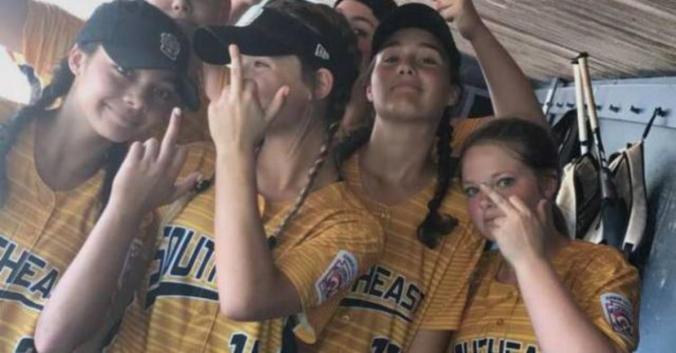
Ten Further Thoughts On The “The Taunting Girls Softball Team”

Well! I returned from my seminar to find an excellent discussion underway regarding this Morning’s Ethics Warm-up, wholly devoted to the Virginia girls softball team that was hammered mercilessly for the raised middle fingers of six teammates to send off their vanquished foes in the semi-finals. Here are some further thoughts after reading the comments:

1. There is no question that the conduct of the girls concerned the game, the sport, and the League. They were in uniform. The message directed the “up yours” gesture to the other team. This is not a case where personal expression via social media was punished by an outside authority. Ethics Alarms has been profuse in its rejections of efforts by schools to punish students for their language, ideas or other expression on platforms like Facebook and Snapchat. Those are clearly, in my view, abuses of power, parental authority and free expression. This is not like such cases in any way. If a cheerleader squad, wearing the uniforms, colors and emblems of a school, behaved like these girls, punishment by the school would be appropriate, right up to the “death sentence” of dissolving the squad.

2. Would the reaction to the photo be different if it were a boy’s team? I just don’t think so.

3. The comparison has been made to the earlier post about Matt Joyce, a major league player, being suspended by the league for a comment made to one fan during a game in a heated exchange. For the life of me, I cannot figure out what anyone would think is similar about the two episodes, the primary difference being the fact that in one case, an adult was disciplined for professional misconduct on the field of play, and in the other, children were disciplined for breaching conduct their sport and organization exists in part to teach, reinforce and convey. The punishment of the player was $60,000 in lost income for a single word, not broadcast via social media. The team was not punished except to have to play without his services for two games, but then it was not colorably a team offense by any stretch of the imagination. I don’t even want to think about what an MLB team would do to six players who, in uniform, made the same gesture the girls did to “our fans.” They might all get released. Continue reading

The Audacious And Everlasting Hypocrisy Of Al Gore

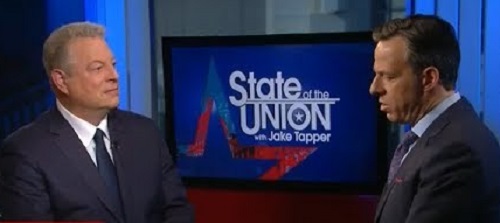
In June, CNN’s Jake Tapper asked Al Gore about his apparent energy-use hypocrisy:

TAPPER: This is a criticism we hear from conservatives all the time when talking about people like you or Elon Musk or Leonardo DiCaprio, that you, yourself, have a large carbon footprint.

GORE: Yes. Well, I don’t have a private jet. And what carbon emissions come from my trips on Southwest Airlines are offset. I live a carbon-free lifestyle, to the maximum extent possible.

As Ann Althouse noted at the time, for  a carbon-based organism like Gore to claim to be living carbon-free is a demonstration of shocking ignorance by someone who has been making his millions as an earth-science huckster. To me, the amazing thing was that after repeatedly showing that he couldn’t pass a middle-school science test (as when he declared on national TV that the core of the Earth was “several million degrees”)

After he found himself the official guru of global warming hype, Gore should have had the sense and discipline to educate himself and really learn about the topics he was purporting to be an expert on. He obviously didn’t bother; like the similarly lazy Sarah Palin, he figured that the people who agreed with him weren’t going to be that discerning, so mastery of facts wasn’t worth the trouble.

The other infuriating aspect of Gore’s answer to Tapper  was his “offset” excuse. That just  meant “I’m rich, so I pay to for all my carbon pollution.” Gore really believes that leaving a carbon footprint the size of Godzilla is responsible conduct for a climate change shill telling the peasants that they must change their life-style, because he can “offset” it. He really believes that’s fair and honest.

In the wake of Gore’s sequel to his error and hype-filled climate change alarmist documentary “An Inconvenient Truth,” the National Center For Public Policy Research, which had embarrassed Gore with its 2007 revelations after his first documentary, checked to see if Al, as he promised at the time, had addressed his own polluting ways. It checked Gore’s electricity usage information through public records requests and conversations with the Nashville Electric Service (NES), and found.. Continue reading

Morning Ethics Warm-Up: 8/4/17

Good Morning!

1. An update to the Michelle Carter fiasco from Taunton, Mass., where the judge in the case discussed here sentenced the young woman to 15 months in jail for her supposedly deadly words, which “made” her boyfriend commit suicide. This classic example of the axiom “hard cases make bad law” provides the censorious camel’s nose access to the tent for advocates of  the criminalization of “hate speech,” opposition to climate change propaganda, and the gradual castration of freedom of speech. Carter should have never been charged or tried; doing so was an abuse of process, prosecutorial ethics and judicial ethics. I strongly suspect that the judge knows the case will be reversed on appeal as unconstitutional, hence his decision to stay the sentence, allowing Carter to remain free while her case winds its way to the Supreme Court. Meanwhile, her life will be stalled, and completely absorbed by the consequences of her texts urging teen Conrad Roy III to act on his expressed desire to kill himself, which he did. This is her real punishment, because the sentence will not and must not stand.

It is unethical to use the legal system this way. When the government takes it upon itself to punish citizens despite the absence of applicable laws, it is treading over the line dividing democracy from totalitarianism.

2. What is to be done about California? States have always maintained their own unique cultures, and that is a national strength. When a state’s culture becomes wholly estranged from and hostile to the values and principles of the nation it belongs to, however, it becomes a danger to that nation and perhaps to its citizens. What, if anything, is the responsibility of the federal government when this happens? What is the duty of the state’s elected officials?

Tucker Carlson’s creepy interview on Fox with a leader of the California secession movement,Shankar Singam, raised these questions and more. Among Singam’s jaw-dropping positions was that the documented exodus of middle class Californians and small businesses from the state was a good thing. “If everyone in the middle class is leaving, that’s actually a good thing. We need these spots opened up for the new wave of immigrants to come up. It’s what we do,” Singam told Carlson. He also told Carlson that “This is California. We’re not the United States.”

At least that settles the question of whether Hillary Clinton won the popular vote.

An ethical, responsible, loyal American governor would recognize the danger inherent in allowing his state to see itself as separate from the rest of the country, and actively work to reverse that dangerous trend and attitude. That governor is not Jerry Brown. Continue reading

Morning Ethics Warm-Up: 8/3/17

Baaaaad Morning for me, GOOD MORNING to you, I hope.

1.  The New York Times, I thought, has an unusually fair story on the two phantom Trump phone calls that roiled “the resistance” yesterday. The President had said that he had received “calls” from the President of Mexico and the Boy Scout leadership, the former to salute him for getting tough at the border and the other to praise his controversial remarks at the annual Jamboree. There were no such calls, as the Mexico and the BSA had strongly suggested, and the White House confirmed this yesterday. In its piece this morning, the Times included a germane quote from pre-politics Trump in his 1987 book “The Art of the Deal”:

“People want to believe that something is the biggest and the greatest and the most spectacular. I call it truthful hyperbole. It’s an innocent form of exaggeration — and a very effective form of promotion.”

Germane, except that we already know that he thinks this way—and I don’t think referring to a conversation (in the case of Mexico) or multiple members of the Boy Scouts leadership”praising his speech in person after he was done (“Nice job!” “Great speech!” “The boys really appreciated it!”) as phone calls qualifies as “hyperbole,” truthful or otherwise.

These are examples of the President’s well-established addiction to speaking in word clouds and approximations. He “saw” (well, maybe not literally) “thousands of Muslims” (Okay, maybe he didn’t see them, but they were there! ) celebrating the doom of the Twin Towers in New Jersey. He never supported the Iraq invasion (saying otherwise to Howard Stern doesn’t count). Now add the hundreds of others we either discussed here or that were flashpoints during the campaign. The President’s attitude toward these little and large imprecisions of language has been, apparently since childhood, “Whatever.” He really doesn’t think they matter, because to him the difference between, for example, “calls” and other communications doesn’t matter.

It’s a terrible habit. It undermines his credibility. It weakens his ability to persuade and lead. It makes him look foolish, careless and stupid, and shows a lack of discipline. It gives his intractable foes easy bullets to shoot at him. It’s also an established trait, at this point. This is, again, the Julie Principle. This is how he is, and both his supporters and detractors know it. What  is accomplished by treating each new example as a major scandal? “Well, you can’t just let him get away with it!” is the reply.

He doesn’t get away with it. It undermines his credibility. It weaken his ability to persuade and lead. It makes him look foolish,  careless and stupid, and shows a lack of discipline.

2. The Times seems to make a mild “everybody does it” excuse for the President, citing the examples of two Presidents the Times also hated, LBJ and Reagan, mostly Reagan. “It is hardly unprecedented for a president to use a story to inspire or motivate, or to embellish a yarn for the sake of punctuating a poignant message,” the Times says. Then it recounts this: Continue reading