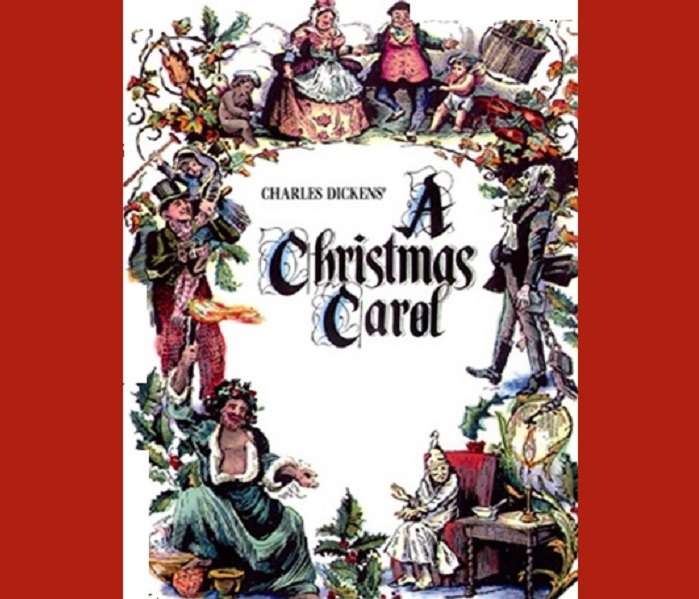
“A Christmas Carol”

-A-Christmas-Carol2

The entire text of “A Christmas Carol” is and has been for a long time listed under Inspirations on the Ethics Alarms homepage. If you haven’t read it (preferably out loud, to your family) recently, I urge you to do so. It is wonderful, and still, after all the movies and TV specials and songs and rival Christmas-themed stories, the best of the genre. It is also delightful literature, and, because I am an incurable romantic, a sap, and a Christmas addict, the story and Dickens’ telling of it gets to me every time.

The first version of the film adaptations of “A Christmas Carol” I saw when I was knee-high to Robert Reich was the version starring Alistair Sim. Many aficionados of “A Christmas Carol adaptations think it is still the best, and I won’t argue with them. Because the movie is in black and white and has been superseded by so many other versions, it is hard to find it on TV now except for the streaming services. Even the much inferior version starring Reginald Owen (with the entire Lockhart family, including young pre-“Lassie,” pre-“Lost in Space” June, as the Cratchits) is shown more than the classic Sim film. In these cynical times, the version of “A Christmas Carol” most likely to be available, sort of, is Bill Murray’s “Scooged.” It’s not the worst version—the musical starring Albert Finney wins that booby prize (“Thank you very much! Thank you very much!” Yecchh.)—but cynicism and dark humor really don’t belong in this story

My personal choice for the best adaptation goes to the 1984 George C. Scott version, if you don’t count “Mr. Magoo’s Christmas Carol,” and you probably shouldn’t, though I love it. The 1984 film has David Warner as Bob; Edward Woodward is the best Ghost of Christmas Present ever; and I think this is the scariest version of Marley.

Here it is…

Sunday Ethics Insomnia, 11/29/2020: No Wonder I Can’t Sleep!

1. I hate 99.9% of the petitions offered at Change.org. but I’m signing this one . It reads,

Professor Dorian Abbot, a tenured faculty member in the Department of Geophysical Sciences at the University of Chicago, has recently come under attack from students and postdocs for a series of videos he posted to YouTube expressing his reservations about the way Diversity, Equity, and Inclusion (DEI) efforts have been discussed and implemented on campus.
In these videos Prof. Abbot raised several misgivings about DEI efforts and expressed concern that a climate of fear is “making it extremely difficult for people with dissenting viewpoints to voice their opinions.” The slides for each of Prof. Abbot’s videos can be found here, and his own account of events and his opinions can be found here. Nowhere in these materials does Prof. Abbot offer any opinion that a reasonable observer would consider to be hateful or otherwise offensive.

Shortly after uploading the videos, Abbot’s concerns were confirmed when 58 students and postdocs of the Department of Geophysical Sciences, and 71 other graduate students and postdocs from other University of Chicago departments, posted a letter containing the claim that Prof. Abbot’s opinions “threaten the safety and belonging of all underrepresented groups within the [Geophysical Sciences] department” and “represent an aggressive act” towards research and teaching communities.

[Pointer: Pennagain]

2. “Hello, Newman...” According to the Postal Service’s own records, more than 150,000 mail-in ballots were not delivered in time for them to be counted on election day. This is, of course, as I and anyone else who was paying attention expected and predicted, because the USPS is undependable

I am surprised that the number was that low.

Continue reading

Ethics Quote Of The Day (And For All Time): Abraham Lincoln [Missing Post Section Recovered!]

On this date in 1863, President Abraham Lincoln added a vital coda to the United States mission statement articulated in the Declaration of Independence nearly a hundred years earlier. Gary Wills, among other historians and commentators, has argued that with this single speech Lincoln reframed the purpose of the American experiment as well as clarifying its core values. Those values, it is fair to say, are today under the greatest threat since the Civil War today. Lincoln’s address lasted just two or three minutes (it was not even announced beforehand as a speech, but rather “remarks”), but also reframed the purpose of the war itself, as not only to preserve the union, but a struggle for freedom and equality for all.

There has been so much written about the Gettysburg Address that it would be irresponsible for me to attempt to analyze it here. It probably isn’t necessary to analyze the speech. Few statements speak more clearly for themselves: if ever a speech embodied the principle of res ipsa loquitur, this is it:

Continue reading

“You Have No Enemies” By Charles Mackay (1814-1889)

Let’s start the week with some poetic inspiration.

The excellent Netflix series “The Crown” launched its fourth season yesterday, with Scully herself, Gillian Anderson, delivering a brilliant portrayal of “the Iron Lady,” Margaret Thatcher. At one point, Queen Elizabeth (Olivia Coleman) warns the Prime Minister that she is making enemies, and she responds by reciting from memory this poem, which I had never heard or read before.

One more thing: Since I posted the poem, it has been the most visited post of the more than 12,000 on Ethics Alarms. If you came for the poem, why not stay for the ethics? Look around, read the comment policies, check out the categories (to your right.) This isn’t the only enlightening post you’ll find here, or even the most enlightening.

You Have No Enemies

You have no enemies, you say?
Alas! my friend, the boast is poor;
He who has mingled in the fray
Of duty, that the brave endure,
Must have made foes! If you have none,
Small is the work that you have done.
You’ve hit no traitor on the hip,
You’ve dashed no cup from perjured lip,
You’ve never turned the wrong to right,
You’ve been a coward in the fight.

Mackay is not well-known in the U.S., and he was a marginal literary figure in England. But in 2019, a confidante of Thatcher’s revealed that she turned to the writings of Mackay for solace and inspiration, particularly “Enemies,” which she kept in her scrapbook.

I’d describe the poem as a simpler, more direct predecessor of Theodore’s Roosevelt’s famous “The Man in the Arena” speech. (Teddy did go on.) Mackay’s poem has the advantage of being suitable for children, who need to be taught, as do almost all of our current politicians, that popularity isn’t everything.

[Note to first time Ethics Alarms visitors: You came for the poem; why not stay for the ethics and the lively discussions? You can find out more about the blog here. Welcome!]

Social Q’s Ethics: The Good, The Bad, And The Stupid

I mentioned earlier that I had stopped checking New York Times  Sunday advice column “Social Q’s” because its author, Phillip Gallanes, had apparently received the memo from Times brass so his advice and choice of queries were now primarily “woke” propaganda. However, reading material in our bathroom was recently in short supply, forcing me to peruse two recent Gallanes columns in which there was one interesting ethics issue raised, and two others that were a perfect examples of where Gallanes’ biases make him an untrustworthy advice columnist.

1. The photograph: The interesting issue regarded a daughter whose parents had recently died, and who was shocked that a valuable photograph was not directed her way in the distribution of the estate. It was, she said, second only to the parents’ home in value, and had appreciated in value greatly in the decades since it was given. Didn’t she have a right to get the photo, since she had given it in the first place? Wasn’t it unethical for the parents to treat it like the rest of their estate?

Gallanes properly pointed out that there was no basis for her assumptions in law or ethics. There are no strings attached to transfers of property unless they are made explicit at the time of the gift. What a cumbersome societal norm that would be: an estate is obligated to figure out the original source of every object of value and make sure they return to the original giver! What Gallanes didn’t say, and I would have, is “Who are you kidding? You want the valuable item, and have concocted a phony justification for claiming it.”

2. The vote. Another Social Q’s questioner wrote,

Continue reading

Rationalization #3A, Pollyanna’s Mantra, or “Every Cloud Has A Silver Lining”

pollyanna

Not only is the Ethics Alarms Rationalization List getting its first new addition since April, it’s also finally up to date. I had neglected to add the two most recent rationalizations, Rationalization 25C, The Romantic’s Excuse, Or “I care so much!” and #52A, Kennedy’s Stall,  or  “We’ll cross that bridge when we come to it”  to the main list after introducing them in posts

I think today’s addition is the 104th Rationalization, and I’m as surprised as you probably are that there are so many. Most of the recent additions have been close relatives of previously entered ones, indicated by the letters A,B, and C, and also making counting them difficult, especially for me, since I count only slightly more accurately than I spell.

Pollyanna’s Mantra, named after the 1913 children’s literature classic by Eleanor H. Porter (and the now more famous 1960 Disney adaptation of the novel that made a sensation out of child actress Hayley Mills, above) about a little girl who was determined to see the good in everybody and everything, is another in the sub-rationalization category, stamped 3A to mark its close relationship with #3, Consequentialism. “Every cloud has a silver lining” carries on the deception of #3, which takes advantage of a quirk of human nature that wants to confer credit for the accidental and unintended benefits of an unethical decision or unethical conduct on the individual responsible for the decision or conduct. Pollyanna’s Mantra seeks to mitigate accountability for unethical conduct that has had predictable negative results by trying to shift attention to some positive consequences, real or contrived.

Continue reading

Discrimination, Diversity, And The Tattooed Teacher

Sylvain Helaine, 35, has, as you can see above, gone to great lengths to cover nearly every centimeter of his body with tattoos, including the whites of his eyes. He is, believe it or not, a kindergarten teacher, and Helaine is complaining that he has been told he cannot teach young children because some of them find his appearance nightmare-inducing. This, he feels, is discrimination.  Nonetheless, he is still teaching older children.

He says that he hopes his tattoos will teach his students about acceptance so that “maybe when they are adults they will be less racist and less homophobic and more open-minded.”

I’m sorry this issue is emerging in France and not in the U.S. It’s an excellent Ethics Incompleteness Principle case. When an individual deliberately mutilates himself like this, a school rejecting him as a teacher of young children, and indeed older children as well, is fair, reasonable and responsible. His “disability” is self-inflicted, his appearance teaches that narcissism and lack of respect for others is admirable, and he is quite possibly mentally ill. Continue reading

Sunday Morning Ethics, 9/6/2020: Dog Food, A T-Rex, An Astronaut, The Pope…But No 2020 Campaign Items Whatsoever! Let’s Hear A Little Applause!

1 . Boy, the Pope must hate the U.S. media. ‘Did you hear that four people say the President called our soldiers “losers”? It’s true! They really say that!’

Pope Francis called gossiping a “plague worse than COVID” and risks dividing  the Catholic Church. The devil, he says, is the “biggest gossiper.” who is seeking to divide the church with his lies.

Francis was discussing a Gospel passage about the need to correct others privately when they do something wrong. The Catholic hierarchy calls this the “fraternal correction” of priests and bishops to correct them when they err without airing problems in public. You know; like when they sexually abuse children. “Gossip” apparently means “talking about things the Church is trying to cover-up.”

Got it, Your Holiness!

2. Proposition: It’s unethical to buy your dog’s food at the Dollar Store. Sunshine Mills Inc., an Alabama-based pet food company, issued a recall of its dog food this week due to the levels of Aflatoxin, a toxic mold by-product with  the potential of making dogs sick, according to a Food and Drug Administration news release. The products recalled are  FAMILY PET Meaty Cuts, Beef Chicken & Cheese Flavors;  HEARTLAND FARMS Grilled Favorites Beef Chicken & Cheese Flavor; and HAPPY LIFE Butcher’s Choice Dog Food. All are sold exclusively at Dollar General and Family Dollar stores.

I wonder if they sell baby food? Continue reading

Ethics Batting Practice, 7/21/ 2020: Baseball Zoom Hangover Edition.

Isn’t that only TWO feet??

Last night’s Smithsonian Associates presentation on baseball and American culture went well, I guess. Presenting on Zoom is like acting in a closet: no connection to the audience, no way to gauge what is working and what isn’t, or whether the invisible viewers are engaged. It did give me  a chance, during the section on baseball cheating, to read one of my favorite passages from Philip Roth’s baseball allegory/satire,”The Great American Novel.” Roth’s narrator, mad sportswriter Word Smith, tells the sad tale of the legendary “Spit” Baal, a master of the spitball, the mucous-ball and other trick pitches aided by surreptitiously applied substances. After such adulterations of the ball were banned in 1920, Baal found his career in tatters, since he could no longer use his signature pitch. (In the real world, the National league and American league allowed acknowledged spitball specialists to continue to throw the pitch legally under a grandfather clause, but Roth’s fantasy  is about a third major league, wiped from history and record books in the Fifties following the discovery that it had been infiltrated by Communists.) One day, again seeing his dry pitches clobbered and realizing that he could no longer get batters out legally, “Spit” has a psychotic break on the mound that ends his career in spectacular if unsanitary fashion:

And so before twenty thousand shocked customers  including innocent children — and his own wide-eyed teammates, the once great pitcher, who was  washed up anyway, did the unthinkable, the unpardonable, the inexpiable. He dropped the flannel  trousers of his uniform to his knees, and proceeded  to urinate on the ball, turning it slowly in his hands  so as to dampen the entire surface. Then he hitched  his trousers back up, and in the way of pitchers,  pawed at the ground around the mound with his  spikes, churning up then smoothing down the dirt  where he had inadvertently dribbled upon it. To the  batter, as frozen in his position as anyone in that  ball park, he called, “Here comes the pissball, shithead — get ready!”

For years afterward they talked about the route that ball took before it passed over the plate. Not  only did it make the hairpin turns and somersaults  expected of a Baal spitter, but legend has it that it  shifted gears four times, halving, then doubling its  velocity each fifteen feet it traveled. And in the end,  the catcher, in his squat, did not even have to move  his glove from where it too was frozen as a target .Gagging, he caught the ball with a squish, right in  the center of the strike zone…

1. So this graph would seem to indicate that the news media is scare mongering, right? Continue reading