Henry James, Mis-Matched Neighbors and the Naked Silhouette

Like most people, I grew up being told that it was dangerous to hitch-hike, because of the many predatory drivers waiting to pounce, and also never to pick up hitch-hikers, because some of them were serial killers. I always seemed to me that the odds favored an eventual convergence in which a psychopathic motorist picked up a murderous hitch-hiker. I wonder what happens then.

Neighbor disputes are often like this: pure chance places very different  people side-by-side, one an inconsiderate boor, and the other an intolerant jerk. We know what happens then: exactly what has happened in Great Falls, Montana.

Brian Smith objects to the large decal on neighbor Shanna Weaver’s car. The decal portrays a white silhouette of a naked woman. To him, it’s pornography, and he objects to have to look at it.  “My upbringing dictates that the human body is a sacred thing, not something that should be put on display,” Smith said. Weaver, however, is not inclined to remove it. “It’s my freedom of speech, which he can’t take away,” Weaver says. “It’s no different than the mud flaps that you see on trucks.”So Smith filed a complaint against Weaver for violating the local anti-pornography ordinance, which was a stretch. [In an earlier version of this post, it wa stated that Weaver sued him for harassment, and was thrown out of court. That was in error, and Ethics Alarms apologizes for its mistake.] Continue reading

Celebrate Columbus Day, Honor Columbus

Today is Columbus Day, not that one would know it to read the typical paper or to watch most newscasts. The Italian explorer’s reputation and legacy have been relentlessly eroded over the years by temporal chauvinists who apply spurious social and historical hindsight to justify unfair criticism of civilization’s heroes. Christopher Columbus deserves the honor this holiday bestowed on him.  He was a visionary and an explorer who, like all transformative figures, possessed the courage and imagination to challenge conventional wisdom and seek new horizons of achievement.

Holding Columbus responsible for the predation of the Spanish and the devastation of native populations that were among the unanticipated consequences of his achievement is the equivalent of blaming Steve Jobs for technology’s elimination of occupations and the fact that our children are fat and have the attention span of mayflies. And of course, anyone who believes that the Stone Age populations of the Americas would have continued to prosper in Avatar bliss without Columbus’s intrusion is ignorant of both human nature and world history. Continue reading

A Fan’s Obligation: 12 Life Lessons From Being a Red Sox Fan

Thanks Carlton. I won't forget.

This is not going to be a fun day.

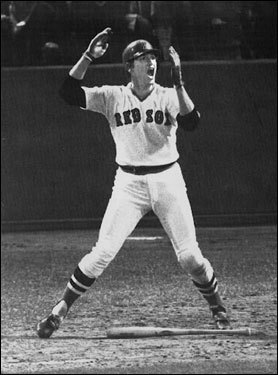
The Boston Red Sox, the baseball team to which I have devoted a remarkable amount of my time, passion and energy over a half-century, are threatening to complete late season collapse of embarrassing and historic proportions. A spectacularly bad month of September has the team holding on to its once assured post-season play-off slot by its fingernails, and the squad appears to be dispirited and unhinged. Today the Red Sox play a double-header with the New York Yankees, the team’s blood-foe, and its prospects don’t look good. I, of course, must watch both games.

Following a losing baseball team is emotionally hard—I listened to or watched every game the Red Sox played in a six year period in which they never had a winning season— but following a collapsing winning team is much, much worse. It feels like a betrayal, yet at the same time the fan feels guilty for being angry with the players, who undoubtedly are suffering more than you are. This is, after all, their career. Still, you have had your hopes raised over many months; you have, if you are a serious fan, attached your self-esteem to your team’s fortunes. Watching it tank is like watching a presidential candidate you have argued for, and gone to rallies for and contributed to make an ass of himself in a debate. (And no, I’m not a supporter of Rick Perry.) Continue reading

The Deceitful, Illogical, Unethical Disclaimer

Don't be fooled by Voldemort's disclaimer!

I once worked for a company that was specifically targeted by an industry group for coordinated attacks and anti-competitive tactics. We obtained a copy of the agenda for the planning meeting for this onslaught, and the bullet points looked like part of a hypothetical in an anti-trust class law school exam. This was the most blatant collusion in restraint of trade imaginable. But the  lawyers for the group apparently thought all could be made benign and legal by a disclaimer on every agenda copy that  said, in effect, “Don’t pay any attention to what this agenda says—trust us, it’s all fair and legal.” The disclaimer stated that the organization fully supported and followed all provisions of U.S. anti-trust statutes, and would never, ever do anything to violate them. This is roughly the equivalent of a mugger telling his victim that he is non-violent while he’s punching him in the face.

I am reminded of that agenda when I see commercials for new drugs, which show healthy, happy, beautiful models frolicking with their families or lovers in idyllic settings while the announcer, usually at breakneck speed, warns that the drug may cause violent flatulence, boils, locusts, insanity, cannibalism and excruciating death. I was reminded of the agenda again when I learned of the latest gambit by PublishAmerica, which earlier this year got in trouble with “Harry Potter” author J.K. Rowling by soliciting money from authors by promising to bring their works to her attention: Continue reading

The Ten Commandments for Ethical Reviewers

Film critic Roger Ebert’s autobiography is out, and I’m sure it’s terrific: Ebert is a lively writer, and he has many good stories to tell. One tale from the book that has been recounted in several  reviews, however, caused me to slap my forehead. Ebert says that he adopted longtime New Yorker film critic Pauline Kael’s approach to film reviewing, which she wrote was, “I go into the movie, I watch it, and I ask myself what happened to me.”

Ah HA! That’s why Pauline Kael was such a destructive film reviewer, and the predominance of her attitude is why reviewers of stage and film do far more damage than good. Once upon a time, when critics had professional standards and cared about fairness, the accepted approach of someone who reviewed films or plays for public consumption wasn’t how a work made the critic feel, but rather how it was likely to make a typical audience member feel. It doesn’t take much insight to decide whether one likes a play or a movie; anyone can do that. Continue reading

Comment of the Day: “Incompetent Elected Official of the Week: Sen. Claire McCaskill”

Karl Penny’s Comment of the Day is further reflection on the futile effort to turn back the tide of new technology, which Senator McCaskill apparently believes can be accomplished with a good marketing campaign, making her a candidate for institutionalization.  A prize for the first reader who identifies what a klepsydra was!

“Jack, sometimes I get a little nostalgic about older technologies, generally ones that figured so prominently in my youth, but have now gone the way of the klepsydra. I get nostalgic enough that, almost, for a moment, ideas like Sen. McCaskill’s seem to make sense, and a gleam comes to me eye, and I begin to think, “Yeah….” Then I remember that it’s daylight out, and however pleasant dreams can be, they’re just dreams.

“I also remember that there are reasons—good reasons—why I and millions of others adopted email, wrote documents on a computer, listened to music through an MP3, read my books on a Kindle, and played games on a computer. Truth to tell, most of us don’t really miss those older technologies, except in brief spurts. I have an old Olympia Portable typewriter in a closet. I must have typed a million documents on that thing, from my freshman year of high school through college. Letters, papers, notes, forms, checks (!) even. It was so indispensable, I took it with me most everywhere. Now, it just sits in that closet, and I hardly ever take it out even to look at. The last time it saw any use was last year, when a local high school was doing a play, and they needed an old manual typewriter as a prop. Now, it’s back in the closet.

“Sen, McCaskill may have successfully deluded herself, but I don’t think she’s going to delude much of anyone else, and thank heaven. But, if this is what passes for progressive thought among our elected leaders, then God help us all.”

“The Star Thrower” and Ethics

My response to the Ethics Alarms reader who pronounced my efforts here pointless and futile received many kind responses from commenters, several of who have pointed me to the story of the man who threw starfish into the sea. I had never read it or encountered it is any way. The fable is often simplified to represent the lesson that just because one person cannot “save all the starfish dying on all the beaches,” saving one by throwing it back into to the sea is still worth the effort, if only to the starfish that is saved. I am grateful for that analogy to what I do, but even more grateful for being alerted to the original  “The Star Thrower,” by anthropologist/philosopher/ writer Lauren Eiseley (1907-2007)

He had a lot more wisdom to convey  to us. You can read “The Star Thrower ” here.

Ethics Train Wreck Warning: Affirmative Action for the Hideous

You won't need that portrait any more, Dorian...the Americans with Disabilities Act has you covered!

It is rare that an ethics train wreck of culture-wide proportions can be prevented with a firm, “Shut up, and go away!” This appears to be one of those times, however, and if anyone is reluctant, I hereby volunteer for the job.

Daniel S. Hamermesh, a professor of economics at the University of Texas, is shilling for his book, “Beauty Pays,” in which he proves the unremarkable fact that being attractive is an advantage in society , and being unattractive is an impediment. He recently hit the op-ed pages of the New York Times, writing, among other things, this:

“Why this disparate treatment of looks in so many areas of life? It’s a matter of simple prejudice. Most of us, regardless of our professed attitudes, prefer as customers to buy from better-looking salespeople, as jurors to listen to better-looking attorneys, as voters to be led by better-looking politicians, as students to learn from better-looking professors. This is not a matter of evil employers’ refusing to hire the ugly: in our roles as workers, customers and potential lovers we are all responsible for these effects.”

“How could we remedy this injustice?”

Whoa! There it is, the magic words that open the door for ham-handed social architects to do what they always to do, try to remedy the results of natural human proclivities and preferences with laws. Continue reading

Children’s Book Ethics: “Maggie Goes On A Diet”

Send it to Hell.

In an earlier post, I wrote about Shel Silverstein’s satirical “Uncle Shelby’s ABZ Book,” an adult audience parody of children’s books which, in addition to teaching an incorrect alphabet, included segments that encouraged night terrors and fear of castration, endorsed sibling jealousy, extolled violent conduct and theft, and even tried to convince children to eat the pages. The book is hilarious, but only because it is clear that no parent in their right mind would ever let a child near such a publication.  No parents in their right minds should let their daughters near “Maggie Goes on a Diet,” either.

Paul Kramer’s fable about an obese 14-year-old who turns her life around by losing weight is as potentially damaging to children as anything in Shel Silverstein’s spoof; unfortunately, the author doesn’t realize it. Let’s hope parents do. Continue reading

Ethics Hero and Artistic Champion: Stephen Sondheim, Defending “Porgy and Bess”

Steve has your back, George.

I read with horror last week that the Gershwin estate, lured by the temptation of an increased revenue stream from the works of their more talented forebears, have agreed to allow director Diane Paulus and the playwright Suzan-Lori Parks to mess with ( that is, “improve”) “Porgy and Bess,” the classic 1935 opera that is one of the towering works in the history of American musical theater. This is, of course, vandalism in the name of ego and commerce, and a full-fledged assault on the masterpiece of not one but four great artists: the Gershwins, George and Ira, and the Heywards, Dorothy and DuBose, who wrote the novel and the play the opera was based on.  It is also stunning disrespect and abuse of power, with the living director and adapter wielding the power of celebrity and influence, and the dead artists retaining no power at all (being dead), having unwisely entrusted the protection of their legacies to greedy and tasteless relatives all too willing to sell out their kin for thirty pieces of silver.  Now, as the New York Times reported, the creators of the New Improved Porgy and Bess are readying new scenes, jazzed up dialogue, back-stories for the characters and an upbeat ending.    

This, as you might imagine, struck to the core of my work as an ethicist and in my position as the co-founder and artistic director of a  professional theater devoted to classic 20th Century stage works. I began to prepare a post on the rape of “Porgy and Bess,” but was distracted by other matters, and didn’t get the piece finished.

That was lucky. I should have remembered that Stephen Sondheim, the only musical theater artist alive who can claim the right to be mentioned in the same breath as George Gershwin, had extolled “Porgy and Bess” as the very greatest American musical in his autobiographical work, “Finishing the Hat.”  Needless to say, Sondheim is an authority on these matters, and also an artist who can appreciate what Paulus and Parks are doing to his colleague, peer and fellow geniuses, the Gershwins. On top of that, he has the wit and rhetorical skills to defend the rights of artists and dissect the rationalizations of vandals like few others.

And he did. John Glass of Drama Urge kindly alerted me that Sondheim has written a letter to the New York Times explaining…not arguing, because there is no argument…why the new “Porgy and Bess” is wrong.  Here it is; you just can’t do it better than this: Continue reading