The Strange and Telling Case of the Illiterate Novelist

True, it was a lousy book, but at least the sentences were grammatical.

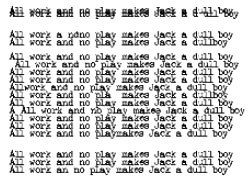
I have noticed of late a disturbing trend, the literary equivalent of those who play their car radios and sound systems at ear-splitting volume with the windows down, or youths who converse in shouts in public places. The trend is proliferation of the proud and unapologetic illiterates,  authors of e-mails, blog posts or even published material who regard the basics of punctuation, grammar, spelling and rhetoric as an annoying inconvenience, and who not only pay little heed to these archaic matters, but also display no regret about the barely readable products that result.

At this point, I am less concerned with why so many of those who communicate in writing are so shamelessly sloppy, and more interested in what the trend signifies for our society. Perhaps some insight can be gained by examining a recent exchange between a grammar and spelling-challenged novelist and a reviewer of her work on a book review blog called “Books and Pals.” Continue reading
The SATs: Flat Learning Curve=Unfair Questions

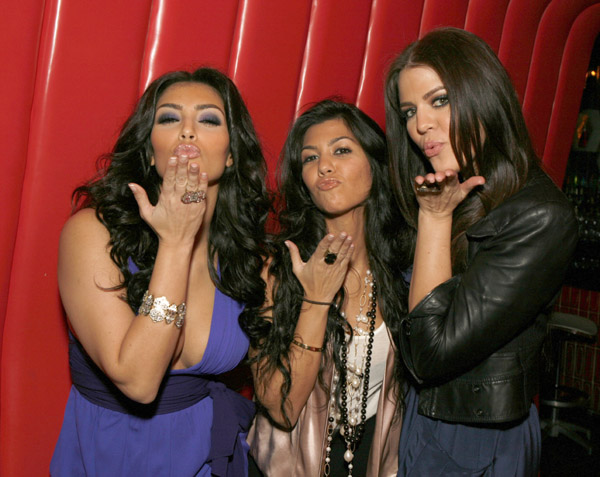
The secret to acing your SATs? Know your Kardashians!

After all the anger, debate and controversy in the Sixties over affirmative action and the Scholastic Aptitude Tests, with the case finally being made to the public’s satisfaction that including test questions  based on cultural references likely to be unfamiliar to African-Americans or lower-income students (such as, famously, questions about yachting) negatively affected their test scores, wouldn’t you think that it would have been thoroughly understood by the people who make up the SAT scores that questions with a cultural bias were inherently unfair and incompetent questions?

Here is the prompt for the essay question in the SAT test given to high school students across the country last week : Continue reading

Comment of the Day: “Ethics Dunce: Rep. Michele Bachman”

Oh, how I LOVE LOVE LOVE this comment, from “ruralcounsel,” regarding my post about Michele Bachmann embarrassing herself, and not for the first time. Seldom does a commenter employ such shameless rationalizations and staples of intellectual dishonesty, and for his grand finale, he breaches one of the explicit Comment Policies by employing that all-purpose fallacy, “you’re just using ethics to go after political enemies.” I’m especially happy about the latter, because no one has accused me of being biased against the Right since “Ronbo.” I can’t hope for as much entertainment from ruralcounsel, but I am certainly grateful for this (Forgive me. I have to give interlinear commentary. I can’t resist): Continue reading

Ethics Dunce: Rep. Michele Bachmann

Ah! Historical New Hampshire...

Rep. Michele Bachmann (D-Minn), Tea Party leader and potential presidential candidate, recently told a Manchester, New Hampshire crowd that she was in the state of “the shot heard ’round the world.” Ethics Foul. Minnesota disgrace. Congressional Disgrace. Tea Party disgrace. National disgrace.

U.S. educational system disgrace!

As most grade school children know (Some grade school children? Grade school children in New England, maybe? Please?), the source of that loud shot, the Battle of Concord (the Battle of Lexington was fought on the same day) was fought in Concord, Massachusetts, which, like Lexington, is a next door neighbor of my home town, Arlington, Massachusetts, known as Menotomy on April 18, 1775 —which, as Rep. Bachmann can tell you, was also the date of Phil Sheridan’s ride. Oops! I mean Paul Revere’s ride! Continue reading

When Satire Is No Excuse: The Jeff Cox Affair

Now if Cox came to work like this, I take it all back...

Indiana deputy attorney general Jeff Cox tweeted “use live ammunition” in response to a tweet by progressive magazine Mother Jones that riot police had been ordered to remove union supporters from the Wisconsin state Capitol in Madison. Mother Jones published the tweet as evidence of what it believes is the predominant conservative mindset, and the progressive blogosphere was soon using his tweet as a rallying cry.

Cox was fired Wednesday. Quite correctly, too. Continue reading

The Wrestler, the Girl, and Cultural Confusion

"Wanna wrestle?"

Sixteen-year-old high school sophomore wrestler Joel Northrup forfeited his match against a fourteen-year-old wrestler with two X chromosomes, Cassy Herkelman, at the Iowa state wrestling championships, saying that “As a matter of conscience and my faith I do not believe that it is appropriate for a boy to engage a girl in this manner.” Obviously Herkelman didn’t require protection from anyone or anything. She was her district’s 112-pound champion wrestler, and she won the Iowa championship for her class as well.  Cassie had won 20 of 33 matches, all against male wrestlers, on her way to the state championship. Maybe Northrup didn’t want to risk being ridiculed for losing to a girl; maybe he was uncomfortable with the sexual overtones of an inter-gender contest. All we can do is assess his conduct by taking him at his word: he believes a young man wrestling a young woman is morally wrong, and was willing to forfeit a match he might have won. Joel was, after all, the fifth-ranked wrestler in the state at 112 pounds, and had a 35-4 record.

Was his decision admirable, or sexist? Was it gentlemanly, or demeaning? Continue reading

Aesop’s Unethical and Misleading Fable: “The North Wind and the Sun”

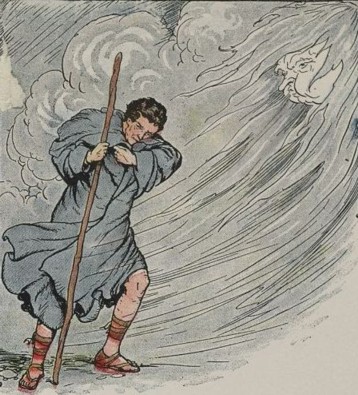
Today, by happenstance, I heard an Aesop’s Fable that I had never encountered before recited on the radio. Like all Aesop’s Fables, this one had a moral, and it is also a statement of ethical values. Unlike most of the fables, however, it doesn’t make its case; it is, in fact, an intellectually dishonest, indeed an unethical, fable.

It is called “The North Wind and the Sun,” and in most sources reads like this:

“The North Wind and the Sun disputed as to which was the most powerful, and agreed that he should be declared the victor who could first strip a wayfaring man of his clothes. The North Wind first tried his power and blew with all his might, but the keener his blasts, the closer the Traveler wrapped his cloak around him, until at last, resigning all hope of victory, the Wind called upon the Sun to see what he could do. The Sun suddenly shone out with all his warmth. The Traveler no sooner felt his genial rays than he took off one garment after another, and at last, fairly overcome with heat, undressed and bathed in a stream that lay in his path.”

The moral of the fable is variously stated as “Persuasion is better than Force” , or “Gentleness and kind persuasion win where force and bluster fail.”

The fable proves neither. In reality, it is a vivid example of dishonest argument, using euphemisms and false characterizations to “prove” a proposition that an advocate is biased toward from the outset. Continue reading

WSJ’s James Taranto Flunks His Ethics Test

A longtime Taranto fan, I was waiting for his Monday installment of his “Best of the Web” blog on te Wall Street Journal site to see if he would retract his flat-out wrong and grossly unfair characterization of the Missoula “Mikado.” Alas, he chose to double down, apparently in thrall to a conservative, Gilbert and Sullivan deprived readership:

“On Friday we noted that a theater company in Montana had inserted into its production of Gilbert and Sullivan’s “The Mikado” a lyric calling for the beheading of Sarah Palin. By the close of business that same day, Michael McGill, executive director of MCT Inc., had announced remedial action…”

[The lyric, once again, is: “And that crazy Sarah Palin, needs a psychoanalyst!  She never would be missed.  No. She never would be missed.” Would any fair, sane, English comprehending person say that this “calls for the beheading of Sarah Palin”? Of course not.  Yet there it is.]

Thus Taranto follows a pattern I have noticed among many of the false critics of the production. They don’t seem to care what the facts are, or what is fair. They just want to rise to poor Sarah’s defense, and are willing to victimize an innocent small theater company of very nice, talented, dedicated people to do it.

Ah, James, I have misjudged you, I fear.

Ethics Train Wreck Report: Lessons, Ethical and Otherwise, of the Missoula “Mikado” Mess

Much of my weekend was occupied by reading, writing, thinking, and talking about the bizarre controversy over a community theater production of Gilbert and Sullivan’s “The Mikado,” which, by a series of misunderstandings, misdeeds, hypocrisies and journalistic malpractice, has created much anger and unhappiness for no legitimate reason at all. If you are late to the story and want to catch up, you can do so here, here, here, and here.

For the first and perhaps only time I can honestly say that Ethics Alarms is the most reliable source on a story. There may be plenty of ethicists who are more knowledgeable, scholarly, prudent and experienced than I am regarding ethics theory, but none of them knows this topic—Gilbert and Sullivan and “The Mikado”, like I do. I have 50 years experience performing, directing, studying, parodying and laughing at the works of these Victorian geniuses. The second I read the astoundingly wrong-headed interpretation being attached to the Missoula Community Theatre’s inclusion of Sarah Palin in Ko-Ko’s famous song “I’ve Got a Little List,” I surmised exactly what was going on, and my assessment has been confirmed by everything that has come to light since.

I will summarize what we now know in brief (well, briefer than reading all the posts) form:

Continue reading

Further Ethical Musings on Ko-Ko’s Little List’s “Eliminationist Rhetoric”: the Duty to Fight the Insanity

The more I think about the controversy over the Montana production of “The Mikado,” which I discussed in the previous post, the more it bothers me.

The fact that some conservative Missoulans were disturbed by Sarah Palin’s inclusion on the iconic “little list” carried by the fictional Ko-Ko, the Lord High Executioner in Gilbert and Sullivan’s classic musical comedy “The Mikado” is disturbing. The fact that the Missoula Community Theater actually caved-in to ignorance and hypersensitivity and removed the lyric is more so.  but the fact that some sensible commentators, like the Wall Street Journal’s usually perceptive and witty James Taranto, have had their brains addled by the current attempt at language, metaphor and humor purging by politically correct hysterics is genuinely terrifying. Continue reading