“Wicked”: A Review (Part 2: Politics and Propaganda)

Gregory Maguire’s “Wicked: The Life and Times of the Wicked Witch of the West” became a critical and financial success by merging the Frank L. Baum children’s series with contemporary issues and values, notably discrimination, prejudice, the abuse of power, and corruption. The still-running Broadway musical “Wicked” softened the preaching and propaganda a bit, but it has come back with full force in the movie adaptation now playing at inflated prices in theater near you. (I purchased a box of Junior Mints and regular size coke. They cost 15 bucks.)

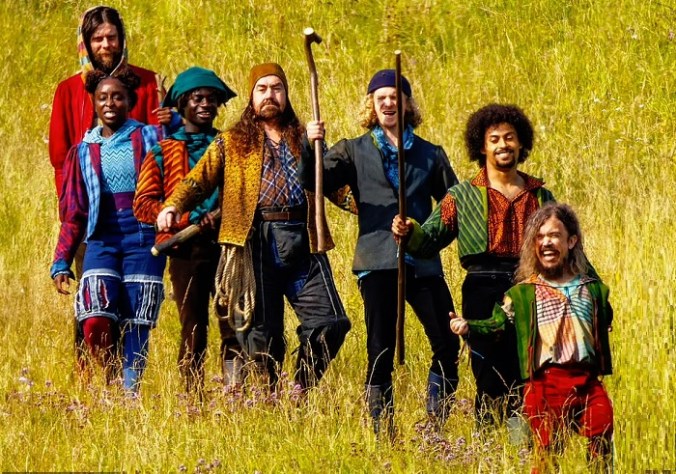
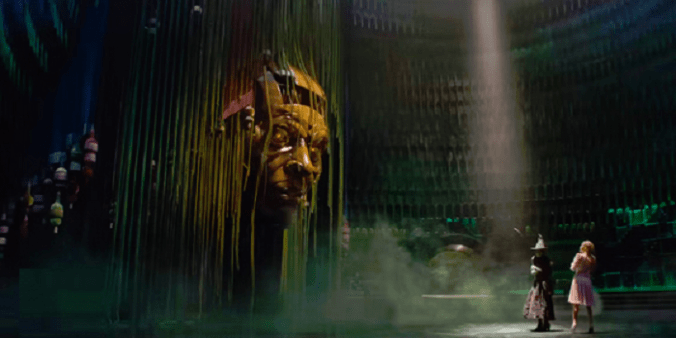
In the novel and the musical, the witch-to-be is born green, leading to a life of being the victim of hate and discrimination. The movie cast not just a black woman in the role, but one with pronounced African features (in contrast to, say, Halle Berry) making it nearly impossible not to experience the plot as a thinly veiled Critical Race Theory brief. Though there are black actors and actresses in Oz here and there, only the white characters are seen to be repulsed or frightened by Elphaba (Maguire gave her a name), because the director correctly calculated that in his film, the character is as much black as green. We see her rejected and cast aside (to be raised by a bear) by her father the moment he sees her skin shade, so it is clear where this is going: Elphaba is going to be forced to fight against the cruel culture that rejected her. Thus we know that she is a personification of the Black Lives Matter riots within the first ten minutes of the movie.

Just as early in the movie we know we are in the grip of sensitive wokism obsessions when we we find ourselves in Munchkinland and the Munchkins pretty much look like anyone you know. The movie “Wicked” is obsessed with, the 1939 classic “The Wizard of Oz,” had the Munchkins played by the Singer Midgets, a little people performing group. In the Baum book that started it all, they are described as being about the same size as Dorothy, who is about 10, but one way or the other, we know the Munchkins are small. Ah, but Disney’s endlessly delayed “Snow White” movie got into trouble after the most famous acting dwarf, Peter Dinklage, declared that the whole idea of portraying the Little People of the familiar fairy tale was offensive, so Disney eliminated the dwarfs entirely. That was also attacked by Little People activists—erasing them, you know. Similarly, Peter Jackson got in trouble for using computer magic to make a full size actor look like he was a a yard or so tall in the “Lord of the Rings series.” So “Wicked” director Jon M. Chu punted and just made the Muchkins normal size and boring. And that wasn’t all: to make sure Dinklage didn’t find some reason to take shots at his movie, the Little Actor was hired to provide the voice of a talking goat.

This is DEI at its silliest. The film gets credit for hiring an “under-represented minority” who was personally responsible for the film not hiring many more members of the same minority. Furthermore, while I like Dinklage (who became famous in “Game of Thrones”) as much as anybody, the only reason he’s a star is because he’s so short. Sure, he plays lawyers, doctors, gangsters, but no matter what he plays, he plays it as a dwarf. That’s the only thing that distinguishes him from hundreds of other equally able actors. It makes no sense at all to hire Peter Dinklage as a voice actor. His unique feature can add nothing to such a gig. The film took away another talented vocal actor’s job so it could be “inclusive” and hire a dwarf for his voice alone.

Continue reading

Note To Candidate Trump: Civility Isn’t Bullshit

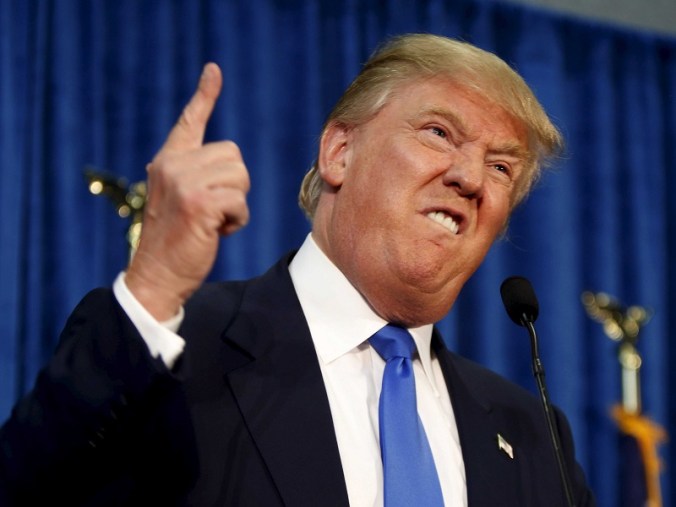
Today’s “Trump is a terrible person and you have to vote against him even though there is literally no rational reason to vote for Kamala Harris” article is “At a Pennsylvania Rally, Trump Descends to New Levels of Vulgarity.” Of course he did. Public discourse and civility, all a part of the crucial ethics value of respect, have plummeted precipitously as Ethics Alarms predicted here and chronicled since, most recently yesterday. Trump has unquestionably been a catalyst for the coarsening of American speech and culture, but as this tag will show you, so many prominent individuals and institutions followed his lead and escalated the rot that blaming Trump alone would be, well, the kind of thing the Trump Deranged do every day.

Naturally, as Vulgarian-in-Chief, Trump couldn’t let himself be reduced to relative civility by Congresswomen saying things like “Let’s impeach the motherfucker!,” iconic actor Robert De Niro getting cheers at events by screaming “Fuck Trump!,” or a coded phrase meaning “Fuck Joe Biden!” being plastered on T-shirts, banners and mugs. Sooooo, as the Times gleefully informs us…

Mr. Trump opened his speech at the airport in Latrobe, Pa., with 12 minutes of reminiscing about the golfer Arnold Palmer, who grew up in the Western Pennsylvania town and for whom the airport was named. His monologue culminated in lewd remarks about the size of Mr. Palmer’s penis. Moments later, Mr. Trump gave the crowd an opportunity to call out a profanity. He went on to use that four-letter word to describe Ms. Harris. “Such a horrible four years,” Mr. Trump said, referring to the Biden-Harris administration, as he surveyed the crowd of hundreds of people in front of him. “We had a horrible — think of the — everything they touch turns to —.” Many in his audience — which was mostly made up of adults but included some children, infants and teenagers — eagerly filled in the blank, shouting, “Shit!” Minutes later, Mr. Trump urged his supporters to vote, telling them that they had to send a crude message to Ms. Harris: “We can’t stand you, you’re a shit vice president.”

Oh, nice. That’s the way to make America great again.

Continue reading

Oh, Great. It’s Bad Enough That Harvard Is Woke and Incompetent, But Its “Ten Minute Rule” Proves That The University Is Now Stupid As Well

I at least expected my thoroughly disgrace alma mater to always maintain some vestige of intelligence, as misapplied as it frequently has been lately.

Guess not.

Before student group-sponsored speakers at the college are allowed to begin, the following official statement from the administration must now be read to the audience:

“A quick note before we begin—Harvard University is committed to maintaining a climate in which reason and speech provide the correct response to a disagreeable idea. Speech is privileged in the University community. There are obligations of civility and respect for others that underlie rational discourse. If any disruption occurs that prohibits speech the disrupters will be allowed for up to 10 minutes. A warning will be issued to all disturbers at the 5-minute mark explaining that the protesters are disrupting the event and ask them to stop. Any further disruption that prevents the audience from adequately hearing or seeing the speakers will lead to the removal of the disrupters from the venue.”

Brilliant.

How smart do you have to be to figure out what’s wrong with this? Let’s see:

Continue reading

Artificial Intelligence Raises a Lot of Ethics Issues, But This Isn’t One of Them…

From An Experiment in Lust, Regret and Kissing (gift link!) in the Times by novelist Curtis Sittenfeld :

My editor fed ChatGPT the same prompts I was writing from and asked it to write a story of the same length “in the style of Curtis Sittenfeld.” (I’m one of the many fiction writers whose novels were used, without my permission and without my being compensated, to train ChatGPT. Groups of fiction writers, including people I’m friends with, have sued OpenAI, which developed ChatGPT, for copyright infringement. The New York Times has sued Microsoft and OpenAI over the use of copyrighted work.)

The essay describes a contest between the bot and the human novelist, who also employed suggestions from readers. I do not see how an AI “writer” being programmed with another author’s work is any more of a copyright violation than a human writer reading a book or story for inspiration. Herman Melville wrote “Moby-Dick” after immersing himself in the works of William Shakespeare. Nor is imitating another author’s style unethical. All art involves borrowing, adopting, adapting and following the cues and lessons of those who came before. In “Follies,” Stephen Sondheim deliberately wrote songs that evoked the styles of specific earlier songwriters. He couldn’t have done this as effectively as he did without “programming” himself with their works. Continue reading

A Symptom of Creeping Totalitarianism: The Left’s Embrace of Newspeak

In the appendix to his novel “1984,” George Orwell explained the principles of “Newspeak,” the mandated lexicon of Big Brother’s dystopian society. The idea behind Newspeak was to prevent free thought and speech by limiting the public’s vocabulary to the point that “wrongthink” was impossible. Maybe nobody reads “1984” any more, and maybe the public is just as ignorant, apathetic and gullible as our political elite count on its members being. It still amazes me that the proliferation of “Newspeak” in the media and political discourse doesn’t create appropriate awareness that the U.S. is being pushed into a totalitarian regime. There is active censorship of certain words and ideas because our Dark Lords think they will upset us (or risk undermining partisan cant). Abortion? What’s that? There is only “reproductive health.” Sex-change operations and hormone treatment for minors? What are you talking about? We have “gender-affirming care.” There’s no illegal immigration, just “newcomers,” and you always want to welcome newcomers!

And so on.

Some words are so upsetting that the news media literally won’t publish them even if a story can’t be understood as a result. Yesterday Boston Red Sox star Jarren Duran, having a rough game, was taunted by a fan and caught on a live mic retorting, “Shut up, you fucking fag!” The Boston papers, however, couldn’t let their readers know what the outfielder said, because it might upset them. So the statement was published as “Shut up you (expletive) (expletive.)”

This is the Orwellian culture progressives are slowly but surely constructing for us, if we let them.

There is no apparent stopping place on the slippery slope. The Museum of Pop Culture in Seattle, one of our most left-addled communities, has an exhibit on the rock band Nirvana that informs visitors that the band’s leader, Kurt Cobain, “un-alived himself at 27.”

Continue reading

Curmie’s Conjectures: “Curse You, Red Baron!”

by Curmie

[This is Jack: Almost as if in response to my secret wish, Curmie has submitted a column designed to turn our attention away from politics, division, culture wars and the rest, instead focusing his analysis on pizza ads. Makes me hungry for more…but not more Red Baron pizza. I’ve been eating a lot of frozen pizza since Grace died, and have placed Red Baron on my blacklist. Yechh. DiGiorno, Frescetta and Trader Joe’s offerings are far superior. ]

I can’t speak for everyone, but I’m a little starved for something, anything, other than politics.  The thought that anyone would vote for either of the likely contenders for the presidency (as opposed to against the alternative) is chilling.  So I’ve been casting about, looking for something else to write about.  This may not be much, but at least it’s something.  And I did sort of open the door for this kind of post last Christmas season with an analysis of ads for Monopoly.

Red Baron (the pizza company, not Snoopy’s antagonist, but why pass up an opportunity like this?) has released a trio of new commercials, all connected to the joys of sharing.  They’re not going to convince my wife and me to buy their product—we’ve tried it and found the gustatory difference between it and cardboard to be insignificant (your mileage may vary), but that doesn’t mean their commercials are similarly boring.

Indeed, “Baddie Librarians,” in which two stereotypically bespectacled (complete with glasses chains) older women naughtily share a pizza intended for a single person, is trite but at least reasonably cute.  “Hipsters” is even more fun, as sharing a delicious pizza leads to sharing of a different sort: one character “shares” that he’s tired of being hip, another (her name is Willow, of course) admits that she doesn’t even know what her neck tattoo means, the pizza is described as “way better than kale” (I’ll grant that much), and kombucha is called “garbage water.”  It’s not laugh-out-loud funny, but at least it brings a smile.

Continue reading

Ethics Dunce: Geoffrey Hinton, “The Godfather of Artificial Intelligence”

You should know the name Geoffrey Hinton by now. To the extent that any one scientist is credited with the emergence of artificial intelligence, he’s it. He was among the winners of the prestigious Turing Prize for his break-through in artificial neural networks, and his discoveries were crucial in the development of advanced Artificial Intelligence (AI) software today like Chat GPT and Google’s Bard. He spent 50 years developing the technology, the last 10 pf which working on AI at Google before he quit in 2023. His reason: he was alarmed at the lack of sufficient safety measures to ensure that AI technology doesn’t do more harm than good.

And yet, as revealed in a recent interview on CBS’s “60 Minutes,” Hinton still believes that his work to bring AI to artificial life was time well-spent, that his baby was worth nurturing because of its potential benefits to humanity, and that—-get this—all we have to do is, for the first time in the history of mankind, predict the dangers, risks and looming unintended consequences of an emerging new technology, get everything right the first time, not make any mistakes, not be blindly reckless in applying it, and avoid the kind of genie-out-of-the-bottle catastrophes that world has experienced (and is experiencing!) over and over again.

That’s all!

Continue reading

Curmie’s Conjectures: Book Reviews and the Warm Fuzzies

by Curmie

[This is Jack: I have to insert an introduction here. Curmie’s headline is fine, but it would come under the Ethics Alarms “Is We Getting Dumber?” or “Tales of the Great Stupid” banners if I had composed it. What he is describing is a culture-wide phenomenon that is far more insidious than its effects on scholarly book reviews alone. I also want to salute Curmie for slyly paying homage in his section about typos to one of my own most common and annoying typos. I know it was no coincidence.]

I published my first book review in an academic journal in 1991.  In all, I’ve written about 30 reviews on a wide range of topics for about a dozen different publications.  In some cases, I was only marginally qualified in the subdiscipline in question.  In others, especially more recently, I’ve been a legitimate authority, as well as being a full Professor (or Professor emeritus) rather than a grad student or rather green Assistant Professor.

The process has changed significantly in recent years, the biggest change being the increased level of editorial scrutiny.  A generation or more ago, I’d send in a review and it would be printed as written.  That was back when I was an early-career scholar, at one point even without a terminal degree, often writing about topics on the periphery of my interests and expertise.  My most recent reviews, when I was a senior scholar writing about subjects in my proverbial wheelhouse, went through three or four drafts before they were deemed publishable.  Note: I didn’t become more ignorant or a worse writer in the interim.

Some of the changes came indirectly, no doubt, from the publishers rather than the editors: I received the same stupid comment—to include the chapter number rather than a descriptor like “longest” or “most interesting”—from book review editors from two different journals published by the same firm.  Actually, one of those “corrections” wasn’t from the book review editor himself, but was a snarky comment from his grad assistant.  You can imagine how much I appreciated being condescended to by a grad student.  Other changes were just kind of dumb: one editor insisted that I change “whereas” to “while” (“whereas” was the better term).

But these are the kind of revisions at which one just shakes one’s head and shrugs.  The ones that actually affect the argument are far more problematic.  One author was writing about the production of a play by a female playwright from the 1950s.  There’s no video footage (of course), and if literally anyone who saw that production is still alive, I think we could forgive them for not remembering many details.  But the author decried the (alleged) sexism of the male newspaper reviewers who weren’t impressed with the production.  Nothing they said, or at least nothing the author quoted, struck me as anything but a negative response to a poor performance. 

Remember, they’re not talking about the play as written, but as performed, so the fact that the text isn’t bad (I’ve read it) doesn’t render the criticism of the acting and directing invalid.  I said that in what amounted to my first draft, but was told that I needed to say that the allegations of sexism could have been true (well, duh!), but weren’t necessarily.  In my view, declaring suspicions as fact, even if there’s some supporting evidence, might cut it as a blog piece, but it isn’t scholarship.  But whatever…

In another review I suggested that the mere fact that male dramatists wrote plays with specific actresses—their “muses”—in mind for the leading roles doesn’t mean that those women should share authorship credit any more than Richard Burbage should get co-authorship credit for Shakespeare’s plays.  I was ultimately able to make that point, but in a watered-down version. 

More recently, I was asked to “tone down” a comment that several of the authors in what purported to be an interdisciplinary collection of essays were so committed to discipline-specific jargon, incredibly complex sentences, and sesquipedalian articulations (see what I did there?) that readers, even those well-versed in the subject matter—me, for example—would find those chapters unreasonably difficult read, and might be tempted to conclude that the authors were more interested in strutting their intellectuality than in enlightening the reader. 

I stand by the analysis, but the editor was probably right to ask me to temper the cynicism.  I did so, but I kept the rest in a slightly revised version.  She seemed pleased, and told me she’d sent it off to press.  When it appeared in print, only the comment about jargon remained… and the verb wasn’t changed from plural to singular.  Sigh.

Perhaps the most telling episode was when I said that a book was extremely poorly edited and proofread.  I’ve never written a book, but I have published several chapters in collections of scholarly essays.  The process varies a little from publisher to publisher, but for one recent chapter I sent a draft to the book editor, who made editorial suggestions and proofread, and sent it back to me.  I approved some of the changes he suggested and made my case for not changing other parts of the essay.  After about three drafts, we both pronounced ourselves satisfied, and the essay went off to the series editor, who requested a couple of very minor changes.  And then it went to the publisher.  And then the professional proofreader.  And then back to the publisher.  And then back to me.  At least five different people proofread that chapter, some of us several times.

It’s still almost inevitable that some typo will still sneak by.  Of course, some publishers will cheat and rely on spellcheck, sometimes without even checking the final product.  I once encountered a textbook that intended to reference the 19th century playwrights Henri Becque and Eugène Brieux, but rendered their surnames as Bisque and Brie—a nice lunch, perhaps, but hardly important dramatists.

But this book, published by a prominent academic press, was ridiculous.  There were four and five typos on a single page, inconsistent formatting so it was impossible to tell when quoted material began and ended, at least two (that I caught) glaring malapropisms, and a number of instances of sentences or paragraphs so convoluted it was literally impossible to tell what was intended.  We’re not talking “teh” for “the” or accidentally omitting the “l” in “public,” here.

I was insistent on making the point that the book was not yet ready to be published.  A lot of the scholarship was really excellent, but the volume read like a first draft, neither edited nor proofread.  Finally, the book review editor had to get permission from the journal’s editor-in-chief (!) for me to go ahead with that commentary.

So what’s going on, here?  I can offer no firm conclusions, only speculations… “conjectures,” to coin a phrase. 

Continue reading

Revolutionary Open Forum, Friday, April 19, 2024

On the 18th of April in ’75…Hardly a man is now alive who remembers that famous day and year.” I was going to post all of Henry Wadsworth Longfellow’s “Paul Revere’s Ride” (the first substantial poem I ever memorized) yesterday, but, as usual, stuff happened. That means today is the 19th of April, a date banged into the heads of children living in Arlington, Massachusetts like me, the anniversary of the ugly little battle that took place just up Massachusetts Avenue a bit on Lexington Green, that officially started the Revolutionary War.

700 British troops were marching on a mission to capture traitors/patriots John Hancock and Samuel Adams and seize a rebel arsenal when they were blocked by 77 Minutemen under Captain John Parker. British Major John Pitcairn ordered ragtag army to disperse, but the proverbial shot rang out, everybody started firing their muskets, and a few minutes later eight Colonists were dead or dying and ten more were wounded. Only one British soldier was injured, but at around 7 am the same fateful day, the Redcoats got what was coming to them a little further up the road, at Concord Bridge.

One subsidiary benefit of memorizing “Paul Revere’s Ride” is that I’ll never forget that famous day and year, or the day after it. I wonder how many of today’s public school-educated children, even those in neighboring Arlington, know the significance of April 19. Heck, I wonder if it will be mentioned in the mainstream media’s blathering today at all. It would be a good day for the President of the United States to use his “bully pulpit” for something positive and remind everyone, but no, these days that platform is reserved to call half the nation fascists.

I digress, however. Celebrate the beginnings of America by taking about ethics, for this is the only nation in the world that was created to embody ethical principles and to model ethical values.

That battle rages on.

Ethics Quiz: Harvard’s Human Skin-Bound Book

As if it doesn’t have enough to worry about, Harvard University announced yesterday that its copy of Arsène Houssaye’s “Des Destinées de L’Ame,” or “The Destiny of Souls” had been stripped of the very feature that made it unusual enough to be worth collecting. The book (above) had been bound in human skin, just like the book in “The Evil Dead” movies. Its first owner, Dr. Ludovic Bouland, a French doctor, had inserted in the volume a handwritten note saying that “a book about the human soul deserved to have a human covering.” The alumnus who gave the book to Harvard in 1934, the American diplomat (and the famous hat family heir) John B. Stetson, had informed the Houghton Library (Harvard’s rare book collection), that Bouland had taken the skin from an unknown woman who died in a French psychiatric hospital.

Harvard removed the binding and said it would be exploring options for “a final respectful disposition of these human remains.” “After careful study, stakeholder engagement, and consideration, Harvard Library and the Harvard Museum Collections Returns Committee concluded that the human remains used in the book’s binding no longer belong in the Harvard Library collections, due to the ethically fraught nature of the book’s origins and subsequent history,” the university’s statement read.

Incidentally, the word for binding books in human skin is anthropodermic bibliopegy.

Your Ethics Alarms Ethics Quiz of the Day is…

Was this really ethically necessary?

Continue reading