1. The NY Times Has A New Author Of “The Ethicist” And 2., Boy, Did He Ever Botch The Dilemma Of The Closeted College Student

"NEXT!!!"

“NEXT!!!”

The New York Times Magazine column “The Ethicist,” long authored competently by non-ethicist Randy Cohen, had lost me due to the biased and often unethical answers to his reader’s queries by his most recent successor, Chuck Klosterman. So repellent was Klosterman’s version of the column that I didn’t even notice when the Times sacked Klosterman late last year after one bizarre response too many.

[The final straw:  An inquirer  went to a Starbuck’s  wanting to buy a regular over-priced cup of coffee, but when the woman in front of the customer  ordered a pumpkin-spice latte  and received a coupon for a free drink because the shop was out of it, “NAME WITHHELD” ordered a pumpkin- spice latte to get the free coupon. Was this ethical, he/she/it asked?” Klosterman’s answer: “No. You’re a liar and a low-rent con artist. And you live in a community where pumpkin-flavored beverages are way too popular.”  Now, “No” is correct, but it’s a great question, and deserving of a serious analysis rather than whatever that was from the ex-Ethicist. The coupon was a nice gesture to someone who had come to the Starbuck’s wanting a specific beverage and was disappointed—a store should not be tantalizing customers with products they don’t have to sell, essentially setting up a bait and switch. The coupon was an ethical “We’re sorry,” but also made the employee vulnerable to anyone who decided to misrepresent his real intent in order to get a free drink later. Yes, taking advantage of this opportunity to the detriment of the store is unethical, because the inquirer took an appropriate gesture clearly intended for a specific situation and exploited it. It was not illegal, however, and was  not a con. I would compare it to the scenario where a computer glitch has resulted in an airline selling tickets online for absurdly small amounts, and travelers rush to take advantage, rationalizing that mistake or not, the opportunity is there and they can legally grab it.]

Now the Times has a new author of “The Ethicist,” after experimenting with a new format in which a podcast including him and some other commentators hashed over ethics hypotheticals and then the podcast was transcribed and published in the Sunday Times magazine. He is Kwame Anthony Appiah, who teaches philosophy at N.Y.U.  This week Appiah’s  first solo, so I would normally say that it’s too early for any fair assessment, but boy, did he ever botch the September 2 podcast. He botched it so badly that I can’t see myself paying much attention to anything else he writes. It was an ethics disaster.

A college student asked if he could ethically lie to his anti-gay father about his sexual orientation so Dad would keep paying the student’s tuition. The father is suspicious based on some clues during his son’s high school days, and has made it very clear to his son that if he is gay, he would not only withdraw all financial support but also reject him entirely. “Questions about my sexuality are inevitable whenever I come home,” the inquirer wrote. “My father has demanded I produce archives of all emails and text messages for him to review, although I have successfully refused these requests on the grounds that he has no claim to my adult communications.”

He asks, “Is it ethical for me to continue accepting financial support for my education and my career that will come from it? Could I continue to lie to accept the support and one day disclose my sexuality and pay him back to absolve myself of any ethical wrongdoing?”

The correct answer is “Of course not,” and it amazes me that anyone would think otherwise. The second part of the question is an especially easy ethics lay-up: the steal now, pay back later scheme, also known as “the involuntary loan,” or “I meant to pay it back!”, is pure rationalization, and its existence proves that the writer knows damn well that what he’s doing is wrong, and just wants someone to tell him that it’s OK.

Astoundingly, Appiah and his podcast buddies (Amy Bloom, a novelist and psychotherapist, and  Kenji Yoshino, an  N.Y.U. law professor) tell the inquirer that it is OK, because, it is clear, they are advocates for gay rights and don’t appreciate anti-gay bigots. Thus they amass nothing but rationalizations  and outright unethical arguments to justify the student’s ongoing deception. As a philosopher who knows better, Appiah should have been correcting his colleagues. Instead, he enables them, because gay advocacy trumps honesty and ethics. Continue reading →
Ethics Quiz: The Memories Pizza Stunt

Memories Pizza, you will recall, rushed to let everyone know that it supported Indiana’s short-lived “Let’s discriminate against gays” law, which Pope Francis would have approved of, apparently.  The poor, naive little establishment, which was about as likely to cater a gay wedding as a White House state dinner, became the immediate target of social justice warrior bullies, who nearly succeeded in running them out of business.

On September 25, 2015, comic Robin Trevino, a member of the gay theatrical ensemble GayCo, drove to Walkerton, Indiana, bought pizzas at  Memories Pizza, , and served Memories Pizza to all the guests at his September 26, 2015 same-sex wedding reception, then released a video to alert the world that Memories Pizza had unknowingly catered a gay wedding  after all.

Your Ethics Alarms Ethics Quiz of the Day:

Was it ethical to do this?

Continue reading →

From The”On The Other Hand” Files: Before You Are Too Hard On Feminists Who Arrive At College Resenting Men, Read This…

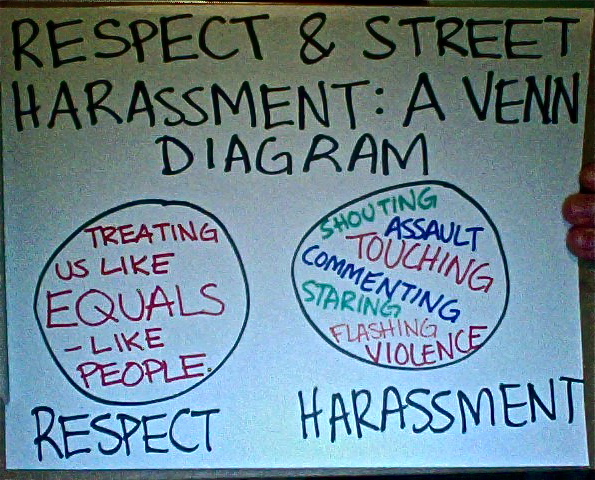
Street harassment sign There is are good reasons why many women come to think of all men as potential predators.

Valerie Steighner authored a powerful essay titled “My 11-Year-Old Daughter Just Got Catcalled for the First Time and I Don’t Know How To Teach Her to Protect Herself From Predators.” Please read it. Here’s an excerpt:

She is 11 years old. She just graduated from elementary school and still plays with small plastic animals. And now along with vocab words, I have to teach her how to protect herself from disgusting men.

I told her that what that man did is called catcalling and catcalling is aggressive behavior and the best action is to ignore it. Usually, men that are willing to yell slurs about you and your body, if provoked, can be unpredictable and dangerous; it’s best to keep walking; don’t make eye contact and stand tall. 

I felt so defeated as the words came out of my mouth. Basically, there is nothing we can do, but pretend it’s not happening….Obviously, I was sexually active all through my twenties, but there is a difference from being what others want and finding what you need…The predator lives everywhere. He lives on our streets, in our grocery stores, on our billboards and in our malls. He constantly reminds us what our value is and where we belong. How do I teach her to catch him, see him and to protect herself from him?  How do I teach her that her body is not a source of shame but a source of power and strength? How do I teach her to hear the predator’s words to know what they mean and still stand tall and confident? How do I teach her to protect herself and still be open?

It sucks. It sucks that this has to happen to my daughter in 6th grade. It sucks that it’s only the beginning. It sucks that she has to learn about her body in the context of men noticing it. 

What also sucks is that the problem is a failure of ethics and civilization to move fast enough. Men are programmed to want sex and to procreate, and once upon a time in America the kind of conduct a disgusting 50-year old focused on the writer’s barely pubescent daughter was a cultural norm. In some places, it still is. Women had no other function but to find a man, have his children and make the home run smoothly, and not finding a man was, in some settings, a catastrophe. In the American West, a woman in her thirties who was uneducated and unmarried was very likely to end up a prostitute: it was the single largest occupation for unmarried women. When so many women are whores, men get in the habit of treating women as whores, and women who don’t want that fate will provide positive reinforcement to flirtations that are really harassment and disrespect. [You can find the many Ethics Alarms posts related to this topic here]

Old habits supported by hormones, traditions and bad role models—like, say, Jack Kennedy, Joe Biden and Donald Trump–will die hard or not die at all. In many ways, the culture still supports the ugly behavior Steighner’s daughter experienced. Many ways.  For example, in a current Geico commercial, the Gecko shows his trophy accompanied by that briefly popular song “Whoomp! There it is!,”  which is essentially street harassment in song form. You will also hear it in sporst stadiums. Continue reading →

Clarence Darrow, in 1926, On Why Black Lives Matter

The all white Detroit jury that acquitted Dr. Sweet.

The all white Detroit jury that acquitted Dr. Sweet.

When I referred to Clarence Darrow’s support for terrorist John Brown in the previous post, I reviewed other references to the great trial lawyer that have appeared here. (As you may know, I authored a one-man play about Darrow, still performed to legal groups by actor (and my friend) Paul Morella, and with historian Ed Larson compiled selections from Darrow’s writings, court appearances and speeches, The Essential Words and Writings of Clarence Darrow.) I have also posted on his famous Leopold and Loeb argument against capital punishment, but I was shocked to find out that I never posted any part of his closing argument in the murder trial of Dr. Sweet.  I need to remedy that omission now. That courtroom oratory is not only the best of Darrow’s closing arguments, but also the most relevant to current events. It is a masterpiece, and  also astonishingly prescient and wise.

In 1925, Dr. Henry Ossian Sweet, a black man, moved his family into a house in a previously segregated section of Detroit. Mobs of whites gathered outside the house with torches, clubs and guns the first two nights of their residence, as police stood by passively. On the second night, a gunshot coming from the house killed one of the demonstrators, and all 11 residents of the home, including Dr. Sweet, were charged with murder. The National Association for the Advancement of Colored People hired Clarence Darrow to handle the defense.

There were two trials, the first ending in a hung jury. In the second, Darrow performed a seven hour closing argument, aspects of which have inspired homages in “To Kill A Mockingbird” and “A Time to Kill.” Despite the all-white jury, Dr. Sweet was acquitted, and the charges against the others were dropped. Darrow isn’t a legend for nothing.

I have left out the parts of the closing argument that recount the testimony and the facts of the case: you can read about the trials on Doug Linder’s excellent website, and you can read Darrow’s whole closing here. This redacted version focuses on Darrow comments about race and race relations. It is longer than the version we used in the play, but this is the version I would have used if audiences could tolerate a three hour one man show.

I continue to believe that this was the high point of Darrow’s incredible career, and also one of the most impressive—and gutsy—speeches in our history. Only Clarence Darrow would challenge an all-white jury like this in 1925. It is also unbearably moving. Paul, when he performs the selection, ends with tears streaming down his face, as Darrow did. You might too. Try reading it aloud to your kid. Or to yourself.

This post also relates to another recent post, the one about jury nullification. That is really what Darrow is arguing here, in the context of confronting racial injustice and bigotry for the survival of the nation and society. The white victim of the shooting was shot in the back. Darrow, at one point, calls it murder himself. Nonetheless, he argues that acquitting Sweet and his family is the right thing to do, whatever the law says.

Here is my abridged version of the epic closing argument made by Clarence Darrow, May 11, 1926, in defense of Dr. Sweet and his family.

Continue reading →

Further Thoughts And Questions On “The Lottery Winner’s Sister-in-Law” (Part 2)

Money-box-gift

As promised, here are some proposed lines regarding the ethics quiz on the lottery-enriched brother and whether his financially-challenged sibling  should ask for a cut—and had a right to expect one. (Part 1 of the “Further Thoughts” is here)

All of the following assume that the lottery-winner does not have a personal emergency or crisis of his own that would require him to spend all or most of the money.

1. The wealthy brother is ethically obligated to offer financial assistance, if he can afford it without excessive hardship, without being asked, if his brother or his brother’s family is facing a health crisis of other catastrophe.

This is true regardless of whether his new financial resources come from luck, planning, work or skill, and regardless of how much money he has. Offering a loan rather than a gift is still fair and ethical. Charging interest under these circumstances is not, unless the poor brother has a record of not paying back earlier loans.

Possible exceptions: Continue reading →

Ethics Dunce: Pope Francis

The Pope and "the Angel of Peace"...

The Pope and “the Angel of Peace”…

Sigh.

I apologize in advance to all the Catholics and others who will be offended by this post. I wish I didn’t have to write it. But I just read one too many “nyah, nyah, nyah conservatives and Republicans, you’re so big on waving God at us and now the Pope says you’re full of crap” Facebook posts from someone who would no more set foot in a church than Damien in “The Omen.”  The Pope is as fair game for criticism when he abuses his influence and power as Kylie Jenner, who was the subject of the previous post, and for similar reasons. To those who say that it is disrespectful for me to compare the Pope’s ethics to those of an ignorant 18-year-old minor celebrity drunk on her own fame, my answer is that the Pope needs to stop acting like one.

I’m going to try to avoid the mocking tone I used with Kylie, I really am.

With great power, the saying goes, comes great responsibility. What I see in this Pope is a very, very nice and well-meaning man who suddenly was given the power to have his every opinion on any subject immediately plastered all over newspapers across the world and recited by news readers as significant, and literally can’t stop himself. He told an Argentinian journalist last week that he just wants to be remembered as “good guy.”  Mission accomplished: I believe he is a good guy. He’s also an irresponsible guy, who knows or should know that his pronouncements will be exploited for political advantage by people and parties that could not care less about his Church, God and religion generally, but who will use his words  to persuade voters who feel the need to know no more about a subject that what the “Vicar of Christ” tells them.

It may be “good to be Pope,” to paraphrase Mel Brooks, and it’s also not “easy being Pope,” to paraphrase Kermit the Frog. I don’t care: he accepted the job, and with it the duty to do it responsibly. Being a responsible Pope means not shooting off your mouth about every topic that occurs to you. In that same interview, Pope Francis opined that humans care too much about pets. I get it: poverty is, by his own assessment, the single most important aspect of the Church’s mission, so it’s natural for the Pope to believe that the money spent on movies, cable TV, make-up, CDs, and Jack Russell terriers should all be given to the Clinton Foundation or his Church instead. That’s a facile opinion from someone who has a staff catering to his every whim, and who sits on billions in the Vatican Bank. Does the Pope understand loneliness? Does he have any compassion for those suffering from it? Does he understand the needs of my sister, divorced and with both children gone, and her desire to have some unconditional love in the house when she returns to an otherwise empty home,  love that  takes the form of a happy, loyal, Havanese? “Care for pets is like programmed love,” the Pope told the interviewer. “I can program the loving response of a dog or a cat, and I don’t need the experience of a human, reciprocal love.”

My response: “Shut up. You don’t know what you’re talking about, and millions of people will assume you got this point of view straight from God.” Continue reading →

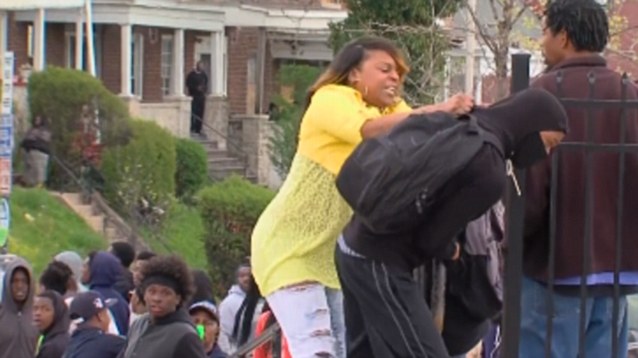
Comment of the Day: “Ethics Hero: Toya Graham, The Baltimore Riot’s ‘Mom of the Year’”

Baltimore mom

I don’t know if a 24 hour period has ever produced as many provocative, passionate and well-argued comments on Ethics Alarms before. This, commenter Holly’s reaction to my designation of the viral  Baltimore mom Toya Graham clobbering her rioter son during the Freddie Gray disruptions in Charm City, is just one of several. I’ll address some of the issues she raises after the post; in the meantime, here is Holly’s Comment of the Day, in a day that will probably have more than one, on the post, “Ethics Hero: The Baltimore Riot’s ‘Mom of the Year’”:

I am surprised at this response. For a number of reasons. In any other circumstance, this woman probably would be going to jail. But if we watch the video more closely, the following observations can be made:

1. This child was leaving with his mother and she was so angry that she chases him to pull him back towards her to continue the beating. He appeared to be complying and in her anger continued to the assault the kid during the walk away.

2. The child was not in imminent danger. There are bystanders all around I saw no rocks being thrown in this video nor police for that matter. It does not appear the threat of losing his life was immediately in front of them.

3. The assault starts with a few close-fisted strikes as well as continuing with open-fisted strikes or what people are calling “smacks”.

Exemplary action on the part of this mother would not have been beating her son as he walked away from the riot, however.  It would have included not allowing a 16 year out of her supervision to wander in the riot in the first place. Continue reading →

Ethics Heroes: Adam and Tanya Phillips

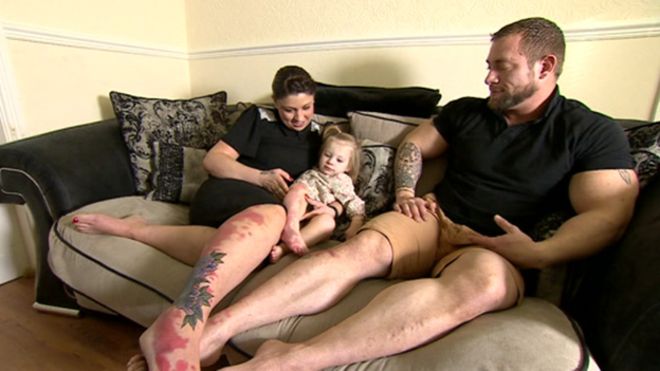
tattoos

I’ve been searching for Ethics Heroes of late. They seem to be candidates for the endangered species list. Now a qualified couple, Adam and Tanya Phillips, has surfaced in the town of Grimsby, in Great Britain. Their 18-month old daughter, Honey-Rae, has a port wine birthmark running from her right foot to her lower back. After they noticed shoppers staring at their child at a local supermarket, the parents both got  tattoos the color and shape of the mark on their own right legs. Each took two-and a half hours, and was painful.

 When Honey-Rae  saw them for the first time, she said “match.”

Loving, selfless, kind…and clever.

And one of the best uses for tattoos I’ve heard of yet

.___________________

Pointer: Althouse

Facts and Graphic: BBC

Legal But Not Ethical: Sex With A Demented Spouse

Rayhons

In Iowa, a jury has found longtime Iowa state lawmaker Henry Rayhons not guilty of sexually abusing his wife by having sex with her at a nursing home. A doctor had told Rayhons that she had advanced Alzheimer’s disease. and was  no longer mentally capable of consenting to sex.

At the trial, Assistant Attorney General Tyler Buller told jurors  that Donna Rayhons’ Alzheimer’s disease had worsened in the months before last May’s alleged incident of unconsented sexual intercourse by her husband. She had washed her hands in dirty toilet water, Buller said, forgotten how to eat a hamburger and thought her first husband was still alive. Dr. John Brady later testified that Donna Rayhons had severe dementia, and thus any positive reaction to her husband’s physical advances could be termed a “primal response” at best. Brady testified that Donna Rayhons’ cognitive capacity had declined dramatically in the months leading up to the alleged offense. He explained that she had been diagnosed with Alzheimer’s based on several tests, including  a standard cognitive procedure in which patients are asked simple questions. By  May, Brady said, Donna Rayhons scored a zero on that test, and any score below eight indicates severe impairment, he said.

On his blog, the Volokh Conspiracy, Prof. Eugene Volokh makes a valiant effort to justify, excuse, or perhaps be compassionate regarding a man having sex with his wife after she has forgotten who he is or even what sex is. He argues, Continue reading →

Ten Ethics Musings On The “Unethical Photograph Of The Year” And The Daughters of Villi and Mary Kay

Here's my Jack Russell Rugby doing his imitation of the dog in "The Artist." It's a good antidote, at least for me, when I look at the Villi and Mary Kay family photo. Keeps the gorge down.

Here’s my Jack Russell Rugby doing his imitation of the dog in “The Artist.” It’s a good antidote, at least for me, when I look at the Villi and Mary Kay family photo. Keeps the gorge down.

I should have included these with original post, but the photo so nauseated me that I was barely capable of critical thought. I’m still nauseated, but better. So now I offer these ten question and thoughts:

1. Will this photo and its implication be used by cultural to excuse student-teacher sexual liaisons? They are grotesquely unethical when minors are involved, but professionally reprehensible even when the loving couple are college professor and student.

2. I presume it will. As I noted in the original post, this photo is a breeding ground for rationalizations, “No harm, no foul” among them, and of course, “It all worked out for the best.” This is like showing the modern China that arose out of Mao’s slaughter of millions with the face of the Great Leader superimposed over it all. It worked out so well! How can anyone argue with that?

3. Every time a grossly wrongful act creates some unanticipated good, consequentialism runs amuck. If Mary Kay  and Rape Victim Vili had produced children who had arms growing out of their mouths or who were drug-addicts and cat-burners, the same people who look at the photo now and say  “Awww!” would be pointing and crowing, “See?”

4. The proper comparison is a family created through incest. That taboo is so powerful still that a similar photo of Mom, Dad/Grandad and lovely Daughter–No, Sister! No, Daughter! No, Sister! (Sorry, I was having a “Chinatown” flashback) would not garner the kind of positive reaction too many are having to the Happy Fualaau. Continue reading →