Ethics Quiz: The Marriage Mark-Up

Wedding reception

The New York Times published a feature in December exposing how hotels and wedding service vendors typically charge more to couples planning wedding festivities than they do to corporations seeking the same facilities and the same services. Is the result of  gauging, market forces, negotiation inexperience by the happy couple, or something else? Is it unethical?

The article seems to conclude that the vendors are simply taking advantage of purchasers who have no sensitivity to price, especially so-called “Bridezillas.” They want what they want for their perfect day, and will pay whatever it will cost to get it. Are the venders being unethical to take advantage of what is an emotional rather than a rational mindset? After considering whether more price transparency in the wedding industry would help (the author thinks not), the piece concludes,

“Strong consumer preferences — about the flower type, bridesmaid dress, cake decorations, music style, whatever — mean less price sensitivity (what economists refer to as greater demand inelasticity). If the cocktail napkins must be blue, the happy couple will be willing to pay more for blue. So if there are enough brides out there with strong and specific preferences, who want their weddings to be the special day they always dreamed of, that’s going to push equilibrium prices higher, no matter how transparently they are displayed. In other words, the Bridezillas keep prices high for the rest of us.” Continue reading →

Michael De Beyer, Like Don Bedwell, An Exemplary Ethics Hero To Inspire Us

Mathis and hero

Writing about my favorite Ethics Hero of all time, Don Bedwell, in 2005, I began, “There are special and rare people whose ethical instincts are so pure and keen that they can make the rest of us feel inadequate.” Like Don Bedwell, Micheal De Beyer is such an individual.

Brittany Mathis, 19, works for De Beyer at his  Kaiserhof Restaurant and Biergarten in Montgomery, Texas, . Her mom and older sister work at the restaurant as well, so she would describe her boss as a family friend. In December, Brittany learned that she has a 1.5 inch brain tumor  She can’t afford to find out whether the tumor is benign or malignant, but her father died from a similar tumor years ago, so her situation is dire. She doesn’t have health insurance.

De Beyer has decided to sell his restaurant, which he opened more than 15 years ago and has an estimated worth of $2 million, to pay for whatever medical treatments are necessary to save Brittany’s life. “I’m not able to just sit by and let it happen,” De Beyer told a local paper. “I couldn’t live with myself; I would never be happy just earning money from my restaurant knowing that she needs help.” Continue reading →

The Fifth Annual Ethics Alarms Awards: The Best of Ethics 2013

Ethics Story 2013

I decided to start with the Best in Ethics this year, in contrast to other years, on the theory that it would get things off to a positive start in 2014. What it did, instead, was make me realize how negative Ethics Alarms was in 2013. Either there wasn’t much positive going on in ethics, or I wasn’t seeing it. My thanks to those of you who send me nominations for Ethics Heroes (and other stories); even when I don’t write about them, they are valuable. Please keep them coming. In the meantime, I pledge to try to keep the jaundice out of my eye in 2014. Things just can’t be as dire as they seemed last year.

Could they?

Here are the 2013 Ethics Alarms Awards for the Best in Ethics:

Most Important Ethical Act of the Year:

The U.S. Supreme Court declared the Defense of Marriage Act unconstitutional, paving the way for the universal legalization of gay marriage. Yes, it was a legal decision, but it was also based, as all such culturally important decisions are, on a societal recognition that what was once thought to be wrong and immoral was, in fact, not. This is ethics, an ongoing process of enlightenment and wisdom about what is right and wrong, and the U.S. Supreme Court did its part. Continue reading →

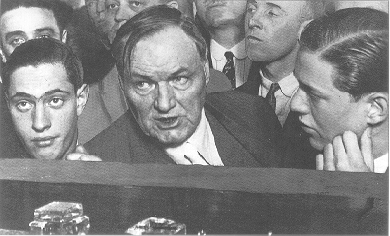
Perspective: The Trial of Nathan Leopold and Richard Loeb (1924), Clarence Darrow’s Closing Argument, And Judge Caverly’s Sentence

Darrow and his clients

Darrow and his clients

I just commented, on the controversial post here about Judge Boyd and the media frenzy regarding the “affluenza” defense offered by Ethan Couch’s lawyers, that the fact that so many of the comments, many of them angry, focused on the fact that a spoiled, rich kid got a break, or, as they used to say in the old days, mercy, that I began thinking about the famous Leopold and Loeb murder trial.   In 2011, I  posted a shortened version of Clarence Darrow’s famous closing argument in that trial, one of my favorite of all courtroom speeches, and it seems appropriate to do so again. It is far from a perfect parallel, but any excuse to revisit Darrow at his best is a good one.

 Nathan Leopold and Richard Loeb were, like Ethan Couch, young, rich and spoiled; they also were Jewish and gay. Their crime was  far worse than Crouch’s: they planned and executed the murder of a child just for the fun or it, and to show that they could outsmart authorities. (Ironically, they were arrested almost immediately). The two teenagers were charged with the premeditated murder of fourteen year-old Bobby Franks. Both defendants were brilliant students (Leopold, the youngest graduate in the history of the University of Chicago; Loeb, the youngest graduate of the University of Michigan),  and the sons of wealthy and successful Chicago businessmen. Neither showed any remorse for their terrible crime. There is no question that had they been poor, they would have been sentenced to die, and would have been hanged. Their parents, however, could afford to hire Clarence Darrow, a foe of capital punishment who had never had a single one of his often guilty clients executed. They got their money’s worth.

His summation on August 22, 1924, remains perhaps the most persuasive and eloquent argument against capital punishment ever made in a court or anywhere else.  It is also an argument for mercy, and especially mercy for the young. The plea worked: Judge John L. Caverly spared Leopold and Loeb, and he sentenced them to life imprisonment without parole—under the circumstances and in those days of rough justice, a gift. In his sentencing statement, which is posted here after Darrow’s summation, Caverly did not indicate that he was swayed by Darrow’s eloquence or reasoning. Caverly based his sentence on the ages of the defendants. Darrow was counting on this particular vulnerability of Caverly, who had helped establish juvenile justice courts in Chicago. Later, Nathan Leopold suggested that he and Dickie Loeb might have gotten the same result if they had simply submitted their birth certificates into evidence.

I doubt that he would have bet his life on it. The pressure on Caverly to hang these two despicable sociopaths was overwhelming, and having Clarence Darrow put his decision in such heroic terms had to steel his nerve, if it needed steeling. Still, as with Judge Boyd in the Couch case, there is no way to be sure that he would not have spared Leopold and Loeb anyway. Also as in Ethan Couch’s case, critics said this was disparate justice, bought and paid for.

This is a condensed version of Darrow’s closing,  edited for The Essential Words and Writings of Clarence Darrow, (2007),  that I co-edited with historian Ed Larson.  Here is one of the great orators of the 20th Century, one of the great progressive thinkers in our history, and the greatest trial lawyer who ever lived, arguing for the life of two murderers and for the soul of our civilization. I do not share Darrow’s absolute rejection of the death penalty, but I always do for a few hours, at least, after reading this. Continue reading →

The T-Rex Escapes: Lessons Of The Washington Redskins’ Nepotism

I can’t exactly say, like Jeff Goldblum as Dr. Ian Malacolm in “Jurassic Park,” that I hate being right all the time…in part because I’m not. It sure is frustrating, however, to see an ethics crisis looming, write about it once, then twice, and still see so many people surprised when it arrives like an angry T-Rex. Thus today, I began the morning by pounding my head against the wall to read in the Washington Post sports section a column by Jason Reid with the headline, “Mike Shanahan, by hiring his son Kyle, has created an untenable situation.” Wait, what year is this? Shanahan, the coach of the Washington Redskins, that team with the name that we’re not supposed to say, hired his son Kyle as the team’s offensive coordinator many moons ago, in 2010. It was a terrible idea at the time, an example of classic nepotism that created an immediate risk of exactly what is occurring now, and perhaps the certainty of it, if the situation endured long enough.

Last season, when the Redskins swept to the NFC East Championship behind thrilling rookie QB Robert Griffin III, the ethics-challenged sports fandom here (Washington, D.C., remember) cited the success as proof that nepotism is an ethics boogie man, nothing more. This was pure consequentialism. As I concluded my post on the topic last January,

“This is rank consequentialism in its worst form. Nepotism is an unethical way to run any staff, company, team, business or government, unfair, inherently conflicted, irresponsible, dangerous and corrupting. It should be recognized as such from the beginning, and rejected, not retroactively justified if it “works.”I’m sure there were and are non-relatives of the Redskins coach who could have devised a successful offense with RG3 taking the hikes. The ethical thing to do was to find them and give one of them the job. The Redskins coach’s nepotism is just as unethical in 2013 as it was in 2012, 2011, and 2010.”

In “Jurassic Park,” the same day that chaotician Malcolm warns that the dinosaur park is so complex that a fatal loss of control is inevitable, the systems break down and he gets nearly gets eaten. The same year I wrote those words, ten months later, it’s Mike Shanahan on the menu as Jason Reid wrote these: Continue reading →

Advice Column Ethics: Amy Forgets The Duty To Butt Out

Get out

Newspaper advice column maven Amy Dickinson encountered one of those juicy letters that boosts readership but that should also set off ethics alarms. Her responsible, ethical course was to leave the situation alone. Unfortunately, she took the bait. How unfortunate, we will never know.

“Conflicted” (I have some better names for her ) wrote to “Ask Amy” because, she said, her conscience was bothering her, and no wonder. She had divorced her husband of five years two years ago. “We loved each other, but our marriage was deeply troubled,” she wrote, which is an understatement. He lied to her. He had “inappropriate relationships with other women.” He was profligate with money, and spent the couple into financial trouble. Worst of all, this: “…during a two-year period of our marriage and on five occasions, he was physically abusive. Not a slap or a shove, but full-out rage. I thought he would kill me.”

Naturally, she is still sleeping with him! “We see each other frequently and have a lively sexual relationship,” she says cheerily. The Ex assumed her old hubby had a social life outside of hooking up with his former wife/punching bag, and was fine with that, since the swinging Ex is also sleeping around: Hey, it’s the 21st Century! But now she has learned that he is in a serious relationship with another woman who does not know he never stopped making whoopee with “Conflicted.” They are talking about marriage and babies.

So now, she tells Amy, she is certain he will ruin this “lovely girl’s” life. She thinks she has an obligation to the innocent young thing to tell her about his spending problems and some other more recent details ( “he owes thousands of dollars on credits cards and has not filed his taxes in two years”) and, she says confidently, he “clearly” hasn’t told her about his spouse-bashing episodes, though  “Conflicted”  hasn’t asked him, and hasn’t talked to her. “What obligation do I have to share any of this information with her? I don’t know what to do,” she asks, plaintively.

Amy: This is the Amityville House talking to you now.

“GET OUT!!!” Continue reading →

Wait…The Judge And The Defense Attorney Were Having An Affair, And The Defendants Were Convicted Anyway? So What’s The Problem?

"Yes, counsel, I am throwing the book at your clients because I love you."*

“Yes, counsel, I am throwing the book at your clients because I love you.”*

The Georgia Court of Appeals has ordered new trials for five men convicted of serious crimes in Fayette County because their trial judge was having an undisclosed affair with defendants’ public defender.

Doesn’t  that seem strange to you? After all, the clients of the judge’s secret love were convicted and sentenced. Why should they get the benefit of  new trials when the judge’s evident conflict and judicial misconduct didn’t benefit them or harm them in any way (unless a judge making sure his lover’s clients get prison time is a quirky way to say “I love you” in the Peach Tree State). This isn’t like the horrendous Charles Dean Hood case in Texas, where a man was sentenced to death after a trial in which the state prosecutor was sleeping with the judge.

The Georgia judge-lawyer affair (and I thought Steven Bochco was making it all up!) came to light in 2010. Paschal English, who subsequently resigned as chief Superior Court judge, had been involved in a romantic relationship with assistant public defender Kimberly Cornwell, who has also moved on to new pursuits, ideally those that don’t require trust or ethics. A three judge panel recently agreed that this relationship, undisclosed and a clear cut ethical violation for both judge and attorney, required that there be new trials for Christopher Wakefield and Travion Willis on charges of armed robbery, kidnapping, aggravated assault and other crimes; William Nutt for aggravated child molestation and aggravated sexual battery; Rashad Arnold for burglary; and Calvin Boynton for armed robbery, aggravated assault, possession of a sawed-off shotgun and drug possession.

Hmmmm… Continue reading →

Proposed PSA: “This Is Matthew, And He Is The Face Of The Tragedy Called Confirmation Bias. Please Help!”

PSA

It is so easy—and tempting—to dismantle Matthew Lynch’s  jaw-dropping essay on the Huffington Post titled “12 Reasons Why Obama Is One of the Best Presidents Ever” that it is unethical, like shooting fish in a barrel. Nearly everything about the post is snicker-worthy, beginning with its timing: this is the equivalent of writing a paean to JFK the morning after the Bay of Pigs.

I have no similar reticence about slamming the Huffington Post for running such an embarrassing screed. If it was intended as satire (and I still think this is a possibility), the piece is incompetent, because when satire is so close to reality that readers can’t tell it’s satire, then it becomes a hoax. There is a possibility, I suppose, that the editors published this because Lynch’s glossy-eyed, alternate reality ravings were entertainingly absurd (they are not: they are tragic), but this would be cruelty, the equivalent of Sean Hannity’s practice of allowing an ignorant, usually poor and uneducated liberal caller to make a fool of herself, slyly impugning the intelligence of the entire American Left. Yet the Huffington Post is largely Obama-friendly: his obeisant  media may finally be moving away from the President, but not that quickly. I think “12 Reasons…” was run because the editors believed the article had substantive merit, in which case, they should all be sent to the Home for Bewildered Editors. (It also may have been planted as link bait.)

If the post was run on its substance, then the editors failed their responsibilities in another respect: they didn’t check Lynch’s facts. His opinions and justifications for them may be Oz-worthy and his alone, but when he writes a flat-out misrepresentation like this… Continue reading →

Well, Crap. Again.

Regret2

I am now in shock, having just learned that a dear friend of four decades is now in a hospice with complications of congestive heart failure, and not long to live. We had been exchanging cheery emails, and while I knew of his health issues, I was under the impression that they were manageable, and certainly not this dire. Naturally, we had kept planning on getting together for dinner or a ball game, but one thing or another always intervened, usually on my end, and I had not seen him since the Spring.

This has happened to me before, more than once. What will it take to make me take the time to show love and appreciation to the many people in my life who have earned it, and to try to enrich their days, however many they have left, in some small way, rather than allowing everything else to get in the way?

________________________

Graphic: Ronnie Tabor

Advice Column Ethics: Amy Dickinson Sounds An Ethics Alarm

"DANGER, Other Woman...DANGER!!!"

“DANGER, Other Woman…DANGER!!!”

Today, syndicated advice columnist Amy Dickinson (“Ask Amy”) answered a query with admirable directness, properly defining the proper  use of ethics alarms for a woman who was puzzled about what to do when the answer should have been obvious. Unfortunately, Amy adopted the letter-writer’s incorrect terminology for an ethics alarm, based on the help-seeking “other woman” in an adulterous relationship writing that her relationship was beginning to feel “icky.”

As we have discussed here many times, “ick” and unethical conduct are not necessarily the same thing.  Humans naturally assume that what is strange or instinctively repugnant is wrong, but that assumption always needs to be tested by sound and objective ethical analysis. The best current example: to heterosexuals, gay sex is “icky,” but that doesn’t make it unethical or wrong. When Amy uses the term “ick-o-meter,’ what she means is “ethics alarm.” Continue reading →