The Story Of “Do You Hear What I Hear?” [Updated And Corrected]

Bing Crosby memorably introduced this last of the popular Christmas songs to have a religious theme to most Americans in 1963, on this live broadcast of “The Hollywood Palace.”  It  was written in October of 1962 during the Cuban Missile Crisis, by a married songwriting team that  wondered at the time if it would be the last thing they ever did.

Noel Regney, who wrote the lyrics, was born in France and had studied music at the Strasbourg Conservatory and at the Conservatoire National de Paris. When France was overwhelmed by Hitler’s troops in 1940, he was conscripted into the German army. As a Nazi soldier, he secretly joined the French underground and served as a spy, passing information along to the resistance. Once he led German soldiers into a trap where they were massacred by French fighters who cut them down in a crossfire. He was shot too, but survived.

After that traumatic encounter, Regney deserted and worked with the French underground until the end of the war. Continue reading →

Morning Ethics Warm-Up, 12/21/2018: Getting The Tree Lights On In One Day Victory Lap Edition, Featuring Sports, Movies, Jerks And “Bambi”

Happy Holidays!

Seven hours, one serious needle wound, and 1300 lights later, victory! I’ll finish the decorations when I get back home, IF I get back home…

1. Itinerary…I’m heading to New Jersey via train to hook up with the brilliant Mike Messer, what we call “the talent,” in an encore rendition of the musical legal ethics seminar, “Ethics Rock Extreme,” lyrics by yours truly, musical stylings by Mike, on the guitar. Then it’s back to D.C. by air on Saturday, if I’m lucky. If I’m not lucky, I’ll be taking the New Jersey bar exam in the Spring…

I have no idea how or whether I’ll be able to keep Ethics Alarms on track once I board the train this afternoon. I’m not going to launch a second Open Forum in leas than a week, so please keep working on the current one here, now at 130 entries and counting. I will be reviewing those on the road, and I’m sure there will be some Comments of the Day to post, eventually.

2. In case I am trapped in New Jersey…Let me alert everyone that Peter Jackson’s apparently terrific (based on the reviews) WWI documentary “They Shall Not Grow Old” will be playing in theaters on December 27, and after that, who knows? The American public’s ignorance about that war, perhaps the greatest human catastrophe in modern history, is a failure of education, perspective and culture. If you have kids, take them. Here is the trailer:

3. Speaking of cultural literacy and movies, TCM is offering a limited engagement in theaters for “The Wizard of Oz,” on January 27, 29, and 30.

Is there another film that so many people purport to know and love so well without actually having seen it as it was intended to be seen? When I finally saw the movie in a theater—no breaks or commercials, big screen—I was shocked at how different and, obviously, better, the experience was. It’s an artistic masterpiece and sui generis: we will never see its like again, nor talents like Judy, Ray and Burt, among others. Continue reading →

Movie Poster Ethics: Is This Good Parody, Bad Taste, Blasphemy Or Religious Discrimination?

Well, it sure isn’t religious discrimination, but that’s what some of The Offended are claiming.

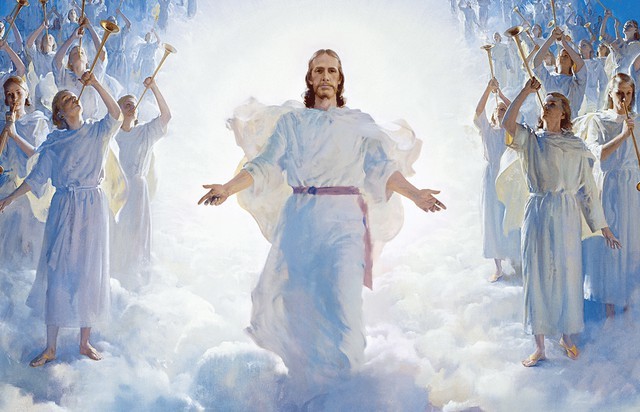
This is a poster for a holiday repackaging of “Deadpool 2,” the tongue-in-cheek sequel to the previous tongue-in-cheek Marvel superhero hit, “Deadpool,” featuring the hideously scarred, invulnerable, foul-mouthed and irreverent superhero who routinely breaks the fourth wall to crack jokes.  The poster is a parody of the “The Second Coming,” a painting by Harry Anderson that is inexplicably popular among Mormons, and often hangs at meetings of members of The Church of Jesus Christ of Latter-day Saints. Here’s the poster’s inspiration:

I

Continue reading →

Christmas Questions For A Thoroughly Confused Culture

In “A Christmas Kiss,” the 2011 Hallmark-style Christmas movie (that premiered on the Ion channel, but really would have been right at home on the Hallmark channel, or for that matter, the Crap Channel), Wendy Walton is an aspiring interior designer. One night, while preparing to go out with her roommates in glitter makeup,  she encounters an impossibly handsome, formally-dressed stranger in the elevator. When the elevator stalls and seems unstable, Wendy is thrown into the stranger’s arms….or perhaps grabs him for support, or in fear.  The elevator starts moving again, and he impulsively embraces her and gives  her a passionate, romantic kiss.  They part without her learning his name, and Wendy breathlessly tells her roommates about her magical encounter with the handsome stranger.

2018 questions:

1 Was the kiss sexual assault? Wendy did not consent to it. Continue reading →

Popehat Nails Dershowitz For Misrepresenting The Law

Ken White of Popehat comes out guns blazing to take celebrity lawyer Alan Dershowitz down for misrepresenting the law in several of his increasingly frequent media appearances. Ken nails his target, too. Even the former prosecutor’s characterization that Dershowitz is lying is not excessive or unfair.

You need to read the whole post, for it is superb, thorough and airtight. Here is a precis, however, in Ken’s words, not mine.

The subject of Professor Dershowitz’s dishonesty — for the purpose of this essay — is General Michael Flynn’s lies to FBI agents and his subsequent guilty plea for lying under 18 U.S.C. section 1001. Professor Dershowitz has asserted, repeatedly, that Flynn did not violate Section 1001 because his lies were not “material” — that is, meaningful. He claims that the lies were not “material” because the FBI knew at the time Flynn was lying, and was not fooled…

Dershowitz has promoted the same point explicitly in writing:

When questioning any suspect, officials should not ask questions whose answers they already know, for the sole purpose of seeing whether the suspect will lie. If they do ask such questions, untruthful answers should not be deemed “material” to the investigation, because the FBI already knew the truth.

This is a perfectly arguable statement of what the law should be. But someone reading Dershowitz’s column could be forgiven for thinking that’s what the law is — or, at least, that the law is unsettled on the point. The essay utterly fails to divulge that every court to consider the argument has rejected it….

I am not aware of any cases construing Section 1001 that go the other way. Nor is there any credible indication that the United States Supreme Court would go the other way and decide that a false statement to the government does not violate Section 1001 if the government already knows that it is false. To the contrary, the Court has signaled that it would reject that argument…

n short, there is no credible argument that Alan Dershowitz’s repeated assertion is a correct statement of the law. It would be malpractice to advise a client that way. It would be deceitful to tell students. And it’s dishonest to tell the nation without telling them that this is your theory of what the law should be, without revealing what the law is. Advocates push the boundaries of the law. They ought to. But honest advocacy doesn’t involve lying about the current state of the law. Indeed, lawyers have an ethical obligation to reveal contrary authority when arguing in court, and judges will burn you down to the ground if you don’t. I would argue that legal experts — who trade on their reputation for knowing what the law is — have a similar ethical obligation to reveal when existing law flatly contradicts what they are arguing.

Continue reading →

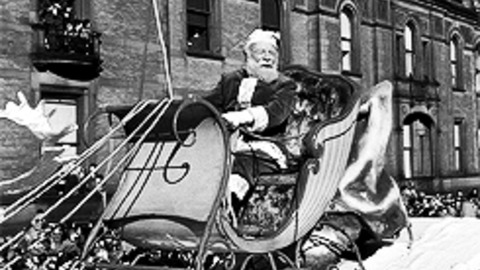
“Miracle On 34th Street”…An Ethics Companion, Chapter One: “Meet Kris Kringle!”

The Introduction is here.

The movie tells us right at the start that 1) the charming old man in the white beard can’t possibly be Santa Claus, and 2) that he’s nuts. That is, he tells adults who are paying attention this as soon as he starts complaining to a New York City storekeeper that his window display has the reindeer mixed up: “You’ve got Cupid where Blitzen should be. And Dasher should be on my right-hand side. And another thing…Donner’s antlers have got four points instead of three!”

Let’s see:

  • No Christmas display has ever distinguished between Santa’s reindeer (except for Rudolph), because the individual reindeer have never had any identifying characteristics in reality or myth. Are we to assume that there are name-tags on the models? If so, why wouldn’t Kris be complaining about the features of all of them, not just “Donner’s” antlers?
  • The names of the reindeer, even if there are flying reindeer, were 100% the invention of the poem “A Visit from St. Nicholas,” or “The Night Before Christmas,” originally published in 1823.  No one has ever claimed that the author had some kind of special info on the actual names of the reindeer when he wrote,

    More rapid than eagles his coursers they came,
    And he whistled, and shouted, and called them by name;

    “Now, DASHER! now, DANCER! now, PRANCER and VIXEN!
    On, COMET! on CUPID! on, DUNDER and BLIXEN!

    …and anyway, if he did, those were their names 120 years before the movie takes place. Nobody has ever claimed the reindeer were immortal, either. I suppose Santa Claus, in a nod to the poem’s popularity (it has been called the most famous poem of all time), could have adopted the practice of always having the reindeer named after the poem’s versions, and when one Vixen dropped of old age, the young reindeer that took her place became the new Vixen.

I suppose. Continue reading →

Morning Ethics Warm-Up, 12/18/2018: One Week To Christmas Edition (Including Nothing About Christmas, Almost)

Good Morning.

A beautiful, naked Frasier Fir is standing in my living room like an unpaid debt.

1. Speaking of Christmas...The first installment on the Ethics Alarms ethics guide to “Miracle on 34th Street” went up late yesterday, and was immediately blocked on Facebook for violating community standards. Nice. It appears my Facebook “friends” took revenge for my chiding their juvenile and unending “Orange Man Bad” posts.

2. Speaking of being ticked off… Professor Turley:

In a surprising admission, the author if the controversial dossier used to secure the secret surveillance on Trump officials admitted that it was paid for by Clinton campaign as a type of insurance to challenge the election.  At the same time, the reporter who helped break the story, Michael Isikoff now says that many of the specific allegations remain unproven and are likely false. 

The Washington Times reported that Steele stated in a declaration in a defamation case that the law firm Perkins Coie wanted to be able to challenge the results of the election based on the dossier.  In an answer to interrogatories, Mr. Steele wrote: “Fusion’s immediate client was law firm Perkins Coie. It engaged Fusion to obtain information necessary for Perkins Coie LLP to provide legal advice on the potential impact of Russian involvement on the legal validity of the outcome of the 2016 US Presidential election. Based on that advice, parties such as the Democratic National Committee and HFACC Inc. (also known as ‘Hillary for America’) could consider steps they would be legally entitled to take to challenge the validity of the outcome of that election.”

In his typical fashion when he is in mealy-mouth mood, Turley says this is “concerning,” since this document was used to get judicial leave to spy on the Trump campaign. The news is only surprising if you had your fingers in your ears and were shouting “Nanananana” for the past year. This issue, you will recall, is what led a previously well-regarded commenter from the Left here to noisily withdraw as a participant because I was, he said, obviously in the throes of irrational Right Wing conspiracy mania because I posted this.

Certain exiles, if they have any integrity at all, owe me a large, effusive, groveling apology—and I still might not accept it.

Concludes the Professor: “The Steele admission only magnifies the concerns over the purpose and the use of this dossier, but has received little media attention.”

Gee, I wonder why THAT is!

3. “And now for something completely stupid” Department. I guess former “Fresh Prince of Bel Air” star Alfonso Ribeiro’s  career isn’t going so well. He is suing the makers of the video game Fortnite for allegedly stealing his “Carlton dance.” You know, this…

It was a big deal at the time because Ribeiro’s character was a geek, and ignorant viewers didn’t know that the actor was professional dancer who had starred in “The Tap-Dance Kid” on Broadway as a child. The fact that a video character does similar moves…

…is no basis for a lawsuit. Choreography copyrighting is a murky intellectual property area, and suing because of an animated figure’s moves is pathetic, as well as an abuse of the civil justice system. The has-been star is angling for a nuisance suit settlement. He should try “GoFundMe” instead. Continue reading →

“Miracle On 34th Street”…An Ethics Companion: Introduction

As with most holiday movies, but perhaps more than most, the entire concept of digging into the ethics of the plot of “Miracle on 34th Street”  can be criticized as beside the point. The movie, at least the 1947 original, is a classic; it works dramatically and emotionally, it makes people feel good, and it has held up over time. That’s all a Christmas movie is supposed to do, and if it does it without really making sense or avoiding ethics potholes along the way, so what?

I sympathize with this view. However, our ethical standards and ethics alarms are affected by what we see, hear, like and respond to. If popular holiday movies inject bad ethics habits and rationalizations into our character, especially at a young age, that is something we should at least be aware of by the tenth or eleventh time we watch one of them.

One ethical aspect of “Miracle on 34th Street” that must be flagged at the outset is competence. The film is so effortlessly engrossing and convincing that it is easy to forget how easily it could have failed miserably. Actually, it is also easy to remind oneself: just watch any of the attempts to remake the film. There have been four of these, starring, as Kris Kringle, Thomas Mitchell, Ed Wynn, Sebastian Cabot, and Richard Attenborough. That’s a distinguished crew, to be sure. Mitchell was one of the greatest character actors in Hollywood history. Wynn was nominated for an Academy Award (for “The Diary of Ann Frank”) and Attenborough won one, Best Supporting Actor Award in 1967 for “The Sand Pebbles.” Cabot wasn’t quite in their class, but he was a solid pro, and looked more like Santa Clause than Mitchell,  Wynn, or Richard Attenborough. None of them, however, were as convincing as Edmund Gwenn. He made many movies—all without a white beard— and had a distinguished career in films and on stage, but even audience members who knew his work had a hard time reminding themselves that he wasn’t Kris Kringle while they watched the movie. I still have a hard time. Continue reading →

On Political Correctness, Eye Candy, And “Deal Or No Deal”

Where are the hunchbacks? Where are the amputees? Where are the burn victims?

A friend of mine—a real one– on Facebook, in a pathetically desperate exercise in virtue-signaling to his leftist hive-mind lawyer friends, issued a naive or disingenuous post making the claim that all “political correctness” was about was “not being an asshole.” This factually and historically false assertion naturally was met with unanimous likes until I again played the skunk at the picnic by pointing out that his comment was utter fantasy. The directive from the British college that laid out guidelines for comedians was classic political correctness, and it was the guidelines-peddlers, not the comedians or those who mocked the restrictions, who were being assholes. Those who persist in calling illegal immigrants illegal immigrants (and not “undocumented immigrants” or just “immigrants”), for that, Virginia, is what they are, are not the assholes, but they are “politically incorrect.” The assholes who go searching through the Twitter feeds of young celebrities searching for politically incorrect words about gays, women or minorities are wielding politically correctness as a weapon of personal destruction. And so on. I could write volumes on similar or more nauseating examples. Maybe I have.

So I pointed out, correctly and undeniably, that political correctness has been used for decades by one side of the political spectrum—guess which!—as a tool to manipulate public discourse and hobble the expression of ideas and attitudes that end doesn’t like, while relieving them of the obligation of making a substantive argument. The immediate attack on this retort came from someone I don’t even know, who wrote, “You are so tiresome.” Yes, I’m quite aware that doctrinaire progressives find ethics, facts and logic tiresome, but there it is. That is what passed for an argument in Facebook’s hive: “Shut up.” I haven’t bothered to respond to the other attacks on me on that thread; it’s not worth my time. If you defend a manifestly false characterization of political correctness, then you are either not being honest, you have an agenda, or are no longer thinking objectively and clearly. Either way, I’d rather debate my dog.

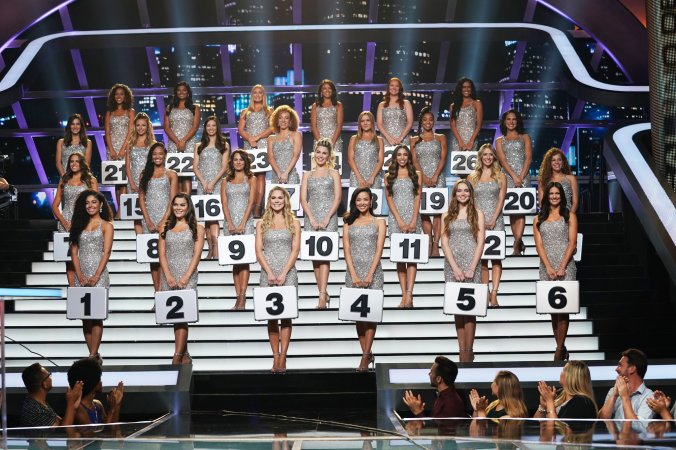
This was a roundabout way of introducing a classic example of political correctness silliness, attacks on the appropriateness of “Deal or No Deal” returning with the same bevy of beauties whose job it is to hold and open suitcases, a job that could be performed with equal competence by the homeless, paraplegics, 9-year-olds, or robots. Writes the Times, metaphorical brow furrowed,

CNBC’s “Deal or No Deal,” which returned for a new season on Wednesday after a nearly 10-year hiatus, and features 26 female models in matching high heels and short, skintight dresses. It’s a formula that helped make “Deal” a prime-time hit when it debuted on NBC in 2005.

That was 13 years ago. But in 2018, as the culture continues to grapple with the way women have been disregarded and sometimes abused by Hollywood and its machers, “Deal” and shows like it raise an awkward question: Is this a convention whose time is up?

Series like “Deal” encapsulate the paradox of the modern game-show modeling gig: On one hand, it offers a stiletto-heeled foot in the door for many young women who aspire to careers in entertainment — Meghan Markle and Chrissy Teigen, among others, got their starts on “Deal or No Deal.” On the other hand, it is unclear whether those advantages are worth the broader message it may communicate in the #MeToo era…

“I do feel it’s a bit tone deaf,” said Nicole Martins, a professor at Indiana University Bloomington, who focuses on media and body image. “These women are used as eye candy, and it reinforces the idea that these women should be appreciated for how they look.”

Yes, Professor, that’s because THESE women are being appreciated for how they look, and for no other reason, because they aren’t doing a job that couldn’t be handled by a well-trained ape. So what? “Deal of No Deal” is moronic, but there is nothing whatsoever unethical, sexist or “tone deaf,” now or ever, about employing attractive people in an entertainment context as “eye candy,” meaning “employing attractive people to be attractive.”

Attractive women are attractive. People like to look at them. People would rather look at them than look at average, typical people they can see every day on the street, or by looking in the mirror. Is there anything wrong with enhancing a stupefyingly repetitive and boring game show with beautiful women? There is not. Nor is there anything wrong with women who are gorgeous while having no other areas in which they excel making a living based entirely on that one asset. Continue reading →

The Good News: This Hasn’t Happened Here…Yet. Well, Not Exactly…

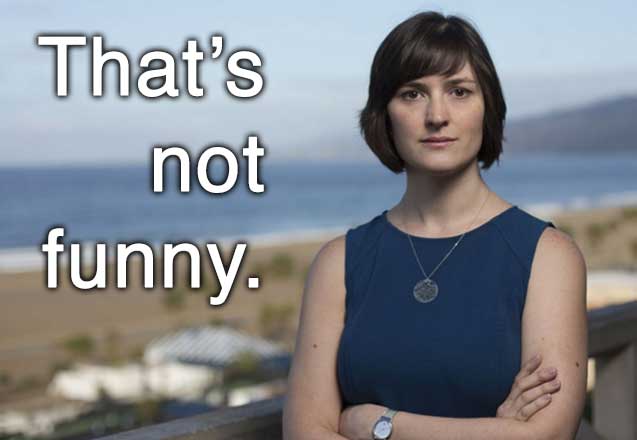
I detest memes, but like all other rules, there are exceptions. Sometimes, only a meme will do.

Of the many warpings and distortions of a healthy culture we have seen emanating from the ideologically extreme, one of the more insidious is the antagonism towards humor. This episode speaks for itself.

The UNICEF on Campus chapter at the University of London sent five local comedians a request to perform at a club sponsored event. However, the requirements to be hired led all five to turn down the job.

Fisayo Eniolorunda, the club’s event organizer, wrote in an email, “Attached is a short behavioural agreement form that we will ask for you to sign on the day to avoid problems.”

Problems like actually being funny, apparently.

The “behavioral agreement” states,

“This comedy night… aims to provide a safe space for everyone to share and listen to Comedy. This contract has been written to ensure an environment where joy, love, and acceptance are reciprocated by all. By signing this contract, you are agreeing to our no tolerance policy with regards to racism, sexism, classism, ageism, ableism, homophobia, biphobia, transphobia, xenophobia, Islamophobia or anti-religion or anti-atheism. All topics must be presented in a way that is respectful and kind. It does not mean that these topics can not be discussed. But, it must be done in a respectful and non-abusive way.”

Respectful of whom and not abusive in what way? Oh, never mind. The agreement is a joke itself. What does “love and acceptance” have to do with humor? Does Fisayo Eniolorunda know what “Comedy” is? Of course comedy doesn’t have to be cruel or mean, but then an audience that would lay out such rigid standards can’t be trusted to judge what cruel, mean, respectful, non-abusive, safe—lordy, especially “safe”–or funny is. These are subjective standards being judged by people who are so besotted with ideological mania, virtue-signaling addiction and political correctness that they can’t be trusted. Continue reading →