Unethical Quote Of The Week: Cartoonist Garry Trudeau

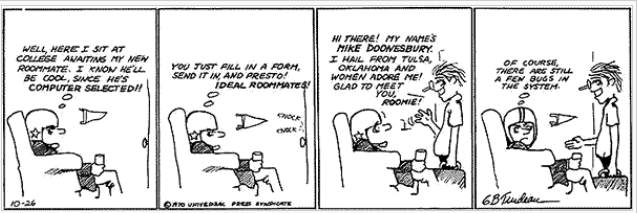
The exquisitely rendered artwork of Gary Trudeau, circa 1970.

The exquisitely rendered artwork of Gary Trudeau, circa 1970.

“At some point free expression absolutism becomes childish and unserious. It becomes its own kind of fanaticism.”

—-Doonesbury cartoonist and relentless critic of the Right, Garry Trudeau, in a speech delivered on April 10 at the Long Island University’s George Polk Awards ceremony, where he received the George Polk Career Award.

Trudeau is a Yale grad, so perhaps we should cut him some slack muddled thinking. (Kidding!) However, in making his weak case that legitimate and socially acceptable satire only consists of “punching up,” he appeared to be advocating government prohibition of certain kinds of speech, to be designated by Trudeau and his ideological allies, who, of course, know best.

In doing this, Trudeau came very close to aping the popular theme from activists on the Left, especially on campuses, that “hate speech isn’t protected by the First Amendment.” “Hate speech” is an invention of progressives, and is generally defined as political or social criticism of members in good standing of their club, or groups and individuals they sympathize with or approve of.  Saying that you hope Rush Limbaugh’s kidneys fail is funny and deserved;  saying Mike Brown engineered his own demise by attacking a cop is hate speech. It’s easy when you get the hang of it: just look at the world like Gary Trudeau.

Earlier in his speech, he talked about “red lines” in satire, and blurrily–that is, inarticulately enough that he has plausible deniability, called for restrictions on “hateful” cartoons like those that prompted Islamic assassinations in Paris: Continue reading

Proof Of Evolving Ethics Enlightenment: Bert The Cop Would Have Shot Walter Scott In The Back Too

For those who think that our ethical sensitivities don’t evolve for the better over time, I prescribe a careful viewing of that family classic, “It’s A Wonderful Life.”

At the film’s climax, George Bailey, the self-sacrificing hero who has been granted his inadvertent wish to see what the world would be like if he had never been born, finds the love of his life and (in the life he has given up for this dystopian hell) the mother of his children now unmarried, alone and working as a librarian despite the fact that she looks like Donna Reed. He embraces her, and since she’s never met him in this alternate reality, she screams, believing she is being sexually assaulted by a madman. Kind, jovial police officer Bert is summoned to quell the ruckus, and George, who is a bit upset, punches him in the face to avoid arrest, and runs away. Bert then takes out his pistol and fires it at George repeatedly.

He’s a lousy shot.

In 1946, when audiences first saw this film, nobody thought there was anything unusual about Bert’s professional conduct. Many, many films right through the 1960s show police officers, “good guys,” even ones not trapped in a strangely mean alternate reality like Ward Bond’s Bert, shooting at fleeing suspects or criminals. That was considered appropriate police procedure then, and the public, society and U.S. culture saw nothing amiss. You were expected, as a good citizen, to submit to a police officer’s lawful authority. If you resisted arrest and ran, then it was fair and reasonable for the officer to shoot you, ideally after a “Stop or I’ll shoot!” warning. Indeed, many people were shot, and killed, this way. If it was news, it wasn’t on the front page, and it wasn’t considered any kind of an outrage.

Now consider the public and media reaction to Michael T. Slager’s shooting of Walter Scott. We now know that Scott was resisting arrest: he had a bench warrant out on him for non-payment of over $18,000 in child support, and Slager was trying to bring him into custody. Instead of doing as the officer demanded, Scott resisted and ran. Burt would have shot at his back too; the difference is that Slager is a better shot, and George was faster. Slager, however, is completely reviled across the country; even his own lawyer found him so repugnant that he refused to represent him.

That represents a massive shift in cultural values in a little over half a century. Continue reading

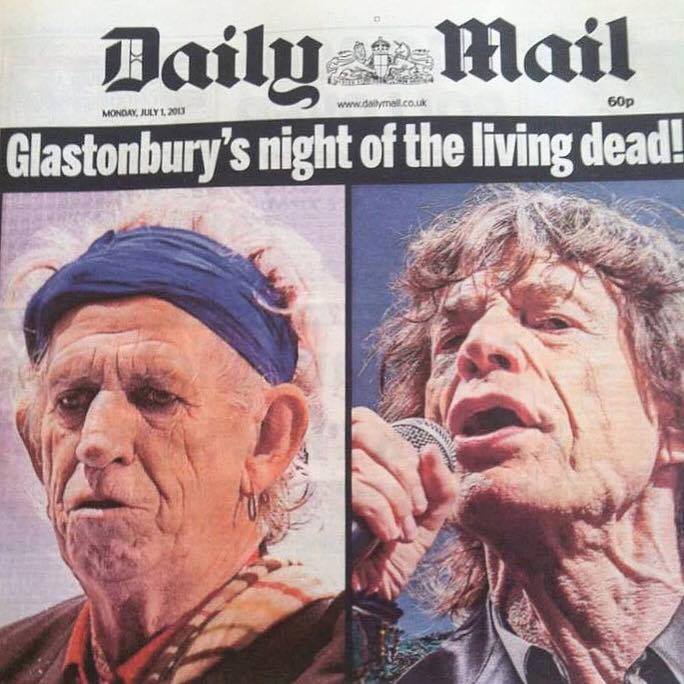
Double Standard Chronicles: Why Is Mocking The Rolling Stones For Their Appearance More Ethical Than Fat-Shaming Kelly Clarkson?

Rolling Stones

It isn’t. It is just as wrong.

Fox’s Chris Wallace has apologized for making a gratuitous and unkind crack about pop singer Kelly Clarkson’s weight on a conservative talk radio show (he was suckered into it by the host, Mike Gallagher, who has also apologized to Clarkson.)

Today I have seen the above graphic circulating on Facebook with many “likes” and snarky comments about Mick and Keith’s faces.

My restrained reply is “Shut up, jerks, and show some respect.

Original members Mick Jagger, Keith Richards and Charlie Watts are over 70 now. Nevertheless, they are embarking on another North America tour. They can still play, in some ways better than ever; Mick can still sing, and can still dance like a chicken. The Stones show passion and professionalism in every performance; those who have seen their concerts leave amazed. The Stones are not like the Beach Boys or the Turtles, croaking out 50-year-old hits to grandparents at county fairs. The Stones can still rock, still have musical integrity, still give their audiences their money’s worth and then some.

I wonder how many of the Facebook trolls writing about how the Stones, who are going to be 73 this year, look old—they are old, and so what? What exactly are they supposed to do about that?—know how hard performing at a professional level is, how exhausting it is, how it impossible to get to sleep for hours after a show because you are soaked with adrenaline, and how much wear and tear it places on the body, emotions and mind.

My guess? Very few. And very few of these obnoxious critics will be able to walk upstairs quickly at the age that the Stones are still rocking arenas. I give three hour, interactive ethics seminars, and I’m a lively speaker. After about two seminars in a week with the related travel, I am fried—and the Stones are expending more energy, more often, then I am. They are also a decade older than I am. I can’t be certain I’ll be able to do my Ethics Chicken Dance when I’m 73. They are an inspiration. Continue reading

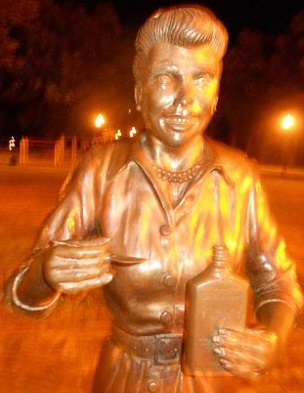
Statue Ethics: “Hey Lucy, I’m Ho…OH GOD NOOOOOOOOOOO!!!!”

Lucy statueIconic comic actress Lucille Ball was born in Celoron, New York, and in 2009 the town’s residents commissioned a statue to honor her. It was designed to show the comedienne performing one of the most famous of her routines on “I Love Lucy,” the “Vitameatavegimin” bit.  For some reason, however, the sculptor either decided to portray Lucy as a creature from Hell, or had never actually seen a picture of Ball and just guessed, badly, at what she looked like. The result, which a sighted “Let’s Honor Lucy” committee member should have rejected at first glance, now stands in the town park, an eyesore and an insult to Ball’s memory.

Now some of the residents are trying to get the town to junk the statue, and rallying Lucy fans to put pressure on the town leadership to act. My question is, what took them so long? Six years of this incompetent abomination is six years too long. A memorial is ethically obligated to honor its subject, not insult and defile her memory. Would the public tolerate a Lincoln Memorial where Abe was sculpted to look like an ape? Would it have stood by at the unveiling and said, “Well, okaaay, I guess we can live with that…I guess. I mean, its paid for and all”?  What’s the matter with the populace of Celeron?
Continue reading

Ethics Dunce: Fox News Anchor Chris Wallace

You won’t read this on The Daily Caller!

Even the pizza deserves an apology...

Even the pizza deserves an apology…

In a radio interview with conservative talk show host Mike Gallagher, Fox News anchor Chris Wallace was riffing on Little Caesars’ bacon-wrapped crust pizza when Gallagher brought up “fat shaming,” which slid into the issue of the current celebrity fat-shaming victim, following in the footsteps of past targets of weight-related ridicule like Kirstie Alley, Roseanne, Adele, Rosie O’Donnell and Lisa Welchel, pop singer Kelly Clarkson.  “Holy cow, did she blow up!” Gallagher said. “She could stay off the deep dish pizza for a little while,” replied Wallace. Ethics Foul , and a vile one. Rude, mean, and completely gratuitous, Chris Wallace has no reason to comment on Kelly Clarkson’s appearance. She’s not a supermodel; she’s a singer, and a really good one who has just has a baby. Her weight is none of his business, and for him to pile on what is already an ugly social media and internet gossip game of mocking Kelly’s dress size is using his prominence to endorse the ugly societal obsession with women’s weight that, as he should know, kills people.

He doesn’t just owe Clarkson an apology.

He owes everyone an apology.

________________

Pointer and source: Mediaite

A Single Mother’s Irresponsible Defense of Single Motherhood

To be fair, Murphy had an excuse for being irresponsible: she didn't exist.

To be fair, Murphy had an excuse for being irresponsible: she didn’t exist.

Allow me to stipulate:

1. Katy Chatel has every right to have a child if she wants to.

2. I accept her assertion that she is able to be, and will be, an exemplary parent, and that her child will not suffer in any way for want of a father.

3. Everything in her Washington Post essay “I’m a single mother by choice. One parent can be better than two” may be accurate and correct from her point of view, which as far as her own life is concerned, is all that matters. I will accept, for the purpose of this post, that it is correct.

4. This is a free country, and she can express any opinion that she chooses.

 Nevertheless,  she should not have written the article, which is irresponsible and cannot avoid doing more harm than good. Continue reading

The Unethical French Animator, the Mammalian Duck, Dysfunctional Ethics Alarms

“Oggy and the Cockroaches” is a French animated comedy series produced by Xilam and Gaumont Film Company. Its future on the Nickelodeon children’s TV cartoon channel NickToons is in doubt, however, after the channel was thrust into an unwanted controversy by an unknown French cartoonist’s practical joke.

A recent episode that aired on NickToons featured a brief view of a framed wall hanging showing a cartoon female duck sporting a pair of bikini briefs, sunglasses and bouffant hair-do, and most significantly, naked torpedoesque breasts of a variety more familiar to afficionados of “Fritz the Cat” than the target audience of eight-year-olds. Naturally, the station was deluged with complaints from parents.

The NickToons  website now appears to have removed the show from both its schedule and its homepage. Good start. It should also end any relationship it may have with Xilam and Gaumont.

I know cartoonists are not known for an excess of maturity, but a network needs to be able to reside a modicum of trust in its contractors, suppliers and partners. If an animator would think it’s funny to slip a topless, sexy duck into a kid’s show, then who is to say the next “joke” won’t be a giant talking penis or Adolf Hitler having sex with a cow?

Far more disturbing than the prank itself are the rationalizations and justifications being offered for it in online comments to the story and in social media: Continue reading

The Unethical Cosby Victim: Jewel Allison

accuser

The thirty or so declared victims of sexual assault by Bill Cosby (sorry: when we get into double figures, “alleged” is misleading) have given various reasons for not reporting the crimes against them: fear of Cosby’s power, fear of retribution from the entertainment industry, fear of publicity, fear of not being believed, fear of humiliation. A recent addition to the list, however, has given an unequivocally unethical explanation for her 20 year silence in a Washington Post op-ed that has been called “courageous.” Jewell Allison’s confession is not courageous. It is disturbing and ominous. It shows what the trauma of the black experience in the United States has done to some African Americans, causing them to place group identification above reason, decency, good citizenship, compassion and common sense.

She writes:

“When I first heard Andrea Constand and Tamara Green publicly tell their stories about being drugged and assaulted by Cosby, I wasn’t relieved; I was terrified. I knew these women weren’t fabricating stories and conspiring to destroy America’s favorite dad, but I did not want to see yet another African American man vilified in the media. As I debated whether to come forward, I struggled with where my allegiances should lie – with the women who were sexually victimized or with black America, which had been systemically victimized.”

This makes no ethical sense or rational sense. Continue reading

Unethical App: Yik Yak

The cute Yik Yak mascot, hanging out at a fraternity, where ethics go to die.

The cute Yik Yak mascot, hanging out at a fraternity, where ethics go to die.

Yik Yak is a suddenly surging social media app that is running viral on college campuses. The app allows users to post anonymous messages (“yaks”) that only appear to users within a 1.5-mile radius. The New York Times called it “ a virtual community bulletin boardor maybe a virtual bathroom wall at the student union.”

Yik Yak is unethical.

There.

Yik Yak was created in late 2013 by Tyler Droll and Brooks Buffington, fraternity brothers (and based on their names, escapees from a Dickens novel) who came up with the idea after seeing that there were only a handful of popular Twitter accounts at Furman College, where they were frat brothers, almost all belonging to campus big shots and athletes. With Yik Yak, they say, they hoped to create a more “democratic social media network” where users didn’t need a large number of followers or friends to have one’s thoughts read widely. Continue reading

“House of Cards” Ethics: Why Should We Believe TV Journalists and Pundits Have Any Integrity When They Don’t Value It Themselves?

Safer interviews "President Frank Underwood." Morley, Morely, Morely...

Safer interviews “President Frank Underwood.” Morley, Morely, Morely…

The third season of “House of Cards,” a Netflix series about the corruption in Washington, continues to corrupt real Washington journalists and talking heads. On the third season  episode I just watched, “This Week With George Stephanopoulos” was drawn into this alternate universe (or Hell) and George, along with regular panel members Donna Brazile and Matthew Dowd, rendered trenchant if predictable opinions about fictional President Frank Underwood with exactly as much passion and certitude as they do when they aren’t just playing themselves, but being professional analysts whose job it is to objectively enlighten the TV news audience. With that, they joined CNN’s John King ,Candy Crowley,and Carol Costello, Soledad O’Brien, now with Al Jazeera America, NBC’s Kelly O’Donnell, MSNBC’s Rachel Maddow, Fox’ Sean Hannity, CBS’s Morley Safer of “60 Minutes,”  and Matt Bai as “House of Cards” journalist/actors. I’m sure I missed a few. The mystery is why none of these journalists (and whatever Sean Hannity and Brazile are) don’t hear ethics alarms ringing when invited to sully their already dubious credibility (they are in the news media, after all), by showing themselves reporting and commenting on fiction exactly the way they are seen reporting on reality. Brian Rooney, a media critic who writes “The Rooney Report,” states succinctly what’s the matter with this:

“The trouble with journalists appearing as themselves in entertainment is that the public already has difficulty discerning fact from fiction in the news. Reporters and news organizations survive on truth and trust. Readers and viewers need to believe what they are told so they can make informed decisions. When real reporters allow themselves to be part of fiction, the trust is shattered. They do it with a wink, like they are in on the joke, but it costs them their credibility.”

Well, it would cost them credibility, if they had any. Continue reading