” I swear, you can do this in court. I saw it on “Ally McBeal”…
Holy crap! Here is a courtroom stunt you don’t see everyday…or ever.
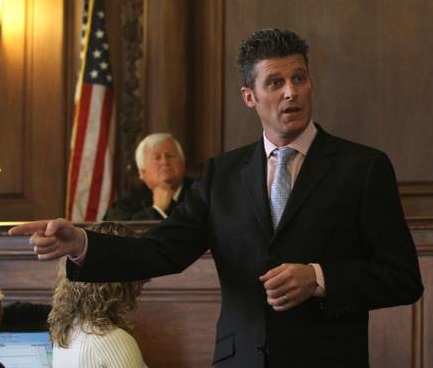
The dramatic bribery trial of Rhode Island defense lawyer Donna Uhlmann and co-defendant Jamaal Dublin took a hard left turn into “Boston Legal” territory and beyond with the, well, creative closing argument of Dublin’s lawyer, Christopher T. Millea. It was so creative, he was nearly held in contempt of court.
“You see, all of this has to do with the throwing of feces,” said Millea, cleverly reminding the jury of the bizarre conduct of a key state witness who once threw his own excrement at a prison guard. “The state wants to throw as much against the wall to see what sticks, just like Michael Drepaul throwing his feces …”
With that introduction, Millea took two bean bags out of a box he had placed in front of the jury, and threw them at the courtroom door. Then he retrieved the turd stand-ins and placed them in another box near the door, and placed that box next to the one in front of the jury, which, it was later discovered, read “Reasonable doubt,” though only the jury could see the words. The first box was labelled, “State’s case.” Continue reading →
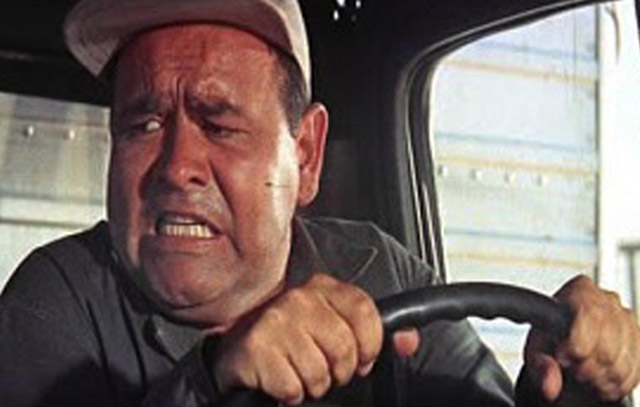
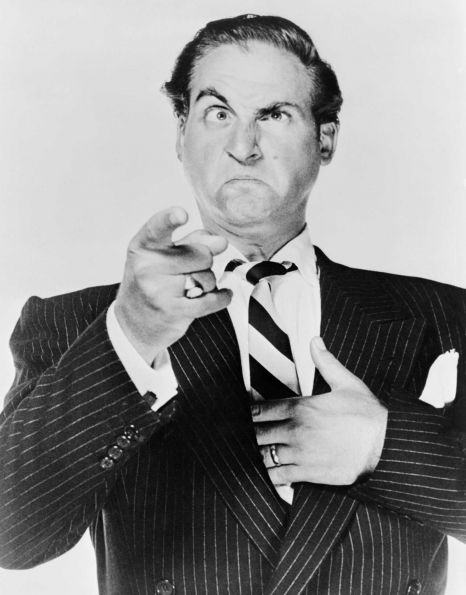
The great Jonathan Winters in the not-so-great “It’s a Mad, Mad, Mad, Mad World”
In past years I have taken the Academy of Motion Picture Arts and Sciences to task for the ethical breach of ingratitude and disrespect, as the honor roll of the year’s deceased film notables have omitted important figures who deserved their final bows. Omissions are inevitable, I suppose, but some of the past examples were unforgivable—last year alone, for example, the Academy snubbed Ann Rutherford, Andy Griffith, R.G. Armstrong, Russell Means, Harry Carey, Jr., and Susan Tyrell. 2012 was worse.
2013, however, shows that the Academy is being more careful, and Oscar deserves credit for cleaning up its act. I have ethical and historical objections to bestowing the prestigious final slot on actor Phillip Seymour Hoffman, dead prematurely of self-inflicted drug abuse, when a genuine, bona fide Hollywood legend, Shirley Temple, was on the list. I understand the thinking: Hoffman had friends and colleagues in the room, and Temple is of another generation; his premature death was a tragedy, and she lived a long and productive life. Still, the priorities and relative values such a choice exemplifies is disturbing. Great actor that he was, Hoffman was a criminal, an addict, and left his children fatherless. Shirley was the greatest child star who ever will be, a ray of sunshine in the dark days of the Depression, a one-of-a kind talent and icon, and later a lifetime public servant who raised a family. She represented the best of Hollywood and the profession; Hoffman represents its dark side. Naturally, he’s the one who received the greatest recognition. I will suppress my dark suspicions that Shirley was docked because she was a Republican. A Facebook friend actually wrote that Shirley deserved to be penalized because some of her movies were racist. My response to this slur was not friendly. Continue reading →
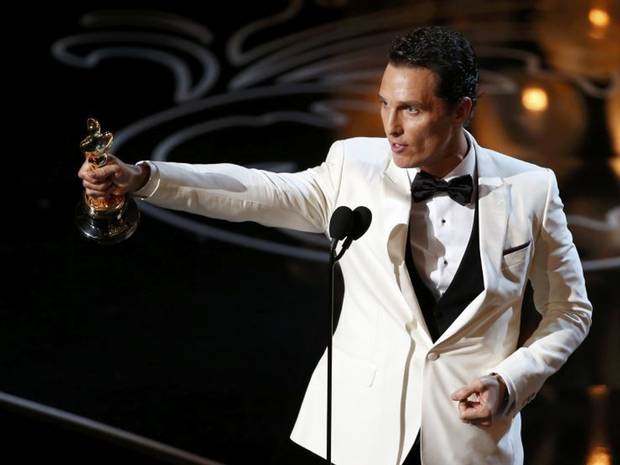
It happens but rarely: an Oscar acceptance speech with something of substance to communicate, other than a list of thank-yous. Yet last night was one of those rare occasions, as actor Matthew McConaughey used his well-deserved award for Best Actor to express his views on how to lead an ethical life:
Here is the text of his speech—much thanks to reader Phil Kraemer, who located it:
Thank you. Thank you, thank you, thank you, thank you to the Academy for this—all 6,000 members. Thank you to the other nominees. All these performances were impeccable in my opinion. I didn’t see a false note anywhere. I want to thank Jean-Marc Vallée, our director. Want to thank Jared Leto, Jennifer Garner, who I worked with daily.
There’s a few things, about three things to my account that I need each day. One of them is something to look up to, another is something to look forward to, and another is someone to chase. Now, first off, I want to thank God. ‘Cause that’s who I look up to. He has graced my life with opportunities that I know are not of my hand or any other human hand. He has shown me that it’s a scientific fact that gratitude reciprocates. In the words of the late Charlie Laughton, who said, “When you’ve got God, you got a friend. And that friend is you.”
To my family, that who and what I look forward to. To my father who, I know he’s up there right now with a big pot of gumbo. He’s got a lemon meringue pie over there. He’s probably in his underwear. And he’s got a cold can of Miller Lite and he’s dancing right now. To you, Dad, you taught me what it means to be a man. To my mother who’s here tonight, who taught me and my two older brothers… demanded that we respect ourselves. And what we in turn learned was that we were then better able to respect others. Thank you for that, Mama. To my wife, Camila, and my kids Levi, Vida and Mr. Stone, the courage and significance you give me every day I go out the door is unparalleled. You are the four people in my life that I want to make the most proud of me. Thank you.
And to my hero. That’s who I chase. Now when I was 15 years old, I had a very important person in my life come to me and say “who’s your hero?” And I said, “I don’t know, I gotta think about that. Give me a couple of weeks.” I come back two weeks later, this person comes up and says “who’s your hero?” I said, “I thought about it. You know who it is? It’s me in 10 years.” So I turned 25. Ten years later, that same person comes to me and says, “So, are you a hero?” And I was like, “not even close. No, no, no.” She said, “Why?” I said, “Because my hero’s me at 35.” So you see every day, every week, every month and every year of my life, my hero’s always 10 years away. I’m never gonna be my hero. I’m not gonna attain that. I know I’m not, and that’s just fine with me because that keeps me with somebody to keep on chasing.
So, to any of us, whatever those things are, whatever it is we look up to, whatever it is we look forward to, and whoever it is we’re chasing, to that I say, “Amen.” To that I say, “Alright, alright, alright.” To that I say “just keep living.” Thank you.
You have to wonder about the various tweeters and pundits who objected to McConaughey’s candor about his inner compass as “bizarre” (Time) or egomaniacal (several). Yes, by nature and necessity actors are unusually self-absorbed; the latter complaint is akin to faulting a dog show winner as inarticulate. What was admirable and inspiring about McConaughey’s speech was his exuberant explanation of how his personal hero is always who he will be in the next ten years.
I doubt that this is an original formula, but I have never heard it before, and it is the essence of ethics: we strive to keep learning, getting better, and aspiring to be the best people we can be, or life is pointless. Ironically, this was also the lesson of “Groundhog Day,” the comedy masterpiece of the late writer-director Harold Ramis, whose name and career were evoked more than one during the Academy Awards broadcast. Having other people as heroes doesn’t accomplish much, unless we aspire to and learn from their values and conduct, and eventually capable of similar heroism ourselves.
As for all those who are criticizing the actor for his religious sentiments: back off. Religion has played a major role in minting some good and remarkable human beings, and McConaughey seems to be one of them. If he chooses to thank God in his moment of exhilaration and triumph, that should be beyond reproach.
The large and respected law firm Mayer Brown has taken the ugly case of some Japanese-American clients who want the city of Glendale, California to remove a memorial to World War II “comfort women” from a public park. In doing so, and in the way it is proceeding, the firm has inspired harsh condemnation from two estimable legal commentators, both First Amendment champions: Marc Randazza, and Ken White. Their objections, which caused Randazza to call the firm “the least honorable law firm in the world,”and White to conclude, “This lawsuit is thoroughly contemptible. It should fail, and everyone involved should face severe social consequences,” are heartfelt, but, I think, misguided. Their argument, beside arguing that the lawsuit is frivolous, is best articulated by Randazza: Continue reading →
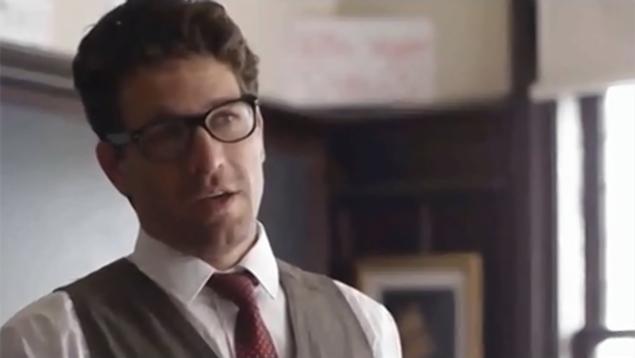
Actor-Teacher Richard Graffanino, who knows how to play a teacher, but not how to act like one.
Yes, there apparently is an Actor-Teacher Showing His Middle School Class Film Clips Of Himself In Bed With A Naked Actress As He Regales The Students With His Romantic Designs On Another Teacher While Wagering On NFL Games Using Food As Bets Principle.
The principle: such teachers get fired, and are damn lucky if that’s the worst thing that happens to them.
I sure hope the A-TSHNSCFCOHIBWANAAHRTSWHRDOATWWONGUFABP doesn’t come into play often, but nothing surprises me any more.
River Dell Middle School teacher Richard Graffanino, teaches impressionable young teenaged minds, and he also acts professionally, with roles on “Law & Order,” “30 Rock,” and some independent films. He was suspended in September of 2013 after complaints from female students, and a sexual harassment claim by a fellow teacher. It looks like he is going to be fired, following an arbitrator’s report last month that found that Graffanino showed a sexually-oriented, inappropriate video, featuring him, in class; discussed his personal relationship with another teacher; and was “inappropriately using food when interacting with students.” Continue reading →
Here is my guess: nearly 100% of all people with two ethics alarms to rub together would be able to answer this question correctly, responsibly, and within about 1o seconds of thought. The question, in essence:
‘I worked as a nanny for a couple I didn’t like, so to make myself feel better, I secretly poisoned them. Now I work elsewhere, and I hear that they are both ill and doctors are stumped. I feel kinda bad about it. What should I do?’
The obvious answer: “For God’s sake, you idiot, tell them what you did, so the doctors can treat them! Why are you wasting time talking to me? They could die, and you would be responsible!”
But this answer isn’t the one given by Emily Yoffe, Slate’s serially incompetent and unethical advice columnist. She responded, in a live online chat that uncovered this vile supplicant, who confessed to routinely dipping her employers’ toothbrushes in the toilet and periodically spiking their bedside water with the same fecal solution, by writing this:
“Part of me would love to tell you to rush to confess. However, I will extend you a courtesy that you didn’t give your “inconsiderate” and “rude” employers. That is, while I think this couple should know the source of their illness, confessing could leave you open to potential prosecution. You may deserve it, but you need to consider the stakes here.”
That part of Emily, apparently, is the sensible, compassionate, ethical part, and it was over-ruled by the unethical, irresponsible, dumb part. The lawyer, if he or she is more ethical than Emily, a good bet, will tell the Potty Poisoner that she should confess immediately in case an E Coli infestation is what is making the couple ill, particularly because they might die, greatly increasing her risk of serious criminal penalties as well as, you know, ending their lives and leaving their children parentless. The lawyer will also explain all the possible scenarios resulting from what Emily seems to dread, honesty and accountability. Even lawyers, who are required to place their clients’ best interests first, are not supposed to advise them to cover up their crimes and allow their victims to perish. Advice columnists are definitely not supposed to do this, and are duty bound to give wise and responsible advice that is in the best interests of all concerned, not just their correspondents, who are likely to be, in general, less than bright, ethically-clueless, and in need of nannies themselves.
“Dear Ethics Alarms: I’m an advice columnist and I told someone who said that she had been poisoning her employers with fecal matter that she didn’t need to ‘fess up, even though they became deathly ill. Now she has written me a follow-up, thanking me for my advice since the couple died, leaving several young children orphaned, and she would have been in big trouble if she had come clean. Now I feel guilty. Should I?”
With a guaranteed contract that would pay him $13.25 million this year, all Boston Red Sox starting pitcher Ryan Dempster had to do was fail to make the team or be relegated to the disabled list to collect it all. Dempster felt, however, that his physical condition would not allow him to contribute to the team’s efforts to defend its 2013 World Championship, and that under the circumstances, decided that it would be better for all concerned if he didn’t play in 2014 and spent the year with his family. Thus, while not retiring, Ryan Dempster announced that he would forfeit the money owed to him.
Dempster made $13.25 million last year, and had made millions for many years before that; he certainly doesn’t “need” the money. Nevertheless, for a professional athlete to handle himself this way is about as rare as an ivory-billed woodpecker sighting. “I could have had a choice of trying to spend the entire season trying to work through those and trying to be able to pitch,” he said in his statement, delivered at the Red Sox Spring Training camp where the team is about to begin training. “But I just felt like it’s something that’s preventing me from doing the job I want to do, and I’m not going to go out there and put my team at a disadvantage or me at a disadvantage by not being able to compete the way I’m able to compete.”
Ryan Dempster, professional athlete, just placed team, family, integrity, and fairness above $13.25 million dollars.
“I remember a satire we did on ‘High Noon.’ The townspeople were supposed to abandon me and return their deputy badges to me by pinning them on my chest. I was supposed to have a sponge inside my shirt. But I didn’t have time to change. So they kept coming, saying, ‘Sorry, Sheriff,’ and pinning on the badges. After it was over, I went backstage, and somebody said, ‘Hey, you did real good pain takes.’ I told him the pain was for real.”
—-Comedy great Sid Caesar,who died yesterday at the age of 91, recounting for the New York Times an example of a how he suffered for his art, which was, always, making us laugh.
Caesar’s anecdote is as perfect a description of professionalism as I have ever seen, or ever will see.
Thank you, Sid Caesar, for devoting your life, body and soul, to laughter.
Shirley Temple Black, perhaps best known to most of us as Little Miss Marker, Curly Top,the Littlest Rebel, Heidi, or, most of all, Shirley Temple, died overnight. I learned of her passing this morning in a Facebook update from child performer advocate Paul Petersen, like Shirley a distinguished and successful former child star who has dedicated his post-performing career to important causes. He wrote:
SHIRLEY TEMPLE passed in the night. She was 85…and no age at all. What a life. What a treasure. A woman of amazing courage and dignity.The world was enriched by her accomplishments. She will always be a part of us. Rest now, Shirley Temple. We love you.
There really isn’t too much more that needs to be said. Few human beings ever began having a positive impact on society so soon in life (she began making adults smile at the age of three, when she made her first film) and continued to do so for so long. From show business, a profession that so often leads to ethical rot, and a rarefied corner of it infamous for leaving its practitioners spoiled, narcissistic, addicted to fame and dysfunctional, Shirley Temple emerged as an adult who was industrious, courageous, intelligent, compassionate, and dedicated to public service. Often dismissed and mocked as a washed-up child star, she proved again and again that her detractors were not just wrong to pre-judge her, but spectacularly wrong. She excelled as a diplomat, serving as U.S. ambassador to Ghana and Czechoslovakia, using her Hollywood fame to open doors and hearts, and also as the U.S. delegate to the United Nations. Temple never played the celebrity: my favorite Shirley moment was when she returned, in her seventies, to join a large group of former Oscar winners (hers was a special award, at the age of six) on the stage of the Academy Awards. As they announced the names of the famous performers and the camera panned the group, it was Shirley who received the most loving response from the Hollywood crowd, which stood and cheered. Shirley looked genuinely surprised, beamed, showed those famous dimples, and handled it, as she always handled everything, with charm and poise.
A proto-feminist, Shirley Temple was one of the first celebrities to go public with a diagnosis of breast cancer, and raised national awareness by promoting a frank discussion of mastectomies. In her autobiography, she also had the courage to point out the predominance of sexual predators in the the Hollywood power structure and culture, recalling that MGM musical unit head Arthur Freed*, whose career is celebrated in “Singing in the Rain,” exposed himself to her in his office when she was barely 13. (She laughed at him; he threw her out of his office.)
Historians credit Shirley Temple with saving the movie studio RKO and raising America’s spirits during the Great Depression; she also was a Cold Warrior, a mother, the inspiration for a best-selling line of dolls as well as the alcohol-free cocktail that still bears her name, and one of a kind. It is fair to say we will never see her like again.
Late in life, she told an interviewer, “If I had it all to do over, I wouldn’t change a thing.” How many of us can say that sincerely?
Paul was right. What a life!
Take a curtain call, kid…
* The original version of the post incorrectly referred to Arthur Freed as Alan Freed, who was an influential disc jockey in the early days of rock and roll. I apologize to both of them.
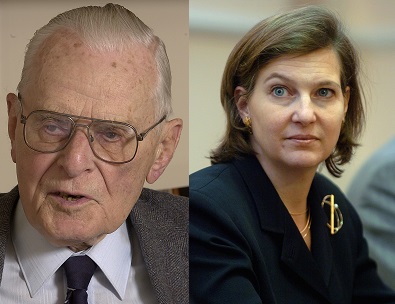
In today’s news, Victoria Nuland, Assistant Secretary of State for European and Eurasian Affairs and the top American diplomat in Europe, is heard in a viral Youtube video saying “Fuck the EU,” meaning the European Union, meaning the United States’ allies in Europe, meaning the constituency it is her job to get along with,and not insult like a middle schooler.
A U.S. government competent in international diplomacy, serious about international affairs, and familiar with the concepts of damage control and accountability would sack the unfortunate Ms. Nuland immediately. Waiting until she becomes completely useless and the gaffe escalates into a serious international rift with substantive consequences would be incompetent, lazy and stupid. But this, remember, is the Barack Obama Amateur Diplomacy Era. Nuland has apologized for saying “Fuck the EU,” and that, for now, is the best the European Union will get, because the President Obama and his subordinates (fish-rots-head-down) doesn’t acknowledge the ethical principle of accountability, nor professionalism and competence, as far as I can see.
In its actions, if not its words, the administration has been saying “fuck the rest of the world” with some regularity. Obama’s nominee for Ambassador of Argentina revealed in last week’s confirmation hearings that he has never been there, nor does he speak Spanish. Unlike the many other countries’ languages that our ambassadors assigned to them can’t understand, it really isn’t hard to find qualified diplomats who speak Spanish. Noah Bryson Mamet, however, wasn’t nominated to head the embassy in a major South American nation because he has a clue of how to do that job. He bundled $500,000 for Barack Obama’s presidential campaign, you see, and no fewer than 23 such “bundlers” have received ambassador posts as their pay-off. Continue reading →




 Ethics Alarms