Signature Significance Lesson: Pazuzu, The Judge And The Racist Email

"Your Honor, uh, you're not quite yourself today.."

“Your Honor, uh, you’re not quite yourself today..”

How many racist e-mails does one have to send out before it proves one is a racist? At Above the Law, legal affairs blogger Ellie Mystal says the answer is one, and I agree. Mystal writes:

“If you send one horribly racist email that actually manages to leak out into public discourse, it’s probably not your only one. Seeing a racist email from someone is like seeing a mouse in your apartment: there’s never just one. I believe in temporary insanity, but I don’t believe in sudden onset racism that magically appears once and only once and then disappears forever. Of course, whenever anybody gets caught in a racist email scandal, they always say that it’s the only one. It’s always “Whoops, that email was racist, but I’m not racist.” The racist email is always allegedly “out of character,” and the person always claims to have shown “poor judgment.” And that person always has some apologists, as if sending one or two racist emails is just something that “happens” in the normal course of business to non-racist people.”

The “out of character” nonsense is what Ethics Alarms refers to as the “Pazuzu Excuse,” as when someone explains that his or her full-throated expression of a vile nature “just wasn’t me” and “doesn’t express how I feel,” as if their being was suddenly possessed by the evil demon that made Linda Blair spit pea soup in “The Exorcist.” People try that excuse—and absurdly often are allowed to get away with it—because, at their core, they realize that signature significance is persuasive when judging character. Non-racists simply don’t send out racist e-mails ever, even once, and one such episode, all by itself, is convincing evidence that the sender is, in fact, a racist.

The racist under discussion by Mystal was retired federal judge Richard F. Cebull, appointed chief judge for the District of Montana by President George W. Bush in 2001. In 2012, Cebull got in trouble when he sent the following e-mail to seven acquaintances: Continue reading


Reluctant Self-Promotion Dept.: An Honor From Trust Across America

Trust

I am directed by management to announce to you all that your Ethics Alarms host was recently honored by Trust Across America, whose co-founder and Executive Director Barbara Kimmel often weighs in here. The inspiring non-profit organization, which pursues the crucial mission of enhancing trustworthy behavior in organizations, annually names its Top 100 Thought Leaders In Trustworthy Business, and I made the 2014 list, which is a distinguished one. For example, it also includes Charles H. Green, whose commentaries on posts here often enhance the site.

The list is described on the TAA site this way:

“While there are many “top” lists and awards, none specifically address trustworthy business – perhaps because the word “trust” presents a definitional challenge. For five years Trust Across America has been working with a growing team of experts to study, define and quantify organizational trust. During the course of our research, we have met with and spoken to hundreds of experts, across a variety of professional disciplines who, when their efforts are combined, help create trustworthy organizations. As our understanding of trust deepens, so does our pool of exceptional candidates. Many of the honorees are well-known CEOs and leadership experts, while others are quietly working behind the scenes as teachers and researchers. We intend to shine the spotlight on both groups, to redirect the focus from the “scandal of the day” to the trustworthy leaders and organizations of the day.”

I could not be more grateful, honored or humble (hey, I can be humble!), and I want to thank Barbara and her organization for this recognition and encouragement. Trust, as I write here often, really is the essential goal of ethics, for without trust, productive human society is impossible. We have a very long way to go to repair the fraying societal and institutional trust now plaguing America, but groups like Trust Across America give me hope that the task is not impossible, just daunting. I do believe that together, by setting and maintaining high standards and not allowing ourselves to be distracted by biases and rationalizations, a more trusting, ethical world is within reach.

Ethics Dunce: Law Professor Josh Blackman, Too Desperate To Take A Cheap Shot At Justice Scalia

Supreme Court Justice Scalia, though not quite to the absurd degree of Sarah Palin, is a conservative who inspires such visceral dislike from the residents of the American Left that he often inspires them to behave irrationally in their eagerness to express their contempt. Such was the case this week, when Scalia sharply rebuked a lawyer making his oral argument before the high tribunal in the case of Marvin Brandt Revocable Trust v. United States, a property rights dispute over the conversion of abandoned railroad rights of way into public trails. The advocate, Steven Lechner, was before Scalia and his colleagues for the first time, and began his argument by reading from his notes. This is not cool, and violates Supreme Court tradition, rules, and long-observed standards.

Tony Mauro, blogging at the Legal Times, explains: Continue reading

The Unforgivable Conflict of Interest: Sports Agents, Robbing Their Ignorant Clients

The ethical course is to choose.

The ethical course is to choose.

Sports agents are rich, powerful, and ethically handicapped by inherent conflicts of interest. The first two qualities so far have insulated them from dealing fairly and openly with the second. This is wrong, and has got to stop. For it to stop, it would help if the players, their unions, the sports leagues and the sports media didn’t either intentionally pretend not to see the obvious, or weren’t too biased and ignorant to realize what’s going on.

Four years ago, I wrote about this problem in a long piece for Hardball Times, a baseball wonk blog of consistent high quality.  The specific agent I was writing about was Scott Boras, the king of baseball player agents, but the egregious conflict I flagged isn’t confined to that professional sport; it’s present in all of them. In the article, I argued that Boras, a lawyer, is engaged in the practice of law when serving as an agent and was therefore violating the legal ethics rules, which prohibits having clients whose interests are directly adverse to each other, specifically in the so-called “Zero-Sum Conflict” situation.

A lawyer can’t assist two clients bidding for the same contract, because the better job he does for one, the worse his other client fares. A lawyer can’t sue a defendant for every penny that defendant has on behalf of one client when he or she has another client or two that have grievances against that same defendant—if the lawyer is successful with the first client, he’s just ruined his other clients’ chances of recovery. There is some controversy over whether the legal ethics rules automatically apply to a lawyer-agent like Boras, but never mind—whether he is subject to the legal ethics rules or not when serving as an agent, the conflict of interest he is blithely ignoring still applies, still harms his clients, still puts money in his pockets, and still should not be permitted. Continue reading

The Fifth Annual Ethics Alarms Awards: The Worst of Ethics 2013 (Part Three)

Jill-Greenberg

Unethical Artist Of The Year

Photographer Jill Greenberg, whose art requires parents to make their children cry. Runner-up: Peeping Tom photographer/artist Arne Svenson

Kaitlyn Hunt

False Allegation Of Anti-Gay Bigotry Of The Year

Kaitlyn Hunt’s parents, who spun a false tale of anti-gay prejudice to portray their sexual predator daughter as a victim after she was accused of statutory rape by the parents of her under-age target. Hunt’s parents even managed to suck the ACLU into their web and the liberal-leaning press portrayed her as a martyr to anti-gay bias. But Hunt’s lies ultimately caused her cover-story to unravel.

 Unethical Hoax Of The Year

Oberlin students Dylan Bleier and Matt Alden, aided and abetted by  Oberlin College and its president, Marvin Krislov. The two students, self-proclaimed progressives, posted a series of racist and anti-Semitic posters, graffiti and anonymous emails as “an experiment.” Krislov and Oberlin, after cancelling classes and engaging in campus-wide navel-gazing, continued to allow the media and the public believe that this was the work of racists on campus well after it had learned who the real miscreants wereRunner-up: The horrible Meg Lanker-Simons, former University of Wyoming student (now admitted to law school—I don’t want to talk about it) who threatened herself with rape and used the bogus threat to show that her campus was violent and sexist.

Most Unethical Use of Social Media Continue reading

I Don’t Care For This Ethics Lesson, Professor…


You keep using that word. I don't think it means what you think it does....

You keep using that word. I don’t think it means what you think it does….

Police reports say that Robby Burleigh, 42, and his pregnant fiancée—she’s 20— got in an argument last week over a text message he didn’t like and the fact that he doesn’t want her to have their baby. According to the fiancée, Burleigh grabbed her, threw her to the floor, pinned her down and broke her phone so, she claims, she couldn’t call for help. Then, she says, he  dragged her across the floor to a safe where he keeps his gun, and said, chillingly, “You’re going to commit suicide today.”

Oh! I forgot the best part!

Burleigh teaches philosophy of religion, biomedical ethics, introduction to ethics and introduction to logic at Baton Rouge Community College, and his fiancée is a student of his. Clever ethics lesson, Professor! Continue reading

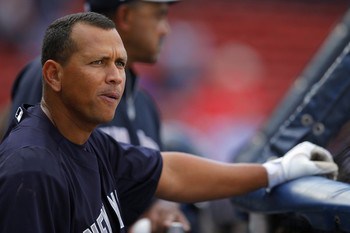
The Alex Rodriguez Suspension, Barry Bonds, And The Slippery Slope

New York Yankees' Alex Rodriguez stretches before American League baseball game at Fenway Park in Boston

In a decision that further defines major league baseball’s cultural standards regarding performance enhancing drugs and the players who use them, New York Yankee Alex Rodriguez was suspended for the entire 2014 season and post-season by an arbitrator yesterday. Rodriguez, a long-time superstar who was once considered a lock to break baseball’s career home run record, and who is the highest paid player in the game, was suspended for illicit drug use without testing positive under the game’s union-negotiated testing system. He was, instead, suspended for a violation of the player’s Basic Agreement under baseball management’s right to police the game and do what is in its best interests.

The evidence that Rodriguez was a flagrant and long-time steroid abuser came from documents obtained from Biogenesis, a lab that developed drugs for athletes and others, as well as convincing testimony. Rodriguez had challenged the suspension in a grievance procedure after MLB handed down a 211 game suspension during the 2013 season. The arbitrator’s ruling, which is confidential, apparently concluded that the player not only cheated, but obstructed efforts to enforce baseball’s intensified anti-drug measures in the wake of the wide-spread use of PEDs in the 90’s and thereafter.

As expected, the result produced the usual complaints and rationalizations from the disturbingly large contingent of baseball fans and writers who remain obdurate regarding the offensiveness of steroid cheating, claiming that it was “a part of the game,” that the objections to it are inconsistent, and that baseball’s vilification of users is hypocritical. They had been practicing these and related arguments for months as they waited for the baseball Hall of Fame voting results announced last week, in which about 65% of the voters showed that they regarded steroid use as a disqualification for the honor, even when a player-user had excelled on the field. Rodriquez’s defeat deeply undermines the cause of the steroid defenders, and the likelihood that their argument will ever prevail. Continue reading

Just So We’re Clear: Some School Sexual Predators Are More Unethical Than Others

lunchladyJanelle Foley, 32,  who works in the cafeteria of Chapman Middle School in Weymouth, Mass., was charged with four counts of statutory rape for having sexual relations with a 15 year old student at the school during the Thanksgiving and New Year holidays.

This is statutory rape, and wrong, but approximately half as wrong as when the sexual predator’s target  is her (or his)  student rather than someone she glops mashed potatoes for in the lunch line. True, every employee in a school has to be worthy of some level of trust, but a teacher is blatantly misusing her authority and blurring roles to the detriment of education as well as social development when she exploits the position of teacher/role model/ authority figure/mentor for the purposes of sexual gratification. A lunch lady is just picking up horny teens. One is a professional breach and a sleazy crime. The other is a sleazy crime, and nothing more.

On the other hand, the role betrayal involved when a friend’s mother seduces her son’s underage friend is every bit as reprehensible as the acts of a predator teacher. I tend to think the Sexual Predator Lunch Lady is not a serious threat in our schools.

And where does “The Summer of ’42” land along this spectrum?

I ‘m not certain, but closer to the lunch lady than to the teacher, I think.

_______________________________

Pointer: Fark

Facts: Boston.com

“Jack Reacher” Ethics, Or Why It’s No Fun Going To Movies With Me

Jack ReacherI thought the Tom Cruise action film “Jack Reacher” would be a good way to escape from an aggravating day at the ethics grindstone, but no. It was rapidly apparent that this would be one of these movies with a sociopathic vigilante hero—Reacher (Cruise) is kind of a cross between Steven Segal and Billy Jack, summarily executing bad guys and completely uninterested in nuances like trials. The character, from the pen of British writer Jim Grant, is supposed to be 6’5″ tall and weigh about 250, so having the diminutive Cruise play him is a bit like having Danny DeVito play Fezzik in “The Princess Bride.”

The main annoyance was the typical persistent misrepresentation of legal ethics, especially the attorney-client privilege. Reacher is dark, free-lance, drifting Mr. Fix-it, and he is engaged by lawyer Helen Rodin as an investigator to prove her client, an ex-military sniper who is being prosecuted by her father, the DA, for apparently gunning down five random innocent victims in a shooting spree, is something more than a mad dog killer. In their initial conversation about the case, Cruise asks if what he is telling her is privileged. She assures him that it is, but the sequence is misleading, for Reacher and for the audience. Continue reading

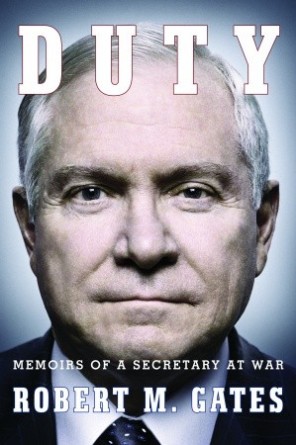
Betrayal: Robert Gates Gets Even

dutygates

When General George Marshall, World War Two military leader, former Secretary of State, and architect of the Marshall plan, was offered a million dollars to write his memoirs in the 1950s, he demurred, saying that there was no way he could write a truthful memoir without undermining people still at work in the government and military.

And then there was David Stockman…Paul O’Neill

…and Robert Gates.

Bottom line: these people betray their colleagues for money, and often, as is Robert Gates’s case, out of spite. Former Defense Secretary Gates, like the others, was given an opportunity to serve his country in a high executive branch position. He was privy to policy discussions and the inner workings of the administration. He was trusted. To reveal details of his tenure while the administration he worked for is still in office, done in a way designed to provoke criticism and embarrass his former associates and boss, is the height of disloyalty, and a breach of implicit confidentiality.

The honorable and ethical way to write such a book would be to wait until it could not actively interfere with the work of the Executive Branch. The people may have a right to know, but they do not have a right to know everything immediately. People in high policy-making positions must be able to be themselves, express opinions, and have productive meetings with the confidence that those they work with are not collecting notes for a future Book-of-the-Month sellout. Books like Gates’s undermine that trust, make it more difficult to get candid and controversial opinions and ideas into the decision-making process, and ultimately hurt all of us. The former  Secretary and those who appreciate the additional ammunition for administration-bashing can assemble a lot of rationalizations for the  book, but they all boil down to “Everybody Does It,” the most threadbare and cowardly rationalization of all.

The ethical thing would have been for Gates to write the book in a few years, or not to write it at all. The ethical conduct for the reading public is to discourage betrayals, no matter who is the one betrayed, by sending such books to the remainders bin.

I suppose I should mention that except for the substitution of Robert Gates’ name for that of Paul O’Neill, and replacing “Treasury” with “Defense,” every word above was written in 2004, when I condemned the sell-out of fired Bush Treasury Secretary O’Neill, who had just provided the information used in a Bush-bashing tell-all called “The Price of Loyalty: The Education of Paul O’Neill.” (Yes, the old Ethics Scoreboard is coming in handy today.) Every word applies with equal force to the new memoir by Gates, who was President Obama’s Secretary of Defense and whose current tell-all attack has set Washington buzzing, except that Gates’s conduct is ethically far worse. Continue reading