The Persecution of Paul Ogden, The Justin Carter Of Legal Ethics

When you become a lawyer, Justin, don't do it in Indiana. Ask Paul Ogden why.

When you become a lawyer, Justin, don’t do it in Indiana. Ask Paul Ogden why.

He hasn’t been jailed like his teenaged, online-gaming counterpart, but Indiana attorney Paul Ogden is also facing government sanctions for what was an unequivocal First Amendment communication. In Ogden’s case, he may lose his right to practice law. His offense is insulting a judge…in a private e-mail.

Ogden represented a client before Superior Court Judge David H. Coleman, and was not happy with Coleman’s handling of the case. Neither were Coleman’s supervisors, who removed Coleman from the case for failing to act within an appropriate period of time, under the so-called “lazy judge” act.  Attorney Ogden, who also blogs about politics, commented to a fellow attorney in a private email that Coleman “should be turned in to the disciplinary commission for how he handled this case. If this case would have been in Marion County with a real probate court with a real judge, the stuff that went on with this case never would have happened.” 

Somebody, perhaps the original recipient of the e-mail, forwarded it to the judge (lawyers can be a back-stabbing bunch), and the judge, insulted, demanded an apology. Ogden refused (lawyers can also be stubborn and have a tendency to stand on principle even when it is going to get them in trouble). Because Ogden declined to grovel, Judge Coleman invoked Indiana Rule of Professional Conduct 8.2 and filed a grievance against him to the Indiana Attorney Disciplinary Commission. The Rule, which is essentially identical to the American Bar Association version, prohibits a lawyer from… Continue reading →

“Lookism” And The Plight of the Borgata Babes

"Uh...Desiree? We need to talk..."

“Uh…Desiree? We need to talk…”

Atlantic City’s Borgata Hotel Casino & Spa calls its waitresses the “Borgata Babes,” and makes its hiring decisions accordingly. The cocktail waitresses’ job description requires part fashion model, part beverage server, part hostess, and entirely eye candy for the male of the species.  When the casino  hires a new BB, it weighs her. If her poundage increases by more than 7 percent, the casino reserves the right to suspend her until she’s back in flirting trim.

Anyone could see this lawsuit coming a mile away, and sure enough, twenty-two newly-portly babes lost a lawsuit against the casino in which they claimed sexual discrimination. (There are no male equivalents to the Borgata Babes, just the usual ugly, flabby male waiters and bartenders.) New Jersey judge Nelson Johnson ruled last week that the Babes are paid sex objects, and that the Borgata’s requirements were legal because the women were aware of them and accepted them as a condition of their employment. Johnson wrote, “Plaintiffs cannot shed the label ‘babe’; they embraced it when they went to work for the Borgata.”

Slate, in writing about the case, sees the ruling as an endorsement of weight discrimination that could spread like the flu, putting corpulent women and men on the breadlines. ” Says Slate:

[T]he ruling also raises questions about the role of babes in workplaces across the country. It’s conventional wisdom that male gamblers will keep pulling away at the slots as long as they’re lubricated by strong drinks served up by babely women. But wouldn’t some female patrons prefer to be served be hunky pieces of man candy? And couldn’t most workplaces argue that its jobs are better performed by babes, regardless of the venue? Is it OK to require that strippers be babes? Casino waitresses? How about investment bankers?”

Now there’s a slippery slope argument if I ever saw one. While it is true that physical attractiveness can be an employment asset in virtually any job—note #2 on fired TV reporter Shea Allen’s “confessions”— there are some jobs for which it is the primary, or at least a substantial and thus legitimate requirement. Strippers, of course. Fashion models. Cheerleaders. Actresses. Personal trainers. Fox newsreaders. Hooters girls, and pretty obviously, Borgata Babes. To say that a business can’t make a decision to have fantasy sex objects as part of its appeal is an excessive use of political correctness grafted to state power. Essentially, the suing Babes are arguing that they can pull a bait and switch—use their well-toned beauty to get hired, agree to maintain the high standard of visual perfection that they presented to their employer, then go to pot and sue if their employer objects. Beauty is an asset in the workplace and a tangible one: the pressure on the culture to behave as if that asset doesn’t exist (the pejorative labeling of a preference for the lovely over the hideous as “lookism” is the weapon of choice) and to prohibit employers from ever hiring on that basis in jobs where it is a substantial and relevant qualification is as unfair to the fit and comely as requiring an investment banker to look like Kate Upton.

Since the law will require, and should require, clear standards, there will need to be a legislative determination of what kind of jobs for men or women can justify termination when their occupants become unsightly. The law should also, however, permit a job applicant’s appearance to provide a legitimate and legal edge when all other qualifications are equal even when the job itself does not have any beauty or fitness requirements. I do not deny that this is an ethical and emotional minefield, implicating age and race bias, and that there are some contentious battles to be fought. I do deny that the Borgata Hotel Casino & Spa is the place to fight one.

One place where the appearance discrimination battle does need to be fought is Iowa, where the case I wrote about earlier, in which a hen-pecked dentist sought to fire his attractive and competent assistant because he found her “irresistible” and his wife was jealous, had the same ridiculous resolution last week. Yet another Iowa court ruled that her impeccable appearance was a legal justification to can her. That’s as outrageous as firing a dental assistant because she’s put on a few pounds, but being a “babe”—or not—should be irrelevant to one’s skill in flossing teeth.

It does give some hope to the ex-casino waitresses. I hear they are hiring unsexy dental assistants in Iowa.

_____________________________________

Facts: Time

Sources: Slate, UPI

Graphic: YouTube (Yikes!)

Lauren Green vs Reza Aslan Aftermath: Attack Of The Spinners

spinningThe interview Lauren Green of Fox news inflicted on her guest, Reza Aslan, was bad journalism, bad television, and just plain wrong–unfair, unreasonable, and biased. In a sane U.S., nobody would defend such a dull-edged hatchet job, which appeared to be crafted, by Green or her Dark Lords at Fox, to make the network’s conservative Christian viewers happy by accusing a scholar of religious bias for simply challenging the historical accuracy of the New Testament. But this is an insane, crazily partisan U.S., where every perceived defeat in the culture wars is cause for garment rending, so such niceties as being honest when one of your allies misbehaves is considered tantamount to surrender.

Thus along comes conservative religious scholar Matthew J. Franck, who on his blog First Thoughts hands the Christian Soldiers of the Right just the ammunition they need to rehabilitate Green. (Note: Green revealed herself as a shameless hack, and doesn’t deserve to be rehabilitated.) Naturally, the strategy is to discredit Aslan, and this he tries to do with gusto in not one, but two blog posts. His accusation: Aslan misrepresented his scholarly credentials, when he was trying repeatedly to challenge Green’s idiotic contention that a Muslim isn’t qualified to write about Jesus. This means, concludes Franck, that Aslan can’t be trusted, so Green was right all along. His book should be ignored.

Ironically enough, this calls to mind another one of Bickmore’s Laws (His First Law of Being Biased was featured in the original post about Green’s interview) , Bickmore’s Second Law of Being Biased:

Nitpicking others’ arguments is not the same thing as “critical thinking.”  That involves nitpicking your own arguments.

This applies nicely to Franck’s attack on Aslan.

Aslan said, off the cuff and while being badgered by Green, Continue reading →

Ethics Quiz: Critic Ethics

How I love critics...

How I love critics…

This is a delicate one for me; the names have been omitted and details disguised to protect…well, for a lot of reasons.

Last week I posted about the mixed-gender version of “I Do! I Do!” I directed for The American Century Theater, which I co-founded and where I am the artistic director. The show met all my objectives and expectations, even surpassed them, and until today, all of the reviews have been raves.

Today, though, a non-rave came out on a local theater website. It is the kind of review I detest, where the standard of the critic is “why didn’t you do it this way? That’s what I would have done.” The answer to that is, bluntly, “Direct your own damn show, then.” Snap judgments from one-time viewers, even extremely sophisticated ones, about what they would do if they were the author, actor, director, or designer of a stage production—when if truth they never have been or could be—are inherently unfair, incompetent and also obnoxious. After considering and experimenting and testing various artistic approaches to any problem over months of preparation, meetings and  intense rehearsal with a large production and artistic team, any production deserves the respect of being assumed to have considered and rejected for cause other solutions, which for various reasons didn’t work.

This is not, of course, a professional reviewer, though a reader could only know that from the quality of the review. Among other tells, the critic misidentifies which performers sing what, and the whole concept of non-realistic sets seems to be alien to him: yes, dear, we could have afforded a four-poster bed; the director felt the show would be better without one, and in fact, it is. Okay, the reviewer is a boob: that’s fine; most theater reviewers are.  I would not make an issue about one sloppy and badly reasoned amateur review, because if I did, I’d be in a padded room.

However, after the review was published, I learned that our company had a prior experience with this reviewer: he had been on the crew of a show last year, and we had to fire him. In 17 years and over 80 productions, he is the only person to be fired from that particular job.

Your Ethics Alarms Ethics Quiz with a theatrical bent:

Does a critic who has a past relationship with a theater company whose production he or she is reviewing have an ethical obligation to disclose it as part of the published review? Continue reading →

Ethics Quiz: The Braless, Blogging Reporter

Too much information?

Too much information?

Shea Allen, an investigative reporter for WAAY-TV, a Huntsville, Alabama, ABC affiliate,  was fired from her job despite what had been considered sterling work because of a post she made on her personal blog.

Titled “Confessions of a Red Headed Reporter,” it was a light-hearted list of, she thought, minor quirks and trivial transgressions.

The fateful list:

1. I’ve gone bra-less during a live broadcast and no one was the wiser.
2. My best sources are the ones who secretly have a crush on me.
3. I am better live when I have no script and no idea what I’m talking about.
4. I’ve mastered the ability to contort my body into a position that makes me appear much skinner in front of the camera than I actually am.
5. I hate the right side of my face.
6. I’m frightened of old people and I refuse to do stories involving them or the places they reside.
7. Happy, fluffy, rainbow stories about good things make me depressed.
8. I’ve taken naps in the news car.
9. If you ramble and I deem you unnecessary for my story, I’ll stop recording but let you think otherwise.
10. I’ve stolen mail and then put it back. (maybe)

Your Ethics Alarms Ethics Quiz:

Was it fair for the station to fire her? Continue reading →

Ethics Mega-Dunce: The First National Bank in Wellston, Ohio

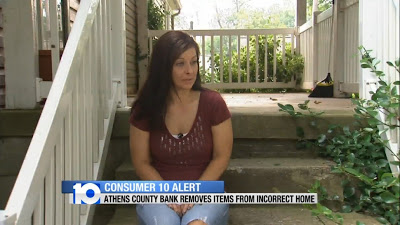
Katie Barnett, the victim.

Katie Barnett, the victim.

As I cull the news to find good topics for ethics discussions, the single thought that goes through my mind most frequently is this: “What is the matter with people?”  This is often followed by “How do people get this way?” and later, “What can we do with them?”

Most ethical decisions are not brain teasers. They are strikingly obvious, unless you are determined to do wrong, an evil super-villain, or were raised in a barn. How people of influence without a serious head injury can make the horrible decisions they do is one of the mysteries of the age, along with the fate of Judge Crater, the elusiveness of Bigfoot, and the continuing popularity of Jimmy Kimmel.

Imagine, for example, that you run a bank. The Three Stooges wannabes who you sent to repossess a home get the address wrong (the lawn hadn’t been mowed, so they “just assume”), and they trash the wrong house. They remove possessions, losing some, auctioning off others, damaging the rest. The innocent owner of the home comes to you and points out that your contractors screwed up outrageously, a fact that is beyond rebuttal. She presents you with a good faith estimate of the property that was lost—never mind the trauma of having her home emptied by strangers and the fact that she has had to live elsewhere for two weeks. What do you do?

If you are the president of the First National Bank in Wellston, here’s what you do, because you have a non-functioning ethics alarm and more than a few screws loose in other places besides: you reject her assessment, and try to low-ball her on the amount.

“What is the matter with people?”

“How do people get this way?” Continue reading →

The Weiner Joke Orgy

Conservatives will grandstand about declining standards of dignity and decorum in the U.S., happily blaming the decline of gentility and civil public expression on rappers, Hollywood liberals and Joe “This is a big fuckin’ deal” Biden, until a Democrat with a name ready-made for bad sex puns and double-entendres shows up, and then its a mad stampede to bad taste.

Wow. Clever.

Wow. Clever.

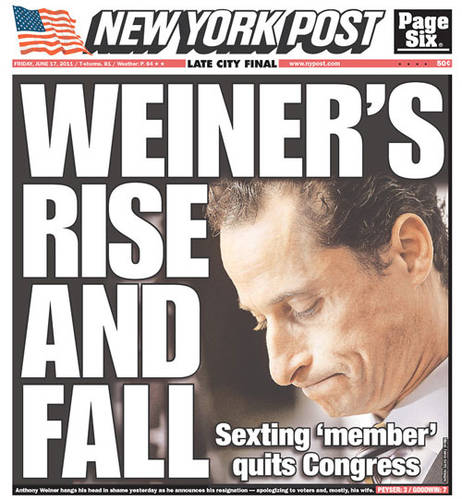
What is it with the Right: is everybody 12? From Rush Limbaugh (“Weiner is hard to swallow…”) to The Daily Caller (“Weiner blows his lead”) to the New York Daily News (“Cuomo Spanks Weiner!”) to dozens of websites that can’t resist versions of “Will Weiner pull out?” and “Weiner Exposed,”  to Drudge (“Weiner Goes Soft”) to CNS (“Boehner Won’t Bite On Weiner”) to, naturally, the reliably crude New York Post ( “Too Hard To Stop!’…”Tip of the Weiner”…”Obama Beats Weiner”…”Weiner: I’ll Stick It Out”…and on, and on–okay, it’s  abrand, I get it ), apparently conservative pundits and headline writers can’t resist seeking naughty snickers from obvious gags.  Continue reading →

Anthony Weiner, Gov. McDonnell, Mayor Filner and the Rest: Degrading Democracy, Tainting Leadership

Hey, Mayor Filner, if San Diegans decide they have a proble being led by a serial sexual harasser, you can run for Mayor of New York!

Hey, Mayor Filner, if San Diegans decide they have a problem being led by a serial sexual harasser, you can run for Mayor of New York!

The mandate for leaders and potential leaders who have engaged in blatantly dishonest, corrupt, undignified or otherwise unethical conduct to remove themselves from office or consideration for office is not that, as hundreds of foolish pundits (like this guy) will try to convince you, hypocrites with a keyboard or a vote falsely pretend that such conduct is unique. There are two justifications for the unethical to resign from office, both undeniable and ancient. I have written enough, for now, about the first—that such conduct demonstrates untrustworthiness, the quality a leader must not have— and want to focus on the second, which is this: if they do not step down and away, such leaders and potential leaders mock the aspirations of democracy, insult its underlying hopes, and degrade, by their persistence, the standards of future leadership.

Once, this was thoroughly understood. Leaders who were exposed as lacking honesty, integrity, responsibility and respect for their own office resigned or withdrew from public life, as self-executed punishment and their last chance at redemption. Democracy, as John Adams wrote, is supposed to be a system that elevates the most accomplished, the most able, the most trusted and the most ethically sound to leadership, for obvious reasons. They are qualified to be leaders because, bluntly, they are better than the rest of us. They are also, because they are better, supposed to be capable of sacrifice and humility, and to recognize that power is a privilege, not a possession to be retained at all costs. Continue reading →

Should Child Actors Be Banned?

Amanda Bynes: A child star's evolution

Amanda Bynes: A child star’s career path

I posed this question years ago to Paul Petersen, a noted child performer himself (on the classic “The Donna Reed Show”) and for decades the courageous advocate for past and present child stars. He has fought for legislation to protect their assets and their welfare, often attracting hatred and attacks from stage parents in the process, but draws a hard line at banning kids in stage, screen and TV. “Gotta have those cute kids, Jack” he replied, essentially admitting that as brutal as pre-adult careers in show business often were, the public would never give up their lovable moppets. I don’t dispute Paul’s clear-eyed acceptance of reality, but I also think his answer ducks the question. As he knows better than anyone (you should check out the website of his non-profit organization here, and consider sending a contribution his way), the carnage on young lives a too-early introduction into one of the most callous and mind-warping of professions brings is well-documented and undeniable. Enablers and apologists, not to mention greedy parents willing to cash in their kids’ chances at a healthy childhood for fees and residuals, point to the prominent child stars (Shirley Temple, Brooke Shields) who did not grow up miserable, dysfunctional, and lost, but that is like arguing that child abuse is tolerable because some victims recover from its wounds.

The evidence of child stardom’s destructive effects is ever-present, so much so that the public has become inured to it, and hardly notices. Incidents and quotes exposing Justin Bieber’s gradual evolution into a narcissistic jerk have been regular features of the tabloid news, as have weekly hints that former Disney star Miley Cyrus is heading off the rails. Her infamous fellow alumna from the Mouse Factory, Lindsay Lohan, continues to cement her credentials as the poster girl for child stars gone bad, and just yesterday, former Nickelodeon comic Amanda Bynes was ordered to undergo psychiatric examination following the latest in a year’s worth of weird conduct.

Over at Cracked, a former child star who managed to escape the Biz with her sanity, values and reputation intact weighed in with an unusually sensitive (for Cracked) essay entitled, “7 Reasons Child Stars Go Crazy.” The author is Mara Wilson, now virtually forgotten despite the fact that she is barely in her thirties and the Broadway musical adapted from her most popular film, “Matilda,” was a 2013 Tony winner.  Wilson identifies the key factors dooming her less fortunate colleagues as… Continue reading →

Well, Let’s Kill All The Lawyers, Then!

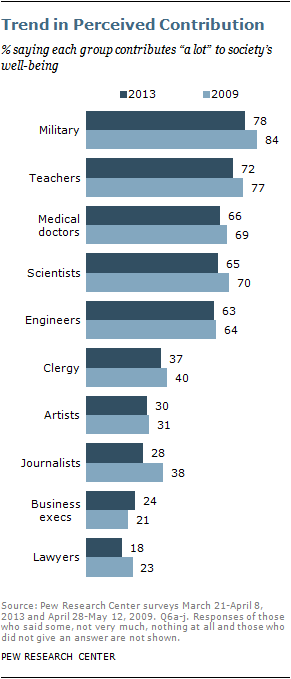
One reason why democracy doesn’t seem to be working very well is that the public is becoming increasingly ignorant about what makes it work at all. Evidence of this trend comes by way of a provocative study by the Pew Research Center, which polled the public regarding which professions it believes contribute the most to society.

The results can be found in this press release, this summary, and this article in The Careerist, but here is a snapshot:

Worth study

Continue reading →