Ethics Observations On The Left’s Unethical Three Freakout Day

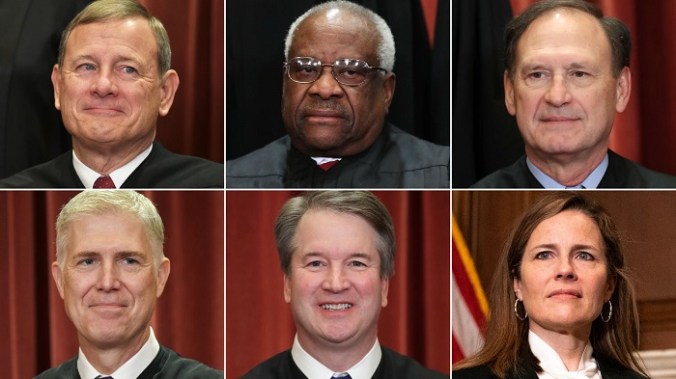
Yesterday’s clean and persuasive Supreme Court decision finally striking down racial discrimination in university admissions after decades of pretending it wasn’t the Consitutional offense it was was followed by two more sound Constitution-based decisions that were as important as they were necessary. All three were quickly attacked as “partisan” and “extreme” when they were neither, except to those who find the boundaries imposed by our nation’s traditional democratic principles overly obstructive to their schemes.

Finally ruling on a lawsuit brought by six state governments, the Supreme Court rejected President Biden’s insane $430 billion student loan forgiveness plan as illegal because it was never authorized by Congress. In a cynical, Harry Reid-ish strategem to buy the 2022 mid-term elections, Biden had announced a $430 billion gift to mostly middle-class and wealthy citizens who were unable or unwilling to do what millions of Americans in their exact situation had done: paying back money they owed for a benefit they had received. In many ways it was progressive irresponsible government at its worst. The Constitution gives Congress, not the the White House,the power to determine how federal funds are spent. As Illya Somin wrote yesterday, “If the administration had won, Biden and future presidents would have been empowered to use vague statutes to usurp Congress’ constitutional control over the federal budget. Moreover, because of the context for this case, it also would have allowed the president to abuse emergency powers for partisan ends.”

The “partisan” accusation was especially dishonest (Vox: “The Supreme Court’s lawless, completely partisan student loans decision, explained”) since that famous right-wing partisan Nancy Pelosi had endorsed the position of the SCOTUS majority just two years ago, saying, “People think that the President of the United States has the power for debt forgiveness. He does not. He can postpone. He can delay. But he does not have that power. That has to be an act of Congress.” Chief Justice Roberts included her statement in his opinion for the majority, but facts don’t matter. The increasingly unhinged progressive mob, aided and abetted by the mainstream media, pronounced the decision the product of an “extreme” conservative majority running amuck.


Continue reading

This Is How The Dean Of Berkeley Law School Teaches Ethics To His Students…

Nice. Violate the law, ignore basic fairness, and honesty, but as long as you don’t tell anyone and can’t be caught, it’s okay.

Chemerinsky is a well-established partisan hack whose legal commentary is almost always polluted by his leftist agenda, but this was low even for him. Do you ever wonder where unethical lawyers come from?

Classes like his.

And professors like him. Yale Law School’s Dean, Georgetown Law Center’s Dean, and others supposedly overseeing the training of tomorrow’s legal professionals have similarly made it clear with their actions and words that ethics are secondary to their political and social agendas. None have done so quite as flagrantly and smugly as Chemerinsky, however.

Unethical Quote Of The Month (And Incompetent Elected Official): Vice-President Kamala Harris, Part 2: Harris Has Directly Violated California’s Legal Ethics Rules

There is another aspect of Kamala Harris’s attack on the Supreme Court majority on Dobbs that bears noting.

In most jurisdictions, a lawyer may not publicly impugn the integrity of a sitting judge, and certainly not a Supreme Court Justice.

Here is the relevant rule in California, one of the jurisdictions with the duty to oversee her conduct. California’s position is that a member of its bar is subject to California rules no matter when the lawyer violates them.

Rule 8.2 Judicial Officials – State Bar of California:

(a) A lawyer shall not make a statement of fact that the lawyer knows* to be false or with reckless disregard as to its truth or falsity concerning the qualifications or integrity of a judge or judicial officer, or of a candidate for election or appointment to judicial office.

Comment “To maintain the fair and independent administration of justice, lawyers should defend judges and courts unjustly criticized. Lawyers also are obligated to maintain the respect due to the courts of justice and judicial officers.”

If there is a California lawyer reading who wants to take a stand for the integrity of the ethics rules, a formal complaint to the would be apt and appropriate.

[The graphic above represents my assessment of the likelihood that the California Bar would ever enforce its rules against a good, abortion-loving Democrat for attacking the U.S. Supreme Court.]

A Barn Door Fallacy Classic From California

California was the only U.S. jurisdiction that had no version of American Bar Association Rule 8.3, which reads in part, “A lawyer who knows that another lawyer has committed a violation of the Rules of Professional Conduct that raises a substantial question as to that lawyer’s honesty, trustworthiness or fitness as a lawyer in other respects, shall inform the appropriate professional authority.”

“Shall” means must, and thus, theoretically, a lawyer who does not report a lawyer for misconduct that amounts to a serious legal ethics violation is himself or herself committing such a violation as well. That’s the theory.

The California legal community has just gone through a spectacular scandal. Tom Girardi, a famous and much-acclaimed plaintiffs trial lawyer, was disbarred after it was discovered that he had defrauded many clients and illegally obtained millions of dollars in the process. The California bar’s investigation report was horrific: his corrupt activities were successful for so long in part because he recruited—and bribed—members of the State Bar leadership and the organization’s employees. Over a hundred lawsuits had been filed against Girardi by clients for misappropriation of funds, but his record with the Bar remained pristine.

Shortly after the ugly story broke, California began to take steps to add some form of 8.3 to its Rules of Professional Conduct governing the ethics of its members, a cynical and useless move designed to appear responsible. It was also an example of what Ethics Alarms calls “The Barn Door Fallacy,” a phenomenon most common today in the area of post-tragedy gun legislation. After a high-profile disaster, the response is to “do something” that supposedly would have prevented the disaster if it had been in place earlier. Usually, as in this case, the reality is that it would not.

Rule 8.3 is something of an illusion anyway. Bar associations are reluctant to second guess a member and punish him or her for their personal assessments of what kind of conduct constitutes “raising a substantial question as to that lawyer’s honesty, trustworthiness or fitness as a lawyer in other respects.” Stealing money from a client is definitely in that category, but proving that another lawyer “knows” about such conduct as opposed to “suspecting” it is not easy. Most bar counsel have no stomach for it, and prosecutions are absurdly rare.

The fact that 8.3 is called the “Snitch Rule” in the profession tells you how most lawyers feel about it. In general, lawyers tend to make ethics complaints to their bars about adversaries. Blowing the whistle on one’s own firm member, a powerful partner, a close colleague or a friend is rarer than—well, pick your metaphor, I’m not feeling clever today.

To see how the news out of California is even less than meets the eye, note how the state’s version of 8.3 is narrower than any other state. It reads,

Continue reading

Now THAT’S An Unethical Lawyer! [Expanded]

Every December, when I do an end-of-year legal ethics seminar for the D.C. Bar, I discuss the Unethical Lawyer of the Year. It’s only June, but it’s hard to see how anyone, not even Alvin Bragg, can match Jason Kurland this year

Kurland, an attorney who represented lottery winners and was once a partner at the prestigious firm Rivkin Radler, one of the 200 largest firms in the nation, was sentenced last week to 13 years in prison. He had been found guilty of wire fraud, wire fraud conspiracy, honest services wire fraud, unlawful monetary transactions and a related conspiracy charge.

Fraudulent representations by Kurland and his co-defendants caused his clients to lose more than $80 million. He also lifted $19.5 million from the account of one lottery winner to make an investment for the benefit of himself and his accessories.

Continue reading

Ethics Dunce: Ty Cobb (No, This Is NOT A Baseball Post)

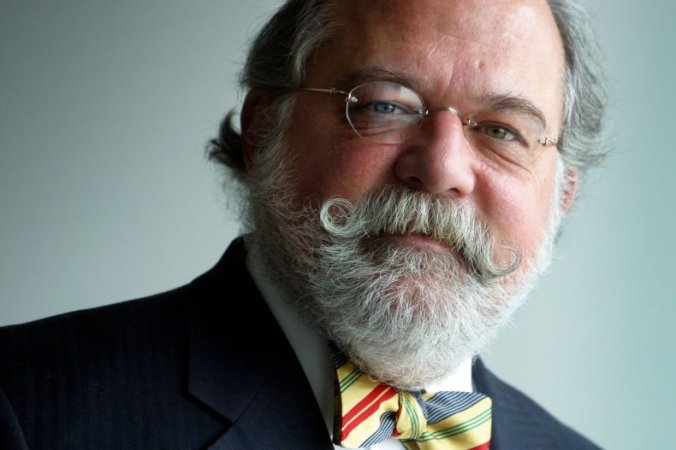
That stylish-looking gentleman above is Ty Cobb III, a descendant of the iconic baseball player, himself a rather infamous ethics dunce. I never quite figured out Ty III’s relationship to Ty the First, but that is neither here nor there. I wish I didn’t have to write this post: I know Ty a bit, for we were in the same class at Harvard (where he already was sporting that handlebar mustache), and I knew many of his friends a lot better than I knew him. He is a nice guy, a funny guy, and by all accounts a terrific lawyer. He may have been the best lawyer ever associated with Donald Trump: Ty joined the White House staff to manage legal matters surrounding the Mueller investigation—yes, the Russian collusion scam run by the Democrats, the FBI, and the news media. He reported directly to Trump, and he was extensively quoted during the media frenzy over that disgusting set-up.

On May 2, 2018, Cobb announced that he was retiring as White House special counsel, and later that year, said that he did not think the Mueller investigation was a “witch hunt,” later saying in an ABC News interview on March 5, 2019, that he thought Mueller was “an American hero.” I almost blew my ethics whistle then; I didn’t: I should have. As a lawyer the public identified with President Trump (though his client was the office, not the man), Ty’s apparent vouching for the investigation was bound to be taken by the public (and certainly the news media) as a hint that someone on the inside with legal expertise knew Trump was guilty. I know I looked at it that way.

Now he’s done it again. Cobb told the news media that the “feds are coming fast” for Trump, and predicted that the investigation into the his alleged mishandling of classified documents will land him in prison. Spewing his opinions like an oil gusher, Cobb said,

Continue reading

Ethics Dunce: The American Bar Association

What do you call an esteemed legal organization that willfully encourages its members to violate its own ethics rules? There are two acceptable answers: 1) An Ethics Dunce, and 2) The American Bar Association.

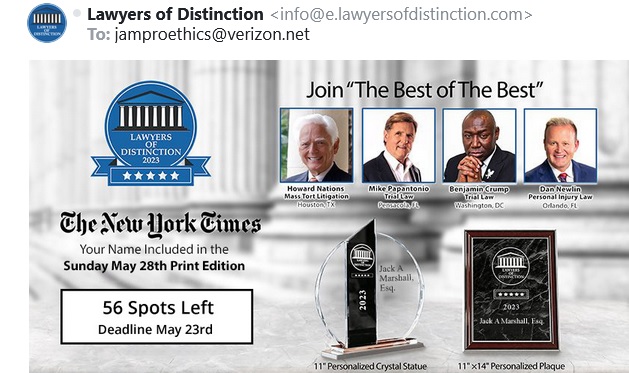
That is a screenshot above of an email that arrived yesterday.

Congratulations on Your 2023 nomination,” it began. “This year marks our 9 year anniversary of “Recognizing Excellence in the Practice of Law™”. Our Selection Committee is hereby extending to you an invitation to join this elite group¹.  Accept your invitation and join by May 23rd, and your name will be included in our roster announcements published in “The National Law Journal” and the Sunday “The New York Times” print edition on May 28th. Please note that only 56 spots remain available. Less than 1% of lawyers in the United States are recognized as Lawyers of Distinction.”

I am many things, but a “lawyer of distinction” I am not. I haven’t practiced law for more than a decade; legal ethics is not the practice of law. Lawyers of Distinction is, to cut to the chase, a scam, and one that is used by lawyers to deceive clients. For the National Law Journal to provide cover for the unethical advertising scheme is bad, but a while back the ABA included an advertisement for “Lawyers of Distinction” in the ABA Journal. The ABA’s Model Rules of Professional Conduct, followed by most jurisdictions, specifically forbids misleading and deceptive advertising, which a lawyer announcing that he or she was “chosen” as a “lawyer of distinction” definitely is. The association attracted a lot of criticism for running the ad, and may not have sunk so low again: I don’t know, because I no longer receive the ABA Journal, but once was enough for me.

Continue reading

Unexpectedly, The Biden Administration Policy Of Using Diversity/Equity/Inclusion And Hyper-Partisanship As Criteria For Law Enforcement Appointments Results In An Unethical US Attorney

Who couldn’t see this coming? The bipartisan effort to politicize the justice system, recently brought into focus by Durham Report, resulted in a spectacularly unethical and corrupt U.S. Attorney, Rachael S. Rollins, the Biden selection for the job in Massachusetts. A 161-page report issued by Justice’s Inspector General, Michael Horowitz, found that Rollins has been a whirlwind of unethical conduct, misusing her office to help a political ally, defying ethics rules to get free tickets to Boston Celtics games, her acceptance of flights and a resort stay paid for by a sports and entertainment company, and lying under oath to investigators, among other misdeed. The New York Times calls the IG’s work “one of the most extraordinary public denunciations of a sitting federal prosecutor in recent memory.” The U.S. Office of Special Counsel released its own findings on Rollins’ sleaziness, concluding that she had violated the Hatch Act, which restricts political activity by federal officials.

Continue reading

Addendum To “An Ethics Conflict Conundrum: The Fraudulent Friend”

Apparently my choice of words confused some readers when I wrote that once “The Ethicist’s” inquirer in this post was made aware of a serious fraud (and an ongoing one) perpetrated by a close friend, she had become an accessory after the fact. That’s a legal term of art and I was careless to use it in nontechnical context. Almost no one is ever charged as an accessory for not blowing the metaphorical whistle, but the woman nonetheless shared responsibility for the harm done by the ongoing fraud by knowing about it, having the ability to stop it, and not doing so, thus letting it continue.

The duty she breached was an ethical one, not a legal one. As I said, I should have been clearer.

I am reminded of a personal experience that might clarify the issue further. I may have even related this story in another post; if so, I can’t find it, and it is worth repeating.

A lawyer friend contacted me for advice. He had been meeting with a client at the client’s home, and overheard, in the kitchen, a loud argument between his client and his wife culminating in what sounded like a hard punch in the face, the woman crying out in pain, and someone falling on the floor. My friend said he had said nothing, but was increasingly bothered by what he heard.

Continue reading

Ethics Implications Of The Bar Exam First-Time Test-Taker Demographic Pass Rates

The ABA Section of Legal Education and Admissions to the Bar released the 2022 ABA data on bar exam pass rates by race, ethnicity and gender. The DEI folks will NOT be happy.

There were 33,721 first-time bar exam hopefuls in 2022. 2,510 candidates were, and presumably still are, black. Their pass rate was 57% in 2022, down from 61% in 2021. Of all of the demographic groups, this was the worst rate. The rest:

  • Native Americans:  60% out of 183 candidates.
  • Hawaiians: 69% out of 45 candidates.
  • Mixed race:  74% out of 1,186 candidates.
  • Asians: 75% out of 2,199 candidates
  • Whites: 83% out of 21,553 candidates.

In the ever amusing gender categories, the breakdown was:

  • 80% for men
  • 79% for the, uh, creative gender identities
  • 77% for women 
  • 63% for those who did not disclose their gender.

The ABA standard for the minimum adequate law school pass rate for first time bar exam-takers is an average of 75% over two years.

Ethical implications:

Continue reading