One of the more depressing developments during the Post 2016 Election Ethics Train Wreck has been how virtually all of our professions have proven unable to remain objective and trustworthy, instead descending into bias and submitting to peer pressure—exactly the kind of behavior professionals are supposed to have the training and integrity to avoid. Journalists have been the worst in this respect of course, with politicians close behind. However, judges, lawyers, educators, academics, psychiatrists, health officials, performers and, yes, ethicists have also disgraced themselves, among others.
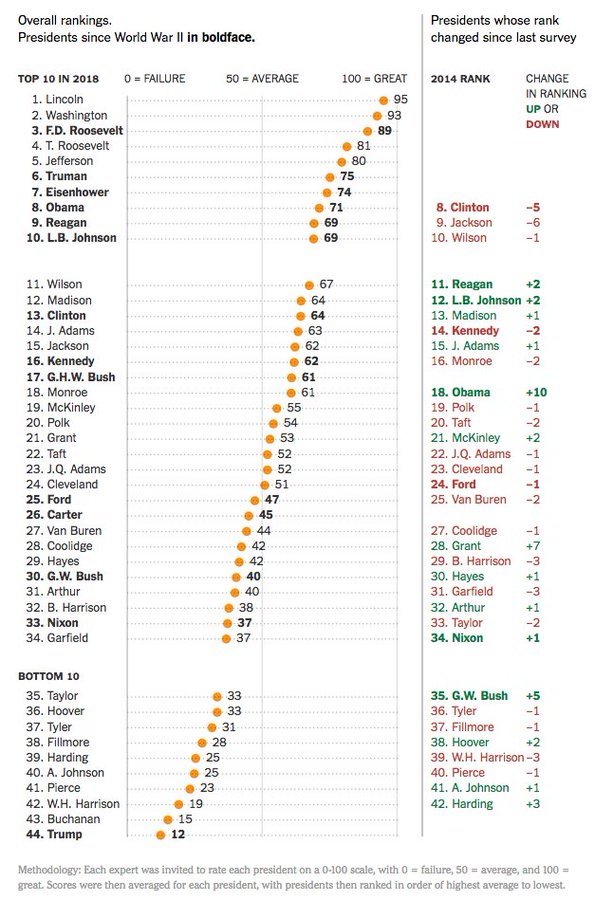
One persistent example of a corrupted profession is historians, and a useful measure of their ethics rot has been Presidential rankings. Here’s one I missed from 2018, when “172 professional historians” were asked to rank the POTUSes from first to last, using a 1-100 scale. A Jimmy Kimmel writer who ran out of current Trump-bashing material circulated this on Twitter, and it is, as they say, “trending.”
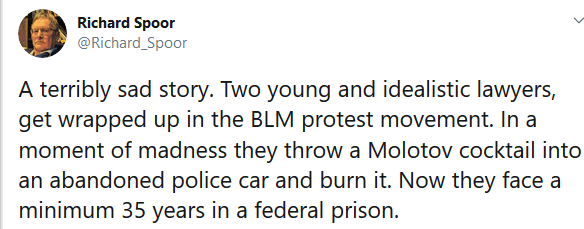
Richard Spoor, he tells us, is a public interest lawyer with a special interest in land reform, mines and communities and compensation for occupational diseases, and a “militant non-racialist,” whatever that means. His tweet is addled in so many ways:
The fate of these two lawyers turned terrorists is no more “sad” than any story of previously law-abiding citizens whose ethics alarms stop working as they knowingly break the law.
The fact that they are “young” makes it no more sad than if they were older, like 50. They’re not kids: both are over 30. They cannot claim immaturity or lack of experience. My son nearly ruined his life with a terrible, spur of the moment decision that could have killed him and others, but he was a teenaged male. He was also lucky. Truly young people like he was wreck their lives with bad decisions every day. That’s sad. Adults doing it is something else.
Participating in a riot and throwing a Molotov cocktail is not the act of an “idealistic” person by definition. Breaking the law, engaging in violence, and trying to destroy property for no good reason does not embody “ideals.” They embody the opposite of ideals. If the two lawyers were really idealistic, this wouldn’t have happened.
They didn’t “get wrapped up” in BLM’s racist movement, they joined it. It isn’t something that just happened to them.
“Moment of madness” is another version of Rationalization #19, The Perfection Diversion, or “Nobody’s Perfect!” and “Everybody makes mistakes!” People don’t suddenly throw Molotov cocktails and go “Ooopsie! What was I thinking?” That’s not “a mistake,” it is the culmination of many intentional acts leading up to a serious crime.
1. Let’s start with some good news! In April of last year, I wrote about Massachusetts judge Shelley M. Richmond Joseph, who was charged with obstruction of justice, along with another court officer, for helping an illegal immigrant (and criminal) elude arrest by the ICE. The story is here. It looks like the judge is going to trial.
U.S. District Judge Leo Sorokin has now denied the judge’s lawyers’ motions to dismiss in a July ruling. “After careful consideration, the motions to dismiss are DENIED because the Indictment alleges the elements of the offenses and sufficient supporting factual detail,” he wrote . Joseph’s attorneys are claiming was that she is protected by judicial immunity, though that should only apply to actions a judge engages in under judicial authority and in the course of her duties. Instructing a court employee to help an illegal immigrant evade being taken into custody by ICE agents after his hearing on criminal charges, including drug possession, is not known as “being a judge.” It is known as “obstructing justice.” Even if the judge avoids punishment, her days as a judge are over.
Good.
2. What’s this? MORE good news? I have been looking for cracks in the monolithic mainstream media, with defections by individuals in the midst of the journalism’s abandonment of its duties to democracy in favor of news manipulation and partisanship. Less than a month ago, New York Timed editor Bari Weiss called out the oppressive culture of partisanship and conformity at the her paper, earning her Ethics Hero status.
Last month MSNBC producer Ariana Pekary quit the network, arguably the most unethical of all the broadcast news outlets, and yesterday she published a blog post explaining why. “I simply couldn’t stay there anymore.” She wrote:
“My colleagues are very smart people with good intentions. The problem is the job itself. It forces skilled journalists to make bad decisions on a daily basis….It’s possible that I’m more sensitive to the editorial process due to my background in public radio, where no decision I ever witnessed was predicated on how a topic or guest would ‘rate,’ The longer I was at MSNBC, the more I saw such choices — it’s practically baked in to the editorial process – and those decisions affect news content every day. Likewise, it’s taboo to discuss how the ratings scheme distorts content, or it’s simply taken for granted, because everyone in the commercial broadcast news industry is doing the exact same thing. But behind closed doors, industry leaders will admit the damage that’s being done…I understand that the journalistic process is largely subjective and any group of individuals may justify a different set of priorities on any given day. Therefore, it’s particularly notable to me, for one, that nearly every rundown at the network basically is the same, hour after hour. And two, they use this subjective nature of the news to justify economically beneficial decisions. I’ve even heard producers deny their role as journalists. A very capable senior producer once said: “Our viewers don’t really consider us the news. They come to us for comfort.”
She claims to want to be part of a solution to this dire situation. We shall see. I reached out to her in an email yesterday, offering my guidance and expertise, gratis of course.
3. On the theory that transparency is good news, it was nice to see Democratic Rep. Karen Bass, supposedly one of the top contenders to be Joe Biden’s running mate, demonstrate how dim-witted she is and unqualified to be President, though at this point even she could probably beat poor Joe Biden in a spelling bee. Over and over, on several Sunday news shows, she repeated her previous explanation for praising Fidel Castro , telling Chuck Todd on “Meet the Press,” for example, regarding calling the brutal dictator’s death a “great loss to the people of Cuba,” that she “wouldn’t do that again. Talked immediately to my colleagues from Florida and realized that that was something that just shouldn’t have been said.”
Astounding. She wouldn’t say that what she said was wrong, outrageous for a member of Congress and demonstrated inexcusable ignorance, but that she should have kept the opinion to herself. Todd, of course, being one of the worst hacks in captivity, didn’t bother to press her on the point for the benefit of members of his audience who can’t recognize signature significance when it’s right in front of them.
Biden, or whoever his ventriloquist is, is officially trapped in ethics zugzwang. The only reason Bass is even being considered is that Biden has to select a black (George Floyd!) woman (#MeToo!) as his VP, and all of his remaining options are horrible by any objective standard. This will be a flaming lesson in the foolishness of placing physical characteristics over ability, experience and character, a perfect example of why affirmative action doesn’t work and will never work. Bass is a light-weight, but Biden’s two other options are Kamala Harris ( whose ugly Ethics Alarms dossier is here), and <ack! choke! yecch! barf! gag!> the even more horrible Susan Rice, Barack Obama’s ethics-free acolyte. Her dossier is here. She would be the most sinister Vice-President candidate since Aaron Burr.
I have to poll this: Who is Joe’s best choice among this unethical trio?
I’m not going to allow “None of the above,” because I don’t think he has that option, or at least doesn’t have the integrity to insist on choosing a qualified candidate who has the wrong tint or chromosomes.
4. Finally, to end on a downer, the Unethical Non-Trump Tweet of the week. Orlando Magic forward Jonathan Isaac was the only NBA player not to kneel during the National Anthem, and also refused to wear a “Black Lives Matter” warm-up like the rest of his teammates. In Sunday’s game, he tore his ACL, a season-ending and career threatening injury. ESPN radio host Dan Le Batard then ran a poll on Twitter asking, “Is it funny the guy who refused to kneel immediately blew out his knee?”
When the poll was pulled, about 45% of respondents said that it was funny, which tells you all you need to know about NBA fans and Black Lives Matter supporters—the genuine kind, not the grovelers. Le Batard issued a phony apology, Level 10 on the Apology Scale.
“We apologize for this poll question,” he wrote. “I said on the front and back end of the on-air conversation that I didn’t think it was funny. Regardless of the context, we missed the mark. We took the tweet down when we realized our mistake in how we posed the question to the audience.”
Lies and more lies. They took the tweet down when it was clear they were getting slammed for it. If he didn’t think a young athlete getting injured was funny because he dared to oppose the BLM mob, why would he think anyone else would? When is someone getting hurt who has done nothing wrong and who did not do something foolish to cause the injury ever funny?
1. Psst! This doesn’t send a message that is complimentary to minorities...The California Supreme Court, which oversees the state bar, agreed to lower the passing score for the exam. The objective is to raise the number of black and Hispanic lawyers. 40 % of California’s population is white, and 60% are not. But 68% of California lawyers are white, according to a new report by the State Bar of California.
Well, so what? Maybe more whites want to be lawyers; whatever the reason, lowering the standards for getting a license seems like a poor way to improve the situation, since it promises to add more dim attorneys. Why do all professions have to have identical demographics to the population at large?
“There is absolutely no evidence that shows having a higher score makes for better lawyers,” said UCLA School of Law Dean Jennifer L. Mnookin. “There is significant evidence that it reduces the diversity of the bar.” Yeah, I’m pretty sure letting people get law licenses by playing beanbag would also lead to a more diverse bar. There is no way to determine whether having higher scores on the bar exam correlates with being a “better lawyer,” but I guarantee not being able to pass the bar exam correlates with being significantly slower on the uptake that a lawyer who can. Mnookin is saying that intelligence and critical thinking skills don’t factor in the practice of law. What an interesting thing for a law dean to say. Do you think she really believes that?
No one has been able to show that the bar exams anywhere have a racial bias, but since other explanations for comparatively low passing rates among African-Americans are not politically palatable, the George Floyd Freakout has led to this. California will now have dumber lawyers of all colors. Progress! Continue reading →
Speaking of gallimaufry, “A Heavy Dragoon” is one of the best Gilbert and Sullivan “list” songs, but you seldom hear it. Erudite is the listener who can identify all the historical figured named! The song is from “Patience,” the firs show I ever directed, and still one of my favorites. The singer in the clip above, Darrell Fancourt, played the part of the Mikado more times than anyone, and even dropped dead while playing the role.
1. In baseball history, it’s Moral Luck Day. On July 17, 1941, New York Yankees center fielder Joe DiMaggio didn’t get a hit against the Cleveland Indians, in great part due to a pait of great plays by Cleveland third baseman Ken Keltner, finally ending his historic 56-game hitting streak, the longest in MLB history then and now. Largely on the basis of the streak, though it helped that the Yankees won the pennant, DiMaggio was awarded the American League MVP award, despite the fact that Boston’s Ted Williams hit .406 that season, nearly 50 points higher than DiMaggio. In fact, Williams outhit the Yankee during the same 56-game period.
The end of The Yankee Clipper’s amazing streak was luck, and the streak itself was luck. All hitting streaks are. Baseball is the sport most governed by random chance, especially hitting: a well-hit ball can become an out if it happens to be hit within a fielder’s reach, and a ball barely touched by the bat can dribble down the baseline for a cheap hit. DiMaggio was undeniably a great hitter, but many players in baseball history were better; he just was lucky—good, but lucky—for a longer stretch of games than anyone else. Yet of all his many achievements, the 56 game streak in 1941 is the first thing baseball fans cite when assessing the greatness of Joltin’ Joe DiMaggio.
2. It isn’t what it is! Yesterday, New York Mayor Bill de Blasio said that releasing prisoners onto the city’s streets to avoid their infection by the Wuhan virus in jail had made New York City safer, saying, “We now have fewer people in our jails than any time since World War II and we are safer for it and better for it.” De Blasio’s office announced that more than 1,500 inmates had been released from city jails in three weeks, reducing the number of prisoners to its lowest level in 70 years.
The problem is that his assertion is ludicrous. De Blasio’s boast that the prisoner release made the city safer defied the evidence of the results of the prisoner release the NYC Bail reform law required in January 2020. Of those who committed felonies that were no longer eligible for bail, 19.5% were re-arrested at least once after an initial non-bail eligible felony arrest, 1,798 of 9,227 individuals were re-arrested. 2020 recidivism resulted in 1,452 major crime arrests (murder, non-negligent manslaughter, rape, robbery, felony assault, burglary, grand larceny, and grand larceny of a vehicle) vs. 681 in 2019. Meanwhile, shootings in the city were up 205% in June compared to a year earlier. Continue reading →
I supposed that should have read “former New York Times editor Bari Weiss.” Until her resignation today, from 2017 to 2020, Weiss was the staff editor for the opinion section of the The New York Times.
Her letter of resignation to the Times publisher is here. It is beyond excellent, beyond brave, beyond important. It is breathtaking.
She writes in part,
I joined the paper with gratitude and optimism three years ago. I was hired with the goal of bringing in voices that would not otherwise appear in your pages: first-time writers, centrists, conservatives and others who would not naturally think of The Times as their home. The reason for this effort was clear: The paper’s failure to anticipate the outcome of the 2016 election meant that it didn’t have a firm grasp of the country it covers…
But the lessons that ought to have followed the election—lessons about the importance of understanding other Americans, the necessity of resisting tribalism, and the centrality of the free exchange of ideas to a democratic society—have not been learned. Instead, a new consensus has emerged in the press, but perhaps especially at this paper: that truth isn’t a process of collective discovery, but an orthodoxy already known to an enlightened few whose job is to inform everyone else…
Stories are chosen and told in a way to satisfy the narrowest of audiences, rather than to allow a curious public to read about the world and then draw their own conclusions. I was always taught that journalists were charged with writing the first rough draft of history. Now, history itself is one more ephemeral thing molded to fit the needs of a predetermined narrative. Continue reading →
[Introduction: Ethics Alarms opined that the President’s proposed “Garden of American Heroes” was badly conceived, and his initial nominations for inclusion proved the point. Mercurial commenter Valkygrrl took the initiative to devise a process for Ethics Alarms readers to compile a better list, and also to organize the results, which I found fascinating. Any further reactions will be confined to the comments.]
The Rules:
1: No presidents, always some controversy, we have other ways of honoring them.
2: Any person who held office must be chosen for something they did outside of said office, no honoring for using the mechanisms of the state no matter how beneficial to society.
3: No Confederates (obvious divisiveness.)
4: You may have only one living person on your list.
5: Your list must be made in good faith. You may not choose anyone you believe will upset or anger me; no “owning the libs”. Honest mistakes accepted.
6: Do not remove someone from your list because they were mentioned by someone else. I want to see if we can find some consensus. That means people Trump or Jack mentioned are allowed.
Here’s the list of nominees as submitted by participants (editorial descriptions mine);
Marian Anderson: Singer, Civil rights activist, Medal of Freedom recipient.
Neil Armstrong: Aviator, Astronaut, First human to set foot on Luna
Isaac Asimov: Teacher, Author of the Foundation series; Seven-time Hugo Award winner (Plus one Retro-Hugo awarded in 2016), Democratic party activist, serial sexual harasser
Irving Berlin: Composer of famous patriotic music
John Brown: Hero, undaunted, true and brave, And Kansas knows his valor when he fought her rights to save; Now, tho the grass grows green above his grave. Popular legend holds that his soul continues to march.
John Moses Browning: Industrialist, Firearms designer.
George Carlin: Humorist, Mentor to time-traveling Gen-Xers.
Andrew Carnegie: Industrialist, Philanthropist, Union buster.
Joshua L. Chamberlain: Union General, Medal of Honor recipient.
Meriwether Lewis and William Clark: Explorers, Naturalists. Two very different people presumably nominated for a single achievement alone. Clark was a bit of a bastard.
Samuel Colt: Firearms manufacturer, used assembly line principals before Henry Ford.
Upon careful consideration, I think this clip is the fairest representation of what black theater activists on Broadway are advocating:
In Part I of this series, we discussed the dead-end strategy recently pursued by the performing woke of imposing one-way limitations on which actors could portray what roles. Across the full range of group grievance activism, everyone is rushing to try to exploit and capitalize upon the George Floyd Freakout, perhaps recognizing that the present state of self-flagellation and submissiveness by white decision-makers, governments, businesses and other institutions won’t last forever. In their haste, many groups—in this I would include the “resistance,” Democrats and the news media among others—are metaphorically cutting their own throats. This is especially true of the theater community.
A coalition of theater artists called “We See You, White American Theater” has posted online a 29-page set of demands that if adopted, the New York Times opines, “would amount to a sweeping restructuring of the theater ecosystem in America.”
Wrong, Bias Breath! If adopted, the demands would kill commercial live theater, and it is more than half dead already, though most theater community members are in denial.
The list reminded me of the bad old days of the 1960s, when student anarchists, protesting the war in Vietnam, would take over university buildings and then, thinking that they had the upper hand, would submit a list of demands including the Moon and the kitchen sink, many of which had nothing to do with the war at all. This list of demands makes those look reasonable, one reason being that simply reading the 29 pages of arrogant woke-speak is a task few will have the patience to undertake.
I’ll just focus on some highlights. (By the way, you need to know that BIPOC means “Black, Indigenous and People of Color”):
“We demand the naming and acknowledgement of American Indian, Alaska Native and Native Hawaiian tribal land and its Native peoples who have lived, currently live, and will live on the land where any theatre activity happens.”
I hate to keep having to break it to these naifs, but theater is just not that important to most people, particularly those in power. “We have to rename Indianapolis to have theater here? OK—we won’t have any theater then! Problem solved!”
The Proceedings of the National Academy of Sciences is a peer-reviewed journal that claims to publish “only the highest quality scientific research.” Now, the authors of a 2019 PNAS article are disowning their research simply because I cited it.
Psychologists Joseph Cesario of Michigan State and David Johnson of the University of Maryland analyzed 917 fatal police shootings of civilians from 2015 to test whether the race of the officer or the civilian predicted fatal police shootings. Neither did. Once “race specific rates of violent crime” are taken into account, the authors found, there are no disparities among those fatally shot by the police. These findings accord with decades of research showing that civilian behavior is the greatest influence on police behavior.
In September 2019, I cited the article’s finding in congressional testimony. I also referred to it in a City Journal article, in which I noted that two Princeton political scientists, Dean Knox and Jonathan Mummolo, had challenged the study design. Messrs. Cesario and Johnson stood by their findings. Even under the study design proposed by Messrs. Knox and Mummolo, they wrote, there is again “no significant evidence of anti-black disparity in the likelihood of being fatally shot by the police.”
My June 3 Journal op-ed quoted the PNAS article’s conclusion verbatim. It set off a firestorm at Michigan State. The university’s Graduate Employees Union pressured the MSU press office to apologize for the “harm it caused” by mentioning my article in a newsletter. The union targeted physicist Steve Hsu, who had approved funding for Mr. Cesario’s research. MSU sacked Mr. Hsu from his administrative position. PNAS editorialized that Messrs. Cesario and Johnson had “poorly framed” their article—the one that got through the journal’s three levels of editorial and peer review.
Mr. Cesario told this page that Mr. Hsu’s dismissal could narrow the “kinds of topics people can talk about, or what kinds of conclusions people can come to.” Now he and Mr. Johnson have themselves jeopardized the possibility of politically neutral scholarship. On Monday they retracted their paper. They say they stand behind its conclusion and statistical approach but complain about its “misuse,” specifically mentioning my op-eds.
The authors don’t say how I misused their work.
In a move redolent of Soviet-style retroactive censorship, Michigan State University deleted its press release promoting the study, which had said in part, Continue reading →
Michael Shellenberger was a Time Magazine“Hero of the Environment,” and he was and is the founder and president of Environmental Progress. Now he has a best-selling book, Apocalypse Never, published at the end of last month. I haven’t read it, and I wouldn’t have the expertise to know whether it was right or wrong. It could be that he is violently rejecting the official climate change hysterics line to fill a profitable contrarian niche, though that would be out of character based on his reputation. It may just be that he is telling the truth, and exposing what was, or should have been, pretty evident for a long time. As he puts it his article,
On behalf of environmentalists everywhere, I would like to formally apologize for the climate scare we created over the last 30 years. Climate change is happening, it’s just not the end of the world. It’s not even our most serious environmental problem. I have been a climate activist for 20 years and an environmentalist for 30, so I may seem like a strange person to be saying this.
But as an energy expert asked by the US Congress to provide objective expert testimony and invited by the Intergovernmental Panel on Climate Change (IPCC) to serve as an Expert Reviewer of its next Assessment Report, I feel an obligation to apologize for how badly we environmentalists have misled the public.
Well, we knew that, didn’t we? The usual people denied it, but was so, so obvious that from Al Gore on, this was science weaponized for political and partisan purposes, by scientists seeking grants and peer approval. One doomsday prediction after another came and went, one model after another failed, and yet the refrain persisted. Climate scientists who were tempted to break ranks were intmidated: as galileo demonstarted, it is not a field often distinguished by courage and sacrifice. Shellenberger writes,
“[U]ntil last year, I mostly avoided speaking out against the climate scare. Partly because I was embarrassed. After all, I am as guilty of alarmism as any other environmentalist. For years, I referred to climate change as an ‘existential’ threat to human civilization and called it a ‘crisis.’ But mostly, I was scared. I remained quiet about the climate disinformation campaign because I was afraid of losing friends and funding. The few times I summoned the courage to defend climate science from those who misrepresent it I suffered harsh consequences. And so I mostly stood by and did next to nothing as my fellow environmentalists terrified the public.”
The cancel culture is after Shellenberger even as I write this, for he’s perceived as a traitor. Forbes, which initially published his mea culpa, pulled it down after being bombarded with social media protests, then gave no substantive explanation for why. Well, they really didn’t have to, I suppose.
Shellenberger lists “some facts few people know,” such as,
Humans are not causing a ‘sixth mass extinction’
The Amazon is not ‘the lungs of the world’
Climate change is not definitively making natural disasters worse
Fires have declined 25% around the world since 2003
The amount of land we use for meat — humankind’s biggest use of land — has declined by an area nearly as large as Alaska
Carbon emissions are declining in most rich nations and have declined in Britain, Germany, and France from the mid-1970s
Netherlands is becoming richer, not poorer while adapting to life below sea level
We produce 25 per cent more food than we need and food surpluses will continue to rise as the world gets hotter
…and more, then later lists some of the conclusions from his book, among them:
Factories and modern farming are key to human liberation and environmental progress
The most important thing for saving the environment is producing more food, particularly meat, on less land
The most important thing for reducing air pollution and carbon emissions is moving from wood to coal to petroleum to natural gas to uranium
100 per cent renewables would require increasing the land used for energy from today’s 0.5 pc to 50 pc
‘Free-range’ beef would require 20 times more land and produce 300 pc more emissions