Cellphone videos of New York City police officers being doused with water while trying to do their jobs became an internet sensation this week, and an unsettling (but inevitable) controversy for New York City. The officers were trying to disperse rowdy groups at fire hydrants during a three-day heat wave, and allowed themselves to be assaulted and humiliated while crowds cheered the attackers on.
The police arrested three men who were caught on video hurling water at police in two incidents. This also caused controversy. “Why is a man facing more severe punishment for dousing a police officer than Officer Daniel Pantaleo is for choking Eric Garner?” asked a Times article. That shouldn’t be a difficult question, but you know—the Times. Eric Garner was a petty criminal resisting arrest. The officers were doing their jobs, and Garner died as the result of an accident, in great part because of his own actions in defying the police. The police were also trying to do their jobs when they were doused with water, in an act that threatens the peace and order of the community.
The Police Department’s highest-ranking uniformed officer, Terence Monahan, the police chief, lit the fuse on a larger controversy, saying,
“Any cop who thinks that’s all right, that they can walk away from something like that, maybe should reconsider whether or not this is the profession for them.We don’t take that.”
But they did take that, and the Mayor of New York wants them to take that, because the whole idea of law enforcement is now, and has often been, anathema to progressive ideology. Continue reading →
The Las Vegas Metropolitan Police Department this week fired Officer Cordell Hendrex for “freezing” (it’s all on video) as a deranged sniper fired hundreds of rounds into a crowd of county music fans below the Mandalay Bay hotel in Las Vegas in 2017. “I’m inside the Mandalay Bay on the 31st floor,” Hendrex said into his radio as he hid behind a wall. “I can hear the automatic fire coming from one floor ahead, one floor above us.”
As Hendrex stayed there in terror (by his own testimony), the gunman continued to fire, eventually killing 58 people and wounding more than 800 in the deadliest mass shooting in modern American history. His lawyers are appealing the decision. His defense? He was scared, that’s all. It’s unreasonable for the public to expect police officers to rise to heroic standards and place their lives in jeopardy in a public safety crisis. The Las Vegas department’s training didn’t prepare Hendrex for storming the hotel room. He’s been a terrific cop, as long as he didn’t have to put his life on the line.
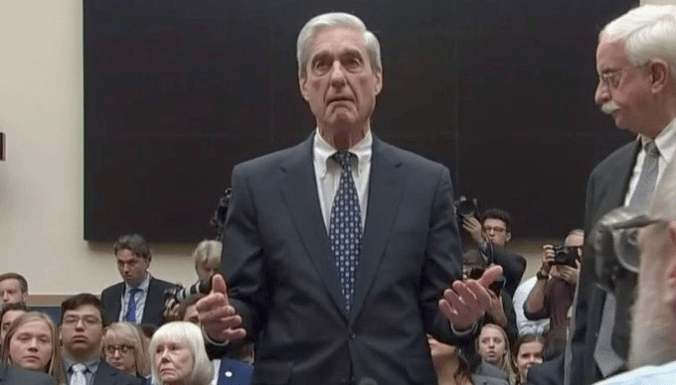
The amazing thing is that the Democrats held the hearings at all. Mueller, as a matter of legal ethics and client confidentiality, was severely limited regarding what he could say beyond what was already in his investigation’s report. Desperate to gain some public relations traction in their endless, nation-rending determination to end a legal and duly elected Presidency without the inconvenience of an election, one can only surmise that Mueller’s ethically problematical press conference led them astray, and not only astray, but into a disaster of their own making.
The first hint that something was amiss was Mueller’s request that an aide sit by him and assist in his testimony. That was not only unusual but ominous, and the Republicans on the committee quickly rejected it. Once Mueller started answering questions, it was painfully clear why this request had been made. He looked disoriented and confused. The 75-year-old Justice Department veteran had to ask committee members to repeat their questions repeatedly, as if he was having difficulty focusing. He often did not know whether the representatives were asking him questions or if they were reading from his own report. In the first 90 minutes of the hearing, Mueller asked for clarification of questions more than 10 times. Under questioning from Rep. James Sensenbrenner (R-Wisc.), Mueller asked: “And where are you reading from on that?” “I’m reading from my own question” was the answer. “Then can you repeat it?” Mueller asked. The audience laughed. By the end, the audience had stopped laughing. As Obama strategist David Axelrod tweeted, the performance was “painful” to watch. Mueller asked Rep. Sheila Jackson Lee to restate her question three times. Rep. Matt Gaetz (R-Fla.) asked the 14 word question, “Attorney #2 in the Inspector General’s report and Strzok both worked on your team, didn’t they?” and Mueller appeared to be confused by it.“Pardon me?” Mueller replied. After Gaetz restated his question, Mueller replied: “And the question was?” Asked by Head Trump-hunter Judiciary Chairman Jerry Nadler (D-N.Y.) to explain what his investigation found “in plain terms,” Mueller answered: “Well, the finding indicates that the president, uh, was not, uh, the president was not exculping, uh, exculpated, uh, for the acts that he allegedly committed.”
Ah! Well thank you, sir, that explains everything! Nadler looked as if he wanted to start banging his head on the table.
In Steven Bochco TV legal dramas—the immortal “Hill Street Blues” was the best of them—everyone was sleeping with everyone else in the judicial and law enforcement system. Police chiefs were having affairs with defense attorneys, prosecutors were having affairs with judges, judges were having affairs with defendants. It was ridiculous, if entertaining, but gave an absurdly misleading impression to the gullible public about the legal system. Later, as Bochco’s star was waning, writer-producer David Kelley continued the myth with his many legal dramas
However, this is not to say that such unethical relationships don’t occasionally occur. Bochco, who died in 2018, would like this story, since he could have written it.
Alabama’s Judicial Inquiry Commission on Tuesday filed a complaint against Coffee County District Judge Christopher Kaminski, alleging that he has been carrying on a romantic relationship with an attorney who frequently practices in his court. Continue reading →
Prosecutors in Massachusetts this week dropped a sexual assault charge against the actor Kevin Spacey, in the only case against the alleged serial sexual harasser to be brought to trial. Mr. Spacey was accused of fondling an 18-year-old man at a Nantucket restaurant three years ago, one of the few of the accusations against him that wasn’t too old to try and that involved criminal conduct. The accuser’s lawyer said that a smartphone being sought as evidence by the defense had disappeared, then the accuser invoked the Fifth Amendment after being warned that he could be charged with a destroying evidence, a felony if he had deleted contents on his phone. When the young man continued to assert his right against self-incrimination, the Cape and Islands district attorney announced that it was dropping the prosecution “due to the unavailability of the complaining witness.” There wasn’t much choice.
Spacey’s far from out of the metaphorical woods. Around the same time as the Nantucket accusation, the Old Vic theater in London announced that 20 people had accused Spacey of inappropriate behavior during his 11-year stint as the theater’s artistic director. There is another investigation in Los Angeles.
So now what? None of the allegations against Spacey have been proven, though, as with Bill Cosby, the sheer number of them leave little doubt—but still some— that he is a serial sexual predator. Spacey’s own house of cards began falling when actor Anthony Rapp gave an interview to BuzzFeed accusing Spacey of assaulting him at a party when Rapp was only 14. The accusation was never proven, but suddenly more stories of sexual misconduct in the workplace and elsewhere started surfacing regarding Spacey. (There is a lot about Spacey’s conduct and problems on Ethics Alarms, here.) Continue reading →
1. More “phantom document” ethics. Last moth I wrote about the ethically dubious “phantom document” tactic, in which a lawyer alludes to a document he or she either does not have, or suggests a document has content it does not in order to trick a witness into recanting testimony.
I just saw the Eighties made-for-TV movie “Perry Mason Returns” that rebooted the classic series (and not so well) for an aging Raymond Burr. The great defense lawyer comes out of retirement to defend old legal assistant Della Street (Barbara Hale), who has been accused of murder. In the trial’s climax, Perry’s investigator Paul Drake, Jr. (played by Hale’s real-life son, actor William Katt of “The Greatest American Hero” fame) bursts into the courtroom and hands Perry a document, which he then holds as he asks the witness (Richard Anderson, playing a different role than he played in the original series) he was in the midst of cross-examining, “Would you like to reconsider your testimony? Would you like me to read a sworn statement from Bobby Lynch, in which he says you hired him to kill Arthur Gordon?”
The witness confesses that he planned the murder that Della was being tried for, and framed her. Della goes free! Perry then tells Della that there was no sworn statement. “I didn’t say I had a sworn statement,” he chuckles, “I just asked if he wanted me to read one.” Continue reading →
“I have had sex with one woman since the day I met Jeffrey Epstein. I challenge David Boies to say under oath that he’s only had sex with one woman … He has an enormous amount of chutzpah to attack me and challenge my perfect, perfect sex life during the relevant period of time.”
—-Alan Dershowitz on Fox News, attacking super-lawyer David Boies, who is representing Virginia Roberts Giuffre, a woman who claims Dershowitz had sex with her while she was one of Jeffrey Epstein’s sex slaves.
Too much information, Professor.
Has Dershowitz never heard of the Streisand Effect? His complaining about the accusation is publicizing it.
Decorum? Modesty? Restraint? Dignity? Privacy? Dershowitz is 80: he’s supposed to be in the generation hat still appreciates these things.
He had sex with one woman for almost two decades? It was nice of him to give her a break while he chatted with Laura Ingaham…
Florida disciplinary authorities have opened an investigation into the professional fitness of a lawyer who forced a stowaway racoon off of his boat a long way from shore, and thought it was all amusing enough to post a video of the incident on Facebook. The bar’s assumption is that the animal drowned. The lawyer is now subject to prosecution for a violation of Florida’s wildlife laws.
In Florida, as in every other U.S. jurisdiction, one of the kinds of unethical conduct that can result in bar discipline is committing “a criminal act that reflects adversely on the lawyer’s honesty, trustworthiness, or fitness as a lawyer in other respects,” as stated by Rule 8.4 (b) of the Florida Rules of Professional Conduct . Should the nautical lawyer’s conduct qualify?
You may recall a far more egregious case of animal cruelty by a lawyer discussed here, where I questioned if a psychopath lawyer’s fatal attack on his girlfriend’s dog Snoopy really tells us anything about his trustworthiness as a lawyer. I wrote then,
Emotionally, I have no problem with seeing an animal abuser kicked out of my profession, but I don’t understand what values are being applied. Is it the commission of a crime? Most lawyer crimes don’t result in disbarment, if they don’t involve lying, cheating or stealing. …There is no basis on which to conclude that [Snoppy’s killer] isn’t competent, zealous and trustworthy—just keep him away from pets.
Now, you may well ask, “Isn’t this at least “moral turpitude?” That’s the character flaw that will keep applicants for bar membership from getting a license due to character deficiency. There are two points related to that. First, moral turpitude might keep you out of the law at the outset, but it is not one of the official no-nos that will get you kicked out of it one you are a practicing lawyer. The legal definition of moral turpitude is an act or behavior that gravely violates the sentiment or accepted standard of the community. Brutalizing an animal would certainly qualify. The ABA, however, greatly narrowed the definition as it was applicable to legal discipline:
The 1983 Model Code (periodically amended by the ABA House of Delegates over the last 32 years) rejected the prohibition against “illegal conduct involving moral turpitude.” The ABA’s reason, which it included in a Comment to its Rule 8.4, was quite simple: “Moral turpitude,” the ABA advised, is a “concept can be construed to include offenses concerning some matters of personal morality, such as adultery and comparable offenses, that have no specific connection to fitness for the practice of law. Although a lawyer is personally answerable to the entire criminal law, a lawyer should be professionally answerable only for offenses that indicate lack of those characteristics relevant to law practice.” The American Law Institute’s Restatement of the Law Governing Lawyers § 5 (Third) (ALI 2000), agreed. It also concluded that “moral turpitude” is vague and may lead to discriminatory or otherwise inappropriate applications.”
This looks like an Ick Factor case to me. The abuse of poor Snoopy is so viscerally repulsive that the bar and the courts can’t keep their ethical priorities in order. It is also, as particularly ugly discipline cases often are, a matter of public relations and self-preservation for the legal profession. The bar association knows that not banning a lawyer like Pastor—one hopes there aren’t many–signals to the public that the bar welcomes brilliant advocates who may be monsters in their spare time. That is a dark and dangerous road the profession would rather avoid.
The lawyer in the Florida video also has some defenses the poodle-stomper did not. Raccoons are wild animals, and cute as the are, they also bite. I wouldn’t want to be trapped on a boat in middle of the ocean with one, though I wouldn’t throw the critter overboard either, unless it was me or him. (My father had a home movie of me jumping out of a canoe and swimming to a lake’s shore when I saw a large spider in the vessel. Of course, I was only 15. All right, I was 26….) The raccoon may have also been a better swimmer than everyone assumes: unlike in the case of poor Snoopy, the lawyer wasn’t trying to kill the animal, just get it off the boat.
I do not, however, second the opinion of Law professor Dane Ciolino, writing on his Louisiana Legal Ethics blog, who says in discussing the case, “A Maryland lawyer was suspended for microwaving a cat. But a racoon? I think not.”
Wait—is the professor really saying that microwaving a live raccoon would not justify bar sanctions, but a cooking a cat does? That’s animal bigotry, but it is consistent with what I detected in the Snoopy case. If that lawyer had stomped to death a raccoon that wandered into the apartment, I doubt that he would have been disciplined.
Yet animal cruelty is animal cruelty. If gratuitously killing a dog or a cat shows that a lawyer is unfit to practice, so does unnecessarily killing a raccoon.
The facts showed that a drunk 16-year-old boy raped an even more drunk 16-year-old in the basement during a party. The boy recorded a video of himself penetrating her from behind, and then shared it on social media among friends along with a text that said, “When your first time having sex was rape.” The victim could barely recall the incident, and when she confronted her attacker, he denied that he had raped her even as he continued to circulate the video. When the victim, known only in public records as Mary, an alias, because of her juvenile status, learned this, she had her mother contact authorities.
The Monmouth County prosecutor’s office wanted the boy to be tried as an adult. They applied for a waiver of his juvenile status, arguing that the alleged assailant’s actions were “predatory and sophisticated.” “At the time he led ‘Mary’ into the basement gym, she was visibly intoxicated and unable to walk without stumbling,” the prosecutor wrote. “For the duration of the assault, the lights in the gym remained off and the door was barred by a foosball table. Filming a cellphone video while committing the assault was a deliberate act of debasement.”
In criminal law, the defendant’s lawyer always tries to get a “good judge,” and in this case, the accused rapist teen hit the jackpot. Judge James Troiano of Superior Court was the ideal judge for this defendant, because he apparently leads his profession in rationalizing idiocy. “Good,” in this case, meant incompetent.Continue reading →
The author is well-published law school professor Lara Bazelon, who often opines at Slate. I could, but I won’t, give Bazelon the benefit of the doubt, assuming that as a lawyer and advocate, the article is intentional hyperbole and intended to both spark debate and to assuage the conscience of other working moms. Lawyers, however, are not supposed to mislead or lie. If Bazelon doesn’t believe that she has picked her job over her kids, then she shouldn’t write it. If she does believe it, then she is rationalizing away a breach of duty.
There are millions of working mothers who have no choice other than to work when their children may need them, but Bazelon is not one of them. She writes, Continue reading →




 Ethics Alarms