Morning Ethics Warm-Up, 10/16/2017: SNL, NFL, Collusion, Gossip, And Bribery

Good Morning.

1 Why am I only now getting around to today’s Warm-Up? It is because I spent more than 8 hours over the weekend, and three hours this morning, writing a Motion to Dismiss in response to a ridiculous, retaliatory, vindictive lawsuit by a pro se litigant with a grudge. The complaint has no legal cites, because no legal authority supports its claims. I, however, have to cite cases to show why the Complaint is completely without merit. Since the Complaint is a brain-rotting 18 pages, I have to carefully redact it to have a prayer of meeting the 20 page limit for motions. Even then, there is no guarantee that this won’t drag on for months.

No penalty will be exacted on the plaintiff for filing this spurious and groundless law suit. To do so would chill the right of citizens to seek justice and redress for wrongs through the courts. Thus the underlying objective of the suit will be accomplished: to force me to expend time and effort that I have far better uses for. Ethics Alarms readers are affected, my family is effected, my work is affected, my enjoyment of life is affected, and, of course, the system and the taxpayers who fund it are affected. This is an abuse of the system, but one that cannot and must not be impeded.

2. Does anyone have a theory about why the bribery trial of Democratic Senator Bob Menendez has received minimal mainstream media coverage that does not show bias? When Abscam was going on, the trials of the various members of Congress caught in a bribery sting were front page, Evening News headlines for weeks. The only U.S. Senator tried (and convicted) was a Democrat Harrison Williams. Has the news media become that much more partisan since the Reagan Administration?

3. As expected, exiled NFL kneeler (first) and quarterback (second) Colin Kaepernick has filed a grievance accusing NFL teams of colluding to prevent him from getting a contract with any team this season.

We’ve been here before. This is the Barry Bonds scenario all over again. Bonds, the definitive ethics corrupter in Major League Baseball and a flagrant steroid cheat and liar, was not resigned by the San Francisco Giants after the 2007 season. He was 42, but his season had been productive, with a 1.o45 OPS, close to the best in the game. I wrote an article for The Hardball Times arguing that Bonds would not be signed, because doing so would permanently scar any team that accepted him, injure the team’s culture, corrupt its young players, and wound baseball itself. The invective hurled at me and my article by sportswriters and readers was unrelenting. ESPN’s Keith Law said that my essay made anyone who read it stupid. MLB’s satellite channel’s hosts laughed about the idea that teams cared about such matters as integrity. Bonds, however, was not signed, and never played again. While he and his defenders claimed collusion among the owners, no evidence appeared. Continue reading

That Settles It, If It Wasn’t Obvious Already: Lisa Bloom Is An Unethical Hack (But I Could Be Wrong…)

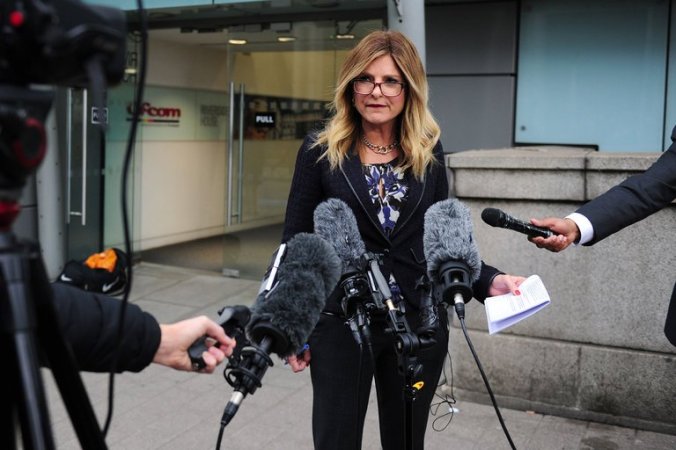
Now, don’t sue me, Lisa! Remember what it says in the “About” section (above), this is all just my opinion. When I say you are a stunningly unethical lawyer, that’s just my analysis; it’s true I know something about legal ethics, teaching and consulting on it full time, but I can’t assert my opinion as fact. I can’t read your mind or slog through your soul. I don’t know what a bar disciplinary committee would decide, though I know this is a famously gray area in legal ethics, so unethical conduct is unlikely to be punished.  And when I say you’re a hack, remember that “hack” isn’t a description subject to objective proof, any more than, say, “asshole.” Perhaps your definition of “hack’ is different from mine. In fact, I’m sure it is.

That said, your conduct is a professional disgrace. I think. Who knows? I may be wrong.

In an interview with BuzzFeed News published this weekend, Bloom, speaking of her recently terminated representation of Harvey Weinstein, said

“I can see that my just being associated with this was a mistake. All I can say is, from my perspective, I thought, ‘Here is my chance to get to the root of the problem from the inside. I am usually on the outside throwing stones. Here is my chance to be in the inside and to get a guy to handle this thing in a different way.’ I thought that would be a positive thing, but clearly it did not go over at all.”

Bloom added that she will no longer represent men accused of sexual misconduct, “even those who convincingly tell me they are innocent….I will just make the best choices I can out of every situation. I have clearly not been successful. I think anybody who does big bold things fails. And I definitely failed on this one.”

What Bloom has failed at is called “being a trustworthy and competent lawyer.”

The next day, during an appearance on Good Morning America, Bloom even more explicitly threw her former client under the metaphorical bus:

“It’s gross, yeah,” Bloom told GMA. “I’m working with a guy who has behaved badly over the years, who is genuinely remorseful, who says, you know, ‘I have caused a lot of pain.’”

Did Bloom actually graduate from law school, or did she just apprentice in her mother’s office (she is Gloria Allred’s daughter) and somehow get an honorary license? Did she never learn about the a lawyer’s duties of loyalty and confidentiality? She obviously didn’t know about conflicts of interest, since she represented Weinstein while agreeing to let him turn her book into a TV miniseries.

Ethics Alarms has previously criticized lawyers who have publicly undermined their former clients. The most recent example  was last year, when a former Trump lawyer used his experiences while representing the future Presidential candidate decades earlier to write a scathing mid-campaign attack on his former client in the Huffington Post. I wrote,

There is strong disagreement in the profession about whether the answer to “Is this unethical?” should be an outright yes. The status of loyalty among the legal ethics values hierarchy is as hotly contested now as it ever has been. If a lawyer wants to attack a former client in a matter unrelated to the representation and no confidences are revealed in the process, is that a legal ethics breach? If it is, it would be a very tough one to prosecute. I think it’s a general ethics breach, as in wrong and unprofessional. It is disloyal, and clients should be able to trust their lawyers not to come back years later, after a client let the lawyer see all of his or her warts, and say, “This guy’s an asshole.” It undermines the strength of the public’s trust in the profession.

Continue reading

Here’s Something The News Media Hasn’t Explained Regarding The Weinstein Scandal: Those Victim Confidentiality Agreements Are Unethical, And Maybe Illegal

Rose McGowan, the new Sexual Harassment Fury on social media, says she was raped by Weinstein and had to accept a $100,000 settlement with a confidentiality agreement as a condition of the deal. That means that if she subsequently told her story and accused Weinstein, she would be liable for damages, and would have to return the money. Right?

Not exactly. Most of the accounts in this sordid series of events make it seem like confidentiality agreements are iron clad and enforceable. Often they are neither. McGowan’s almost certainly wasn’t.

Debra Katz, an attorney specializing in sexual harassment law suits, recently explained that if employees or former employees came forward with information about Weinstein participating in criminal misconduct, their non-disclosure agreements or confidentiality agreements would probably be unenforceable, saying,

“These kind of very broad NDAs or confidentiality agreements typically violate public policy. Employees have to have the legal ability to discuss any concerns about unlawful behavior in the workplace … These broad provisions that would effectively silo people, make them feel like they can’t speak about this, are simply an instrument to put fear in people.”

My position has always been that lawyers who construct such agreements, knowing that they are unenforceable, are committing sanctionable ethical misconduct. The lawyer for the employee being silenced, moreover, has an obligation to let the client know that the requirement is unconscionable. Of course, it’s the client’s decision whether she wants to take the money.  It is also unethical to make an agreement you have no intention of honoring. Continue reading

Morning Ethics Warm-Up, 10/13/17: All Aboard The Weinstein Ethics Train Wreck!

Good Morning, Hollywood!

I’m sorry to bombard you with this ugly topic again first thing, but I’d like to stop having to think about it as soon as possible.

1 My sister, a committed Democrat who naturally prefers that damning stories about her favorite politicians go down the memory hole as soon as possible, complained yesterday that she didn’t understand why Harvey’s demise was such a long-running story. He’s a pig, we’ve seen it before, he’s fired, big deal, she protested. There are more important things going on.

There are undoubtedly more important things going on, but from an ethics perspective, the importance of the Harvey Weinstein Ethics Train Wreck and who boards it (and who has been riding it for decades) is as significant and chock full of lessons as a story can get. The Penn State-Jerry Sandusky-Joe Paterno scandal was important for some of the same reasons. It exposed the tendency of organizations to become corrupted when non-ethical considerations, usually money, freeze the clappers on multiple ethics alarms. It showed how “virtuous” people with power and influence can betray their values, admirers and supporters in the pursuit of personal or organizational goals. It showed how even usually complacent and biased journalists will suddenly become responsible when the details are juicy enough…and how some won’t. The Sandusky saga also was one more clue to how inherently warped an entire industry’s culture—in that case, big time college football—was (and is).

The Weinstein Train Wreck is worse, however, and also more significant. Weinstein is typical—extreme, perhaps, but typical—of  a popular and glamorous industry that has abused power to debase and exploit women for a century. The trade-offs and incentives turned many of the abused women into accessories of future crimes against other women, while some women, too powerful to have to fear the consequences of doing the obviously right thing, chose to protect the community and the industry rather than human beings. That they, and complicit men in the industry as well, did this while spending the past six years making angry public speeches about the sexist and misogynist attitude of Republicans flagged the kind of hypocrisy that demands substantive consequences.

It also demands reform. Anyone who  thinks Hollywood is going to retire the casting couch because of one especially disgusting and prolific predator is kidding themselves. Sexual harassment and gender discrimination is rampant at every level of the performing arts, from high school theater up through Broadway, and on to Hollywood. I question whether that culture will ever change significantly. At least this episode might educate the public that if they take moral grandstanding from the likes of John Legend, Meryl Streep and Jimmy Kimmel seriously, they are asking to be betrayed and disillusioned.

And that doesn’t even reach the political hypocrisy exhibited by the Democratic Party and progressives, which embraced and celebrated a sexual predator from Hollywood because he gave them money, just as they have been giving a sexual predator from Arkansas the King’s Pass on similar conduct because he gave them power. As long as the only voices calling attention to this are from the Right,  count on progressives to ignore or minimize the issue. After all, conservatives and Republicans accepted the devil’s bargain in allying themselves with Roger Ailes. Still, the criticism of the party and predator enablers like Hillary Clinton needs to come from the Left to do any lasting good. So far there has been some criticism from that direction, but not nearly enough.

2. Weinstein’s contract with The Weinstein Company  included a clause that allowed  his sexual harassment as long as he paid the costs of settlements out of his own pocket, TMZ reported yesterday. So much for the sham posture that the company was shocked and disgusted at his conduct. Poor Donna Brazile, desperately trying to join the futile virtue signalling by hypocrites who have been cheering on Hillary and her husband for decades, tweeted her admiration for the TWC board thusly
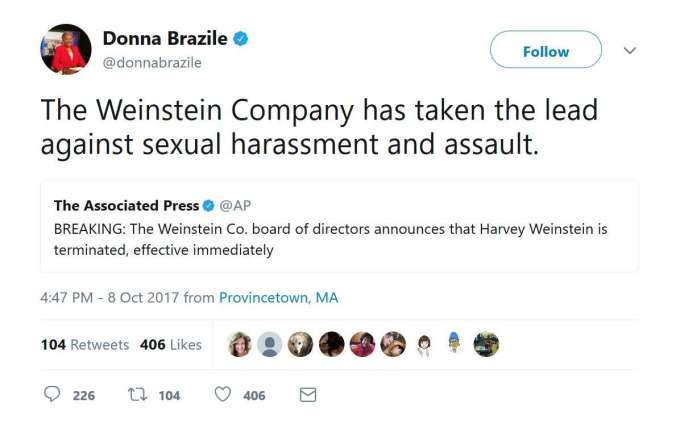
…only to have to delete the tweet later. Did Donna really believe that the TWC board, including Harvey’s brother, didn’t know what Weinstein was doing? Is she that stupid?

3. A lot of contentious debate on this topic at Ethics Alarms has arisen regarding the complicity and obligations of various Hollywood actresses. There are different categories, and conflating them only leads to confusion. Here are the categories and subcategories:

A. The powerless victims of harassment These are the young, aspiring actresses who were propositioned or assaulted by Weinstein, and convinced, rightly or not, that they would never have a chance if they complained

These are the equivalents of Bill Cosby’s victims, who only came forward after their abuser was wounded and vulnerable.

A 1. Powerless victims who accepted cash settlements. This means that since other remedies were unavailable to them, they at least triggered some kind of punishment and compensation. This required, however, allowing future victims to go unwarned, since the pay-offs were accompanied by confidentiality agreements.

B. Victims who were not powerless, due to connections in the industry. I place actresses like Ashley Judd, Angelina Jolie and Gwyneth Paltrow in this category.

C. Victims who, over time, became powerful, wealthy, popular and influential enough that they could have exposed Weinstein, if they chose, but didn’t.

C 1 Victims who received cash settlements when powerless but whose careers  progressed to the point that they could forfeit the cash and accept any legal consequences of breaking the contractual agreements.

D. Rape victims. Sexual harassment is a civil offense; rape is a crime. Many rapes can be substantiated by medical examinations, and rapists are dangerous. Accepting a cash settlement for not reporting one’s rape when the rape could have been substantiated—this is what Rose McGowan did—is a breach of multiple civic duties.

E. Women in the industry who became aware of Weinstein’s conduct and did nothing about it.

F. Women in the industry who became aware of Weinstein’s conduct,  did nothing about it, and continued to praise him in public.

G. Actresses who accepted Weinstein’s proffered bargain, and exchanged sexual favors for roles and contracts, turning what is laughably regarded a a meritocracy into sexual commerce. We don’t know who these women are, but it strains credulity to think there were none.

Of course, many male Hollywood figures also fall into categories E and F.

Categories C, EF and G are the most unethical categories. D is problematic as well.

4. Jane Fonda revealed to Christiane Amanpour that she is in category E. She “found out about Harvey about a year ago,” said the certified Hollywood royalty, outspoken feminist and progressive champion.  “I’m ashamed that I didn’t say anything right then,” Fonda said. 

Well, that’s nice. As long as she is ashamed.

We can proclaim our principles and values all our lives, but if we don’t act according to them when the lives of others are at stake, all of what went before is meaningless. How many women suffered at Weinstein’s hands after Jane knew? Continue reading

Morning Ethics Warm-Up, 10/11/2017: Words, Debt, And Costumes

Good morning from Richmond, Va.!

1 Passengers keep piling onto the Harvey Weinstein Ethics Train Wreck:

  • Fashion designer Donna Karan, questioned about Weinstein at an event, said in part:

“I also think how do we display ourselves? How do we present ourselves as women,” Karan said to the Daily Mail. “What are we asking? Are we asking for it by presenting all the sensuality and all the sexuality?”

Then she pointed to Weinstein’s achievements, and said Weinstein and his wife were “wonderful people.”

(Note to the designer: men who use their power to harass and assault women are not wonderful people by definition.)

After the predictable response to these idiotic comments, Karan protested that her quote was taken out of context, as if the context wasn’t Harvey Weinstein, and issued a low level apology that could only mean, “I’m deeply sorry I said something in public that reveals the miserable level of my values.”

  • Lindsay Lohan, currently in exile in Great Britain and Dubai, used social media to remind her fans in the US that she is, after all, a moron, writing on Instagram,

“I feel very bad for Harvey Weinstein right now. I don’t think it’s right what’s going on….He’s never harmed me or did anything to me – we’ve done several movies together.I think everyone needs to stop – I think it’s wrong. So stand up.”

One of the real benefits of social media is that it reveals the total lack of ethics comprehension, reasoning ability and life competence that inflict so much of the public, including celebrities. With clarity of thought like that, is there any mystery regarding how the once rising star managed to mangle her career despite beauty, talent, and early success?

  • NBC was presented with the Weinstein story before it was broken by the New York Times, says Ronan Farrow, the author of a new Weinstein investigative piece in The New Yorker. The network hasn’t said why. Does it have to? Weinstein was close to both the Clintons and the Obamas, and the scandal directly implicates the Democratic party and its core supporters….like NBC. It is fascinating to watch cable and network anchors and guests desperately try to analogize Weinstein to President Trump, but the Hollywood mogul was enabled by self-righteous liberals and was given the King’s Pass (with an assist from the Saint’s Excuse) because he gave to Planned Parenthood and Hillary, making him, in Donna Karan’s words, “wonderful” by definition. The analogy is Bill Clinton, of course, and any journalist who refuses to acknowledge that has confessed crippling partisan bias.

2. This brings us to a quote by blogger Ann Althouse:

“My hypothesis is that liberals — including nearly everyone in the entertainment business — suppressed concern about sexual harassment to help Bill Clinton. Giving him cover gave cover to other powerful men, and the cause of women’s equality in the workplace was set back 20 years.”

Her hypothesis is correct, and I said so when the liberals, feminists, abortion zealots, artistic community and others circled their wagons around Clinton during the Lewinsky scandal. This is one reason why Hillary’s campaign stance as standard-bearer for women’s rights and victims of sexual assault was so grotesque.

Here’s another quote from Althouse that I like:

“Who are the women who accepted the deal as offered by Harvey Weinstein? Will their names be kept out of the press? Should they?…

…So much silence facilitating so much harm! Should the women who took the bargain and got what they wanted out of it be regarded as victims and entitled to keep their names secret, or are they part of a system that hurt many others, and subject to outing.”

I’ve answered this question in various comments on previous posts, much to the unhappiness of readers who believe that victims who remains silent and thus allow evil to continue shouldn’t be criticized. The women are part of the system, and accountable. Continue reading

Morning Ethics Warm-Up, 10/8/2017: TV Comics, Law Deans, Sports And California…Everything Is Seemingly Spinning Out Of Control!

Good Morning!

On the day that the Boston Red Sox will begin their stunning comeback against the Houston Astros …


1 Speaking of baseball, a poll shows that the NFL fell from the most popular major sport in the nation last year to the least favorite last month, while baseball regained its traditional but usually treated as fictional “National Pastime” status. The NFL also dragged down the popularity of college football. Not all of this can be blamed on Colin Kaepernick, Black Lives Matters, and incoherent protests that aren’t against the National Anthem, well, maybe its third verse, but take place during the National Anthem, well, because. Ethics Alarms isn’t the only voice that has declared football to be callous and barbaric, now that the game’s unavoidable concussions are being shown to cause a deadly brain disease. Too many helmeted heroes beat their spouses and lovers, and commit felonies. The biggest star in the NFL, Tom Brady, is a smug, cheating jerk. It never helps when the President of the United States, even one like Trump, attacks an institution from the bully pulpit. Still, the timing certainly suggest that the NFL’s botched handling of The Knee is the catalyst for its current nosedive in popularity. Just think how many brains will be saved if this is permanent.

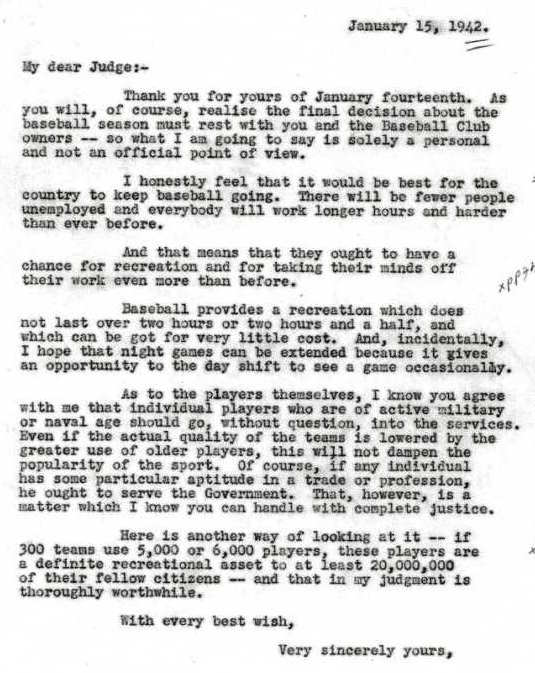
Meanwhile,  Major League Baseball is benefiting from staying true to its traditional national role of unifying the country rather than dividing it. No on-field protests mar the National Anthem. The sport is entertainment, celebrating American themes like individualism, the triumph of the underdog, and grace under pressure. In 1942, FDR urged Major League Baseball to keep playing, even though the remaining players were unfit for military service, leaving the teams stocked with older players and a collection of misfits, like Pete Gray, the one-armed outfielder.  After Baseball Commissioner Judge Kenesaw Mountain Landis wrote President Roosevelt in January, FDR replied with this letter the same day:

It is not, however, in the best interest of the country to keep the NFL “going.” Continue reading

Here We Go Again: Harvey Weinstein, Lisa Bloom And The Thing About Lawyer Ethics That The Public And The News Media Just Cannot Seem To Grasp

LawNewz writes, and in so doing wins a Legal Ethics Dunce so easily that I’m not even going to bother,

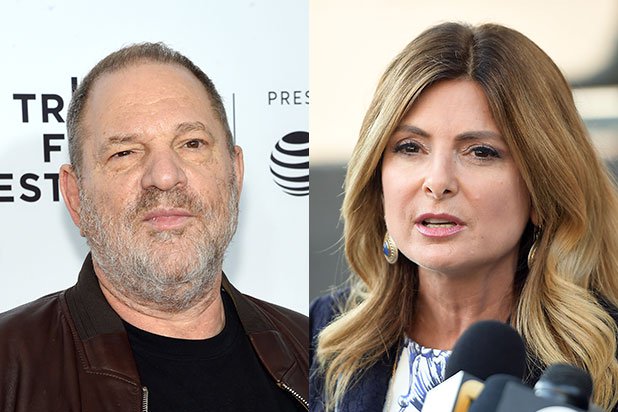
Feminist attorney Lisa Bloom, who has represented dozens of women against accused sexual harassers like Donald Trump and Bill O’Reilly, is now representing an alleged sexual harasser. In, quite frankly, a shocking move, Bloom agreed to give her “advising” services to film studio executive Harvey Weinstein, who is accused of harassing women over a thirty-year timespan. Immediately, many in the legal world wondered what would motivate such a principled women’s rights advocate to represent a man facing such sordid accusations.

Weird! I have the strangest feeling I have been here before…it’s Ethics Alarms déjà vu!

No, I have been here before, and if you’ve read the blog regularly, so have you, like here, for example, when the post was called,  No, There Is Nothing Unethical Or Hypocritical About A Feminist Lawyer Defending Roger Ailes.or here, when I defended Hillary Clinton….yes, you read that right…when she was being called a hypocrite for once defending not only a child rapist, but a guilty child rapist.  Then there was this post, when liberal icon Larry Tribe was representing a coal company. Bloom, Tribe, Estrich and Hillary all have the same defense, not that lawyers should need a defense for being lawyers.

Let’s see…I think I’ll quote myself from the Hillary piece this time… Continue reading

But…But… It Doesn’t Mean He’s Not A Good Lawyer!

RIP, Snoopy.

This is a fascinating example of the legal community’s incomprehensible standards regarding who is and who isn’t fit to practice law.

In New York,  the bar took away lawyer Anthony A. Pastor’s license after he violently killed his girlfriend’s poodle “Snoopy.” See Matter of Pastor, 2017 NY Slip Op 06729, (App. Div. 1st Dept. Sep. 28, 2017).

An autopsy revealed that Snoopy  had nine broken ribs, a crushed kidney and massive internal bleeding, all at the hands of Pastor.

In disbarring Pastor, [ Matter of Pastor, 2017 NY Slip Op 06729, (App. Div. 1st Dept. Sep. 28, 2017)], the court noted that the sentencing judge’s comments that the respondent’s conduct “‘showed almost incomprehensible violence, and malice,’ that the dog was in ‘excruciating pain’ up until she lost consciousness while respondent ‘sat down at his computer in the most cold-blooded manner, and went to work, knowing that the dog lay dying, . . . on the floor behind him.’”

Nice.

But what does it have to do with whether the creep is a competent, honest, trustworthy lawyer?

Again I note that John Edwards never faced discipline for his massive deceptions and machinations, while his wife was dying of cancer, and while he was running for President. This conduct directly implicated trust and character, yet the refrain of Edwards’ colleagues was that his deceptions and cruelty, while clearly unconscionable, did not involve the practice of law, and thus did not preclude Edwards continuing to be regarded as a trustworthy lawyer. Are they kidding? I wouldn’t trust John Edwards to mail my water bill. Still, I hear this argument all the time in my legal ethics classes. One hypothetical is about a law partner who is caught cheating at poker in a regular game among fellow attorneys. Does that conduct mandate reporting him to the bar for discipline? Most lawyers say no.

They are wrong. Continue reading

Reminder: Hateful Racist Mass Murderers Have The Same Rights You Do

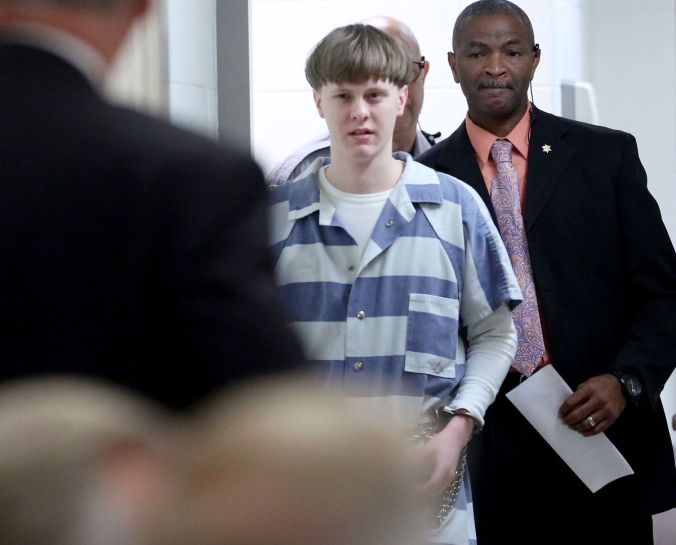
Dylann Roof, the white supremacist sentenced to death after killing nine black church members as an attempt to start a race war, asked a court to replace his appointed appellate lawyers because they “are my political and biological enemies.” The Richmond, Virginia-based 4th U.S. Circuit Court of Appeals denied his request.

Roof’s pro se motion stated that his lawyers, Alexandra Yates and Sapna Mirchandani, “are Jewish and Indian, respectively. It is therefore quite literally impossible that they and I could have the same interests relating to my case.”  Roof had difficulties on the same basis with his court-appointed lawyer, David Bruck, during his trial. The murderer wrote  in his motion that Bruck is Jewish and “his ethnicity was a constant source of conflict even with my constant efforts to look past it.”

I have been shocked at the reaction of the legal profession, the news media and the public to the 4th Circuit’s ruling. It really does appear that all the education in the world, ethics rules, principles and the Constitution will still be steamrolled by hate and emotion, even when crucial, indeed existential values for our society are at stake. My trust and respect for all professions—all of them—have been grievously reduced by their conduct and ethics blindness over that past several months. No wonder the First Amendment is under attack. No wonder our institutions are being weakened to the point of collapse.

The public literally  not understand the principle I am going to explain now. Apparently naively, I thought lawyers, judges and law professors did. In the interest of clarity, I am going to do this in short, straightforward segments.

I. The Court’s ruling is not just wrong, but frighteningly wrong.

Roof, like all citizens accused of a crime, has a right to a competent, zealous legal defense. A  competent, zealous legal defense requires that the defendant be able to participate fully in that defense. If a defendant does not or cannot trust his lawyers, he cannot be assured of a competent, zealous legal defense.

II. A client has to trust his lawyer.

It doesn’t matter why a client doesn’t trust his lawyer, and the lawyer need not agree that the lack of trust is warranted. The question is whether a lawyer who is not trusted by his client can do an adequate job representing him. The answer is no. The Sixth Amendment, which guarantees a fair trial and legal representation in criminal cases, is not there for the lawyers, or courts, or government. It exits to protect the accused—all accused.

In a famous medical ethics case, an elderly Korean man in a hospital wanted his doctors, specialists in his malady, replaced because they were Japanese-Americans, and as a survivor of the horrors Japan inflicted on Korea, he was convinced that they would kill him. The hospital ethics committee held that he was an irrational bigot, and that he either had to accept the qualified physicians despite their race, or get out. The AMA disagreed. It said that the patient’s welfare is paramount in medical ethics, and a patient who does not trust his doctors—the reason doesn’t matter—will have his welfare and health endangered as a result.

The same principle should apply to Roof. A client who does not trust his lawyer will not, for example, be candid with him, or trust him to keep confidences.

Under the circumstances Roof described, the lawyers have an ethical obligation to withdraw. Two rules are involved:

Client-Lawyer Relationship
Rule 1.7 Conflict Of Interest: Current Clients

(a) Except as provided in paragraph (b), a lawyer shall not represent a client if the representation involves a concurrent conflict of interest. A concurrent conflict of interest exists if:

(1) the representation of one client will be directly adverse to another client; or

(2) there is a significant risk that the representation of one or more clients will be materially limited by the lawyer’s responsibilities to another client, a former client or a third person or by a personal interest of the lawyer.

(b) Notwithstanding the existence of a concurrent conflict of interest under paragraph (a), a lawyer may represent a client if:

(1) the lawyer reasonably believes that the lawyer will be able to provide competent and diligent representation to each affected client;

(2) the representation is not prohibited by law;

(3) the representation does not involve the assertion of a claim by one client against another client represented by the lawyer in the same litigation or other proceeding before a tribunal; and

(4) each affected client gives informed consent, confirmed in writing. Continue reading

Ethics Observations On The Trump-Deranged Prof’s 2016 Post-Election Freak-Out

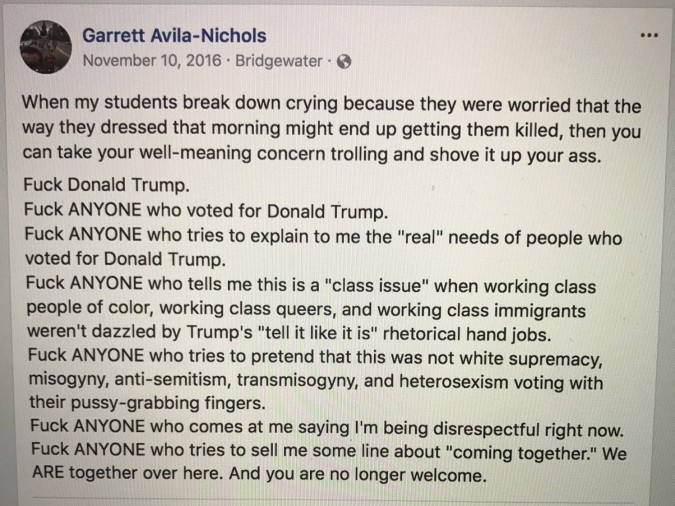
Bridgewater State University professor Garrett Avila-Nichols wrote the Facebook screed above shortly after the November 8 defeat of Hillary Clinton by President Anti-Christ. Somehow the post didn’t become known to students—at least the ones he hate—and apparently even the university’s administration until this week.

Observations:

1 We are seeing one example after another of college professors making tweets and other social media posts denigrating conservatives, Republicans, whites, men and Trump voters in emotional, vicious and frequently obscene rhetoric. Can anyone recall any similar conduct from professors directed against liberals, conservatives, minorities, women, or Obama, Clinton or Carter voters? I know that there was no social media to abuse for much of those periods, but still: when did professors get the idea that attacking large segments of the population and the student body was tolerable? Why do they think it is acceptable conduct now?

2. Is it because they see, hear and read so much similar hate and fury in the mainstream media, social media, and mouth-foaming  anti-Trump fanatics like Maxine Waters, Keith Olberman, and Stephen Colbert, and see them get away with it relatively unscathed?

3. Professor Turley is almost an absolutist on the matter of professors being able to exercise their First Amendment rights on social media. Would he defend this? Really? How can someone teach students when he has declared in print and online that some of them aren’t welcome? How could such students trust such a professor to grade them objectively and fairly? Teachers are supposed to be mentors and allies: how can someone who hates you perform those roles? How can a school trust a professor who writes something like that?

4.  Does it matter that this is an old post? I don’t think so. Emotions that intense and judgement that terrible are signature significance. Rational, reasonable, trustworthy professionals don’t make public outbursts like that. Ever. Continue reading