Does The Naked Teacher Principle Apply To A Porn Star Teacher Whose Students Don’t Know What Porn Is?

The Ethics Alarms Naked Teacher Principle states:

A secondary school teacher or administrator (or other role model for children) who allows pictures of himself or herself to be widely publicized, as on the web, showing the teacher naked or engaging in sexually provocative poses, cannot complain when he or she is dismissed by the school as a result.

Various discussions  f the NTP can be found here. [The original post on the topic is on the old Ethics Scoreboard, which is down at the moment thanks to an incompetent web hosting operation. It will be back soon, or there will be blood….]

Now we have the borderline case of a kindergarten teacher—that’s primary school, not secondary school—who is a proud porn performer as a second occupation.

Nina Skye is a preschool teacher at a religious school in Los Angeles and decided to go public—with Fox News, of all places—with her secret double life moonlighting in the adult film industry.

“I love teaching. I love sex. If I can get away with doing both, then I will,” Nina says. “I know what I’m doing when it comes to teaching, I’m a really good teacher.”  On the other hand, “It’s easy money. For my very first scene, I just did a regular boy on girl and I got paid $2,500 on the spot.”

Skye’s explanation about why she is revealing her passion at the risk of her teaching? “I guess some people are really tied by that moral code, ” she says.  “There’s a really big stigma associated with it, and how our society views it, but that’s not how I am… I’m really open-minded. Super open-minded and not judgemental.” Continue reading

Over At “The Ethicist,” An Off-The-Wall Ethics Question Gets An Even More Off-The-Wall Answer

I don’t have many opportunities to take issue with the current writer of The New York Times Magazine’s “The Ethicist” column, because he, unlike his predecessors, really is one, and doesn’t come up with whoppers like they used. Professor Appiah had some “Bonus Advice” this week, however, from a Judge John Hodgman. The judge reminded me of those halcyon days when “The Ethicist” was good for a couple of Ethics Alarms attacks a month. Good times!

First, the question:

My roommate takes long, casual phone calls while on the toilet. I have tried explaining why this behavior is creepy and rude to the person he is talking to, as they do not know they are talking to someone who is going to the bathroom. He thinks it’s actually rude when people don’t answer phone calls simply because they’re in the bathroom.

Wait…what? WHAT?

It is impossible to be secretly rude. It has no effect on the person on the other end of the line if you are naked, making faces, or writing “I hate this idiot!” in the mirror in blood. Nor is it “creepy” to have a phone conversation on the toilet. I’m typing this while I’m on the toilet and wearing a duck on my head, and it’s nobody’s business but mine.

Nor is it rude to refuse to answer phone calls when one is in the bathroom. In fact, it is almost never rude to decline a phone call.  That bell is an  invitation to have a conversation, not a command. I don’t answer calls when I’m taking a nap, a shower, having a live, face-to-face conversation, writing an Ethics Alarms post, cooking, eating a meal, enjoying an orgy, or chopping up my victim after a murder. It’s my option, my time, and my schedule.

These two roommates are made for each other.

Now the judge’s response:

“Your roommate is quite wrong: What’s actually rude is people making phone calls in the first place. We have so many better ways to communicate now that do not involve repeating yourself constantly, saying the wrong thing under the gun and then realizing you’ve been talking for five minutes to a dropped call. Even the ringing of a good old landline is the intrusive announcement that either a) someone thinks you don’t deserve to choose how to spend your time, or b) someone you know has been killed or injured. If only to protect the meditative solitude of the bathroom act, your roommate should stop this habit, never mind the fact that it is just plain gross.”

Think about it: someone with this level of judgment is a judge.

1. We have better ways of communicating than talking to each other?

2. If someone doesn’t want to talk on the phone, they can turn the phone off.  They can have an unlisted number, or a cell phone number they only share with people they won’t think are rude when they call.  They can not have a phone at all. If you make it possible for people to call you when you don’t have to do so, people reasonably assume that you don’t mind being called. Calling too late or too early is inconsiderate, unless there is an emergency.  Robocalls and solicitor calls are intrusions. But a friend or relative “reaching out to touch someone” as the old Bell  long-distance ad sang? That’s rude? What’s the matter with this guy?

3. Let me rephrase that: What the HELL is the matter with this guy? We have to obey his rules for what we do in the bathroom? I read my baseball books in the bathroom…is that a violation of “meditative solitude’? How about having long discussions with my wife through the bathroom door—not sufficiently meditative? What’s happening on the toilet isn’t gross, but talking to someone who has no idea where you are and what you are doing is gross? I can be as gross as we want when the only witness is me, and there is absolutely nothing rude, inappropriate or unethical about it.

As long as I clean up afterward.

( PSSST! The Supreme Court Just Unanimously Pointed Out That The Courts Blocking The Trump Temporary Travel Ban Were Playing Partisan Politics, Not Objectively And Ethically Doing Their Jobs)

As many predicted (including me), the Supreme Court unanimously slappped down the lower court injunctions based on claims that the Trump temporary travel restrictions on six Muslim countries were unconstitutional, writing,

But the injunctions reach much further than that: They also bar enforcement of §2(c) against foreign nationals abroad who have no connection to the United States at all. The equities relied on by the lower courts do not balance the same way in that context. Denying entry to such a foreign national does not burden any American party by reason of that party’s relationship with the foreign national. And the courts below did not conclude that exclusion in such circumstances would impose any legally relevant hardship on the foreign national himself. See id., at 762 (“[A]n unadmitted and nonresident alien . . . ha[s] no constitutional right of entry to this country”). So whatever burdens may result from enforcement of §2(c) against a foreign national who lacks any connection to this country,they are, at a minimum, a good deal less concrete than the hardships identified by the courts below.
At the same time, the Government’s interest in enforcing §2(c), and the Executive’s authority to do so, are undoubtedly at their peak when there is no tie between the foreign national and the United States. Indeed, EO–2 itself distinguishes between foreign nationals who have some connection to this country, and foreign nationals who do not, by establishing a case-by-case waiver system primarily for the benefit of individuals in the former category. See, e.g., §§3(c)(i)–(vi). The interest in preserving national security is “an urgent objective of the highest order.” Holder v. Humanitarian Law Project, 561 U. S. 1, 28 (2010). To prevent the Government from pursuing that objective by enforcing §2(c) against foreign nationals unconnected to the United States would appreciably injure its interests, without alleviating obvious hardship to anyone else.

…The Government’s application to stay the injunction with respect to §§6(a) and (b) is accordingly granted in part. Section 6(a) may not be enforced against an individual seeking admission as a refugee who can credibly claim a bona fide relationship with a person or entity in the United States. Nor may §6(b); that is, such a person may not be excluded pursuant to §6(b), even if the 50,000 person cap has been reached or exceeded. As applied to all other individuals, the provisions may take effect.

Got that?

“To prevent the Government from pursuing that objective by enforcing §2(c) against foreign nationals unconnected to the United States would appreciably injure its interests, without alleviating obvious hardship to anyone else.” Continue reading

Salon Asks: “When Is A Leak Ethical?” NEVER. That’s When.

Ethically challenged left-wing website Salon somehow found an ethically challenged law professor, Cassandra Burke Robertson, to justify the leaks in the Trump Administration. Robertson,  despite being a Distinguished Research Scholar and the Director of the Center for Professional Ethics at Case Western Reserve Law School, advocates unethical and sanctionable conduct in a jaw-dropping post, “When is a leak ethical?

Here, professor, I’ll fix your misleading and dishonest article for you: It’s NEVER ethical to leak.

Never.

She begins by noting “I am a scholar of legal ethics who has studied ethical decision-making in the political sphere.” Wow, that’s amazing….since she apparently is hopelessly confused about both, or just pandering to Salon’s pro-“resistance” readers.

Robertson writes:

“Undoubtedly, leaking classified information violates the law. For some individuals, such as lawyers, leaking unclassified but still confidential information may also violate the rules of professional conduct.”

1. It is always unethical to break the law, unless one is engaging in civil disobedience and willing to accept the consequences of that legal breach. By definition, leakers do not do this, but act anonymously. Thus leakers of classified information, lawyers or not, are always unethical, as well as criminal.

2. Lawyers may not reveal confidences of their clients, except in specified circumstances.  Here is D.C. ‘s rule (my bolding): Continue reading

What Is The White House’s Obligation To Journalism And Journalists When They Are No Longer Behaving As Journalists Nor Abiding by Journalism Ethics?

I know: I’m full of questions lately, and short on answers. I certainly don’t have an answer to this one, and the urgency of finding an answer, and a solution to the underlying crisis, is critical.

Here was Camille Paglia last week describing the state of American journalism:

“It’s obscene. It’s outrageous, OK? It shows that the Democrats are nothing now but words and fantasy and hallucination and Hollywood. There’s no journalism left. What’s happened to The New York Times? What’s happened to the major networks? It’s an outrage. I’m a professor of media studies, in addition to a professor of humanities, OK? And I think it’s absolutely grotesque the way my party has destroyed journalism. Right now, it is going to take decades to recover from this atrocity that’s going on where the news media have turned themselves over to the most childish fraternity, kind of buffoonish behavior.”

(I would link to a non-right wing source, but for some reason the mainstream media didn’t feel Paglia’s assessment was worth reporting. I wonder why?)

Now here was Peggy Noonan, in a Wall Street Journal op-ed:

“Dislike of Mr. Trump within the mainstream media is unalterable,” she wrote. “It permeates every network, from intern to executive producer and CEO. Here is a theory on what they’re thinking: They’re thinking attempts at fairness and balance in this charged atmosphere get them nowhere. They’re attacked by both sides. And anyway they think Mr. Trump is insane. They live on ratings, which determine advertising rates. Hillary Clinton got 2.9 million more votes than Mr. Trump, so the anti-Trump audience is larger.

Hillary Clinton got 2.9 million more votes than Mr. Trump, so the anti-Trump audience is larger. Moreover, people who oppose Mr. Trump tend to be more affluent, more educated, more urban. They’re more liberal, of course, and they’re younger. They’re a desirable demographic. The pro-Trump audience is more rural, more working- and middle-class, older. A particularly heartless media professional might sum them up this way: “Their next big lifestyle choice will be death.”

So, if you are a person who programs or sets the tone of network fare and you want to take a side—you shouldn’t, but you want to!—you throw your lot with the anti-Trump demo, serving them the kind of journalistic approaches and showbiz attitudes they’re likely to enjoy.

Mr. Trump, you are certain, won’t last: He’ll bring himself down or be brought down. You want to be with the winning side. So play to those who hate him, exclude others, call it integrity and reap the profits.”

Both women are substantially right at worst, despite the furious head-shaking you get from journalists, who are either in denial or corrupt, and most progressives and Democrats, who have every reason to deny the phenomenon because 1) they are the beneficiaries of it and 2) they have been leached of all integrity by emotion, arrogance, and bias.

Currently the mainstream news media is having a collective conniption because the White House is increasingly limiting reporter access. The journalists regard this as an ominous effort to constrain the free press, which it would be, except that the “free press” is not conducting itself as honest and trustworthy journalists are obligated to do.

If a lawyer practices law in blatant violation of the ethics rules, he or she doesn’t get to practice law any more. If a doctor breaches the ethical tenets of the medical profession, he or she is barred from treating patients. Journalism styles itself as a profession, meaning that it exists for the public good. Its ethical principles demand fairness, competence, responsible reporting, independence and objectivity. For a long, long time, what we still call “journalism’ for lack of a better name has not met any of these ethical ideals with sufficient consistency, and since the 2016 election, it has openly, shamelessly allied itself with the partisan effort to undermine and destroy the legally elected Presidency of Donald Trump. To do this, the mainstream news media has jettisoned its ethical values, and its right to be trusted by the public. As polls show, the public doesn’t trust them. The public still gives them more trust, out of habit, that they deserve.

For example, here’s a news flash: Continue reading

Sought: An Ethical Reason Why This Professor Should Not Be Fired Immediately, And Never Hired For A Teaching Position Again, Anywhere


Meanwhile, for Trinity College, the countdown has started.

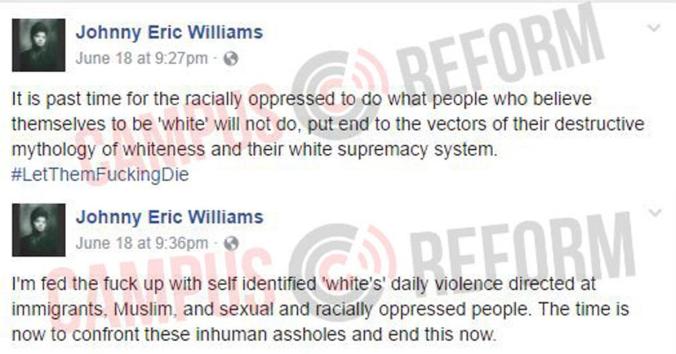
After Professor Johnny Eric Williams, associate professor of sociology at Trinity College in Hartford, approvingly posted a Medium article titled “Let Them Fucking Die” on Facebook, he went on to endorse the article’s thesis ( potential rescuers like those who helped Rep. Steve Scalise should let imperiled white people die as a form of combating white supremacy) in his own Facebook posts:

The Medium article concluded with this advice regarding one’s responsibilities as a citizen and a human being when a white person is in mortal peril… Continue reading

Morning Ethics Warm-Up: 6/22/17

1.  I’m trying to get this up while I prepare for a new legal ethics seminar, teaming once again with the brilliant D.C. actor Paul Morella who has toured the country in the Clarence Darrow one-man-show he and I collaborated on more than a decade ago, using Darrow’s career and courtroom oratory to analyze modern legal ethics.  Readers here have encountered a lot of those Darrow-related discussions already. For once, I’m grateful most lawyers don’t frequent this blog.

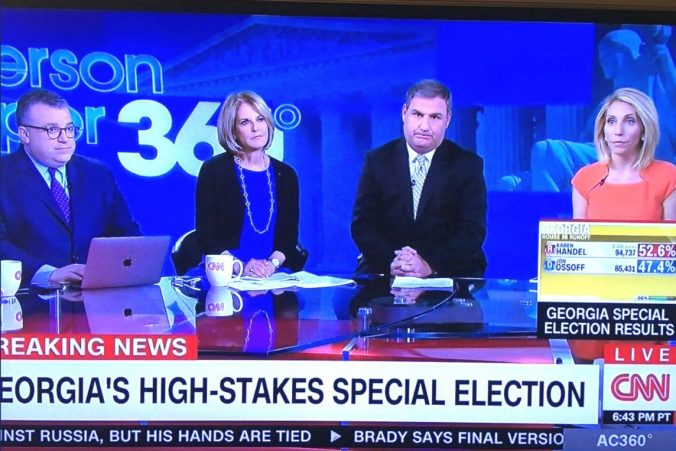
2. This now viral photo of the faces of CNN’s talking heads and analysts at the moment they realized that the Democrats had lost the Georgia Sixth District special House election that was hyped to be the beginning of a surge to the Left rejecting Donald Trump…

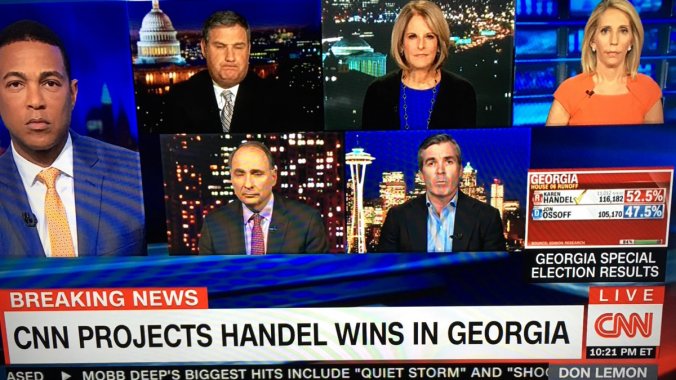
…and this one…

…are more than just gags. They are smoking gun evidence of the stunning lack of professionalism in journalism, and especially CNN. If there was any sensitivity or commitment to ethics on that set or in that production chain of command, every one of these arrogant hacks would have been told, “I want poker faces up there at all times. Objective and fair news reporting includes body language and facial expressions. Your attitudes warp your reporting. If anything about your demeanor betrays your personal preferences or political biases, you’re getting suspended. Got that? This isn’t a cheerleading squad.

3.  This warrants its own post, but today will be a squeeze, so I’ll focus on the astounding chutzpah of  that race’s loser here and now. Losing Georgia Six Democratic candidate Jon Ossoff was interviewed by NPR’s Rachel Martin, and this exchange resulted: Continue reading

Comment Of The Day: “Comment Of The Day: ‘Ethics Quote Of The Week: Ken White of Popehat’”

This is the second Comment of the Day within a week from Ethics Alarms prodigal son Curmie, a college prof, who makes the case that college education is being excessively maligned. You should probably re-read the post he’s responding , another Comment of the Day, to appreciate his argument.

Here is Curmie’s Comment of the Day on the post, Comment Of The Day: “Ethics Quote Of The Week: Ken White of Popehat”:

This is a cogent analysis up to a point, but I must say I’m more than a little sick and tired of having people tell me what goes on in my classroom. I teach at a non-flagship state university. And the description of what happens in college classrooms simply does not match my experience of them.

(Side note to Ryan: I really do like a lot of what you’ve said here. I apologize if the succeeding sounds like a personal attack. It is not intended in that spirit. Just one too many sweeping generalizations about my profession, and the last straw happened to be yours.)

Ryan cites Thomas Aquinas. I prefer the great late-20th century philosophers known as Monty Python: “I’m not dead yet.”

I do expect students to know some objective facts: if you can’t tell me the basic tenets of neoclassical theory or who David Garrick was, you’re not going to fare well in my theatre history class. If Ryan wants to say that in this sense I insist on regurgitation, he has my permission to do so.

But to get an A on the research paper, you’d better be able to interpolate from incomplete data, and to articulate a point of view based on the facts as they are available to us. That means finding out what the facts are, but also finding context: okay, so it cost a penny to see a play at the Globe Theatre. But that’s a meaningless statistic if you don’t know what that Elizabethan spectator could have bought for a penny if he didn’t spend it on standing room in an outdoor theatre. Continue reading

Ethics Quiz: The Ferguson Settlement

News Item:

The parents of black teenager Michael Brown and the city of Ferguson, Missouri, have settled a lawsuit over his fatal shooting by a white city police officer in 2014, according to a court document filed on Monday. …Terms of the wrongful death settlement between Ferguson and Brown’s parents, Michael Brown Sr. and Lesley McSpadden, were not disclosed. U.S. District Judge E. Richard Webber approved the settlement and ordered it sealed.

“The gross settlement amount is fair and reasonable compensation for this wrongful death claim and is in the best interests of each plaintiff,” Webber wrote. Both James Knowles, the mayor of the blue-collar, largely black St. Louis suburb, and Anthony Gray, the lead attorney for Brown’s parents, declined to comment.

Wait, what?

A thorough investigation found Officer Wilson guilty of no crime, nor did the shooting appear to be the result of officer malfeasance or negligence. Brown’s parents, Michael Brown Sr. and Lesley McSpadden, meanwhile, took extraordinary measures to stir up racial hatred and anti-police sentiment, not just locally but nationally, sparking deadly riots in Ferguson and elsewhere, and leading to attacks on police. They even made a human rights complaint to the United Nations, based substantially on a lie (“Hands up! Don’t shoot!”) concocted by their son’s friend and credulously reported as fact by the news media. By what theory are Brown’s parents deserving of damages from Ferguson? By agreeing to this settlement, is not Ferguson setting the precedent that any time a black suspect is shot by a white police officer, it is a wrongful death mandating damages?

Your Ethics Alarms Ethics Quiz of the Day:

Was this settlement, whatever the amount, ethical?

I’ll launch the debate by saying that the city probably had no choice but to settle, as the sooner this whole catastrophe can get in the rear view mirror the better off the city will be. In the narrow sense, then, the settlement was in the city’s best interest and the responsible course.

Long term, however, I see nothing but bad results flowing from this result. If Wilson was not wrong, then Brown was at fault. If Brown was at fault, his family should not benefit. If Ferguson paid out a significant amount when its police officer behaved reasonably, then Ferguson just set a precedent that Black Lives Matter could have authored in its dreams.

If a black victim is shot by the police, it is  racism and a wrongful death per se, whatever the facts are.

Ethics Quote Of The Week: Ken White of Popehat

“A few hysterically censorious kids screaming for a professor’s termination for crimethink do not threaten the foundations of free speech, but Yale lauding them does. Relatively few thugs disrupting a speech and even physically assaulting a professor don’t call into question the culture’s support for free speech, but Middlebury offering weak slaps on the wrist and shrugs for that violent behavior does. A violent mob in Berkeley does not undermine the legitimacy of free speech doctrine — a mob is a mob — but Berkeley’s timorousness or indifference in the face of violent censorship does. Students furious at a professor disagreeing with them don’t call into question the nation’s commitment to freedom, but state officials refusing to guarantee a professor’s safety do. In short: the regrettable behavior of officials who have failed to stand up to disruption of speech are the people most responsible for legitimizing further disruptions of speech, whoever commits them.”

——Lawyer/blogger/ free speech champion Ken White, writing about efforts on both the Left and the Right to interfere with or punish speech and opinions they don’t approve of.

Well and truly said, Ken.

Ken continues,

“But we can, and should, do better. Commitment to free speech as an American value — as an element of American exceptionalism — has always required tolerating evil and injustice and idiocy. We don’t refrain from disrupting speech because the speakers deserve it, or because we’ve been treated fairly by the speakers or their allies. We refrain from disruption — and ought to punish those who disrupt — because free speech is the necessary prerequisite of a society based on individual rights and freedoms. It’s the right that’s the gateway to all other rights. Shrugging and abandoning it as a value is an abandonment of our commitment to all rights.”

Why is this so hard to teach in colleges? Perhaps because the faculties and administrators prefer that their students never learn it.