Without Courage, Integrity And Professionalism In The Legal Profession, The Rule Of Law Hasn’t A Prayer: The House of Representatives v. Burwell Saga

" Nice law firm you got here. Too bad if something were to happen to it..."

” Nice law firm you got here. Too bad if something were to happen to it…”

As I explained  here and here in 2015, the process of judicially determining whether the Defense of Marriage Act was constitutional or not was unethically sabotaged by  threats to and improper lobbying of the law firm that had agreed to defend it. The Justice Department and the President had refused to do their sworn duty to uphold the laws of the United States, and same-sex marriage activists pressured the biggest client of the firm that had accepted the case to pass the pressure along. It worked. The firm dropped the case, precipitating a resignation by the partner handling it and this ringing assertion of traditional legal ethics:

“…[D]efending unpopular positions is what lawyers do. The adversary system of justice depends on it, especially in cases where the passions run high. Efforts to delegitimize any representation for one side of a legal controversy are a profound threat to the rule of law.”

This was, we are learning, not an anomaly. On the Volokh Conspiracy, law professor Josh Blackmon relates how the same strategy of applying of unethical political pressure, and the unprofessional capitulation of major law firms to it, nearly made a legitimate challenge to illegal payments to insurers under Obamacare impossible. He explains in part: Continue reading

California Decides It’s The Government’s Function To Help Actors Pretend They Are Younger Than They Really Are

picture-of-a-birthday-cake-with-lots-of-candles

California increasingly appears to be hell bent on serving as the cautionary example of how the belief that government has an unlimited brief to meddle in everything leads to abuse and derangement.

Gov. Jerry Brown last week signed legislation that prevents  entertainment websites such as the Internet Movie Database (IMDb),from posting an actor’s age or birthday if the actor doesn’t want anyone to know how old he or she is.

The law, which becomes effective January 1, applies to entertainment database sites that allow paid subscribers to post resumes, headshots or other information for prospective employers. Only a paying subscriber can make a removal or non-publication request. The beneficial end that supposedly justifies  this unconstitutional and suppressive means is that age discrimination is allegedly rampant in show business.

“Even though it is against both federal and state law, age discrimination persists in the entertainment industry,” Golden State legislature Majority Leader Ian Calderon, D-Whittier, said in a statement. “AB 1687 provides the necessary tools to remove age information from online profiles on employment referral websites to help prevent this type of discrimination.”

Naturally the actor unions are all for this form of government censorship. “Gov. Jerry Brown today stood with thousands of film and television professionals and concerned Californians who urged him to sign AB 1687, a California law that will help prevent age discrimination in film and television casting and hiring,” said SAG-AFTRA President Gabrielle Carteris. You remember Gabby, don’t you? She was the brainy, non-sexy teen in the original “Beverly Hills 90210.” I’m sure she thinks the reason her career tanked as she edged into middle age was “discrimination.”

I’ve seen you act, Gabrielle. It wasn’t. Continue reading

Tales Of The Insidious Double Standard: SNL’s New Latina’s Tweets

You better be hilarious, kid...

You better be hilarious, kid…

 Saturday Night Live recently announced that it was hiring its first Latina cast member, as the show has finally capitulated to placing diversity over humor as a priority. Mexican-American comedian Melissa Villaseñor, 28,  the designated quota-filler, barely had time to take a victory lap before that mean internet thingy tracked down some embarrassing baggage, especially for a performer recruited to buff SNL’s progressive credentials. Aura Bogado, a writer for Grist,  tweeted that Villaseñor had deleted more than 2,000 tweets from her archives over the course of a week.

Why, you ask? Well, because there were tweets like this…

snl-tweet5

aaaand THIS…
snl-tweet4…this:
snl-tweet-1
…THIS…

Continue reading

Next Up At Bat On “Controversial Tweet Friday,” The Reserve Catcher’s Tweets!

cropped_clevenger

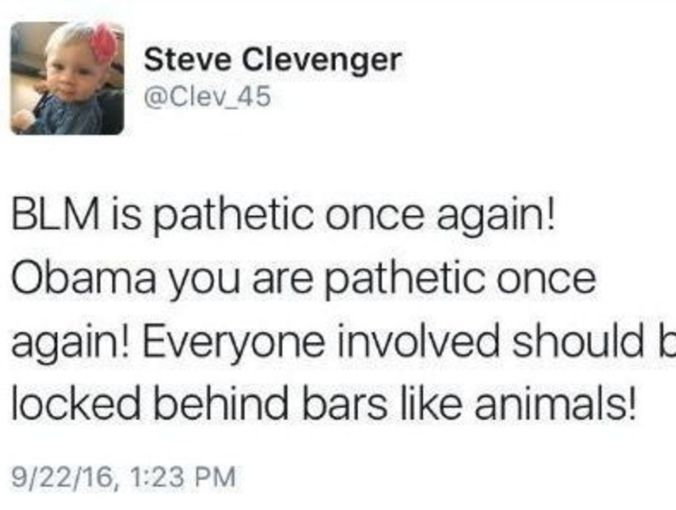
Like Prof. Reynolds, Seattle Mariners second-string catcher  Steve Clevenger decided to express his unhappiness with the riots in Charlotte using his Twitter account, and also like the “Instapundit,” found himself in trouble as a result. Before posting the above tweet, Clevenger wrote this as his introduction:

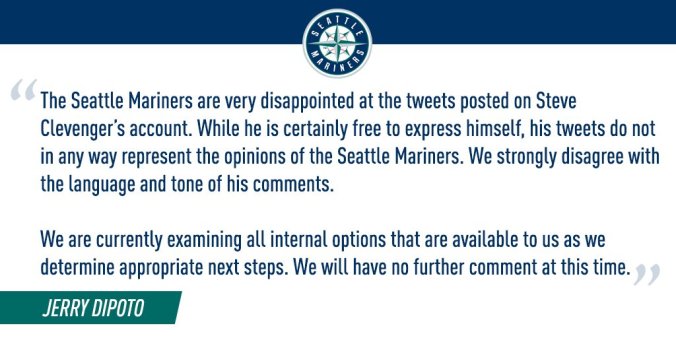
cropped_steve_clevenger1Twitter didn’t suspend Clevenger’s account, but his employer, a baseball team located in a very liberal city and also a team that is embroiled in a desperate fight to make the play-offs, reacted initially with this, also on Twitter…

mariners-tweet

Clevenger apparently didn’t expect that his tweets would suddenly result in his being labelled as a racist blight on humanity  by the many, many, people on social media who live for such incidents, and he quickly released a long and emotional apology:

First and foremost I would like to apologize to the Seattle Mariners, my teammates, my family and the fans of our great game for the distraction my tweets on my personal twitter page caused when they went public earlier today. I am sickened by the idea that anyone would think of me in racist terms. My tweets were reactionary to the events I saw on the news and were worded beyond poorly at best and I can see how and why someone could read into my tweets far more deeply than how I actually feel.

“I grew up on the streets of Baltimore, a city I love to this very day. I grew up in a very culturally diverse area of America and I am very proud to come from there. I am also proud that my inner circle of friends has never been defined by race but by the content of their character. Any former teammate or anyone who has met me can attest to this and I pride myself on not being a judgemental person. I just ask that the public not judge me because of an ill worded tweet.

“I do believe that supporting our First Amendment rights and supporting local law enforcement are not mutually exclusive. With everything going on in the world I really just want what is best for everyone regardless of who they are. I like many Americans are frustrated by a lot of things in the world and I would like to be a part of the dialogue moving forward to make this a better world for everyone.

” I once again apologize to anyone who was offended today and I just ask you not judge me off of a social media posting. Thank you and God bless everyone.”

Steve Clevenger

Continue reading

Observations On The Instapundit’s Tweet

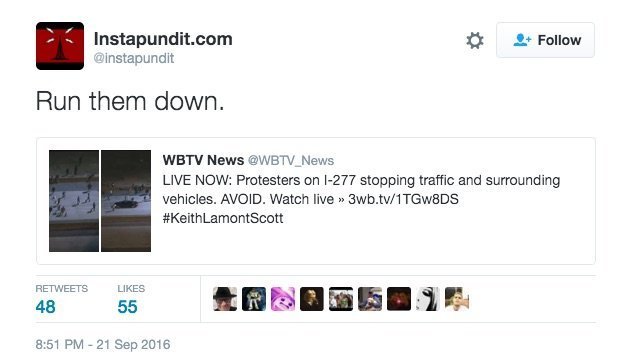
reynolds-tweet

Yesterday, conservative law professor, author and blogger Glenn Reynolds learned that Twitter had suspended his account, and he wrote on his iconic website Instapundit...

Can’t imagine why they’d do that, except that it seems to be happening to a lot of people for no obvious reason. It’s as if, despite assurances to the contrary, Twitter is out to silence voices it disagrees with or something.

Then he learned that his offense was the above tweet. Reynolds wrote…

Sorry, blocking the interstate is dangerous, and trapping people in their cars is a threat. Driving on is self-preservation, especially when we’ve had mobs destroying property and injuring and killing people. But if Twitter doesn’t like me, I’m happy to stop providing them with free content.

and..

“Run them down” perhaps didn’t capture this fully, but it’s Twitter, where character limits stand in the way of nuance”

But one of Reynolds’ extra-curricular gigs (he is a University of Tennessee law professor) is monthly columnist for USA Today. After the progressive Furies took to social media and demanded that he be fired from the law school, dropped by the newspaper and forced to wander in the wilderness in sackcloth, Gannett’s paper suspended him for a month.

Reynolds was reinstated by Twitter after purging the offending tweet, and he issued this mea culpa to USA Today:

Wednesday night one of my 580,000 tweets blew up. I didn’t live up to my own standards, and I didn’t meet USA TODAY’s standards. For that I apologize, to USA TODAY readers and to my followers on social media.

I was following the riots in Charlotte, against a background of reports of violence. Joe Bruno of WSOC9 interviewed a driver whose truck had been stopped by a mob. Trapped in her cab, she “feared for her life” as her cargo was looted. Then I retweeted a report of mobs “stopping traffic and surrounding vehicles” with the comment, “Run them down.”

Those words can easily be taken to advocate drivers going out of their way to run down protesters. I meant no such thing, and I’m sorry it seemed I did. What I meant is that drivers who feel their lives are in danger from a violent mob should not stop their vehicles. I remember Reginald Denny, a truck driver who was beaten nearly to death by a mob during the 1992 Los Angeles riots. My tweet should have said, “Keep driving,” or “Don’t stop.”

I have always supported peaceful protests, speaking out against police militarization and excessive police violence in my USA TODAY columns, on my website and on Twitter itself. I understand why people misunderstood my tweet and regret that I was not clearer.

Today, Reynolds wrote on Instapundit:

TWITTER HAS UNBLOCKED MY ACCOUNT ON CONDITION OF DELETING THE OFFENDING TWEET. But lest I be accused of airbrushing, it’s preserved here. Still planning on quitting Twitter, though, after making a few points. Earlier post is here. UPDATE: From Nick Gillespie at Reason: In Defense Of InstaPundit’s Glenn Reynolds. “Whatever you think of the tastefulness of his suggestion regarding the protesters in Charlotte, the idea that he is seriously inciting any sort of actual or real threat is risible.”

Related: “Glenn Reynolds is old enough to remember Reginald Denny. (Look it up, kids.)”

and

SO MY USA TODAY COLUMN is suspended for a month. My statement is here. I don’t apologize for saying that you shouldn’t stop for angry mobs, even if they’re blocking your way. But I could have said it better

Observations:

Continue reading

Why It’s Unethical For Journalists To “Fact Check” Donald Trump—Especially CNN Journalists

Donald Trump

In Donald Trump’s meaningless statement yesterday, which was covered by the news media as if it was the revelation of the millennium, he  officially conceded that Barack Obama is a natural born U.S. citizen. He also used the silly media attention to drag out his announcement into a long campaign infomercial for which he didn’t have to pay a cent. Nice, and it serves the broadcast media right for giving any significance to a five-year-long trolling exercise.

Trump used the phony controversy over President Obama’s birth certificate to get publicity five years ago, because he is shameless. That’s all. Did he really think Obama was born in Kenya? Oh, who knows? He is an idiot, after all. Then again, he is a skilled professional troll. Whether he believed it or not, Trump used the issue to get attention then, and now has used his 180 degree reversal to get attention now. Obviously nothing has changed that would justify this flip-flop if he believed what he insisted was true for five years. A more transparently cynical and insincere retraction I cannot conceive. Who cares what Trump says he believes at any point, about anything?

But I digress. What really seemed to enrage the journalists who have embraced Rationalizations #28. The Revolutionary’s Excuse: “These are not ordinary times,” and #31. The Troublesome Luxury: “Ethics is a luxury we can’t afford right now” to anoint themselves as full-time volunteer members of the Hillary for President campaign, was that Trump said this:

“Hillary Clinton and her campaign of 2008 started the birther controversy. I finished it.”

Quoth the thoroughly partisan news media,

“ARRGH!!!!:

Continue reading

Sometimes It All Comes Together…But First, A Song!

As those who have read here for a while know, among my fondest passions, virtually life-long, are baseball,  theater and ethics. Today, I have the pleasure of seeing them all come together in a single event. How often does that happen?

At noon, I will be giving my most recent musical Continuing Legal Education ethics seminar, “Ethics Cabaret,” at Nationals Park in D.C. prior to the Mets-Nats game. “Ethics Cabaret,” like its six predecessors, presents legal ethics hypotheticals  as parodies of pop, rock, Broadway or country-western standards, presented by a professional performer. In this case, the performer is American Century Theater veteran Esther Covington, who accompanies herself on the keyboard. I write the songs that make the young lawyers cry, but she sings them, beautifully and often hilariously.

Speaking of Barry Manilow, my favorite segment of the seminar is the parody of one of his signature songs, which you can hear above—it’s an ear-worm, so be careful. The legal ethics version is about “Bridge of Spies” and the many quandaries raised in the film, which I examined in this post earlier this year. The parody is called “Who is the Client?,” lyrics-only copyrighted by ProEthics. Here they are….you can sing them along with Barry’s version! Continue reading

Ethics Hypothetical: Rules, Compassion, Integrity, Fairness, And A Looming Race Card

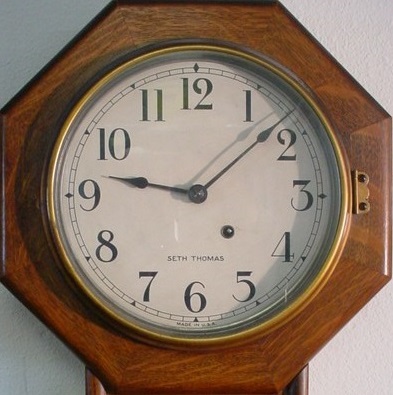
clock2

[The hypothetical is inspired by two recent events I witnessed in the past week.]

Preface: The state requires new bar admittees to take a one-day course covering the basics of practicing law in the jurisdiction—how the courts work, special procedural rules, unique aspects of local practice, horror stories, the works. They must complete the course or they can’t be certified, and the court-ordered series of lectures and presentations is held only once a month.

A company runs the mandatory curriculum under contract to the state, and is required to confirm in writing to the courts that its requirement have been fulfilled. One key requirement is that every attendee must be present for every minute of the presentations, except for brief emergencies, like using the rest rooms. The course administrators carefully monitor attendance. The published description of the course directs that once the course begins, theoretically at 9 am sharp, no late-comers will be admitted.

As you might imagine, missing the session can be quite a hardship, as participants often live and work in other jurisdictions.

The Event: It is 9:08 am on the day of the program, and the introductory video that begins the orientation is almost finished. It consists of interviews with members of the bar about the benefits of practicing in the state, the importance of ethical practice, etc: to say it is not substantive is an understatement. Literally nothing that is said and shown in the video is anything but boilerplate.

A young man, sweating profusely, bursts in the door, looking unhappy and desperate. “I’m sorry I’m sorry!” he babbles. He says that he had to drive up from a neighboring state and had an accident. “Can I still get in?” he pleads.

The male staffer responsible for the session chats briefly with an associate. The program was late starting, and this late arrival will miss nothing if he goes in now. “All right,” the honcho says as the young man heaves a sigh of relief. “I shouldn’t do this, but you haven’t missed anything.” As he goes into the auditorium, one can here the opening remarks of the first speaker, a judge. It is now 9:12 am, and another young man bursts through the door on a dead run. “My crazy cabbie’s been driving me all over the city for an hour!” he shouts. “I flew in last night from Arizona! Please, please, don’t make me do this again…I barely was able to afford this trip.” The administrator is wondering if he had seen the previous guy go into the auditorium. He’s heard this judge’s spiel many times: all that has been missed, to be honest, are a few (lame) jokes. “All right, all right, get in there quick!” he tells the new supplicant. “I’ll finish your paperwork during the break!” The kid looks like he’s going to cry, he’s so relieved.

I’m there, watching this (I’m on the program) and say to the administrator, “I bet this happens every time.” He says, “It does. I know that nobody misses anything that isn’t in the printed materials until 9:15, so it’s a hard stop after that.”

And another late arrival bursts through the door. It’s a bit after 9:14. The staffer has just told me that the final final deadline is 9:15, and it’s not that yet. This poor guy is bleeding through his pants,  has a big bruise on his face, and is saying something about a bicycle accident. By the time he gets himself settled—he is told that there is no time to clean up—it’s past 9:16. He starts toward the auditorium door as the other staffer says, “OK, that’s IT,” and starts to take the registration materials and lists away….just a very stressed young African-American woman enters, in plenty of time to see the bicycle rider, who is white, enter the auditorium. I can hear the judge through the open door. He’s still telling jokes, longer this time than usual.

Issues and Observations

1. The young woman was not admitted, and told that she had to come back another month. She too was from out of state. She also had a legitimate-sounding excuse.

  • Was that fair to her?
  • Should it have mattered that the program had not yet reached a serious stage?
  • She was told that 15 minutes was the absolute, unwaivable deadline. That was true, but it was not the deadline the company was contracted and pledged to enforce. That deadline was 9:00 am.

2. Should the explanations used by the latecomers play any part in the decision to allow them in? Why? Continue reading

Ethics Quiz: Ammon Bundy’s Cowboy Boots

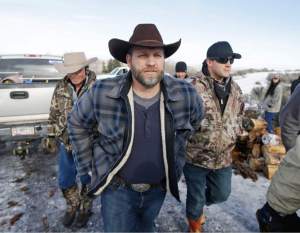
Ammon Bundy. Nice look...that last name is a problem, though.

Ammon Bundy. Nice look…the jury should like it. That last name might be a problem, though.

Jury selection is was about to begin last week  in the trial of Ammon Bundy (Son of Cliven, no relation to Ted) and his fellow defendants who led an armed stand-off on federal lands in Oregon.  First, however, the judge in the case had to rule on Bundy’s lawyer’s motion demanding that the defendants, who are in custody, can wear neckties, belts and boots at trial as requested.

The U.S. Marshal’s Service  emailed  Bundy and the rest to alert them that certain  items of apparel wouldn’t be permitted at their trial: “Ties, Bows, Belts, Handkerchiefs, Cuff Links, Steel toe boots/shoes, Shoe laces, Shirt tie down straps, Safety pins, Shirt pocket pen protectors.” When U.S. District Judge Anna J. Brown Tuesday afternoon asked Barbara Alfono, the deputy U.S marshal in charge of the Bundy trial, about the requirement, she explained that security concerns were the source of the order. Those accessories could be used as weapons against deputy marshals or the defendants themselves, she said. As for the boots, they would interfere with the shackles that are placed around the defendants ankles as they are transported to and from the courthouse. (The shackles will be removed, because prior courts have ruled that they are prejudicial, making defendants look dangerous to the jury.)

J. Morgan Philpot,  Ammon Bundy’s marvelously named lawyer, argued that since his client is innocent until proven guilty, he should be allowed to wear the civilian clothes that he chooses.  “These men are cowboys,” Philpot wrote  in his motion, “and given that the jury will be assessing their authenticity and credibility, they should be able to present themselves to the jury in that manner.” He continued:

“We must consider, when he does so, how will he look? And what are the spot assumptions and impressions will the jury have about him when they see him in the kind of white socks and loafers he was wearing today, with his beltless trousers, and dressed in a formal suit without a tie,Just as significantly, how will the lack of belt, tie, or other apparel compare to others in the courtroom, as he and the other detained defendants are the only ones who will appear that way.”

The judge ruled against him.

Your Ethics Alarms Ethics Quiz of the Day:

Is it ethical for the system to prevent accused cowboys from looking like cowboys during their trial?

Continue reading

Jacoby Ellsbury, Catcher’s Interference, And The Perplexing Ethics Problem Of “Using A Shield As A Sword”

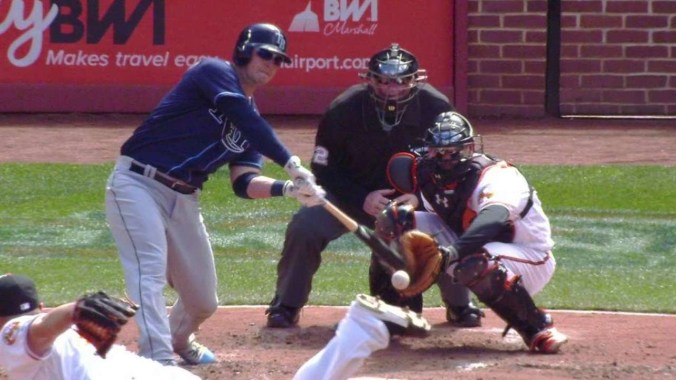
interference

I led two legal ethics seminars for the Oregon State Bar yesterday. For some reason the issue of “using a shield as a sword ” kept coming up.

“Using a shield as a sword” is when lawyers game the ethics rules. Many local bar associations include a pledge within their creeds promising not to intentionally use the ethics rules as a tactical weapon; still, it’s not an enforceable promise. Examples are limited only by a lawyer’s devious ingenuity, but they usual involve one side creating a conflict of interest for the opposing firm or lawyer that will force the lawyer to withdraw from the case. One ploy: a lawyer recruits a key expert witness specifically because she was once a client of the the lawyer on the other side, making it impossible for her to be impeached on the witness stand by that lawyer because he would have confidential information about her that he would be bound to keep secret, even while being required to represent his current client by ripping her credibility to shreds.

What does this have to do with Yankee centerfielder Jacoby Ellsbury? Well, Ellsbury is in the process of shattering an obscure baseball record: number of times reached base on catcher’s interference during a season. Catcher’s interference refers to instances in which a catcher makes any contact with a batter or his bat during a pitch. Usually, this involves the batter’s bat hitting the catcher’s glove, as in the photo above. When that happens, a player is awarded first base. The rule is based on fairness and  designed to protect the batter, but apparently Ellsbury has perfected the weird practice of using it as an offensive weapon.

Jacoby Ellsbury became the single-season record holder in catcher’s interference calls  in July with his ninth instance  getting rewarded for it. The record was formerly held by Roberto Kelly, who did this eight times in 1992.  Since breaking the record, Ellsbury has gotten catcher’s interference called three more times, for a current total of 11 with almost a month  left to the season. He is also second all-time in catcher’s interference with 23. The career record belongs to Pete Rose with 29; since Rose is baseball’s all-time leader in games played and career at bats, we would expect him to hold this record. No one else in baseball history has more than 18. Ellsbury is only five catcher’s interferences shy of Rose’s mark, and has done it in less than a third of the at bats. Continue reading