The story that the great radio story-teller Paul Harvey would now tell us the rest of was the subject of the post below, from August 2024. As you will see, it made my head explode, but there has finally been a resolution, and ethics and common sense prevailed. Review the horrible case. Will voters really hand power back to the party that not only responsible for such things, but that still wants to establish them as our national standards? Really?
But I digress. Here is the original post, and I’ll add the recent developments at the end…
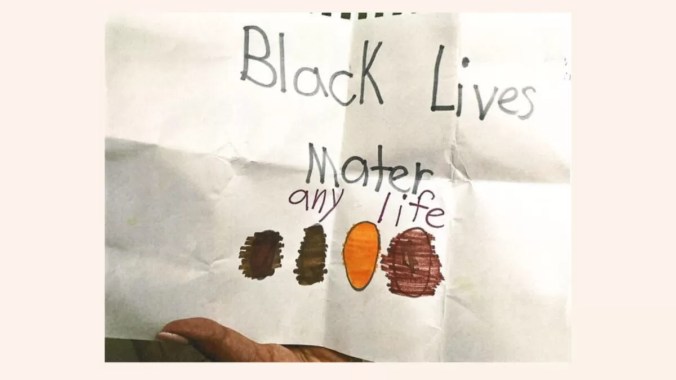
That crude, ambiguous drawing above got a first grader—we’re talking six-years-old here—suspended. That’s almost all you have to know for your head to explode if it is properly wired.
The Ethics Villains and Dunces are so thick in this fiasco you could use it to lay bricks. I’m almost embarrassed to tell the story, which I first saw at Reason…
In March of 2021, a first grader referred to as “B.B.” ” drew a picture we are told was intended to show people of different races, representing “three classmates and herself holding hands.” (I’d save the money the family was planning on spending on art school for B.B., if that was their intent.) Above the drawing, B.B. wrote “Black Lives Mater” (Latin!) with the words “any life” stuck in-between the slogan and the jelly beans, or whatever they were. B.B. then gave the drawing to a black classmate, as what B.B. testified was intended as a friendly gesture. But the classmate either ratted out B.B. or the principal was told about it by the teacher, or something (because school administrators don’t have anything better to do than to police the political correctness of kids’ drawings).
The school’s principal, Jesus Becerra, admonished B.B., saying that the drawing was “inappropriate.” B.B. was ordered to apologize to her classmate, prohibited from drawing any more pictures in school, and prevented from going to recess for two weeks.
Back in 2015, in an earlier grade- and recognition-inflation post, I wrote in horror about the growing tendency of high schools to name up to a third of the graduating class “valedictorians.” I observed in part,
“…this atrocious practice is obviously catching on. Integrity is such a chore. Excellence, superiority, achievement…they are all chores too. As for the genuinely superior students, they are out of luck: this is the high school equivalent of all the gladiators standing up and crying “I’m Spartacus!,” except now it’s “I’m the smartest one in the class!” This Maoist denial of the fact that some of us earn more success than others and that there is nothing wrong with doing so is all the rage…”
In a cover essay in the current issue of Harvard Magazine, Lindsay Mitchell writes about “The True Cost of Grade Inflation,” focuses not on the costs of deceiving employers and flooding the job market with young sufferers of the Dunning-Kruger syndrome, but on student self-esteem and stress. The former Harvard instructor writes in part,
“…As Amanda Claybaugh, the dean of undergraduate education who authored the October grade inflation report, told me, “One might expect that a world where everyone got A’s would be a very relaxed world, but actually, it’s the most stressed-out world of all.”…The psychology driving this grade-frenzied atmosphere stems from the way A’s flooding the marketplace changes their value as a currency, rendering them both essential and trash at the same time. When you feel that everybody’s got an A, then you must get one, too—every time—or you have failed to keep up with the mainstream. Yet all the A’s in the world will still do zilch to get you ahead…
“…the swelling fear of not keeping up with the perfectly graded masses discourages students from taking academic risks. On campus, stories abound of introductory classes populated by enrollees who don’t need them—many have already taken a version of the same class in high school—but who are willing to repeat the material to have their A outcome in the bag. In those classes, if there’s a curve set by the highest or median score, students taking the class to actually learn the material are often left to claim the lower grades.
“And instead of picking courses that might prove challenging or just exploratory, many students aggressively seek out “gems,” the new Harvard slang for “guts”: easy classes without rigorous grading schemes. Meanwhile, the number of students taking classes pass-fail drifts upward, as students cower before intimidating subjects and elect the route that obviates grading altogether…terrified students would often email me their revised drafts repeatedly to get me to say they were “okay” before I graded them. On occasion, someone emailed me every couple of hours when I didn’t respond immediately. With one abject soul, I was able to track her miserable night by looking at the string of messages she dispatched through the wee hours, while I was sleeping. She had sent me her thesis statement over and over—with each successive iteration showing an almost imperceptible tweak—pleading with me to tell her if it sounded like an A thesis…When students become this obsessed with grades, the student-teacher interaction is reframed in crudely transactional terms…I, as the instructor, acted merely as a giver of A’s, and my willingness (or lack thereof) to grant them in turn defined the value of the student, who would go out into the world and make money or attain status in proportion to her graded value. With this mindset, my students mostly received solid A’s with an attitude of relief rather than joy. Any grade below that, on the other hand, landed as deflating or even ruinous, depending on how GPA-dependent that student’s future plans were…
“In my own classes, I frequently encountered reading comprehension issues serious enough to hamper the putative goal of a writing class—and even seemed to witness students’ reading skills degrading in real time. In my early Expos days, I liked to bring an old Lampoon parody of a Harvard student essay into class to read aloud together—with each person taking the next sentence round robin at the seminar table—as a lighthearted way to kick off a discussion of my students’ own papers. After several years, though, I noticed more and more students seemed unfamiliar with the vocabulary in the parody, with many now stumbling over words like “penchant,” “motif,” and “preponderance.” I finally stopped bringing the Lampoon piece to class, since by then the laughs had turned scarce and the faces had turned red with embarrassment…These students were not puffed up with unjustified praise, like the entitled Harvardian of the grade inflation think pieces. They showed awareness that they were not performing as well as they should…Many students feel the inflated grades they’ve received compose a smooth edifice that surrounds them and could crumble at any moment to reveal the pockmarked reality of their performance. For some, this can become a source of shame, because their inflated A’s suggest their faults are unspeakable and must be hidden, whereas, for all they know, other students’ A’s are entirely deserved. Grade inflation then becomes a dimension of imposter syndrome that reflects other aspects of this generation’s coming-of-age experience. It is similar to looking repeatedly at a friend’s social media posts portraying her life as perfect, while knowing that your own posts were curated to obscure a multitude of flaws…
“Most of the students I talked to about the grade inflation report, even while admitting grades are too high, took a defensive stance. They were already being worked to the point of exhaustion—and now Harvard was talking about making things harder yet? These conversations confirmed how entrenched grade inflation is in the modern educational landscape. To reinstate strict academic standards, Harvard will need to help students see how a world with fewer A’s could be a better one for all involved…”
[This is a long post, but I urge you to read it all the way through. I cannot imagine a more powerful rebuttal to the advocates of “diversity, equity and inclusion.”]
Last October, in “Harvard’s Self-Indicting Grade Inflation Report,” I wrote about the school’s embarrassing report that revealed that 60% of the grades handed out at the supposedly elite college (my alma matter, and my sister’s, and my father’s, where my mother was Dean of Housing once-upon-a-time) are now As, making Harvard resemble Garrisons Keilor’s imaginary Minnesota community where “all the children” seem to be are “above average” even though that’s impossible.
In a prescient comment (as is often the case), AM Golden wrote in part, taking off from a Dean Amanda Claybaugh’s statement that it was desirable to “ produce a broader distribution of grades,”
That’s the problem. They don’t want to admit they accept unqualified applicants because many of those applicants will be disproportionately minorities. Returning standards to what an elite institution should have will mess with the faculty push for D.E.I. The standards have to stay low if the experiment is to be prioritized over pure academics. They have set too many precedents to easily back away now…
They have created bubbles where remote learning, mask wearing, protesting for the correct causes and making equal outcomes are virtues valued over a solid education. Backing up now will cause mass revolt on campuses. Like the news media, the colleges will be accused of caving to Trump. The asylum has been run by people who should have been inmates for so long that the actual inmates can’t be helped.
Sometimes I think Ethics Alarms is the only online community where clear-eyed vision dependably resides. For right on cue, as Harvard announced a long term effort to start grading seriously again, a coalition of “of color” Harvard students sent this open letter to the campus:
A few days ago, I saw a chart showing what U.S. demographics believed that the United States invented slavery. I noted it for a future post, and now I can’t find it, but I found plenty of authority that supports that assertion. Coleman Hughes, a fellow at the Manhattan Institute for Policy Research and a fellow and contributing editor at their City Journal, has been making this point for years. Way back in 2016, The College Fix wrote in part,
For 11 years, Professor Duke Pesta gave quizzes to his students at the beginning of the school year to test their knowledge on basic facts about American history and Western culture.
The most surprising result from his 11-year experiment? Students’ overwhelming belief that slavery began in the United States and was almost exclusively an American phenomenon, he said.
“Most of my students could not tell me anything meaningful about slavery outside of America,” Pesta told The College Fix. “They are convinced that slavery was an American problem that more or less ended with the Civil War, and they are very fuzzy about the history of slavery prior to the Colonial era. Their entire education about slavery was confined to America.”…
The origin of these quizzes, which Pesta calls “cultural literacy markers,” was his increasing discomfort with gaps in his students’ foundational knowledge.
“They came to college without the basic rudiments of American history or Western culture and their reading level was pretty low,” Pesta told The Fix….
Often, more students connected Thomas Jefferson to slavery than could identify him as president, according to Pesta. On one quiz, 29 out of 32 students responding knew that Jefferson owned slaves, but only three out of the 32 correctly identified him as president. Interestingly, more students— six of 32—actually believed Ben Franklin had been president.
Pesta said he believes these students were given an overwhelmingly negative view of American history in high school, perpetuated by scholars such as Howard Zinn in “A People’s History of the United States,” a frequently assigned textbook.
A dumb or obviously biased opinion column in what passes today for our journalism platforms arguably isn’t strictly “unethical.” It does, however, demonstrate incompetence, contempt for the public, or in many cases indolence, as in “Hey Marge! We need something to fill that space on the Op-ed page!” “Oh hell, let’s publish that thing about reparations. It will be good for a few Letters to the Editor.” “Okay! You got it!”
“This year, Evanston, Illinois, will send $25,000 payments to 44 Black residents and descendants of Black residents who lived in the city between 1919 and 1969,” writes Erec Smith, a research fellow at the Cato Institute and a former associate professor of rhetoric at York College of Pennsylvania. Oh! He must be an expert, then! How come he can’t spell “Eric”?
Erec continues,
“At its core, the Evanston program is race-specific, providing benefits solely to Black residents who meet narrow historical criteria. This raises an obvious legal question: Can the government dole out money based on race? Critics have already flagged the program as constitutionally questionable under the equal protection clause of the 14th Amendment. Beyond legality, there is a broader question about fairness. The program compensates some individuals while excluding others who may face equal or even greater financial need. Wealthier Black residents in Evanston receive the same payments as those struggling economically, while low-income residents of other races receive nothing. Isn’t a poor White person more in need of that money?”
Listen above to Newsom, the incompetent governor of California, as he engagingly insults a roomful of African Americans. Promoting his Presidential campaign-launching memoir, “Young Man in a Hurry,” Newsom was asked about his dyslexia and his personal experiences that voters could relate to (the old “he understands people like me” trope that Bill Clinton exploited so well). He responded by describing his struggles with dyslexia and somehow managed to sound like he regarded his low SAT scores as a badge of honor, telling the almost all black audience: “I’m like you. I’m no better than you.”
Already there are many discussions of this—what was it? A gaffe? A canny bit of self-deprecation? Smoking gun patronizing?—on the web and social media. To me, and I admit I’m mired in confirmation bias when I look at anything Newsom does through the lens of his frightening EA dossier—I mean, just look at that mess!— I classify the remark as pure res ipsa loquitur: the thing speaks for itself. Newsom blundered into expressing the attitude progressives and Democrats have had toward American blacks for decades. They believe that it is a voting bloc that is easily fooled and exploited, and, as a group, gullible and not too swift on the uptake. That’s Newsom, and that’s the Democratic Party that he wants to lead.
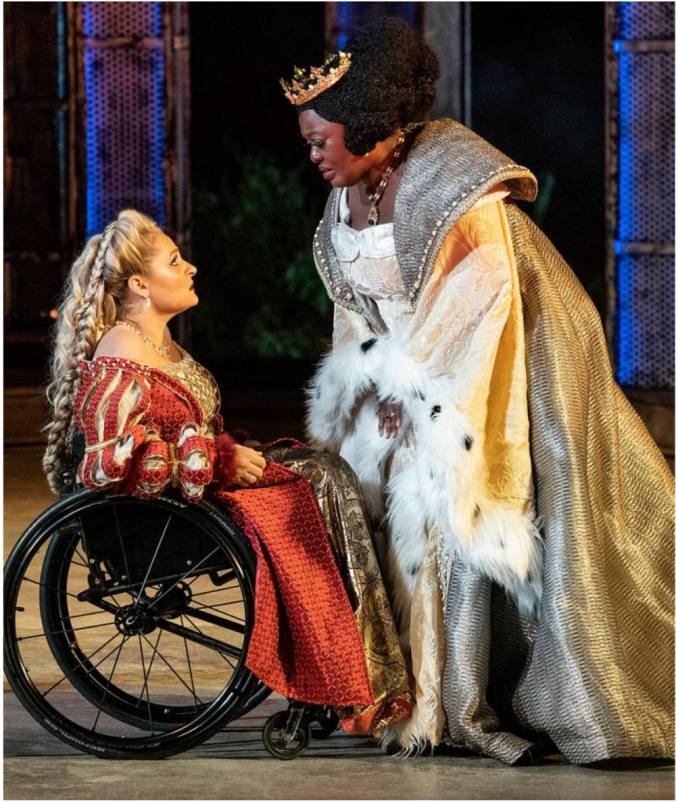
“But I don’t think it’s necessarily antiwoke to tell an all-white story or to relegate nonwhite characters to the margins, if that’s where they fit the creative intentions.”
—Former Washington Post theater critic Naveen Kumar in the paper’s “Whitewashing ‘Wuthering Heights.'”
Oh, well that’s really big of the critic, don’t you think? How generous of him! He is willing to concede that a director might still be regarded as a good person if he or she doesn’t cast actors “of color” (you know, like the critic) to play characters written as white, visualized by the playwright as white, in a story obviously about white people!
Yes, this fatuous, offensive statement came late in an essay that was already obnoxious, with the biased and reductive headline, “Whitewashing ‘Wuthering Heights’.” [Gift link!] The Post post was defending, sort-of -but- not-really, Emerald Fennell’s “Wuthering Heights” film, in which Heathcliffe, Emily Bronte’s hormonal romantic anti-hero, is played…
…by a white actor. Never mind that previous film adaptations have cast Heathcliff as white, notably the classic starring Lawrence Olivier in the role, probably because he was the best actor alive at the time.
Yes, it is true that the ethnicity of Heathcliff has always been a matter of debate: with Bronte describing him as “dark-skinned,” a “gypsy,” and a “little Lascar,” a term for South Asian sailors. The idea is that he is an outsider and at the bottom of the social ladder; that certainly would justify casting a black, Indian or other non-white actor, but certainly doesn’t mean he has to be played that way. (I would not think that casting Heathcliff as Swedish would work, but you never know: I could see one of the Skarsgaard boys pulling it off.)
I chose that memorable Saturday Night Live bit above because it shows Jesse Jackson, the civil rights leader who died today, at his best: smart, self-deprecating, charming and likeable. Jackson could slide into demagoguery (he was good at it), and he was frequently, even usually, a divisive presence on the national scene. Nonetheless, he was ultimately a catalyst for more good developments in American society, culture and politics than bad. But it’s a close call.
Civil rights was by no means achieved by the time Martin Luther King was assassinated in 1968. The stain of Jim Crow was still strong in the South, and de facto segregation was rife everywhere else, as in my hometown of Boston where it often seemed like there were more black players on the field playing for the Red Sox than in the stands at Fenway Park. The school busing controversy was six years away in 1968.
With the eloquent and charismatic King martyred, the nation needed a new leader of the civil rights movement. Malcolm X was brilliant and charismatic but radical and racist. Rev. Ralph Abernathy was boring, a pale (no pun intended) successor to King. The other leaders of the civil rights movement resonated as grifters, determined to prove Eric Hoffer right when he argued that “Every great cause begins as a movement, becomes a business, and turns into a racket.” As happens so often in American history, Jesse Jackson was the right leader to emerge when the nation needed him.
REPORTER: “Mr. President, you frequently criticize Joe Biden for not knowing what is going on in his name. This racist video that was posted is on your social media.”
PRESIDENT TRUMP: “I know what’s going on a hell of a lot better than you do! You don’t know what’s going on! I know what’s going on. No, Joe Biden didn’t have a clue, but we know everything. And when you look at what’s happening with our economy, think of it, we’re way years ahead of schedule. We have thousands and thousands of businesses being built right now, so Joe Biden had no clue. If Joe Biden were elected or if Kamala were elected, we wouldn’t have country right now. We won the election because of minority voters.”
REPORTER: “Does this post maybe hurt Republicans with, you know, Black voters after the…”
PRESIDENT TRUMP: “You know, I was, look, we did criminal justice reform. I did the historically Black colleges and universities. I got them funded. Nobody has been, and that’s why I got a tremendous, the highest vote with male Black voters that they’ve seen in many, many decades. I’ve done great with them. Black voters have been great to me. I’ve been great them. Black voters has been great me. I’ve been great to them. And I am, by the way, the least racist president you’ve had in a long time, as far as I’m concerned. We have — I’ve had a great relationship. Think of what I’ve done. Criminal justice reform. Nobody else could do it. Obama couldn’t do it, nobody could do. Clinton couldn’t. They actually went the other way. They went into a very bad thing for African American people, Black people. They went to a — they did very bad things. I did very good things. But criminal justice reform, and then I funded the universities, which nobody else was willing to do. They were going every year, they’d come back to Washington and they’d be begging for money, begging. I got to be friendly with some of the heads of the schools and they would come back and they would literally tell me they’re forcing us to beg. I’m the one that got them long-term financing and more than they were looking for. So there’s nobody that’s done more. And I think maybe more than anything else was criminal justice reform. They’ve been trying to get it for years. And I’m the one that got it done, so nobody can tell me about that.”
“That somebody posts, the staffer posts, you know, posts. And I knew it was all about, if you take a look at that, and see the whole thing, it was a small section at the very end. But that was about fraudulent elections, which we have, a lot of them. We’re gonna get it stopped. And I liked the beginning, I saw it, and just passed it on.”
Immigration from Africa and the Middle East has transformed the demographics of Europe in recent decades. And while the growing diversity is reflected in many sports such as soccer — Sweden’s men’s national team has several Black players including Liverpool striker Alexander Isak — it hasn’t made a dent in winter sports…At the Milan Cortina Winter Olympics, Sweden is sending a team made up almost exclusively of ethnically Swedish athletes, with NHL player Mika Zibanejad, whose father is from Iran, a rare exception. That hardly reflects the diversity of the Nordic country: About 2 million of its 10 million residents were born abroad, about half of them in Asia or Africa, according to national statistics agency SCB.
The lack of athletes of color at the Winter Olympics — and in winter sports in general — has been a recurring theme in the U.S., which is sending one of its most diverse teams to the Games. It hasn’t gotten the same attention in Europe.
The Olympic rosters of France, Germany, Switzerland and other European winter sports nations look a lot like Sweden’s: overwhelmingly white and lacking the immigrant representation seen in their soccer or basketball teams…”



 Ethics Alarms