Ethics Quiz: Disney’s Maui Costume

maui

It’s a bit early for Halloween costume controversies , but the outrage machine is ever vigilant, and has provided a provocative ethics quiz, though not a difficult one if one isn’t the Headless Horseman.

Disney released a Halloween costume for kids that will allow tykes to dress up as the Polynesian demi-god Maui, a character in its new animated movie “Moana.” This is classic Disney cross-marketing, what Wells Fargo would call “cross-selling,” and what Elizabeth Warren would call “evil,” because it makes money for a big corporation. The difference is that Disney allows customers to actually purchase such products intentionally, while Wells Fargo charges customers for products without their knowing it.

Wait, how did I get off on Wells Fargo and Warren? Right: the next post. Sorry.

Back to Maui: The costume features a body-suit with thin brown material covered by traditional Polynesian tattoos, as well as a grass skirt and a plastic bone necklace. As soon as it was released on the web, the costume was attacked as racist (it’s the equivalent of blackface, critics say) and an example of cultural appropriation. Marama Fox, co-leader of New Zealand’s Maori Party, said that selling the costume is “no different to putting the image of one of our ancestors on a shower curtain or a beer bottle” while Pasifika news site Samoa Planet described the release as “cultural appropriation at its most offensive worst”.  The New Zealand Human Rights Commission issued a statement calling on Disney to “listen to the views of the communities and people whose cultures their movie is based upon.“ Translation: “Bend to our will, or else.”

Activist Chelsie Haunani Fairchild argued on Facebook that Disney was encouraging a children to wear “the skin of another race.”

“Polyface is Disney’s new version of blackface. Let’s call it like it is, people,” Fairchild argued in a video.

Oh, let’s!

Your Ethics Alarms (Ridiculously Early Halloween) Ethics Quiz of the Day is this:

Is there anything genuinely unethical about making, advertising, selling or wearing the Maui costume?

Continue reading

Unethical Quote Of The Week: President Barack Obama

“If I hear anybody saying their vote does not matter, that it doesn’t matter who we elect — read up on your history. It matters. We’ve got to get people to vote,” Obama said. “I will consider it a personal insult — an insult to my legacy — if this community lets down its guard and fails to activate itself in this election. You want to give me a good sendoff? Go vote.”


President Obama's argument for electing Hillary Clinton...

President Obama’s argument for electing Hillary Clinton…

—-President Barack Obama, addressing the Congressional Black Caucus gala in a speech excoriating Donald Trump and praising Hillary Clinton as the candidate of black America. Obama warned that while his name would not be on the ballot in November, all of the progress that the country has made over the last eight years was on the line. 

Observations: 

1. What progress? This is the Big Lie that has been repeated from the beginning? The greatest progress made in the last eight years has been the stock market, which is not, I assume, the progress the Congressional Black Caucus cares about. Divisions in American society have been exacerbated, and grossly so. Racial trust is at its lowest level in decades. The schools? Higher education? The debt? The nation’s leadership abroad? The Affordable Care Act, which has helped health insurance become less affordable for anyone not receiving government subsidies? Gross incompetence, malfeasance and lack of accountability in one federal department and agency after another: is that progress?  Has there been progress in dealing with the threat of terrorism? Murder rates are up after years of decline. There have been more mass shootings in this administration than in the last three combined. More Americans are on public assistance: is that progress to Obama? A majority of the public thinks the country is off the tracks; public trust in government is at its lowest point in history, far lower than after Watergate. First Amendment, Second Amendment, and Fourth Amendment rights are under assault as never before. Progress?

The question isn’t political, it’s ethical: if there isn’t progress, then Obama’s statement is a lie. By his own benchmarks when he ran for office, the major one being governing as neither white or black, liberal or conservative, but for the welfare of the entire nation, he has failed disastrously, and the signs are everywhere. No, his spinners don’t get to argue that there would have been progress if the evil Republicans in Congress hadn’t foiled Obama (in part because he hasn’t the political skills to negotiate or the political courage to compromise), because Obama said there IS progress. Continue reading

A Moral Luck-Riddled Ethics Quiz: The Compassionate, Correct, Fired Police Officer

man-pointing-a-gunI have solicited opinions from some police authorities , and have yet to receive an answer. Maybe that’s cheating, though.

On May 6 of this year,  Weirton, West Virginia police officer Stephen Mader confronted a distraught and armed man after responding to a domestic violence call. “I saw then he had a gun, but it was not pointed at me,”  Mader told reporters. A silver pistol was in 23-year-old Ronald Williams’ right hand, hanging at his side and pointed at the ground.

Officer Mader calmly told Williams to put down the gun. “Just shoot me, ” Williams  responded, and jerked his wrists, suggesting that he was preparing to raise his weapon. “I’m not going to shoot you brother, ” replied Mader.

“I thought I was going to be able to talk to him and de-escalate it. I knew it was a suicide-by-cop,” he said.

Then two other Weirton officers arrived on the scene. Williams walked toward them waving his gun, and one of Mader’s colleagues shot Williams in the head, killing him instantly.

A West Virginia State Police investigation later concluded that the shooting was justified. Mader, in the meantime, faced an investigation of his own. In a meeting with his chief and the city manager,  Mader was told that he was being placed on administrative leave, and that an investigation would determine if he would still be employed.  “You put two other officers in danger,” the police chief told him.

Following the investigation, Mader received a notice of termination stating that by not shooting Williams, Mader“failed to eliminate a threat.”

Your Ethics Alarms Ethics Quiz of the Day:

Was it fair and responsible for the department to fire Officer Mader as a result of this incident?

Continue reading

Ethics Quote Of The Month: Hillary’s “Basket Of Deplorables”

basket-of-deplorables

“You know, to just be grossly generalistic, you could put half of Trump’s supporters into what I call the basket of deplorables. Right? The racist, sexist, homophobic, xenophobic, Islamophobic — you name it. And unfortunately there are people like that. And he has lifted them up. He has given voice to their websites that used to only have 11,000 people — now 11 million. He tweets and retweets their offensive, hateful, mean-spirited rhetoric. Now some of those folks — they are irredeemable, but thankfully they are not America.”

—-Democratic nominee Hillary Clinton during a fundraiser—just as Mitt Romney’s infamous “47%”  comment in 2012 was made at a fundraiser!—the LGBT for Hillary Gala in New York City on Sept. 9, 2016.

One of the consistent features of both Clintons is that they engage in so much problematic conduct that often one incident worthy of serious criticism will be knocked out of the headlines by another.

Hillary’s 9/11 “over-heating, well, dehydration, well, ok, since it’s on video, she has pneumonia” fiasco,  demonstrating that suspicions that she and her campaign aren’t being truthful about the state of her health are not “conspiracy theories,” effectively muted discussion about her “basket of deplorables” classic, complete with an imaginary word, “generalistic,” that if it had been uttered by George W. Bush would have been mocked far and wide.

I categorize this as an ethics quote rather than an unethical quote, because it is both ethical and unethical simultaneously. (The Clinton’\s seldom say things that aren’t adaptable to multiple interpretations; this allows them to leap from one to the other, like they are ice floes, when one meaning is justly condemned or found to be false.)

On the ethical side, it is completely fair and accurate to diagnose Trump supporters as deplorable, defined as “lamentable, or deserving censure or contempt.” This doesn’t apply to those conflicted potential voters who have reluctantly decided that in the terrible binary choice Americans have had shoved down their civic gullets by the two incompetent political parties, Donald Trump is preferable to Hillary Clinton. That is not the most responsible choice—it can’t ever be responsible to give such power to an unstable and ignorant boor—but it is an excusable mistake, given the horrible dilemma.

Supporting Trump, however, as in actively wanting him to become President, is as good a definition of “deplorable” as I can imagine. In this respect, Hillary was too generous. 100%, not merely 50%, of Trump’s supporters are deplorable. They lack the values, civic responsibility, understanding of their own nation and its history, or sufficient intelligence to be competent voters.

You know: deplorable. Continue reading

Observations On A Bad Police Stop


The ACLU of Colorado last week posted the above  video of an Aurora, Colorado police encounter with two black citizens last February.

The sequence, drawn from one of the officers’ body camera, shows Darsean Kelley and another man being stopped by police after they had received a call about a man allegedly pointing a gun on a child, but with no description of the man. Kelley and his companion were standing on the sidewalk in the vicinity of the alleged incident. Police asked the men  to sit down, which Kelley said was impossible to do because he had a groin injury. Officers then told both men to put their hands behind their heads and turn around. As his friend remained silent and apparently compliant, Kelley kept his hands raised and asked why he was being detained. Immediately after he said, “I know my rights!” one of the officers shot him in the back with a stun gun. He fell backwards into the street.

The police then arrested Kelley on a charge of disorderly conduct for failing to obey a lawful order. In his report, the officer wrote that he thought he might be reaching for a weapon. The ACLU of Colorado then filed a motion to dismiss the case arguing that Kelley was unlawfully detained and arrested without probable cause or reasonable suspicion.

Observations:

1. Kelley and the other man were unlawfully detained and arrested. Were they unlawfully stopped? No. The police could stop men in the vicinity of a complaint like the one they had received in order to investigate it. When people become belligerent or uncooperative during such legal stops, cops sometimes become suspicious, or decide to use their power to stick it to an individual who shows hostility when the officers feel they are just doing their jobs, or trying to. This is when such situations escalate.

I’m sure the officers regarded the “I can’t sit down” claim as suspicious and provocative. I would. Note that no harm befell the other man, who remained quiet and followed the officers’ instructions. This is the correct way to respond.

2. I’m sure Kelley felt that he was being “stopped for being black.” I would if I were him. How are police officers today supposed to allay this suspicion at the outset of a legitimate stop? (Or maybe they WERE stopped for being black…)

3. What is the policy for tasing? The typical hierarchy for the use of force in police departments used to be this:

Table 1: Use-of-Force Continuum
Suspect resistance Officer use of force
1. No resistance 1. Officer presence
2. Verbal noncompliance 2. Verbal commands
3. Passive resistance 3. Hands-on tactics, chemical spray
4. Active resistance 4. Intermediate weapons: baton, Taser, strikes, nondeadly force
5. Aggressive resistance 5. Intermediate weapons, intensified techniques, nondeadly force
6. Deadly-force resistance 6. Deadly force
(Adapted from the Orlando, Florida Police Department’s Resistance and Response Continuum)


After the introduction of more powerful electronic control devices, many departments changed  their use-of-force directives  for handling suspects who were only passively resisting the lawful orders of the officer, and increased the required level of resistance by suspects to warrant use of stun guns or tasers from passive resistance to active, physical resistance.

Table 2: Levels of Resistance Defined

Passive Resistance The subject fails to obey verbal direction, preventing the officer from taking lawful action.
Active Resistance The subject’s actions are intended to facilitate an escape or prevent an arrest. The action is not likely to cause injury.
Aggressive Resistance The subject has battered or is about to batter an officer, and the subject’s action is likely to cause injury.
Deadly-Force Resistance The subject’s actions are likely to cause death or significant bodily harm to the officer or another person.
Adapted from the Orlando, Florida, Police Department’s Resistance and Response Continuum

I don’t know what the Aurora police policy is, but certainly under the kinder, gentler, saner revised standards above, stunning Kelley was excessive. Police brutality is not an unfair description of what he experienced. Continue reading

The Cos Plays The Race Card

race_cardBill Cosby’s lawyer, Brian McMonagle,  issued a statement this week claiming that the comedy legend’s legal problems are the result of racial bias and prejudice. He really did.

“Mr. Cosby is no stranger to discrimination and racial hatred, and throughout his career Mr. Cosby has always used his voice and his celebrity to highlight the commonalities and has portrayed the differences that are not negative — no matter the race, gender and religion of a person. Yet over the last 14 months, Mr. Cosby and those who have supported him have been ignored while lawyers like Gloria Allred hold press conferences to accuse him of crimes for unwitnessed events that allegedly occurred almost a half-century earlier. The time has come to shine a spotlight on the trampling of Mr. Cosby’s civil rights. Gloria Allred apparently loves the media spotlight more than she cares about justice. She calls herself a civil rights attorney, but her campaign against Mr. Cosby builds on racial bias and prejudice that can pollute the court of public opinion. And when the media repeats her accusations — with no evidence, no trial and no jury — we are moved backwards as a country and away from the America that our civil rights leaders sacrificed so much to create.”

I don’t blame McMonagle, and nobody else should. He’s doing what he can to defend his client, who looks about as guilty as a man can. Nor did he say this without the approval of his client. Lawyers discuss their strategy with clients: if Cosby didn’t want to sink this low and look this desperate, he didn’t have to. Then I would have been able to salvage a slim iota of respect for the man.

It isn’t worth much time or thought discussing how ridiculous this accusation is. Bill Cosby? White America’s darling? The Jello pudding man, the charming interviewer of kids, the educator who preached to black families that they need to raise their children to reject hip-hop culture? Whites made Cosby rich, powerful, and once, the most popular, respected and influential celebrity of any color in the nation. And suddenly they turned on him when they realized he was black?

The claim is an insult to African-Americans who really do face bias and discrimination. More important, however, it is so depressing. Is there any prominent African-American in the the public eye who is capable of not playing the race card when he or she is in trouble? I held out hope that Bill Cosby, as loathsome as we now know he is, might be an exception if only because the claim in his case is so, so absurd. Let’s see, which is the reason for Bill’s fall: a hundred women of all races coming forward to detail almost identical accounts of the comedian drugging and sexually assaulting them, or racial prejudice? Gee, let me think; this is a tough one. Never mind, though: apparently this alibi is so ingrained in black culture, so beaten into the brains of American blacks, so exploited by race hucksters and so much a foundation of the left’s politics that it exists as a permanent “In case of a crisis, break glass” last resort that is an African-American’s secret weapon—after all, when whites screw up, they can’t claim anti-white bias, though trends in government, justice and academia may be changing that.

If Roger Ailes were black, he would have attributed his fall at Fox to racial prejudice.

Clarence Thomas played the race card. So has Obama. O.J. Barry Bonds. Herman Cain. Susan Rice. Eric Holder. Kanye West, though in his case it is dwarfed by his other outrages. This is kind of an anti-matter version of “white privilege”: while whites, we are told, are blissfully unaware of all the ways their success, if they have any, is based on systemic advantages in the culture, blacks are immersed in the idea that they are being persecuted because of race and led by role models and leaders to develop a self-image that can render them incapable of ever knowing when the problem might be their own conduct rather than oppression by others. Continue reading

The Georgetown Time-Traveling Ethics Slavery Freak-Out, or “If You Can’t Count On Jesuits For Ethical Coherence, What Hope Is There?”

"Yikes! Gotta stop that slave sale in 1838!"

“Yikes! Gotta stop that slave sale in 1838!”

Last week, Georgetown University, one of the most prestigious  liberal arts institutions in the nation, took a flying leap into full-fledged radical lunacy, basicly announcing that the entire school’s mission, budget, operations and culture must be centered on self-flagellation for the sins of slavery, and inviting the rest of the nation to do likewise.

As first steps, announced by Georgetown University President John J. DeGioia, the descendants of the slaves who built and worked at the Jesuit institution will be given the same edge in admission consideration as the children of faculty and alumni. Two buildings on Georgetown’s campus campus will be renamed, one for a slave, the other for a black Catholic educator who founded a local school for black girls. The university will also launch a center to study slavery and commission a memorial to slaves. That’s just the beginning.

What spawned all of this–and there is much more to come, if the report guiding the university is going to have the influence it promises—is the discovery that  in 1838, a Georgetown University official, Father Thomas Mulledy, a co-president of the college, sold 272 slaves to a Louisiana plantation in order to keep the college open. Mulledy is being punished for this decision by having his name purged from a campus building and replaced by the name of one of the slaves who was sold. Now, nobody knows anything about “Isaac” other than his name. He could have been a bounder; he might have been a killer, a thief. Never mind. By virtue of simply being a black slave, he is now worthy of honor on the campus, and a priest who devoted himself to the college and his faith is consigned to oblivion.

Thus proceeds the airbrushing of history on our nation’s college campuses and elsewhere, as the leftist theory takes root that the way to control today’s minds is to remake the past to comfortable and politically correct specifications.

The building bearing the name of the other co-president who did not have the foresight to insist that the college dissolve rather than sell off assets in a completely legal and unremarkable transaction for the time will also be renamed, for a black Catholic educator who founded a local school for black girls…in other words, for someone with no connection to Georgetown University or reason to be honored there except her race.

Later, Georgetown is likely to enact other measures recommended in the report, such as mandating new students to take a“Historical Walking Tour of Black Georgetown,” touring the campus and the neighboring area to see sites that were involved with the institution of slavery. The report wants local public schools to collaborate with Georgetown  to teach students about the university’s involvement with slavery. The University needs to “invest in diversity” by improving the “racial climate” on the campus through sensitivity training, also known as indoctrination. There will be ongoing studies on the current consequences of the school’s dependency on slave labor, and, of course, much research will be required to determine who the descendants of those 272 slaves are. No doubt about it: this will be the go-to school for those who want four years of concentration on an institution that was abolished in 1865. Continue reading

Ethics Quiz: Ad Hominem Or Not?

I frequently find myself correcting commenters who accuse me of ad hominem attack when I diagnose their problem, based on their arguments as jerkism or mental deficiency. (I recently found one legal blogger who actually states that if a commenter uses the term incorrectly, the comment will be rejected). Ad hominem is an argument fallacy that holds that if a messenger is flawed, his or her argument can’t be valid. It’s a cheap debate tactic, and unethical. If I conclude, however, that your argument is so idiotic that it could only be devised by an  idiot and thus designate you as one in so many words (because you have a right to know), that’s not ad hominem.

African-American pastor Mark Burns is a rafter-shaking speaker and an unusual and useful advocate for Donald Trump. He has been on cable news segments frequently, and even spoke at the GOP Convention. Being black, he is obviously roundly detested by those who regard Trump as a bigot, indeed by those who just dislike Trump generally. This almost certainly includes journalists on CNN, a Hillary stronghold.

A member of the black fraternity Kappa Alpha Psi alerted CNN that  Burns had claimed to have been a member,  but there was no record to support it. This set CNN on a quest to check all of Burns’ credentials and biography items, and it found that he had other dubious claims. Confronted on the air by (also African-American) CNN reporter Victor Blackwell with these discrepancies, Burns stuttered, humina-huminaed, protested, lied (his web site bio had been “manipulated” in some way, he said—the Weiner Excuse: “I’ve been hacked!”), and finally stormed out of the interview, which is to say, he ran.

Mark Burns is a Trump ally and supporter of note because he is a black pastor. He is still a black pastor. He makes a case for why blacks should support Doonald Trump. That case does not in any way rely on his military record or where he went to school, or, for that matter, how well he responds to having his honesty and integrity challenged on TV.

Your Ethics Alarms Ethics Quiz of the Day is...

“Was CNN’s attack on Pastor Burns fair and responsible, or..

Was it an unethical ad hominem attack designed to discredit a Donald Trump ally?”

Continue reading

Curse You, Political Correctness Bullies! Now You’re Forcing Me To Defend Lena Dunham!

Dunham2

A downside of running an ethics blog is that you have to defend really disgusting people from time to time: Harry Reid, Bill Clinton, Donald Trump…and now Lena Dunham. In fact, this story rescued the “Girls” creator from a different post here, as she recently had to apologize for an online newsletter rant that attacked the character of NFL star Odell Beckham Jr. and attributed various sexist attitudes to him based purely on the fact that he showed no interest in her when they were seated together at a recent function. ( Legitimate reasons why he may have ignored her: he had other things on his mind, she’s not his type, she’s a professional jerk, she’s Lena Dunham).

Before I have to defend Dunham, who is an awful person based on available evidence, let me make a few observations. One is that fame in the 21st Century can expose the unsavory and unethical nature of the famous far more than it did in pre-social media days. This is part of Donald Trump’s plight. Another is that Twitter and social media are literally traps for jerks, and it is amazing that so many of them keep getting caught, even with the bodies of previous trap-ees littering the immediate landscape. Finally, I wonder if there are still publicists around in the tradition of my late friend, Bob McElwaine. and if there are, why doesn’t Lena hire one to save her from herself? Bob was a Hollywood Golden Age publicist who saw his job as keeping the fact that his clients were jerks secret. He was great at it: his major client was Danny Kaye, a truly vile, troubled and nasty individual whose public persona was exactly the opposite.

All right, enough stalling.

For some reason, this Dunham tweet from five years ago surfaced, and has led a social media lynch mob to attack Dunham as being a racist…

Dunham tweet

Pop quiz: What exactly is it about the tweet that makes it racist?

The answer is “Nothing.” Racism requires attributing negative features or conduct to an individual or group based solely on racial bias and prejudice. It is not racism to base conclusions on statistical reality. Interestingly, most of the attacks on the tweet claim that the tweet is anti-Asian. It is racist to attribute virtuous qualities, like a reluctance to rape, to a race? Wow! Apparently the tweet is being condemned as a slur on Asian manhood. Since when is it manly to rape someone? Silly me: I assumed that Dunham was referring to well-documented  cultural support of respect for women, law-abiding conduct and other ethical virtues in Asian-American families.

Or is the complaint that by assuming an Asian-American is less of a threat than a male of another race, Dunham was by extension saying that other races were more of a threat? This would most fairly interpreted as an anti-white slur, however, since whites make up almost 75% of the population of convicted rapists. I thought anti-white bigotry was OK in political correctness circles! Continue reading

Incompetent Elected Official Of The Month: Maine Gov. Paul LePage (R)

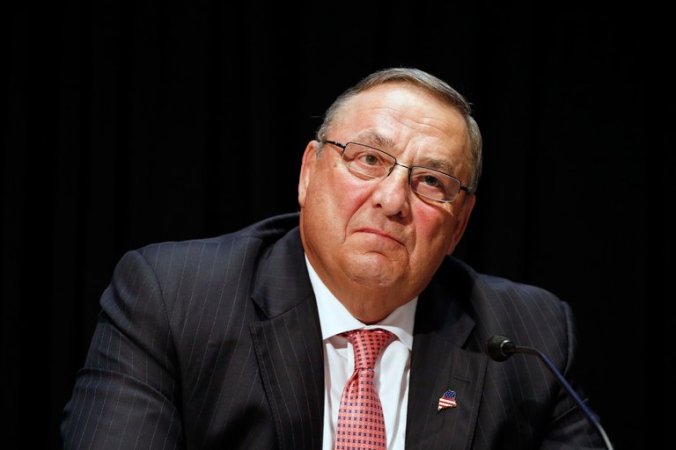
lePage

Those who want a glimpse into what a Donald Trump presidency would be like need look no farther than the perpetual self-created mess that is the tenure of Republican Paul LePage as governer of Maine. The New York Times recently provided a handy summary of his more recent embarrassments and attacks of absurd incivility and unprofessional behavior:

2016

April

Mr. LePage apologized after storming offstage and calling protesting students “idiots” during a public appearance.

March

Mr. LePage displayed “Wanted”-style posters aimed at environmentalist and union groups during a town meeting, saying those groups were holding the state back.

February

Mr. LePage said asylum-seekers brought disease and the “ziki-fly.” When asked to apologize at an event in June, Mr. LePage did not, and said conditions like hepatitis C and H.I.V. were on the rise in Maine. Mr. LePage also drew criticism that month for appearing to mock a Chinese businessman’s name.

That month, Mr. LePage also delivered his State of the State address in the form of a letter, breaking the tradition of giving a speech to lawmakers. He said it would be “silliness” to address lawmakers who had tried to impeach him.

January

Mr. LePage apologized for a “slip-up” after saying drug-dealers would come from out of state and “impregnate a young white girl” before leaving. The drug dealers, he said, in a comment that was widely perceived as racially charged, “are guys with the name D-Money, Smoothie, Shifty — these types of guys.”

2015

July

Mr. LePage apologized to the son of a cartoonist for The Bangor Daily News because he had told the son he would “like to shoot” his father. That comment drew criticism, with some noting its added insensitivity given the attack at the Charlie Hebdo newspaper in Paris earlier that year, although the son said he was not offended.

June

A charter school in Maine said Mr. LePage had threatened to take away its funding if it did not rescind a job offer to the House speaker, Mark Eves, a Democrat.

“The full power of the state was used to put a father of three out of a job because he was a lawmaker who disagrees with the governor on policy,” the editorial board of The Press Herald wrote.

Some Democrats called for impeachment, but an effort to investigate Mr. LePage — which would have been a precursor to impeachment in January 2016 — did not muster enough support for a vote.

May

Mr. LePage vowed to veto all Democratic-sponsored bills until the party accepted his effort to eliminate the state’s income tax. The question of whether Mr. LePage had vetoed 65 bills within the proper time frame ended up in the State Supreme Court, which found that the bills could stand as law.

2013

August

Two lawmakers, who remained anonymous, said they had heard Mr. LePage say at a fund-raiser that President Obama “hates white people.”

June Mr. LePage made a graphically lewd statement about Troy Jackson, a Democrat who was the assistant Senate majority leader at the time. He added that Mr. Jackson was a “bad person” with “no brains” and a “black heart.”

2012

July

Mr. LePage compared the Internal Revenue Service to the Gestapo in a radio address. Asked about the comment in a follow-up interview several days later, he said: “What I am trying to say is the Holocaust was a horrific crime against humanity and, frankly, I would never want to see that repeated. Maybe the I.R.S. is not quite as bad — yet.”

2011

January

Mr. LePage said leaders from the N.A.A.C.P. who had questioned his decision not to attend Martin Luther King’s Birthday events could “kiss my butt.”

2010

September

During his campaign for governor, Mr. LePage told a group of fishermen that he would tell Mr. Obama to “go to hell.”

People like LePage and Trump don’t improve over time, because they don’t learn. If they did, they would not still behave like this at such advanced ages. Thus Governor LePage recently shattered his own record for outrageous conduct, whatever it was, beginning last week.  LePage told a town hall meeting addressing the current heroin-use epidemic in Maine that most drug dealers in the state were black or Hispanic, and that he had a binder to prove it. Continue reading