Comment Of The Day: “I’m Sick Of Hearing These Arguments That College Admissions Favor The Wealthy And Privileged…”

Humble Talent has provided a nicely provocative snapshot of the frustrating and weird state of the quest for fair college admissions. Here is his Comment of the Day on the post, “I’m Sick Of Hearing These Arguments That College Admissions Favor The Wealthy And Privileged Because The Problem Is Easy To Fix. So Fix It.” (It also touches on the “disparate impact” scam, discussed here in another context.)

***

What I have trouble dealing with is how incoherent some of the positions some of the people are taking are.

Legacy admissions are a great example. We all know why they’re happening: Legacy admissions are a great way of enticing future philanthropy out of donor parents. While I’m sure there are some racists in admissions, that’s financially driven, not racially driven. But we pretend it’s a racial issue because of disparate impact.

In fact, we’re supposed to pretend that legacy admissions are a resource of white supremacy, despite the fact that legacy admissions are almost perfectly proportionate, at least for white applicants (hovering very close to 70%). I don’t know about you, but if I were designing a system that was supposed to privilege my race over others, I might devise a system where my race isn’t almost perfectly proportionately treated.

Continue reading

Ethics Quiz: “Colored People” Bad, “People Of Color” Good!

I almost missed this kerfuffle completely. Of all people, one of my most reliably Democrat-supporting friends raised it, beginning by saying. “I know this is not something a good progressive is supposed to say or think, but….

…why in the world is it ‘racist’ to say ‘colored people’ but politically correct to use the term ‘people of color’ when by the undeniable rules of English, they mean exactly the same thing?”

She continued, “And how can anyone belonging to an organization called ‘The National Association for the Advancement of Colored People’ accuse someone of being a racist for saying it?”

Arizona Republican Rep. Eli Crane was arguing for his amendment to the defense budget and policy bill, as he wants to prohibit the Pentagon from requiring participation in DEI training or the use of ” race-based concepts” in the hiring, promotion or retention of individuals. In the course of debate, Crane said “My amendment has nothing to do with whether or not colored people or black people or anybody can serve, okay? It has nothing to do with color of your skin… any of that stuff.”

Recognizing a “gotcha!” when she saw one, black Democratic Rep. Joyce Beatty, an enthusiastic member of the racist Congressional Black Caucus, demanded Crane’s words be stricken from the congressional record. “I am asking for unanimous consent to take down the words of referring to me or any of my colleagues as “colored people,'” said the dues-paying member of the NAACP. Crane wanted to amend his comments to “people of color,” but Beatty insisted that she wanted his words stricken. Censorship is, after all, her party’s way, and no Republicans had the guts to object.The chair ordered Cranes entire statement stricken by unanimous consent.

Beatty then worked to exploit the gaffe for all it was worth, writing on Twitter: “I am still in utter and disbelief that a Republican uttered the words ‘colored people’ in reference to African-American service members who sacrifice their lives for our freedom… I will not tolerate such racist and repugnant words in the House Chamber or anywhere in the Congress. That’s why I asked that those words be stricken from the record, which was done so by unanimous consent.” Then the Ohio Democrat told CBS that Crane’s explanation that he “misspoke” was a lie. “He didn’t misspeak,” Beatty said. “He said clearly what, in my opinion, he intended to.” 

In other words, he intended to use a racist slur.

Your Ethics Alarms Ethics Quiz of the Day is…

What is fair treatment for Rep. Crane?

Continue reading

One Ethics Villain Promotes Another, As The Associated Press Pimps For Black Lives Matter On Its Anniversary

Sometimes an ethics story defies my ability to devise an appropriate headline. The AP story “Black Lives Matter movement marks 10 years of activism and renews its call to defund the police” is a prime example. The story is even worse than the headline (“activism” is a deceitful and deceptive euphemism for violence, lies, divisiveness and fraud), with the once-trustworthy news organization displaying the worst of U.S. journalism’s ethics rot.

The scam that is Black Lives Matter has done nothing but damage since its emergence in 2013, but to hear the AP tell it, this is a movement for Americans to honor. Let’s see…I haven’t checked yet, and I promise to reveal what I find: is the AP’s reporter who wrote this junk, Aaron Morrison, an African American?

Why yes, he is! What a coinkydink. This piece of propaganda could only have been written by a devoted supporter; the AP rigged the story. That’s American journalism in 2023.

Let me provide some highlights with commentary:

Continue reading

Ethics Dunces, Sociology Dunces, Law Enforcement Dunces…Whatever: The California Reparations Task Force

Try a mind experiment: if California’s ridiculous and racist Reparations Task Force wanted to exacerbate racial tensions as much as humanly possible while also making African-Americans seem as toxic to society as a KKK Grand Dragon could imagine in a fever dream, what would it be doing differently that it is doing right now? We know that the group is already recommending that millions of dollars in taxpayer reparations for slavery be handed out to the state’s blacks, even though slavery never existed in the Golden State. But wait, there’s more!

Continue reading

Falsely Describing Bad Research To Advocate Irresponsible Policies Is No Way To Serve On The Supreme Court, Justice Jackson…[Corrected And Expanded]

UPDATE: A critical Ethics Alarms reader informed me that in his view the text of this post was too similar to that of its main source, The Daily Signal, in an article by Jay Greene. Although I linked to the piece and also credited Greene with a quote, upon reviewing the post I agree that it included too many substantially similar sentences and phrasings. I apologize to the Daily Signal, Jay, and Ethics Alarms readers. I was using several articles in preparing the piece (including one from another source that was also extremely close to the Signal article), and for whatever reason, did not notice that I had leaned so heavily on Green’s phrasing. It has happened before over the past 13 years, though not often, and never with the intention to deceive. Thus I have revised the post; in the future, if anyone feels that an Ethics Alarms article does not properly credit sources or seems insufficiently original, the favored response is to alert me, rather than to accuse me in obnoxious terms of “plagiarism.”

Fans of affirmative action reacted to Justice Ketanji Brown Jackson’s depressing defense of racial discrimination by praising her remarkably hypocritical dissent in the recent 6-3 decision by the Supreme Court declaring Harvard’s and the University of North Carolina’s admission policies unconstitutional. Those who believe that Justices should base their analyses on law rather than group loyalties were appropriately critical. Both, however missed some really ugly trees for the metaphorical forest, as Jackson injected false statistics into her dissent. They were, of course—we’re used to this phenomenon—uncritically accepted and used in subsequent media propaganda condemning the decision.

Justice Ketanji Brown Jackson wrote in part,

“Beyond campus, the diversity that UNC pursues for the betterment of its students and society is not a trendy slogan. It saves lives. For marginalized communities in North Carolina, it is critically important that UNC and other area institutions produce highly educated professionals of color. Research shows that Black physicians are more likely to accurately assess Black patients’ pain tolerance and treat them accordingly (including, for example, prescribing them appropriate amounts of pain medication). For high-risk Black newborns, having a Black physician more than doubles the likelihood that the baby will live, and not die.”

Wow! Racial discrimination saves lives! The problem, or rather problems, are that as Jay Greene of the Daily Signal points out, 1) the claim that survival rates for black newborns double when they have black physicians attending is based on a misleading analysis 2) Even if the results of the Proceedings of the National Academy of Sciences study were as Justice Jackson claimed, they are unbelievable and 3) even if Jackson had described the results of the study accurately, and even if those results were credible, they still wouldn’t justify the use of racial preferences in medical school admissions.

Continue reading

Ethics Zugzwang And High School Theater

I have no idea what can be done about this now, but it is among the saddest consequences of the culture wars and The Great Stupid, and, as is so often the case, the casualties are children….which means that in the long-term, the casualty will be American society itself.

Ethics Alarms has periodically chronicled the sagas of high school theatrical productions halted or distorted by various politics- or ideology-based complaints and protests, but I never focused on what a tightening strangle-hold on cultural education this phenomenon represents. The New York Times examined the problem here, and though the Times slant seeks to blame it all on conservatives (you know, those meanies who also want to “ban books”), the description of the problem is accurate and gloomy. A sample:

Continue reading

Ethics Observations On The Left’s Unethical Three Freakout Day

Yesterday’s clean and persuasive Supreme Court decision finally striking down racial discrimination in university admissions after decades of pretending it wasn’t the Consitutional offense it was was followed by two more sound Constitution-based decisions that were as important as they were necessary. All three were quickly attacked as “partisan” and “extreme” when they were neither, except to those who find the boundaries imposed by our nation’s traditional democratic principles overly obstructive to their schemes.

Finally ruling on a lawsuit brought by six state governments, the Supreme Court rejected President Biden’s insane $430 billion student loan forgiveness plan as illegal because it was never authorized by Congress. In a cynical, Harry Reid-ish strategem to buy the 2022 mid-term elections, Biden had announced a $430 billion gift to mostly middle-class and wealthy citizens who were unable or unwilling to do what millions of Americans in their exact situation had done: paying back money they owed for a benefit they had received. In many ways it was progressive irresponsible government at its worst. The Constitution gives Congress, not the the White House,the power to determine how federal funds are spent. As Illya Somin wrote yesterday, “If the administration had won, Biden and future presidents would have been empowered to use vague statutes to usurp Congress’ constitutional control over the federal budget. Moreover, because of the context for this case, it also would have allowed the president to abuse emergency powers for partisan ends.”

The “partisan” accusation was especially dishonest (Vox: “The Supreme Court’s lawless, completely partisan student loans decision, explained”) since that famous right-wing partisan Nancy Pelosi had endorsed the position of the SCOTUS majority just two years ago, saying, “People think that the President of the United States has the power for debt forgiveness. He does not. He can postpone. He can delay. But he does not have that power. That has to be an act of Congress.” Chief Justice Roberts included her statement in his opinion for the majority, but facts don’t matter. The increasingly unhinged progressive mob, aided and abetted by the mainstream media, pronounced the decision the product of an “extreme” conservative majority running amuck.

Continue reading

Ethics Quiz: “Erica Marsh” [Corrected]

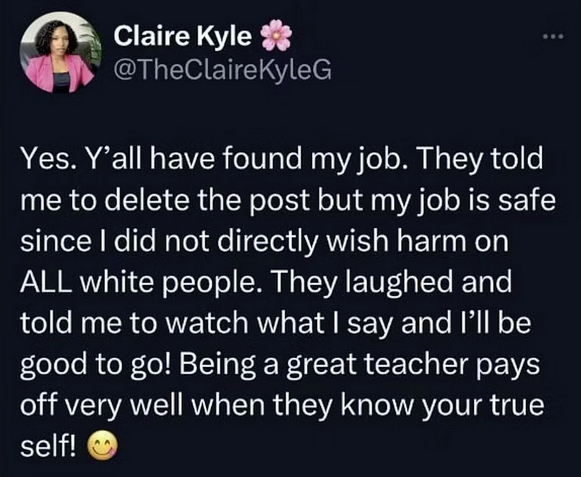
The tweet above has “gone viral” with its seemingly approving statement of the underlying arguments being raised in protest of yesterday’s SCOTUS decision ending affirmative action in universities. Conservative pundits and wags are using it to mock the hypocrisy and racism of progressives, some apparently believing the tweet is sincere, others believing it is satire but treating is as genuine anyway. The low-IQ quadrant of Woke World like the tweet because its denizens can’t detect its glaring idiocy; the smarter segment is outraged at the tweet’s blood-drawing power, and reacting like this:

Before I pose today’s ethics quiz question, here are a few things to consider:

Continue reading

SCOTUS Strikes Down Harvard’s Affirmative Action Admissions Policy

Good.

Much about this was predicted and predictable: the split, 6-3, in which the diversity trio (A wise Latina, the historic black woman, and a lesbian) took their required stand, and the decision’s spokesjustice, Roberts, who had signaled this result by famously saying, last time around this controversy, “The way to stop discrimination on the basis of race is to stop discriminating on the basis of race.” However, many thought the opinion would ultimately provide wiggle room for colleges, and it does not. From the opinion, here, by Chief Justice Roberts, who reflected on Justice Sandra Day O’Connor’s observation in a previous affirmative action case that “25 years from now, the use of racial preferences will no longer be necessary to further the interest approved today” (which signaled that the Court was allowing an exception to Constitutional requirements continue for a limited period):

Twenty years later, no end is in sight. “Harvard’s view about when [race-based admissions will end] doesn’t have a date on it.” Tr. of Oral Arg. in No. 20–1199, p. 85; Brief for Respondent in No. 20–1199, p. 52. Neither does UNC’s. 567 F. Supp. 3d, at 612. Yet both insist that the use of race in their admissions programs must continue.

But we have permitted race-based admissions only within the confines of narrow restrictions. University programs must comply with strict scrutiny, they may never use race as a stereotype or negative, and—at some point—they must end. Respondents’ admissions systems—however well intentioned and implemented in good faith—fail each of these criteria. They must therefore be invalidated under the Equal Protection Clause of the Fourteenth Amendment….

It is true that our cases have recognized a “tradition of giving a degree of deference to a university’s academic decisions.” Grutter, 539 U. S., at 328. But we have been unmistakably clear that any deference must exist “within constitutionally prescribed limits,” ibid., and that “deference does not imply abandonment or abdication of judicial review,” Miller–El v. Cockrell, 537 U. S. 322, 340 (2003). Universities may define their missions as they see fit. The Constitution defines ours. Courts may not license separating students on the basis of race without an exceedingly persuasive justification that is measurable and concrete enough to permit judicial review.

I particularly want to applaud Roberts’ clear statement that the use of “diversity” by colleges to justify discrimination is undefined, pie-in-the-sky hooey, if not outright flim-flammery:

Unlike discerning whether a prisoner will be injured or whether an employee should receive backpay, the question whether a particular mix of minority students produces “engaged and productive citizens,” sufficiently “enhance[s] appreciation, respect, and empathy,” or effectively “train[s] future leaders” is standardless. 567 F. Supp. 3d, at 656; 980 F. 3d, at 173–174. The interests that respondents seek, though plainly worthy, are inescapably imponderable.

Later, the Chief chides Harvard et al. for the obvious phoniness and arbitrary nature of their categories:

Continue reading

Baseball Ethics: Everything Isn’t About Race, Kurt

Kurt Streeter is allegedly the New York Times; primary sports pundit, but if he has written more than a handful of columns that didn’t drag race into his commentary, I’d be surprised. Most sports fans would be happy never to have to think about the obsessions of partisans and social justice warriors while following their favorite teams and athletes, but it is the mission of activists posing as sports analysts to have that hope a pipe dream.

In his latest column, Streeter marvels at Luis Arraez, a Miami Marlins infielder and last year’s American League batting champion, who is making the first plausible run at a season-long .400 average since George Brett came close (.390) in 1980. Arraez, who makes the softest contact in the Major Leagues and might best be compared to “Wee” Willie Keeler, a 19th Century star known for poking baseballs “where they ain’t,” is a fun story this season, but Streeter being Streeter, he must examine Arraez through a racial lens. “No player,” Streeter informs us portentously, “has ever finished a season batting at or above .400 since Major League Baseball became an integrated game.”

Ah! I get it: Streeter is saying that all those other.400 seasons by white players aren’t really legit, because they didn’t have to face all the great black pitchers who were being kept out of the game by racism. In this he includes Ted Williams, the last .400 hitter (.406 in 1941), just a bit short of Babe Ruth as the greatest hitter in MLB history, implying that if “Teddy Ballgame” was playing in a fair league, he might not have hit .400 at all.

The contention can’t be proved or disproved, of course, but this is the second time in a week I’ve heard the argument and it is illogical and offensive. Consider:

Continue reading