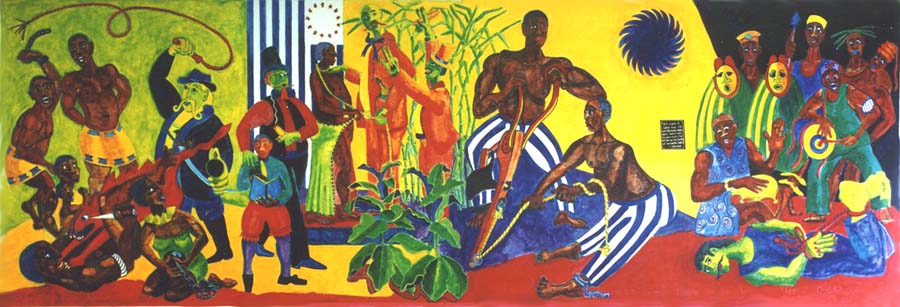
UPDATE: The Ethics Alarms post below ran in 2021. Now the revolting controversy is back in the news: the Vermont Law School in South Royalton, Vermont still seeks to remove the artwork above and below depicting the history of slavery in the U.S. As I wrote in 2021, the school simply capitulated to irrational, power-seeking student complaints alleging a racist message being conveyed by anti-racist art. To his credit, the artist has fought back, and the school has wasted resources intended for education to support the worst kind of mindless race-hucksterism.
At the end of the post, it noted that the case was headed to an appellate court, and it finally reached the U.S. Court of Appeals for the Second Circuit in New York, where the two sides presented arguments on January 27. For two years, the law school has covered the paintings with white panels suspended just above their surface so as not to damage them, pending the outcome of the court appeal.
I still think Kerson is likely to lose. I do not see how a Court can compel a school to display an artwork it doesn’t want to display. The federal law at issue says artists can prevent modification of their work if the change would harm their “honor or reputation.” The law school says that covering the murals, even permanently, is not a modification. An attorney representing the law school states simply, “If you own a painting, of course you have the right to decide whether or not to display it.”
The white artist, Sam Kerson argues that his reputation will be scarred if his work is falsely treated as “racist.” “He must suffer the indignity and humiliation of having a cover put over his art,” his lead attorney, argued to the Second Circuit.
Nothing much has changed since the 2021 post, but some of the quotes cited in the New York Times article this week are demonstrate how thoroughly race issues have become unmoored from rationality and fairness:
- “If someone is saying to you, ‘How you’re depicting me is racist,’ for you to live in your own ignorance, and further aggravate the situation — now you’re showing us who you are,” said Yanni DeCastro, a second-year student. [In other words, if someone claims your art is racist, disagreeing with that assessment is racist.]
- “We need to stop protecting white fragility,” said another student. [Another transparent tactic to ban disagreement with race hucksters! Kerson isn’t uncomfortable talking about race: his painting is an invitation to face racial history. It’s his black critics who are “fragile.”]
- The same student told the Times: “The mural is covered, but what’s really changed? What is the plan to ensure that students of color feel safe and welcome?” [Yes, students are threatened by a covered painting. What kind of lawyer can someone like this become? My guess: a poor one.]
- A second-year student told the Times: “What is real to me is a painting to you The artist was depicting history, but it’s not his history to depict.” [Only blacks can write about, make movies about, or paint pictures regarding black history. Why wouldn’t the converse also be true, then?]
Here is the original post:
Continue reading →




 Ethics Alarms